In 2026, supply chains are no longer shaped by rare, unexpected disruptions. Volatility has become structural. Demand swings, climate events, geopolitical shifts, supplier fragility, and regulatory pressures now influence day-to-day decisions across global networks.
This growing complexity is reflected in the rapid expansion of the global supply chain management industry itself. As organizations invest in planning, visibility, logistics, and execution capabilities to cope with uncertainty, the market for supply chain management solutions is projected to grow from approximately USD 38.5 billion in 2025 to USD 58.4 billion by 2030. This growth spans procurement, inventory planning, transportation management, and end-to-end orchestration, signaling a clear shift from static planning toward more adaptive, decision-driven supply chains.
Yet scale alone does not create resilience. As supply chains grow larger and more interconnected, the cost of poor or delayed decisions increases. In this environment, scenario planning has emerged as a critical capability for supply chain leaders.
What is Scenario Planning?
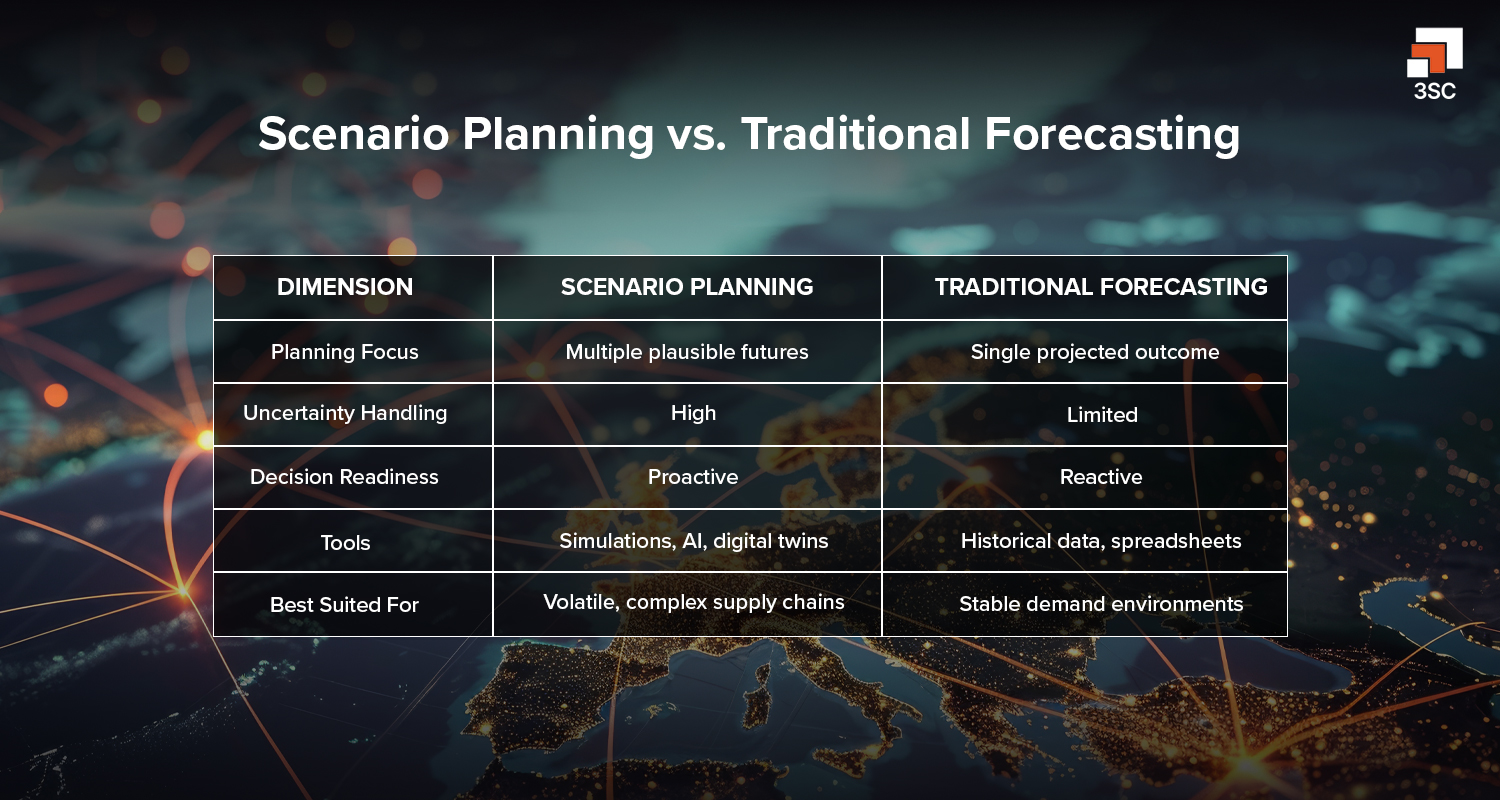
Scenario planning is a structured decision-making discipline that simulates multiple operating conditions to evaluate how a supply chain would perform, compare outcomes, and guide better decisions before risks materialize.
Instead of asking “What will happen?”, scenario planning reframes the discussion to “What could happen and how prepared are we to respond?”
Unlike traditional forecasting, which typically produces a single expected outcome, scenario planning explores multiple plausible situations. These scenarios may include supplier disruptions, abrupt demand shifts, logistics constraints, or regulatory changes. Each is assessed for its impact on key business metrics such as inventory levels, cost, service performance, and cash flow.
By testing decisions across a range of scenarios before they occur, supply chain leaders can understand trade-offs, identify vulnerabilities, and predefine response actions, reducing reaction time when conditions change.
Originally developed for military and strategic planning, scenario planning has become a core capability in modern supply chain management, particularly for organizations operating at scale in fast-moving, high-uncertainty environments.
Why Scenario Planning Matters in 2026 - Why is Scenario Planning important?
Supply chain uncertainty has shifted from being episodic to persistent. Disruption is now a built-in operating condition for global businesses rather than an exception to plan around.
Leaders must continuously manage:
- Demand volatility across channels and regions
- Climate-driven disruptions affecting sourcing and transportation
- Geopolitical instability and evolving trade policies
- Sustainability and regulatory compliance pressures
- Deep reliance on complex, multi-tier supplier networks
In this environment, reactive decision-making falls short. Scenario planning allows organizations to surface vulnerabilities early, understand how risks interact across the network, and evaluate response options before decisions are forced by events.
For consumer goods, retail, manufacturing, and healthcare supply chains, scenario planning is becoming a foundational capability for resilience. It enables a shift from firefighting to foresight, helping organizations protect revenue, sustain service levels, and keep operational decisions aligned with financial and strategic priorities amid continuous uncertainty.
What are the Types of Scenario Planning?
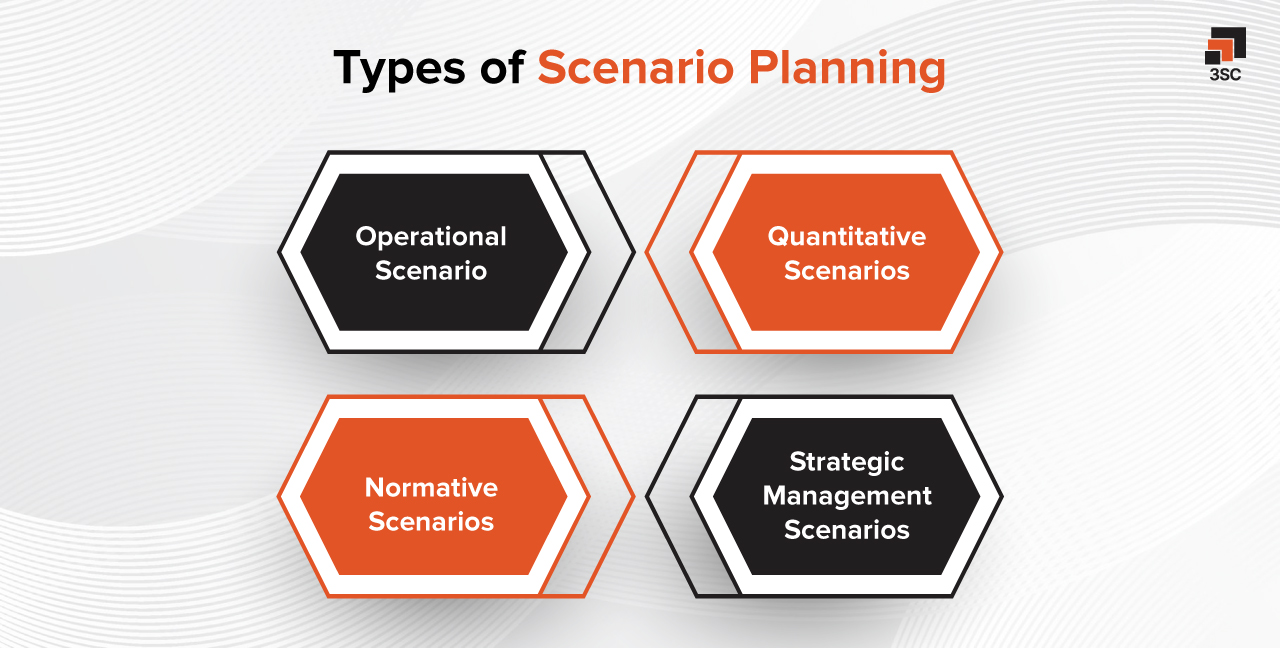
1. Operational Scenario: This type of scenario planning deals with quick decisions that have to be made in the context of a sudden occurrence of an event. These are usually strategic calls made to diffuse any major challenge from being mounted.
2. Quantitative Scenarios: This technique lays out the possible outcome efficacy based on its best—and worst-case scenarios, leaving SCM to decide which factor to tweak to attain the desired outcome.
3. Normative Scenarios: Under this scenario analysis roadmap, the goal defines the best plan of action. This sometimes might include not often the most efficient route but effective, nonetheless.
4. Strategic management scenarios: An action plan that finds its footing on the back of the organization's performance on the back of products and services in the market. This requires stakeholders to have real good knowledge of their own company, their offerings, their standing in the market, and their competitors.
How to do Scenario Planning?
The approach to scenario planning involves studying various components that have an immense say on the outcome. Here are the steps involved in the titular process.
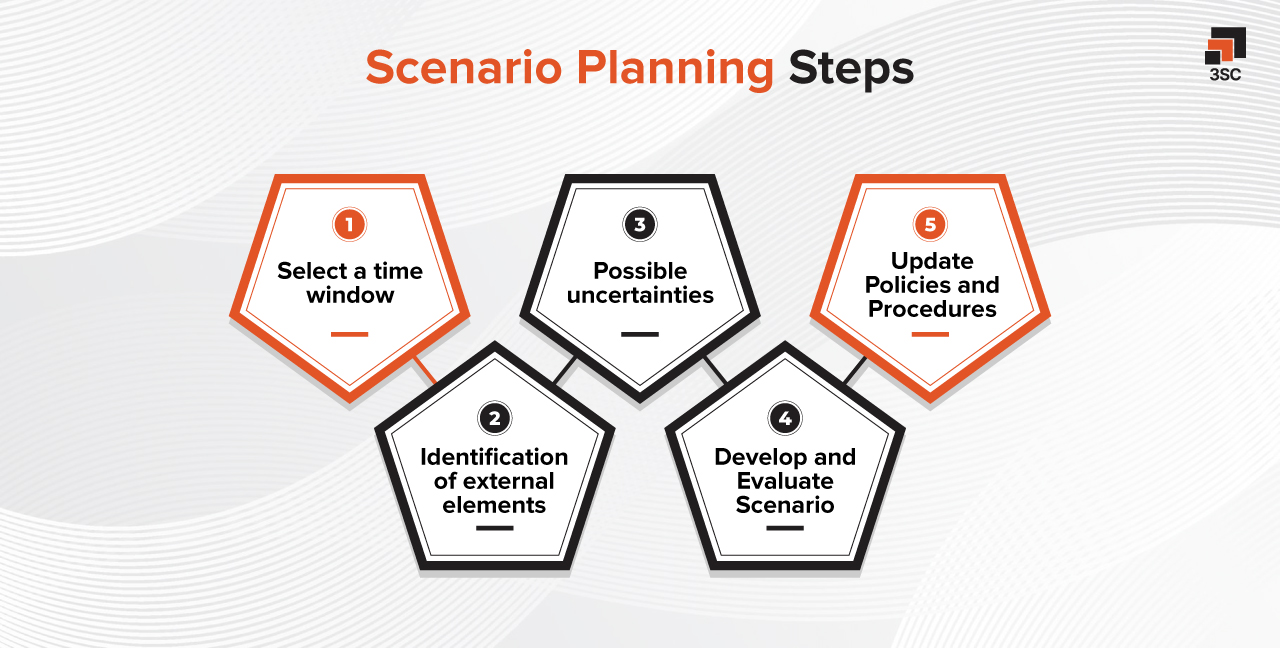
1. Select a time window: The starting base is to select a time frame which will be evaluated. This will serve as a marker to study a product’s life cycle, the competition which shapes your offerings and the external factors.
2. Identification of external elements: While stakeholders are very well versed in their own workings, external agents require a keen eye to avoid any detrimental impact on a supply chain.
3. Possible uncertainties: There are always factors that drive some uncertainty. These can appear in the form of consumer behaviour and market trends, among others. It’s important to have a thorough approach wherein the SCM learns what they can about possible external influence to prepare themselves well.
4. Develop and Evaluate Scenario: After factoring in all the drivers, stakeholders must devise a scenario and evaluate its performance to understand its impact on their value chain processes. If the scenario performs according to the metrics of time and expected performance, well and good; if not, management can consider tweaking a few variables accordingly.
5. Update Policies and Procedures: A scenario’s outcome can help a business make constructive adjustments to its workflow, making it smarter in its process of making informed decisions that benefit organizations big time.
How Scenario Planning Works
Scenario planning works by turning uncertainty into a structured input for decision-making, rather than treating it as an external disruption to be managed after the fact.
At a high level, scenario planning follows a repeatable and evolving process:
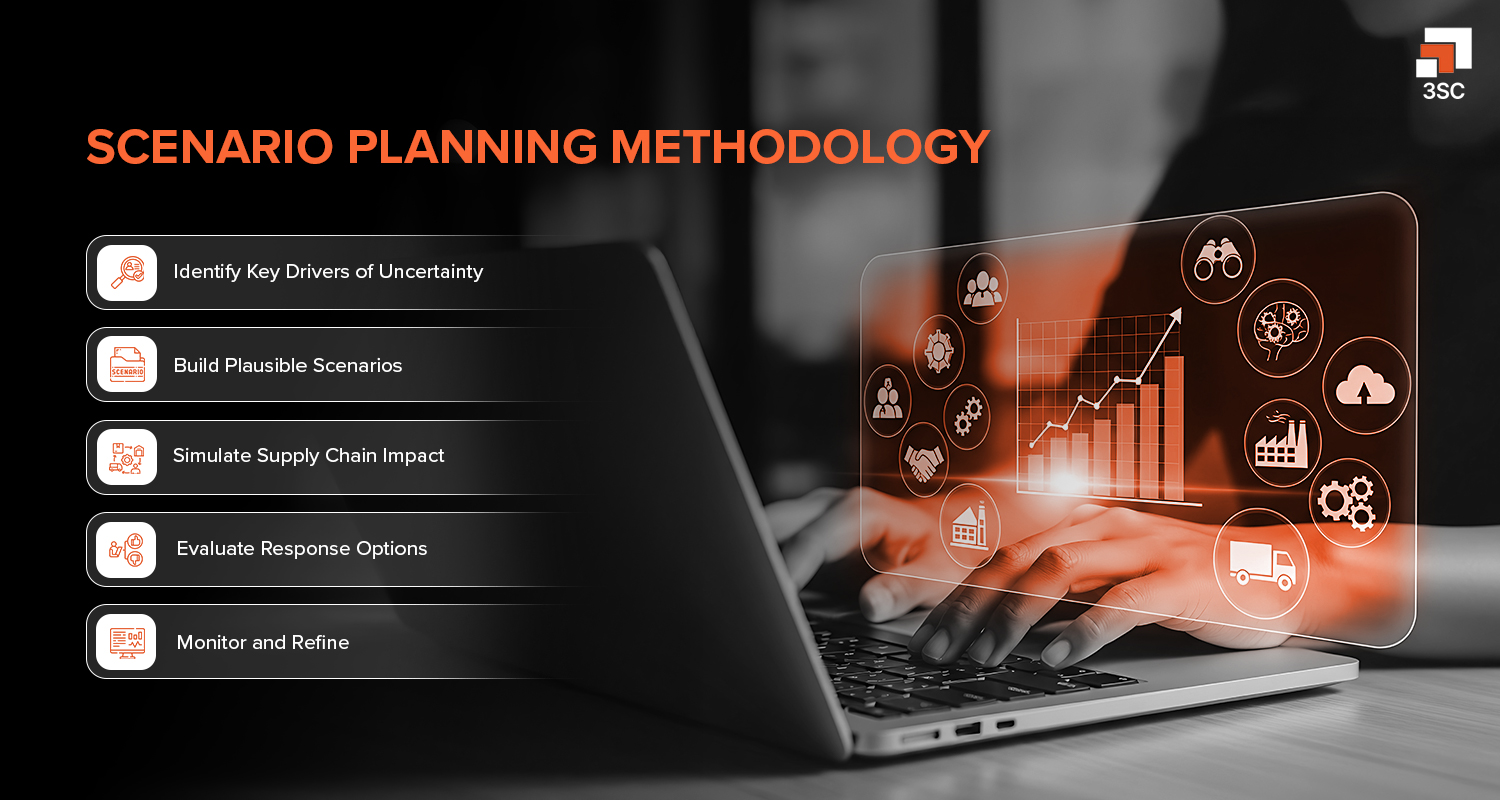
1. Identify Key Drivers of Uncertainty: These may include internal constraints such as capacity or labor, as well as external factors like fuel price volatility, weather disruptions, or regulatory changes.
2. Build Plausible Scenarios: Teams define realistic future states, for example, a sudden demand spike, a supplier outage, or port congestion rather than extreme or unlikely events.
3. Simulate Supply Chain Impact: Each scenario is assessed for its effect on service levels, inventory, cost, lead times, and working capital.
4. Evaluate Response Options: Organizations test alternative actions such as rerouting supply, adjusting safety stock, reallocating production, or prioritizing customer segments.
5. Monitor and Refine: Scenarios are continuously updated as new signals emerge, ensuring planning remains dynamic rather than static.
Over time, scenario planning evolves into a continuous capability rather than a one-off exercise. As market signals change, scenarios are refined, and decisions are recalibrated, allowing organizations to stay ahead of disruption instead of reacting to it. This shift enables supply chain leaders to operate with greater confidence in an environment where uncertainty is constant.
Key Benefits of Scenario Planning
When embedded into planning and decision-making, scenario planning delivers a set of reinforcing benefits that materially improve how supply chains operate under uncertainty.
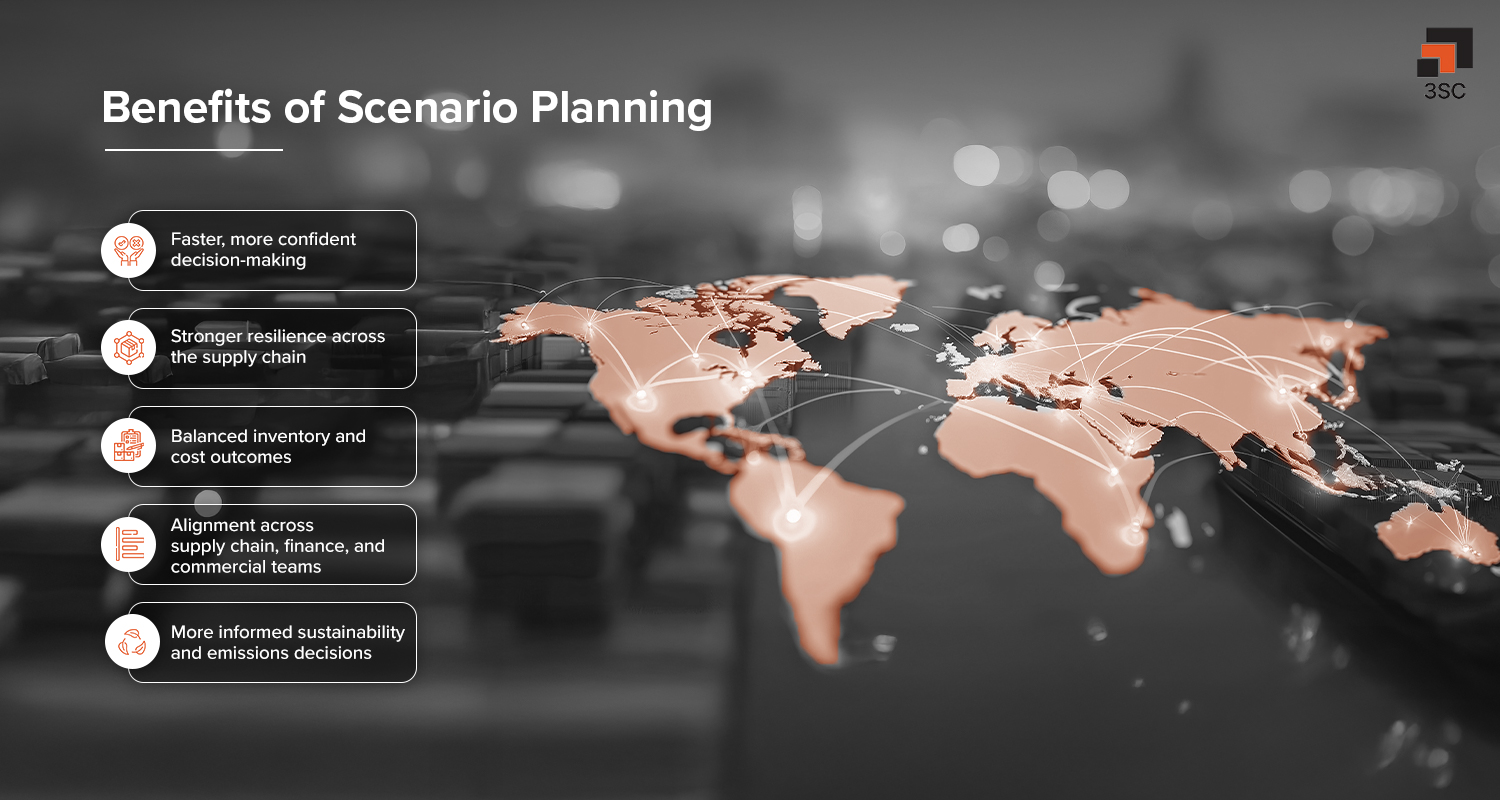
1. Faster, more confident decision-making: By evaluating response options in advance, leaders reduce hesitation during disruptions. Decisions are guided by pre-tested trade-offs rather than ad-hoc judgment under pressure.
2. Stronger resilience across the supply chain: Scenario planning improves preparedness across sourcing, manufacturing, and distribution, allowing organizations to absorb shocks and recover faster when conditions shift.
3. Balanced inventory and cost outcomes: Instead of reacting to shortages or excess after they occur, teams can anticipate where buffers are truly required protecting service levels while avoiding unnecessary working capital exposure.
4. Alignment across supply chain, finance, and commercial teams: Shared scenarios create a common fact base, making trade-offs between service, margin, and cash explicit and enabling faster cross-functional alignment.
5. More informed sustainability and emissions decisions: Scenario planning allows organizations to evaluate operational choices against environmental objectives alongside cost and service supporting more credible and measurable sustainability outcomes.
Organizations with mature scenario planning capabilities consistently outperform peers during periods of volatility, not by eliminating uncertainty, but by making better decisions in the presence of it.
Mastering Scenario Planning: Proven Principles for Uncertain Times
When it comes to successful adoption of scenario planning; it is driven less by tools and more by how organizations approach decision-making under uncertainty. The most effective implementations share a few common principles.
Start with decisions that matter most: Organizations that see tangible value begin with a small number of high-impact scenarios tied directly to decisions that influence service levels, cost structures, and working capital. This focus ensures scenario planning addresses real business outcomes rather than abstract risk analysis.
Prioritize decision clarity over analytical perfection: Scenario planning delivers value when it sharpens choices, not when it produces overly complex models. Effective teams use scenarios to make trade-offs explicit, helping leaders understand implications across cost, service, and cash before acting.
Build cross-functional alignment early: Early involvement of stakeholders from supply chain, finance, and commercial teams is critical. Shared scenarios create a common fact base, reducing functional bias and accelerating alignment when decisions must be made quickly.
Embed scenario planning into regular planning cycles: As maturity increases, scenario planning becomes part of everyday planning and review processes rather than an occasional exercise. This shift transforms it into a repeatable capability that supports faster, more confident decisions across the enterprise.
When implemented this way, scenario planning moves beyond preparedness for disruption and becomes a foundational element of how organizations plan, prioritize, and execute in an uncertain environment.
Common Challenges and How to Overcome Them
While scenario planning offers clear value, many organizations face barriers in sustaining it. These challenges are less about technology and more about how planning and decisions are structured.
- Data silos often limit end-to-end visibility, making integrated planning processes essential to create a shared view of risks and trade-offs.
- Resistance to change can emerge if scenario planning is seen as control rather than support; positioning it as a decision-enabler improves adoption.
- Capability gaps may slow progress, requiring targeted upskilling or selective partnerships to build analytical and decision-oriented expertise.
- Over-complexity can dilute impact, focusing on a small set of high-impact scenarios ensures relevance and speed.
Above all, leadership sponsorship remains the single most important factor. When leaders actively use scenario planning to guide decisions, it becomes embedded in how the organization plans and operates, rather than remaining a standalone initiative.
Looking Ahead: The Future of Scenario Planning
As uncertainty continues to rise, scenario planning is evolving from a planning technique into a core operating capability. Organizations are increasingly relying on real-time digital representations of end-to-end supply networks, supported by AI-driven sensing of geopolitical, climate, and market risks.
Scenario planning is moving beyond static models toward predictive narratives enabled by generative AI, helping leaders interpret signals faster, anticipate second-order impacts, and act with greater precision. At the same time, sustainability considerations are becoming embedded directly into operational decisions, with scenarios evaluating emissions, cost, and service together rather than in isolation.
Scenario planning has become essential. It is emerging as a defining capability for supply chain leaders separating organizations that respond to uncertainty after it materializes from those that navigate volatility with confidence and intent through the decade ahead.