
Key Takeaways
- Supply chain planning balances supply and demand for efficient operations.
- Core planning elements drive supply chain efficiency.
- Effective planning requires continuous monitoring and adjustment.
- Modern supply chains face challenges like volatility, data silos, and supplier risks.
- Integrated planning helps organizations build resilient and aligned supply chains.
Imagine ordering a product online and receiving it exactly when promised. The experience feels effortless, but behind the scenes lies a highly coordinated system of suppliers, manufacturers, warehouses, transportation networks, and technology. Each step must work together perfectly to ensure products move smoothly from raw materials to the customer’s doorstep.
What makes this coordination possible is supply chain planning.
In today’s world, where disruptions, changing customer expectations, and global competition are constant, businesses cannot rely on guesswork. They need a structured way to predict demand, coordinate operations, and ensure that products reach customers efficiently.
In this blog, we’ll explore what supply chain planning is, the core elements, the process that make it effective, and the challenges companies face in building a resilient supply chain in 2026.
Understanding Supply Chain Planning
Supply chain planning is a strategic, end-to-end process that aligns demand, supply, and other operational functions to drive efficiency, resilience, and long-term value creation. It goes beyond day-to-day coordination, enabling organizations to anticipate market shifts, customer demand patterns, and potential disruptions rather than simply reacting to them.
This broader approach integrates demand forecasting, procurement planning, production scheduling, inventory optimization, and logistics coordination with financial planning, risk management, and cross-functional collaboration. By connecting these elements, businesses can make more informed, data-driven decisions, balance service levels with costs, and respond dynamically to changing conditions ensuring a more agile, scalable, and future-ready supply chain.
According to research, strong supply chain planning can improve overall performance by up to 30%, enabling organizations to respond faster, reduce costs, and improve service levels.
The ultimate goal is simple: deliver the right product, at the right place, at the right time while using resources efficiently. However, achieving that balance requires aligning several interconnected functions across the supply chain that are explained below.
Why Supply Chain Planning Matters Today
The value of supply chain planning lies in how it turns uncertainty into preparedness. Research and industry insights highlight a few core benefits that make it indispensable for modern businesses:

1. Improved Forecast Accuracy
Traditional forecasting often relies on historical sales alone, which falls short in today’s volatile environment. Modern planning incorporates broader signals, market trends, promotions, economic indicators, and even weather patterns, to refine demand forecasts. This reduces both overstocking and stockouts, directly impacting profitability and customer satisfaction.
Recommended For You - Methods of Demand Forecasting in Supply Chain
2. Resource Optimisation
Balancing production capacity, inventory availability, and supplier constraints is one of the most complex challenges in operations. Effective supply chain planning ensures that resources are allocated to priority demands and high-value products, while minimizing waste and inefficiency. This not only drives cost savings but also enables organisations to operate leaner and more sustainably.
3. Faster, More Agile Response
Static plans are no longer enough in an environment where disruptions occur with little warning. Adaptive planning enables businesses to model multiple “what-if” scenarios, such as a supplier delay, a demand surge, or a logistics bottleneck, and adjust their operations accordingly. Agility in planning directly improves resilience and competitiveness in uncertain markets.
4. Stronger Collaboration Across the Network
A supply chain is only as strong as its weakest link. Effective planning provides a common framework for manufacturers, suppliers, distributors, and retailers to align on shared goals. This transparency improves trust, reduces miscommunication, and allows for joint problem-solving when challenges arise, turning fragmented supply chains into cohesive networks.
5. Enhanced Resilience
Resilience is not built in the moment of crisis; it is embedded through structured planning. Organizations with robust planning processes can absorb shocks, reroute flows, and prioritize critical orders without losing sight of long-term strategy. Over time, this preparedness builds customer loyalty, protects revenue streams, and ensures business continuity.
The Core Elements of Supply Chain Planning
Supply chain planning integrates multiple interconnected functions that ensure operations remain efficient, responsive, and aligned with business goals. These elements work together to balance demand, supply, and operational constraints while optimizing cost, service levels, and overall resilience.
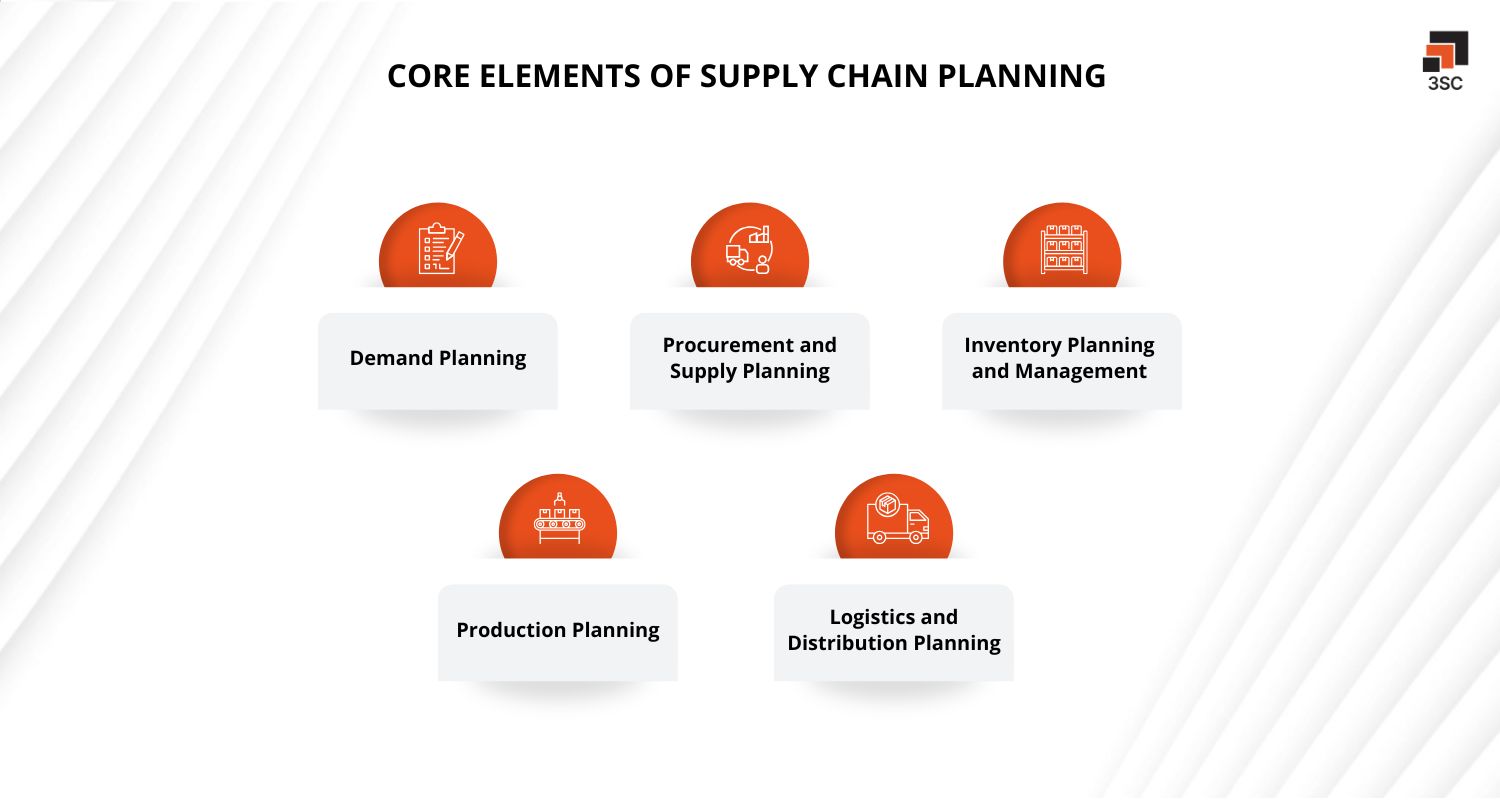
1. Demand Planning
Demand planning forms the foundation of supply chain planning. It involves forecasting customer demand using historical data, market trends, and advanced analytics. Accurate demand forecasts enable organizations to anticipate customer needs, reduce uncertainty, and align all downstream activities such as procurement, production, and logistics.
2. Procurement and Supply Planning
Procurement and supply planning focuses on ensuring the timely availability of raw materials and components required for production. This involves supplier coordination, lead time management, and capacity alignment. Effective supply planning helps prevent material shortages, reduces dependency risks, and ensures that production plans can be executed without disruption.
3. Inventory Planning and Management
Inventory planning is about maintaining the right amount of stock across warehouses and distribution centres. Companies must carefully balance two risks. Holding too much inventory ties up valuable capital and increases storage costs, while holding too little inventory can lead to stockouts and lost sales.
To manage this balance, businesses use techniques such as safety stock calculations, reorder points, and ABC analysis. Safety stock acts as a buffer against unexpected demand spikes or supply delays. Reorder points ensure that new orders are placed before inventory levels fall too low. Meanwhile, ABC analysis helps planners prioritize high-value products that require closer monitoring. When inventory planning is done correctly, companies can maintain product availability while minimizing operational costs.
4. Production Planning
Once demand and supply are aligned, production planning converts forecasts into actionable manufacturing schedules. Planners determine what products should be produced, in what quantities, and at what time. This requires coordinating labour, machinery, and materials to ensure smooth operations. A well-structured production plan maximizes the efficiency of manufacturing resources, minimizes bottlenecks, and enables organizations to respond quickly to changes in demand or supply conditions.
5. Logistics and Distribution Planning
After production, the focus shifts to delivering products efficiently to customers. Logistics and distribution planning manage the movement of goods across transportation networks and distribution centres. This includes selecting transportation modes, optimizing delivery routes, and coordinating warehouse operations. Efficient logistics planning reduces transportation costs, shortens delivery timelines, and ensures that products reach the right location at the right time, improving overall customer satisfaction.
From S&OP to IBP: Evolving Toward Integrated Planning Excellence
Sales and Operations Planning (S&OP) is a structured process that aligns demand with supply around a single, unified plan. Its primary purpose is to ensure that sales targets, production capacity, and inventory levels are realistic, balanced, and achievable.
In many organizations, different functions operate with competing priorities, sales may push for aggressive growth, while operations must manage production constraints, supplier limitations, and inventory risks. S&OP addresses this by bringing teams together through regular planning cycles to create a consensus-driven plan that matches demand with supply capabilities, improving coordination and operational efficiency.
As supply chains have grown more complex, many organizations have evolved beyond S&OP to adopt Integrated Business Planning (IBP). While S&OP focuses specifically on aligning demand with supply, IBP takes a broader, more strategic approach by integrating all business functions into a single planning framework. It connects operational plans with financial objectives, strategic priorities, and executive decision-making.
By incorporating inputs from finance, leadership, and other key functions, IBP enables organizations to evaluate trade-offs holistically, align decisions with business goals such as growth and profitability, and ensure that every function is moving in the same strategic direction.
Risk and Scenario Planning
Today, supply chains operate in an increasingly uncertain environment, making risk and scenario planning a critical element. This involves identifying potential disruptions such as demand volatility, supplier failures, or geopolitical risks, and preparing contingency plans. Scenario planning enables organizations to evaluate different outcomes and respond proactively rather than reactively.
Together, these elements form a connected planning ecosystem that enables organizations to move from reactive decision-making to proactive, data-driven operations. As complexity increases, integrating these elements through structured planning process becomes essential for building agility, resilience, and long-term competitive advantage.
The Supply Chain Planning Process
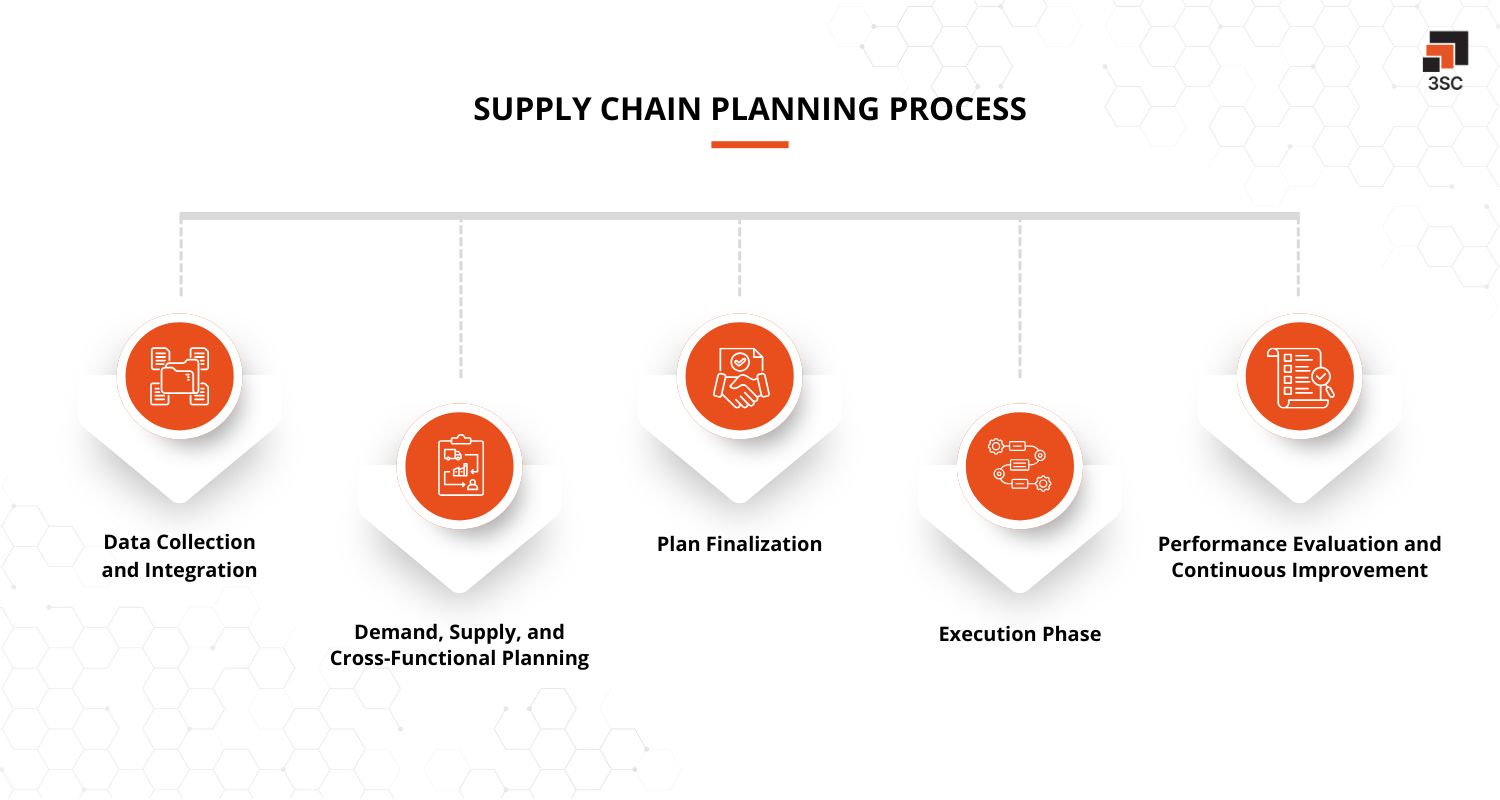
Supply chain planning is a continuous, iterative cycle that evolves with changing demand, supply conditions, and business priorities. Rather than being a one-time activity, it follows a structured sequence of steps that enable organizations to plan, execute, and continuously improve their operations.
1. Data Collection and Integration
The process begins with gathering data from across internal and external sources. This includes historical sales data, market trends, inventory levels, supplier performance, and production capacity. The objective is to create a reliable, unified data foundation that supports accurate planning and informed decision-making across all functions.
2. Demand, Supply, and Cross-Functional Planning
Using the collected data, organizations forecast future customer demand by analysing historical patterns, market signals, and external factors. These demand forecasts then guide supply and production planning, where organizations determine how demand will be fulfilled by evaluating inventory levels, supplier capacity, and manufacturing capabilities.
At the same time, key functions such as sales, marketing, operations, and finance come together to review and align on the plan. Each function contributes its perspective, constraints, and priorities, enabling trade-offs to be evaluated and a consensus-driven plan to be established. This integrated step ensures that demand expectations, supply capabilities, financial objectives, and overall business strategy are aligned before execution.
3. Plan Finalization
Once alignment is achieved, the plan is finalized and approved. This becomes the single, agreed-upon roadmap that guides procurement, production, inventory, and distribution activities across the organization. A finalized plan ensures clarity, accountability, and coordination across all functions.
4. Execution Phase
The approved plan is then executed across the supply chain. Procurement teams source materials, production teams manufacture goods, and logistics teams manage storage and distribution. Effective coordination during this stage is essential to ensure that the plan is implemented smoothly and efficiently.
5. Performance Evaluation and Continuous Improvement
After execution, organizations monitor performance using key metrics such as forecast accuracy, service levels, inventory turnover, and delivery timelines. Insights from this evaluation are used to identify gaps, improve future forecasts, and refine planning processes. This creates a continuous feedback loop that enhances supply chain performance over time.
While this structured process enables better alignment and decision-making, organizations often face practical challenges in planning as well as executing it effectively at scale.
Challenges in Modern Supply Chain Planning
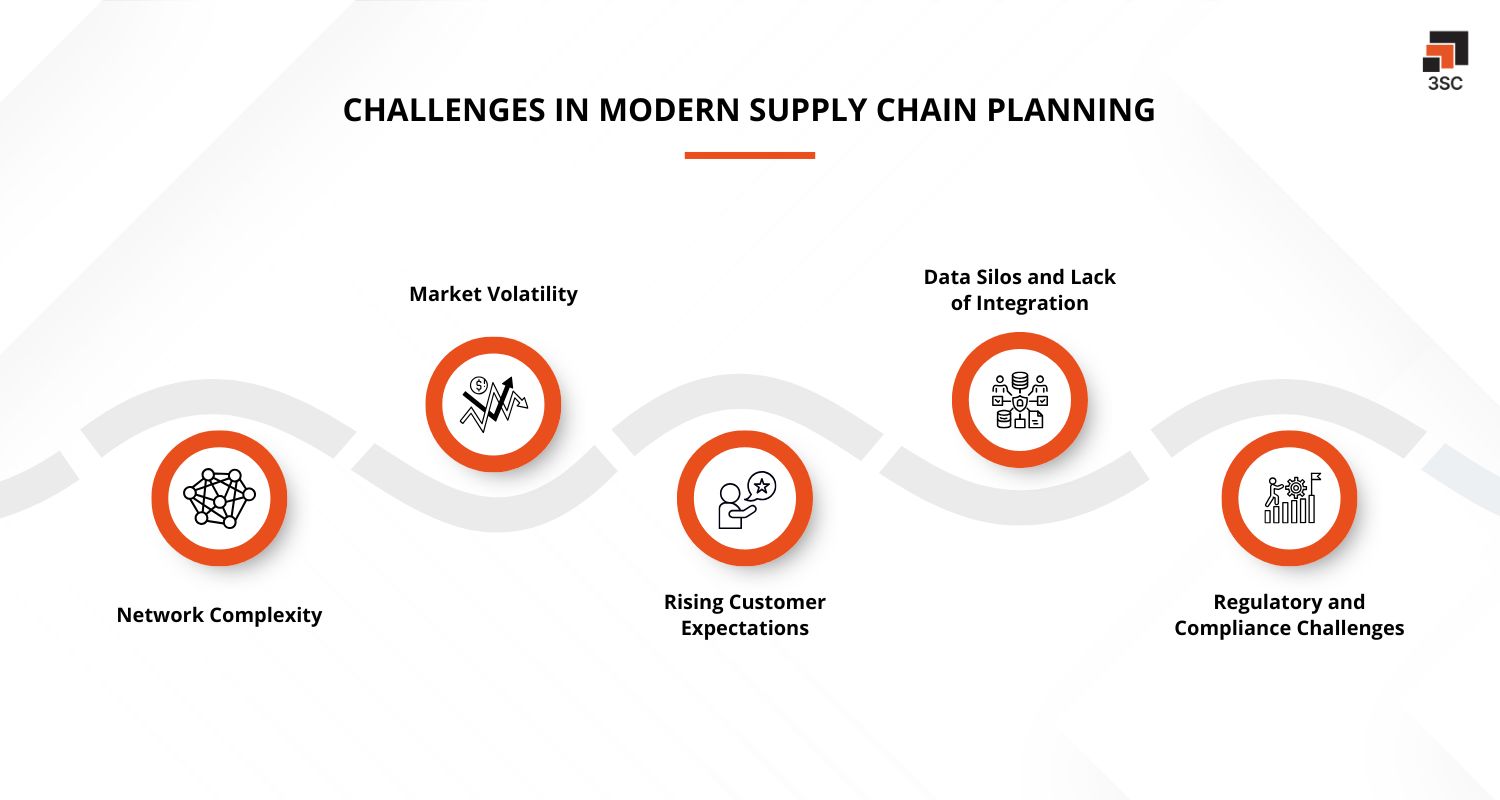
Even with advanced technologies and well-defined processes, supply chain planning remains inherently complex due to constant disruptions and real time complexities. Modern supply chains operate across global networks, involve multiple stakeholders, and must respond rapidly to constantly evolving market conditions. As a result, organizations face several challenges that can disrupt operations and impact overall business performance.
1. Network Complexity
Most supply chains span multiple countries and involve extensive networks of suppliers, manufacturers, warehouses, and distribution partners. Each participant operates with its own systems, processes, and constraints. Coordinating such a network requires synchronizing production schedules, inventory levels, transportation flows, and supplier deliveries. Even a minor disruption such as a delay from a single supplier can create cascading effects across the entire system. As supply chains scale and become more interconnected, maintaining end-to-end visibility and coordination becomes increasingly difficult.
2. Market Volatility
Supply chains are highly sensitive to external disruptions. Economic shifts, geopolitical tensions, natural disasters, pandemics, and transportation bottlenecks can significantly impact both demand and supply.
For instance, a sudden surge in demand may require rapid scaling of production, while simultaneous raw material shortages or logistics constraints can limit responsiveness. This constant uncertainty forces organizations to continuously adapt their plans and build greater flexibility and resilience into their operations.
3. Rising Customer Expectations
Customer expectations have evolved significantly, driven largely by the growth of e-commerce and digital platforms. Customers now expect faster deliveries, real-time order visibility, and consistently high product availability. Meeting these expectations requires highly responsive supply chains, optimized inventory positioning, and efficient logistics networks. Failure to deliver on these expectations can result in lost sales, increased churn, and long-term damage to brand loyalty.
4. Data Silos and Lack of Integration
A major barrier to effective supply chain planning is the presence of data silos across functions. Departments such as sales, procurement, production, and logistics often operate on separate systems with limited data sharing. This lack of integration reduces visibility and leads to misaligned decisions. For example, demand signals from sales may not be fully reflected in production or procurement plans. Without a unified data environment, organizations struggle to create accurate, coordinated, and timely plans.
5. Regulatory and Compliance Challenges
Supply chains must operate within an increasingly complex and evolving regulatory landscape. Changes in trade policies, environmental regulations, labour laws, and product standards can directly impact sourcing, production, and distribution strategies. Ensuring compliance requires continuous monitoring and adaptation. Failure to meet regulatory requirements can result in financial penalties, operational disruptions, and reputational risks, adding another layer of complexity to planning.
These challenges highlight that supply chain planning is not just an operational exercise, but a strategic capability. Successfully navigating this complexity requires strong cross-functional alignment, integrated data, and the ability to adapt quickly in an uncertain and dynamic environment.
The Future of Supply Chain Planning
If the past few years have taught businesses anything, it’s that uncertainty is here to stay. The next decade will not be about eliminating risk but about building supply chains that can think, adapt, and act faster than ever before.

Supply Chain Planning (SCP) is evolving into a smarter, more autonomous discipline, one where technology plays a decisive role in shaping resilience and competitiveness.
1. Generative AI and Agentic Systems
Planning is moving beyond predictive models into autonomous decision-making. Generative AI and intelligent agents can now suggest, and in some cases execute, actions such as reallocating inventory, rerouting shipments, or optimizing replenishment. This shift is fuelling rapid market growth, with the generative AI in supply chain market expected to surge from USD 640 million in 2024 to nearly USD 27.4 billion by 2034, reflecting a CAGR of about 45.6%. By reducing reliance on manual intervention, these technologies are making supply chains more intelligent, adaptive, and responsive in real time.
Recommended For You - AI Agents vs. Agentic AI in Supply Chain
2. Digital Twins for Stress-Testing
Digital twins enable organizations to simulate their entire supply chain before disruptions occur, creating virtual replicas of networks, factories, and logistics systems. This capability allows businesses to assess the potential impact of climate shocks, geopolitical shifts, or trade disputes in a controlled environment, shifting planning from reactive defence to proactive preparedness. Adoption is steadily increasing, a 2023 Gartner survey reported that 60% of supply chain leaders are piloting or planning to implement a digital supply chain twin, although only 27% currently intend to extend this to a “digital twin of the customer.” By embedding this technology, enterprises can enhance resilience and strengthen decision-making through scenario-driven insights.
Recommended For You - Why is Digital Twin and Risk Management in Supply Chain Important?
3. Sustainability and ESG Alignment
Planning is no longer measured only by cost efficiency or service levels. Increasingly, organisations are being held accountable for their environmental and social footprint. Future-ready SCP will integrate ESG metrics into planning decisions, optimising not just for profit, but also for carbon reduction, ethical sourcing, and compliance with global standards.
4. From Periodic to Continuous Planning
Historically, planning cycles followed monthly or quarterly rhythms, a pace that no longer aligns with the volatility of global markets. Today, IoT sensors, blockchain traceability, and cloud-native platforms are enabling continuous, real-time planning, allowing companies to respond instantly to demand signals, supplier delays, or logistical bottlenecks. The impact is substantial, research shows that up to 43% of working hours for supply chain professionals could be transformed through generative AI, particularly across planning, production, procurement, and related functions. This marks a decisive shift from static processes to intelligent, adaptive, and always-on planning.
Building Resilient Supply Chains Through AI Powered IBP
To manage the growing complexity and volatility of modern supply chains, AI Powered Integrated Business Planning (IBP) is becoming a business necessity rather than an optional capability. Traditional planning approaches are no longer sufficient in dynamic environments where speed, alignment, and adaptability are critical. IBP extends beyond traditional Sales and Operations Planning (S&OP) by integrating demand, supply, financial planning, and strategic decision-making into a single, unified framework. It brings together teams across sales, marketing, operations, finance, and supply chain to create aligned, data-driven plans.
Moreover, the layering of AI, especially Agentic AI, further strengthens IBP by enabling continuous, intelligent planning. AI systems can monitor data in real time, simulate scenarios, identify risks, and recommend actions, allowing organizations to respond faster and make more informed decisions. In addition, Agentic AI can take over routine, low-priority decisions and operational tasks, reducing manual effort and freeing up leadership to focus on high-impact, strategic decisions that require human judgment and expertise.
By combining cross-functional alignment with AI-driven insights and automation, IBP enables organizations to move from reactive planning to proactive, adaptive decision-making. In today’s environment, it is not just an improvement; it is essential for building resilient and future-ready supply chains.
Final Thoughts: Why Supply Chain Planning Matters More Than Ever
Supply chain planning has evolved from a back-end operational function into a critical driver of business performance and competitive advantage. Organizations that invest in strong planning capabilities are better equipped to anticipate demand shifts, optimize resources, and respond swiftly to disruptions. More importantly, they build supply chains that are not only efficient, but also resilient, agile, and aligned with long-term strategic goals.
In an environment defined by constant change and uncertainty, the ability to plan effectively determines how well a business can adapt, compete, and grow. Supply chain planning is not optional anymore; it has become a foundational capability that directly impacts customer satisfaction, profitability, and long-term success.
Turn Supply Chain Planning into a Competitive Advantage
Effective planning creates visibility. Integrated execution makes it resilient. In today’s volatile supply chain environment, the ability to align demand, supply, and strategy determines how well organizations respond to change.