Key Takeaways
- Demand planning forecasts customer needs; supply planning ensures they are met.
- Demand looks outward to markets; supply looks inward to operations.
- They differ in focus and inputs but work best when integrated.
- Integration creates a feedback loop between forecasting and execution.
- Aligned planning builds agility, lowers costs, and improves customer satisfaction.
- Silos cause mismatches, while integration drives resilience and growth.
Every product that reaches a customer is the result of two critical processes working together: demand planning and supply planning. One predicts what customers will need, the other ensures it can be delivered. Aligned correctly, they form the backbone of a resilient and efficient supply chain.
When demand planning provides a reliable forecast, supply planning translates it into actionable steps, securing raw materials, allocating production capacity, and organizing logistics. Together, they create a cycle of balance: one looks outward to capture demand signals, the other looks inward to mobilize resources.
This balance is vital in today’s fast-moving business environment. Without effective demand planning, companies risk missing market opportunities or being left with unsold stock. Without strong supply planning, even accurate forecasts cannot be fulfilled efficiently. The strength of a supply chain lies not in one process but in how both processes complement and reinforce each other.
The cycle begins with demand planning, which focuses on anticipating customer needs before resources are aligned to meet them. Over time, as execution unfolds, feedback from supply constraints (e.g. capacity limits, lead time variability) refines future forecasts and “closes the loop.” This constant interplay helps organizations remain agile and responsive to market shifts. According to industry thought leadership, integrated demand‐and‐supply planning enables greater alignment across functions and reduces risks of disruptions.
What is Demand Planning?
Demand planning is the process of forecasting customer demand so businesses can proactively prepare for future needs. At its core, it answers the question: What products will customers want, in what quantity, and when?
To achieve this, demand planning relies on a combination of:
1. Historical Sales Data
Analysing past sales helps identify buying patterns and customer behaviour trends, forming the foundation for accurate demand forecasts.
2. Market Trends
Incorporating external factors such as economic conditions, competitor activities, and shifts in consumer preferences ensures forecasts remain relevant and adaptive.
3. Seasonality
Recognizing and planning for predictable demand cycles like holidays, festivals, or peak buying periods that helps align inventory and production schedules effectively.
4. Promotional Activities
Adjusting forecasts to account for demand spikes caused by marketing campaigns, product launches, or discounts helps maintain balance between supply and demand.
The aim is to strike a delicate balance: avoiding shortages that disappoint customers while also preventing excess inventory that ties up working capital. Unlike a one-time forecast, demand planning is a continuous and adaptive process. It evolves in response to shifting consumer preferences, supply chain disruptions, and unpredictable external events such as economic downturns or global crises.
In short, demand planning equips organizations with foresight, helping them minimize uncertainty, make better decisions, and align their operations with real-world market conditions.
While demand planning lays the groundwork by forecasting future needs, supply planning turns those forecasts into actionable strategies for sourcing, production, and delivery. It bridges the gap between “what customers want” and “how the business will deliver it.”
What is Supply Planning?
Supply planning ensures that organizations can meet forecasted demand efficiently. Where demand planning looks outward to the market, supply planning looks inward at the company’s resources and capabilities. Its primary goal is to match supply with demand, delivering the right product at the right time, without unnecessary cost or waste.
To achieve this, supply planning involves:
1. Procurement - The process of sourcing and securing raw materials and components from reliable suppliers to ensure consistent production flow.
2. Production Planning - Strategically scheduling manufacturing activities to align with demand forecasts, ensuring efficient use of resources and timely output.
3. Inventory Management - Monitoring and maintaining optimal stock levels to avoid shortages or overstock situations, ensuring smooth operations and cost efficiency.
4. Logistics and Distribution - Coordinating the movement of goods from warehouses to customers, ensuring timely deliveries and maintaining service quality across the supply chain.
Effective supply planning is about balance and efficiency. Too much inventory leads to higher holding costs, while too little results in lost sales and customer dissatisfaction. By optimizing material flow, production schedules, and logistics, supply planning makes sure businesses are not only prepared but also competitive.
|| Recommended for You - What is Supply Chain Planning?
In essence, supply planning transforms demand forecasts into practical execution, the step that ensures promises made to customers through demand planning are actually delivered.
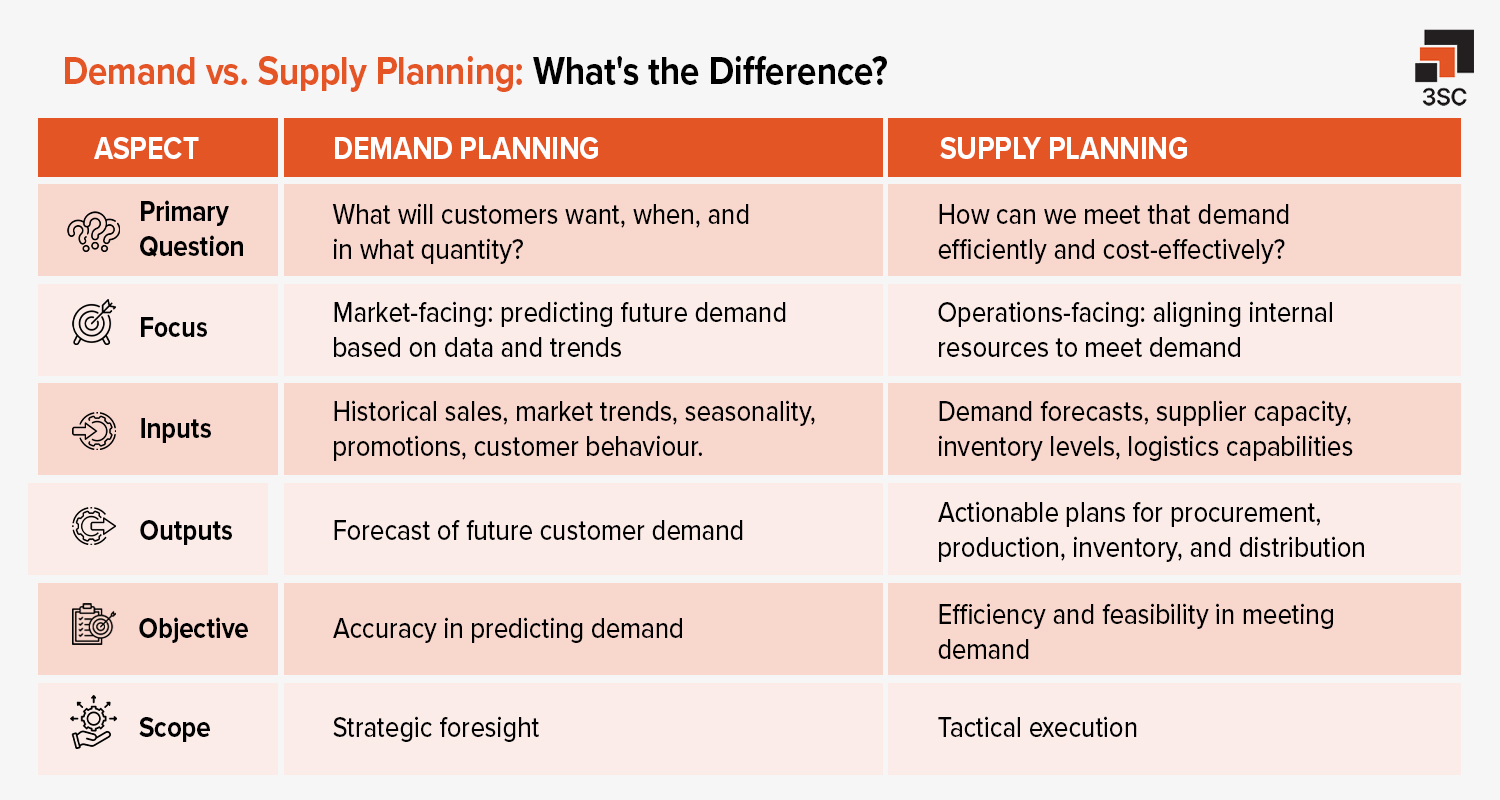
Demand Planning vs Supply Planning - Key Differences
Although demand planning and supply planning are closely linked, they serve distinct purposes within the supply chain. Understanding their differences is crucial to seeing how they complement one another.
Aspect | Demand Planning | Supply Planning |
Primary Question | What will customers want, when, and in what quantity? | How can we meet that demand efficiently and cost-effectively? |
Focus | Market-facing: predicting future demand based on data and trends | Operations-facing: aligning internal resources to meet demand |
Inputs | Historical sales, market trends, seasonality, promotions, customer behaviour | Demand forecasts, supplier capacity, inventory levels, logistics capabilities |
Outputs | Forecast of future customer demand | Actionable plans for procurement, production, inventory, and distribution |
Objective | Accuracy in predicting demand | Efficiency and feasibility in meeting demand |
Scope | Strategic foresight | Tactical execution |
Demand planning provides the foresight, while supply planning ensures its execution.
Though different in purpose, their value multiplies when they are aligned, transforming forecasts into actionable strategies. This synergy is what makes supply chains both efficient and resilient.
How Demand Planning and Supply Planning Work Together
Demand planning and supply planning are deeply interdependent, and their true impact is realized only when they operate as part of a single, integrated process. Together, they create a continuous cycle that links forecasting with execution, enabling businesses to respond effectively to both market opportunities and operational constraints.
1. Translating Forecasts into Execution
Demand planning generates a forward-looking forecast of customer needs. Supply planning translates that forecast into concrete strategies, covering production schedules, procurement activities, inventory levels, and logistics execution. Within an Integrated Business Planning (IBP) framework, this translation becomes even more powerful, linking financial, operational, and commercial plans to ensure every decision aligns with enterprise goals.
2. Strengthening the Forecast with Feedback
Supply planning provides critical feedback to demand planners, highlighting constraints such as limited supplier capacity, extended lead times, or production bottlenecks. This exchange ensures that forecasts remain not only accurate but also realistic and achievable. Through IBP, these feedback loops extend beyond supply chain teams, allowing finance, sales, and operations to collaborate on scenario-based plans and align on one version of truth.
3. Enabling Agility in a Volatile Environment
When unexpected shifts occur, such as a sudden spike in demand from promotions or external market disruptions, demand planning revises the forecast. Supply planning then adapts sourcing, production, and delivery strategies to keep operations aligned with the new reality. IBP enhances this agility by connecting strategic, tactical, and operational horizons, ensuring that rapid adjustments in one area cascade effectively across the organization.
4. Aligning on the Customer Promise
The goal of both processes is to deliver value to customers. Demand planning reduces the risk of shortages and excess stock, while supply planning ensures that products are delivered efficiently and on time. Together, under an IBP-led approach, they safeguard service levels, optimize costs, and align customer commitments with business profitability.
When managed in silos, demand and supply planning can create misalignments: forecasts may promise more than supply chains can deliver, or supply strategies may prepare for demand that never materializes. In contrast, firms that adopt integrated planning often see 10–20 % reductions in inventory costs and improvements in forecast reliability. When integrated, however, they enable a synchronized, resilient, and cost-effective supply chain, one that turns foresight into reliable delivery.
Conclusion
Demand planning and supply planning are not competing functions; they are complementary pillars of a well-structured supply chain. One provides the forward-looking intelligence to anticipate customer needs, while the other mobilizes resources to ensure those needs are met with precision.
When these processes operate in harmony, within Integrated Business Planning (IBP), they become part of a larger ecosystem that unites strategy with execution. IBP bridges the gap between demand, supply, finance, and operations, ensuring that every plan contributes to enterprise-wide goals.
In a business landscape shaped by volatility and rising customer expectations, companies that integrate demand and supply planning are better equipped to thrive. Foresight without execution is a missed opportunity; execution without foresight is a costly gamble. Success comes from uniting both.
At 3SC, we enable businesses to integrate demand and supply planning within a unified, intelligent framework, empowering them with greater accuracy, agility, and resilience across the supply chain.