Key Takeaways
- MEIO optimizes inventory across the full supply chain.
- It reduces duplicate safety stock across the network.
- It balances inventory, service, and working capital.
- It relies on strong data and cross-functional alignment.
- MEIO strengthens both resilience and item availability.
For many leadership teams, inventory is no longer just an operational metric. It is a boardroom issue tied directly to working capital, service reliability, resilience, and growth.
Yet in many supply chains, inventory decisions are still made in fragments - one warehouse at a time, one plant at a time, one region at a time. That disconnect creates a familiar and frustrating outcome: excess stock builds up across the network, but availability still falls short where it matters most.
The pressure to fix this is intensifying. Demand volatility is rising. Lead times are becoming less predictable. Supply disruptions are more frequent and more visible. At the same time, leadership teams are under pressure to improve service levels while tightening working capital. Set-and-forget inventory policies and broad just-in-case buffers are no longer sufficient. They are too blunt, too expensive, and too slow to respond to change.
What appears to be an inventory problem is often, in reality, a structural planning problem. The network is being managed in parts, while performance is being judged as a whole.
This is precisely where Multi-Echelon Inventory Optimization, or MEIO, comes in.
What is Traditional Inventory Planning and why it falls short?
To understand the value of MEIO, it helps to look at how inventory has traditionally been planned.
In single-echelon inventory optimization, each node in the supply chain is planned independently. A warehouse sets stock levels based on its own demand and lead times. A plant does the same. A regional distribution centre applies its own rules to determine safety stock and reorder points. This approach can work reasonably well in smaller, less complex supply chains.
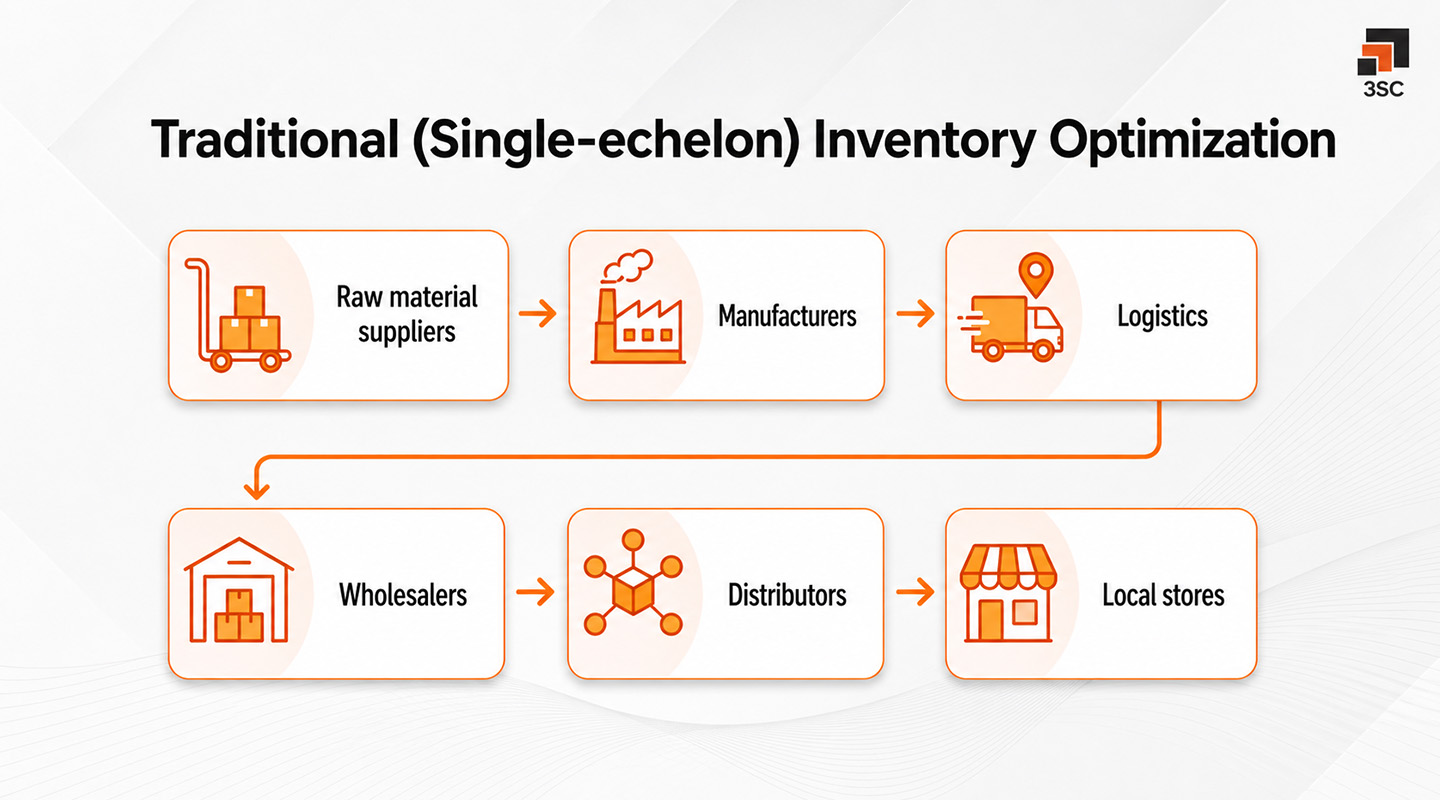
However, in larger, faster moving, and more interconnected networks, its limitations become clear.
When every node plans in isolation, the business loses sight of how inventory decisions at one point affect performance elsewhere. One location may hold more stock than necessary while another remains exposed. Safety stock is duplicated across echelons because every part of the network is trying to protect itself. As a result, businesses end up with excess inventory overall yet still experience shortages in the places that matter most.
For industries with shorter inventory cycles or limited shelf life, such as food and beverage, pharmaceuticals, retail, and quick-service restaurants, this problem becomes even more costly. Excess stock does not simply sit on the balance sheet. It can expire, become obsolete, require markdowns, or turn into waste. At the same time, shortages in high-demand locations can lead to lost sales and lower service reliability. The result is a double loss: capital is locked in the wrong inventory while availability still suffers where demand actually exists.
This is the central weakness of a siloed inventory model. It optimizes local nodes, but not the network. And in today’s operating environment, especially for industries where inventory value changes quickly over time, that gap is no longer manageable.
What is Multi-Echelon Inventory Optimization (MEIO), and how does it connect inventory decisions across the supply chain?
Traditional inventory planning often focuses on setting stock levels for individual locations based on local demand, lead times, and service expectations. While this gives each node a planning structure, it does not always show how inventory decisions interact across the wider network.
This is where MEIO takes a different approach.
Multi-Echelon Inventory Optimization is a supply chain planning approach that optimizes inventory across multiple levels of the network at the same time. Rather than treating each stocking point as a separate decision, it evaluates how suppliers, plants, central warehouses, regional distribution centres, retailers, and other inventory-holding nodes depend on one another.
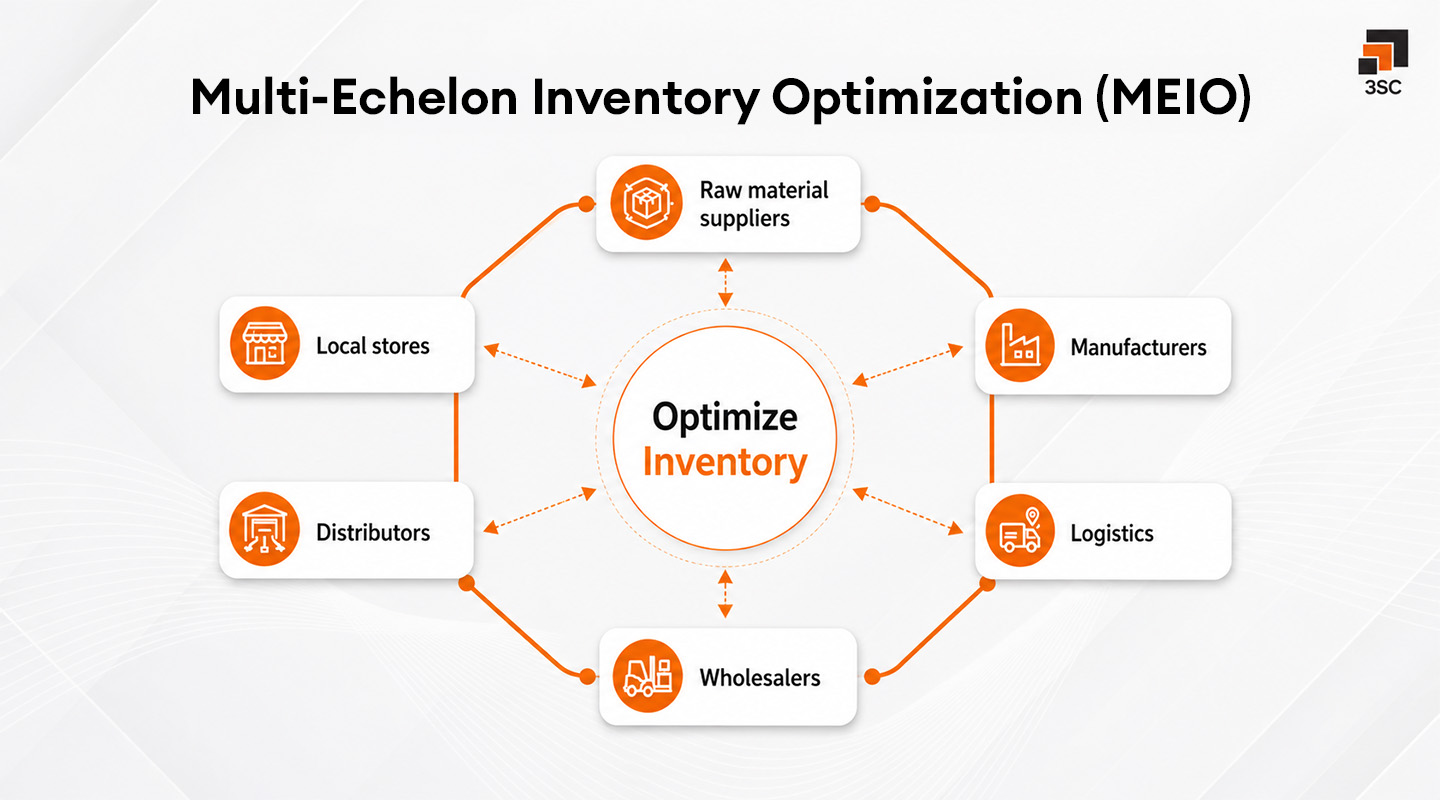
Its objective is to achieve target service levels with the minimum necessary inventory investment.
In practice, MEIO helps organizations answer three connected questions:
- How much inventory is required across the network?
- Where should that inventory be held?
- How should inventory be positioned to balance service, cost, and resilience?
The difference lies in the level of decision-making. Traditional planning looks at inventory location by location. MEIO looks at inventory as a network decision. It considers how demand variability, lead time uncertainty, replenishment frequency, service targets, and cost trade-offs move across echelons. This allows the business to identify where stock creates the highest service impact, and where it only adds cost.
MEIO changes the logic from local protection to network value. It evaluates the full chain as one system and determines where inventory should be placed to create the greatest overall benefit. That is what makes it not just a planning enhancement, but a more strategic way to manage inventory. MEIO has enabled companies to reduce inventories by up to 30% and improve item availability by up to 5% - outcomes that reflect both financial efficiency and supply chain responsiveness.
Traditional Inventory Optimization Vs Multi-Echelon Inventory Optimization (MEIO)
Aspect | Traditional Inventory Optimization (Single-Echelon) | Multi-Echelon Inventory Optimization (MEIO) |
Planning approach | Optimizes inventory at each node independently | Optimizes inventory across the full network |
Decision focus | Looks at one warehouse, plant, DC, or location at a time | Looks at how suppliers, plants, warehouses, DCs, and retailers interact |
Safety stock logic | Each node carries its own buffer to protect local service | Safety stock is placed where it creates the best network-level protection |
Visibility | Limited view of upstream and downstream impact | End-to-end view of inventory movement and dependencies |
Inventory outcome | Can lead to duplicated safety stock across locations | Reduces excess and duplicated inventory across the network |
Service impact | May improve local service but still leave gaps elsewhere | Improves service reliability across the network |
Cost efficiency | Can increase carrying costs due to local buffers | Balances service levels with lower total inventory investment |
Decision quality | Based mainly on local demand, lead times, and reorder rules | Considers demand variability, lead times, service targets, costs, and network structure together |
Best suited for | Smaller, simpler, or less connected supply chains | Larger, complex, multi-tier supply chains |
Strategic value | Helps manage inventory at individual locations | Helps balance inventory, service, working capital, and resilience across the business |
How does MEIO works across the network?
At its core, MEIO treats the supply chain as one interconnected structure rather than a collection of independent nodes. It analyses how inventory, demand, lead times, service expectations, and costs interact across the entire network, then determines where stock should sit to deliver the best total outcome.
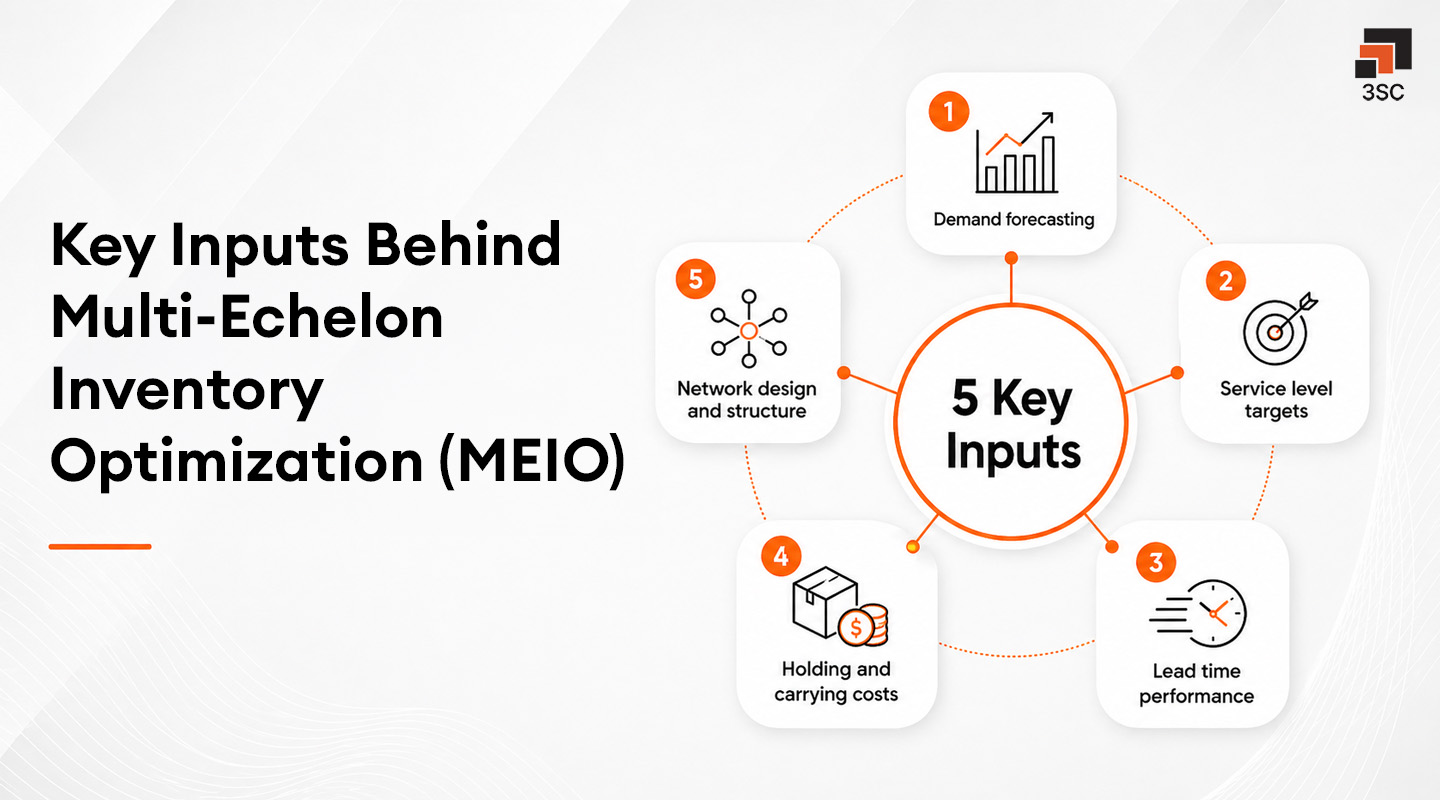
To do this effectively, MEIO depends on five key inputs:
- Demand forecasting - MEIO needs visibility into customer demand across locations and time periods, including variability, seasonality, and forecast error. Without this, the model cannot accurately determine where protection stock is most needed.
- Service level targets - Not every product, customer, or channel requires the same level of availability. Differentiating service expectations allows MEIO to allocate inventory where it has the greatest impact rather than applying a uniform buffer across the network.
- Lead time performance - Replenishment and transportation times influence how much stock the network needs and at which echelon buffers will be most effective. Longer or less reliable lead times require more upstream protection; shorter, more predictable ones allow inventory to be held closer to demand.
- Holding and carrying costs - Inventory ties up capital, consumes space, and creates risks such as obsolescence, damage, or waste. MEIO weighs these costs against service value to identify where stock is genuinely earning its place in the network.
- Network design and structure - A serial supply chain behaves differently from an assembly network, a distribution network, or a broader multi-tier structure. MEIO accounts for these design differences when determining optimal stock placement and decoupling points.
Taken together, these inputs allow MEIO to identify where safety stock should sit, how much should be held at each echelon, and how the business can balance cost against service reliability. This is why MEIO should not be seen as a simple inventory formula. It is a network-level decision framework.
What are the Benefits of implementing Multi-Echelon Inventory Optimization (MEIO)?
When implemented well, MEIO delivers benefits that go well beyond inventory cost reduction.
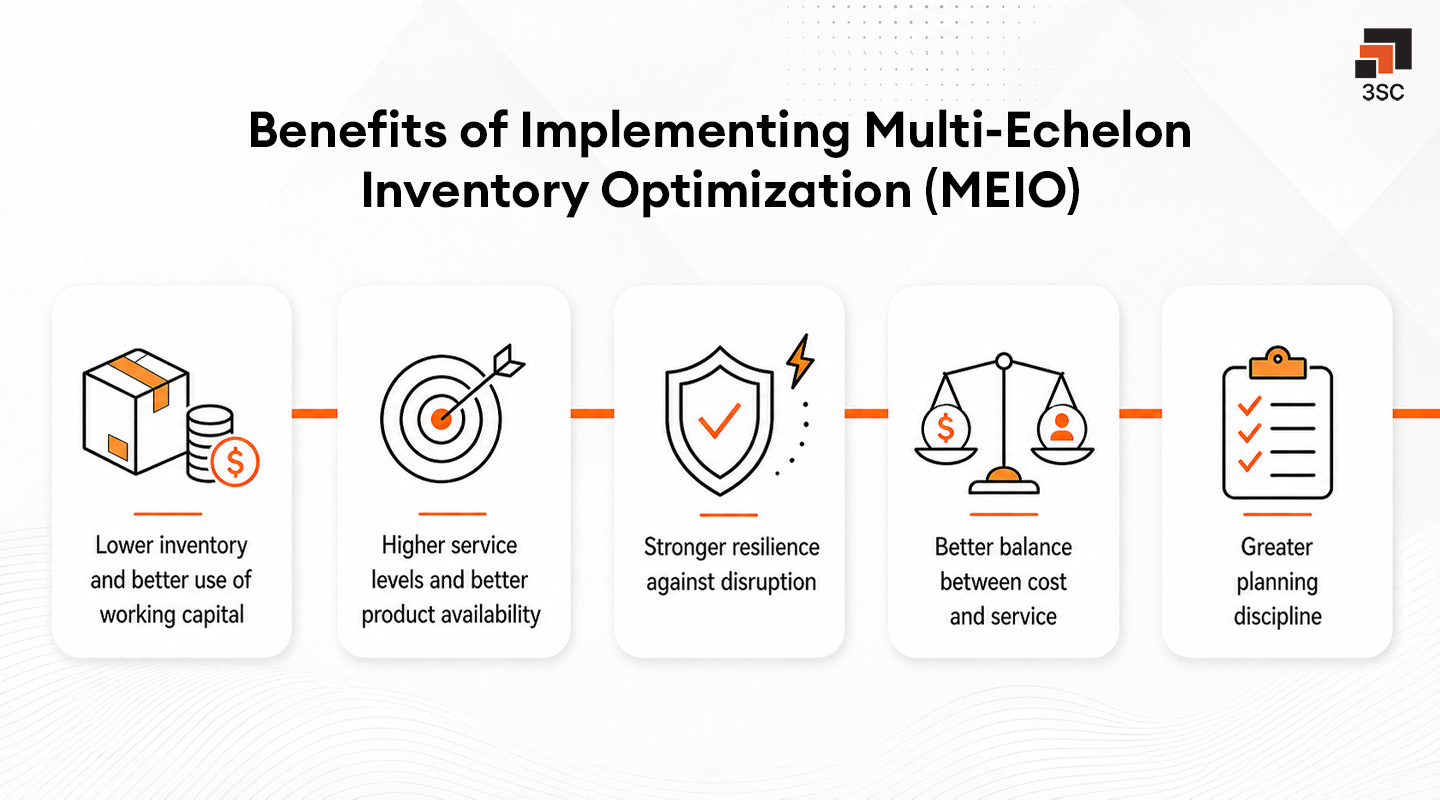
- Lower inventory and better use of working capital - Instead of every node carrying buffers for its own protection, inventory is positioned where it can protect demand most effectively. This reduces total stock while freeing up working capital for other strategic priorities.
- Higher service levels and better product availability - MEIO improves the ability to meet customer demand by placing inventory where it has the greatest impact. Rather than holding excess stock in slow-moving locations, the business can create more reliable availability where actual demand occurs.
- Stronger resilience against disruption - Because MEIO considers the full network, it improves the organization's ability to respond to shifts in demand, lead time variability, and supply interruptions. Shared buffers and better visibility prevent a local disruption from becoming a broader network failure.
- Better balance between cost and service - Every supply chain must make trade-offs between efficiency and responsiveness. MEIO helps organizations understand exactly where additional inventory creates meaningful service value and where it simply adds cost, enabling more deliberate and defensible decisions.
- Greater planning discipline - MEIO relies on data, analytics, and scenario-based decision-making rather than broad assumptions or static rules. That leads to better-informed inventory strategies, fewer reactive decisions, and a more mature planning culture over time.
What are the main challenges in implementing MEIO?
MEIO can create significant value, but like any network-level planning approach, it needs the right foundation. These challenges are not barriers to adoption. They are practical areas organizations should address so the model can be trusted, used, and scaled effectively.
Challenge 1: Data may not be ready at the start
MEIO works best when it has a clear view of demand history, lead times, inventory levels, service targets, and network structure. The more complete and consistent this data is, the stronger the recommendations become and the easier it is for teams to trust the model.
How to solve it: Start with data readiness. Review the most important inputs first, especially demand patterns, replenishment rules, lead time assumptions, and inventory records. The goal is not perfect data from day one, but a dependable base for better decisions. As the model matures, data quality can continue improving in stages.
Challenge 2: Teams may need time to trust the recommendations
Since MEIO looks at the full network, its recommendations may differ from familiar inventory practices. When teams understand the logic behind these recommendations, it becomes easier to see how changes in one location can improve service, reduce excess stock, or lower risk across the wider network.
How to solve it: Make the logic easy to understand. Use small-scale trials, simulations, and scenario comparisons to show how recommendations improve service, reduce excess stock, or lower risk. When teams can see the reason behind the decision and compare it with current planning methods, trust builds naturally.
Challenge 3: Local goals may not support network-level decisions
MEIO creates the most value when sites, regions, and functions are aligned around total network performance. Since inventory decisions often affect multiple teams, shared goals help ensure that each location supports the wider business outcome, not only its local target.
How to solve it: Create shared performance metrics. Instead of only tracking local inventory levels, include measures such as total inventory investment, service levels, fill rate, cost-to-serve, and availability. Cross-functional governance between supply chain, finance, operations, and commercial teams helps ensure decisions are evaluated at the network level.
Challenge 4: Existing systems may have limited optimization capability
MEIO performs best with planning systems that can model inventory across multiple echelons, evaluate trade-offs, run scenarios, and explain recommendations clearly. This gives planners the visibility they need to make confident inventory decisions.
How to solve it: Use planning tools that support multi-echelon modelling, scenario analysis, and explainable recommendations. The technology should not feel like a black box. Planners need to understand why the system is suggesting a particular inventory position so they can act with confidence.
Challenge 5: Scaling MEIO across the full network can take time
A clearly defined first implementation area makes MEIO easier to scale. Starting with a product category, region, business unit, or high-impact part of the network helps teams prove value, build confidence, and expand adoption step by step.
How to solve it: Start with a focused scope. Choose a product category, region, business unit, or part of the network where the value can be measured clearly. Use that first phase to test assumptions, build confidence, and refine governance. From there, MEIO can be scaled step by step, with high-impact areas prioritized first.
As organizations address these foundations, MEIO becomes more than an optimization exercise. It becomes a stronger way to plan, decide, and respond across the network.
Conclusion
The future of inventory optimization is moving beyond static policy setting toward more intelligent, integrated, and adaptive network decision-making. With AI, machine learning, real-time data, and scenario analysis, MEIO is becoming more responsive to changes in demand, supply, lead times, and service requirements.
But the core idea remains simple: supply chains do not underperform only because one node makes a poor decision. They underperform when every node makes reasonable decisions independently, without considering the total system.
MEIO addresses that structural problem. It helps organizations position inventory where it creates the greatest network value, reduce unnecessary stock without sacrificing service, and respond to volatility with greater confidence.
For leaders and CXOs, that is the real significance of Multi-Echelon Inventory Optimization. It is not simply a better inventory method. It is a more strategic way to manage network performance. And in an environment where service, capital efficiency, and resilience must all improve together, that shift can become a meaningful competitive advantage.