Key Takeaways
- AI is making supply chains more connected and adaptive.
- Real-time data is driving faster execution.
- AI improves performance across the entire value chain.
- Better visibility leads to stronger coordination and resilience.
- Future supply chains will be intelligent and scalable.
Every supply chain decision today carries more weight than it did a few years ago. A delayed shipment, a missed demand signal, or an unexpected disruption is no longer an isolated issue, it can ripple across the entire network within hours.
In fact, 94% of companies in supply chain plan to use AI to assist with decision-making, highlighting how central intelligent, real-time judgment has become to modern supply chain operations. Yet many organizations are still navigating growing complexity with processes and systems built for a more stable world.
For supply chain leaders, the real challenge is not efficiency alone. It is balancing service, cost, inventory, and responsiveness simultaneously, under constant disruption. That balance does not come from faster reporting. It comes from faster, more consistent decision-making at every level of the organization.
What is AI in Supply Chain?
AI in supply chain is the use of intelligent technologies to help organizations plan, predict, and respond more effectively across the supply chain. It improves decision-making by analysing data in real time, identifying patterns, anticipating disruptions, and supporting faster action across areas such as forecasting, inventory, logistics, and supplier management.
AI is not just providing better insights. With the rise of Agentic AI, supply chain systems can also go a step further by not only recommending actions but autonomously taking routine decisions and executing tasks within defined workflows. This helps supply chains become more adaptive, efficient, and resilient in a fast-changing environment.
Top Strategic AI Use Cases Across the Supply Chains
AI creates the most value when applied to the priorities supply chain leaders manage every day: improving service without inflating inventory, responding faster to volatility, reducing execution gaps, and protecting margin under pressure. The following use cases show where that value is becoming most visible.
Demand Forecasting and Sensing: Catching Shifts Before They Become Costly |
Inventory Optimization: Smarter Trade-offs, Less Locked Capital |
Intelligent Logistics and Routing: Staying Ahead of Disruption in Real Time |
Supplier Risk and Performance Management: Seeing Upstream Problems Before They Hit Operations |
1. Demand Forecasting and Sensing
Traditional forecasting models rely heavily on historical data. In a fast-changing environment, where channel shifts, weather events, promotions, and competitor activity can alter demand patterns within days, that lag becomes costly. The issue is not just forecast error. It is the chain of decisions that follows, from production plans locked too early to inventory placed too broadly or too late.
AI improves this by continuously ingesting real-time signals such as customer behaviour, market trends, promotional activity, and external data, helping teams detect demand shifts earlier. For supply chain leaders, that earlier signal translates into faster and better-positioned decisions, with less emergency expediting, fewer stockouts, and less excess inventory built around assumptions that no longer hold.
The value is not just a more accurate forecast. It is the time and flexibility that better forecasting creates for execution.
Related read - Demand Forecasting in Supply Chain
2. Inventory Optimization
Inventory decisions sit at the centre of one of the most difficult trade-offs in supply chain management: protecting product availability without locking up excessive working capital. Both sides matter, and both pull in different directions.
AI helps organizations make that trade-off more intelligently by continuously analysing demand variability, replenishment cycles, service targets, and supply constraints across locations and segments. Instead of relying on static inventory rules, teams can adjust inventory positions more dynamically as conditions change.
The impact is measurable: improved inventory turns, lower excess stock, reduced carrying costs, and fewer service failures caused by avoidable shortages. For leaders under pressure to release working capital while maintaining fill rates, this remains one of the clearest and most practical AI value cases in supply chain.
3. Intelligent Logistics and Routing
Logistics performance is increasingly shaped by disruption, delivery variability, fuel costs, traffic conditions, capacity constraints, and changing customer expectations. In that environment, static transport plans break down quickly.
AI helps organizations improve logistics execution by dynamically recalculating routes, prioritizing deliveries more effectively, and adjusting transport decisions in response to changing conditions. This allows teams to contain avoidable cost increases while improving delivery reliability.
For leaders managing tight margins, this matters because logistics is no longer just an execution layer. It is a major driver of service performance, cost control, and network responsiveness.
4. Supplier Risk and Performance Management
Many supply chain disruptions begin upstream. A supplier delay, quality issue, capacity shortfall, regulatory event, or geopolitical disruption can affect continuity long before it appears in internal performance metrics.
AI helps strengthen supplier risk management by continuously monitoring supplier performance, lead-time patterns, financial signals, and external risk indicators. This allows teams to detect warning signs earlier and act before the issue becomes a broader service or inventory problem.
That earlier visibility becomes critical when organizations are already dealing with constrained capacity, volatile lead times, and repeated manual escalations to keep supply on track. For leaders, the advantage is not just better risk awareness, but more time to respond with sourcing adjustments, inventory reallocation, or contingency activation.
Benefits of AI in Supply Chain
When these capabilities work together, their impact shows up in the metrics that matter most to supply chain leadership: OTIF, forecast accuracy, inventory turns, working capital, stockout rates, planner productivity, and logistics cost.
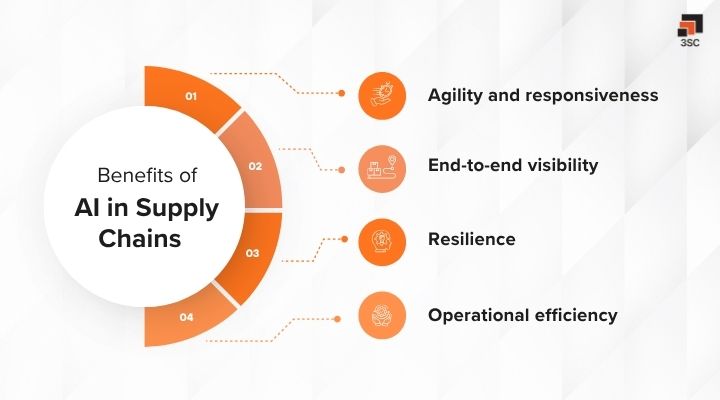
- Agility and responsiveness: improve because the supply chain is not waiting for manual analysis to surface an issue. AI tracks what is happening across the network continuously, enabling faster adjustments in production, inventory, and logistics before a problem escalates.
- End-to-end visibility: improves because AI integrates data across fragmented systems and provides a unified, real-time view of operations, inventory levels, shipment status, supplier performance, and process health, in one place. Better visibility means fewer coordination failures and faster escalation when something goes wrong.
- Operational efficiency: improves not just through automation, but through consistency. Manual processes introduce variation. Agentic systems execute the same workflow the same way, every time, at a speed that human coordination cannot match.
- Resilience: improves because AI is monitoring continuously, not periodically. Risk signals surface earlier. Response options are broader when they are identified earlier. The gap between a disruption occurring and an organization responding narrows.
These are not incremental improvements. For supply chain leaders managing multiple trade-offs simultaneously, they are shifts in what is operationally possible.
Future Trends of AI in Supply Chain
As supply chains continue to evolve, AI is moving beyond improving individual processes to transforming how the system operates. But this evolution is rarely immediate. In most organizations, adoption progresses in stages, starting with better visibility and exception detection, moving into decision support, and then advancing toward selective automation in high-value workflows.
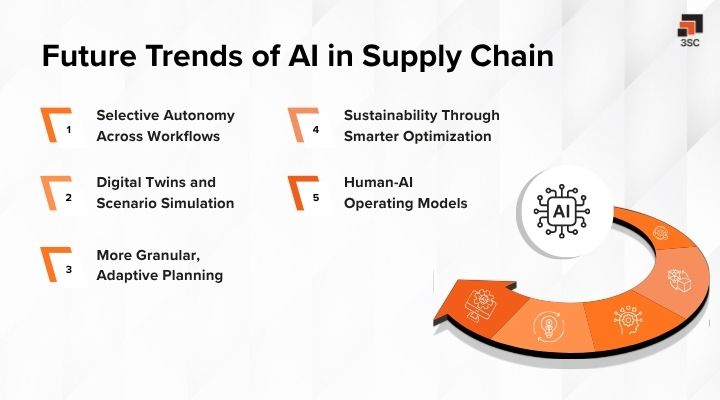
1. Selective Autonomy Across Workflows
Supply chains are moving toward higher levels of automation, but the shift will be gradual and selective. Most organizations will not automate end-to-end decision-making all at once. They will start by applying AI in high-frequency, high-value workflows where decisions are repetitive, time-sensitive, and heavily dependent on manual coordination.
This is where Agentic AI is likely to gain traction first.
2. Digital Twins and Scenario Simulation
Digital twins will play a larger role in helping organizations model network behaviour, test disruption scenarios, and evaluate decision impacts before acting. Combined with AI, these simulations can improve readiness and support better planning under uncertainty.
3. More Granular, Adaptive Planning
Demand, fulfilment, and customer expectations are becoming more localized and channel specific. AI will increasingly support planning at a more detailed level, helping organizations respond with greater precision across geographies, segments, and routes to market.
4. Sustainability Through Smarter Optimization
Sustainability goals are becoming more closely tied to operating decisions. AI can support these goals by improving route efficiency, reducing waste, optimizing resource usage, and helping organizations make more responsible trade-offs without losing operational performance.
5. Human-AI Operating Models
The future of supply chain is not human versus machine. It is human judgment supported by systems that can process more information, identify patterns faster, and automate routine execution where appropriate. Leadership, collaboration, and exception management will remain deeply human responsibilities.
These trends point to a clear direction. Supply chains are evolving into more intelligent and adaptive systems that can adjust continuously to changing conditions.
The Road Ahead
AI in supply chain is no longer a future concept. It is already reshaping how supply chains operate across planning, inventory, logistics, and supplier management.
However, the real value of AI does not come from isolated adoption. It comes from embedding intelligence into the operating rhythm of the supply chain so decisions can be made faster, execution can become more consistent, and disruption can be managed with greater control.
As this shift continues, AI will play an increasingly important role in closing the gap between planning and execution. It will help organizations respond to change with greater speed, reduce avoidable manual friction, and improve performance across the trade-offs that matter most.
For supply chain leaders, the priority is not to pursue AI as a standalone innovation agenda. It is to apply it where decision velocity, execution consistency, and business impact are most visible, especially in the points of tension between service and inventory, cost and responsiveness, and planning and execution.
The organizations that create the most value will not be the ones running the most pilots. They will be the ones embedding AI into day-to-day supply chain decisions in ways that improve measurable outcomes. In an environment defined by constant volatility, that is what will separate experimentation from real competitive advantage.