Key Takeaways
- IBP builds the plan, but IOP ensures it holds when reality changes.
- In a volatile world, responsiveness matters as much as planning accuracy.
- IOP bridges the gap between strategy and real-time execution.
- Resilience comes from sensing and acting fast.
- Disruption is the norm, not the exception.
Your team has built the plan precisely. Demand forecasts are aligned, supply is balanced, inventory is optimized, and every function is working in sync. Your Integrated Business Planning (IBP) process has done exactly what it is supposed to do by bringing structure, alignment, and clarity to a complex supply chain.
And then, something shifts.
You wake up to headlines about the 2026 US-Israel war against Iran. A sudden escalation that disrupts global trade routes, spikes fuel prices, and creates uncertainty across suppliers and logistics networks. What felt stable yesterday now feels unpredictable.
But the plan didn’t fail because it was flawed. It struggled because the world it depended on changed overnight. And that is the reality supply chains operate in today.
In fact, research found that supply chain disruptions lasting over a month now strike every 3.7 years on average, costing businesses up to 45% of a year's profit over a decade. Disruption is not the exception anymore; it is the schedule.
When Volatility Becomes the Norm
For years, planning excellence was defined by how closely organizations could align their plans with expected outcomes. Greater forecast accuracy and tighter cross-functional coordination translated into more stable and predictable operations.
But today, the challenge is no longer just about how well the plan is built. It is about how effectively the organization can respond when reality begins to diverge from that plan.
Today, demand patterns shift faster than planning cycles. Supply constraints emerge without warning. External factors like geopolitical tensions, climate disruptions, market volatility continuously reshape the operating landscape.
In such an environment, even the most robust plan is built on assumptions that may not hold for long. Which brings us to a simple but critical realization: Planning is not just about getting it right; it’s also about staying effective when things change.
Introducing Integrated Operations Planning (IOP): Planning for the Unplanned
This is where, Integrated Operations Planning (IOP) acts as the bridge between planning and execution in an unpredictable environment.
Integrated Operations Planning (IOP) is a structured approach to risk detection, assessment, and management within the supply chain. It operates in real time to identify emerging disruptions, evaluate their potential impact on the business, and enable coordinated responses across demand, supply, and operations. Rather than reacting after issues escalate, IOP ensures that risks are continuously monitored and addressed proactively.
In essence, IOP ensures that as risks emerge, they are detected early, assessed accurately, and managed effectively keeping operations stable even in an unpredictable environment.
Integrated Operations Planning (IOP): Key Capabilities
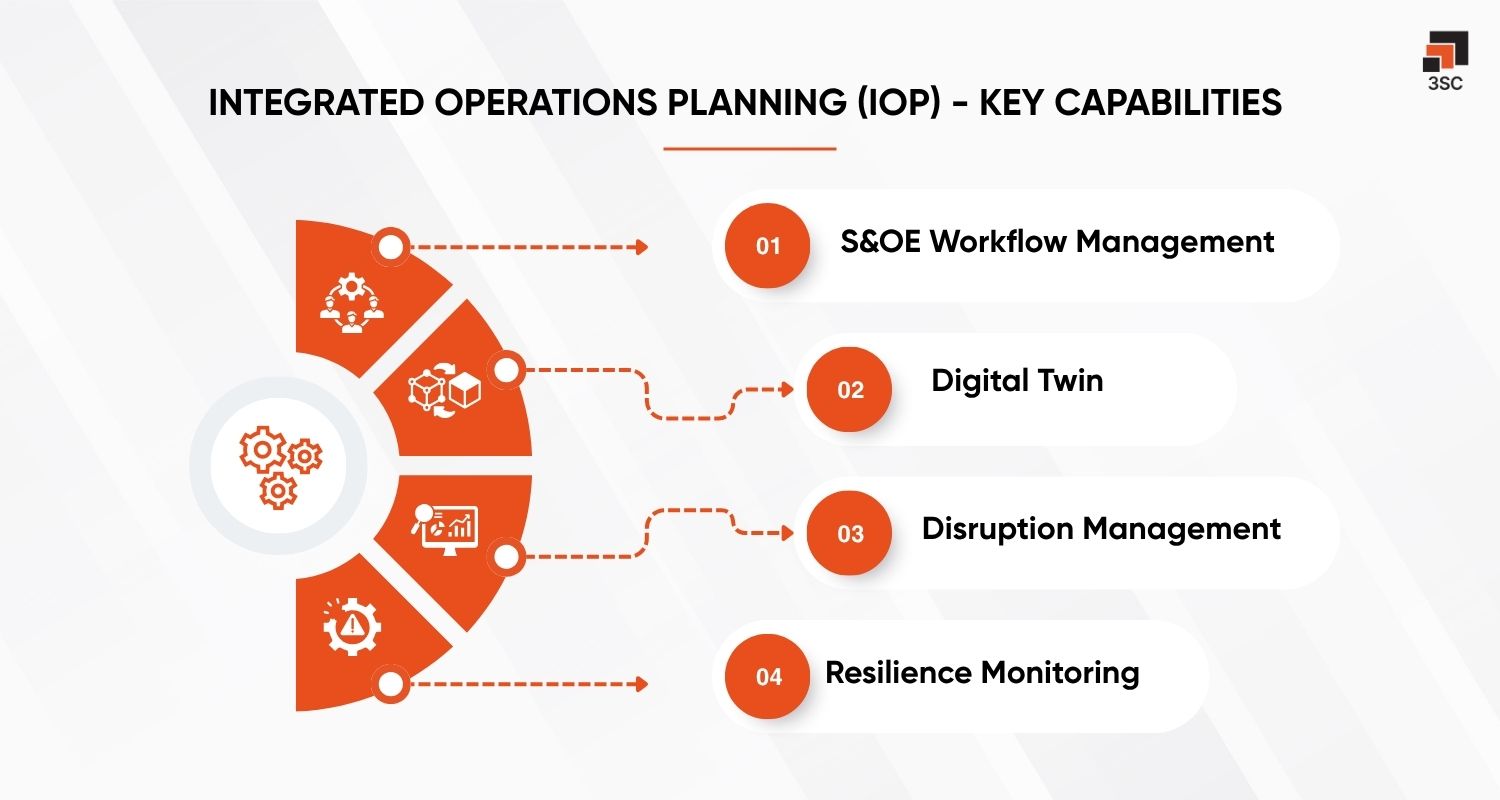
1. S&OE Workflow Management: Governing Execution in Real Time
Sales and Operations Execution (S&OE) acts as the daily execution control layer that bridges the gap between periodic planning and continuous operations.
Between IBP cycles, demand fluctuates, supply conditions change, and execution teams often rely on fragmented tools to manage disruptions. This leads to unstructured overrides, misalignment, and gradual drift from the plan. S&OE brings discipline into this layer by enabling real-time demand and supply sensing. Demand signals such as orders, POS data, and promotions are continuously monitored to detect short-term shifts, while supply sensing tracks inventory, capacity, and supplier commitments.
Instead of replacing the base plan, S&OE allows controlled adjustments such as reallocations, reprioritization, or expediting while maintaining governance. All deviations are tracked against the original plan and fed back into future cycles.
This ensures execution stays responsive without losing alignment, turning daily volatility into something that can be managed rather than endured.
2. Digital Twin: One Orchestration Layer, Complete Visibility
Digital Twin provides a unified, real-time view of the supply chain by creating a virtual replica of operations, eliminating fragmentation across systems and functions.
In most organizations, data exists across multiple platforms, making it difficult to understand the full impact of a disruption. A Digital Twin consolidates this into a single operational model, creating a shared and consistent view across Plan, Source, Make, and Deliver.
Its key strength lies in connecting data and tracing impact. When a disruption occurs, it enables organizations to see how it propagates across suppliers, production, inventory, and customer commitments. It also supports scenario evaluation before execution. Through built-in what-if modelling, teams can test multiple response options under real constraints, replacing delayed, spreadsheet-based analysis with real-time insights.
With continuously synchronized data and system-driven intelligence, decisions are grounded in a clear, connected understanding of the current state.
3. Resilience Monitoring: From Reaction to Prevention
Resilience Monitoring shifts the focus from responding to disruptions to anticipating them early.
While organizations have access to large volumes of historical data, they often lack structured mechanisms to identify emerging risks. Leading indicators are not consistently tracked, and gradual performance drift often goes unnoticed until it becomes a disruption.
This capability introduces continuous risk intelligence by monitoring key indicators across the supply chain. Using statistical and machine learning techniques, it detects anomalies, identifies patterns, and distinguishes meaningful signals from noise.
More importantly, it assigns probabilities to potential risks, allowing organizations to prioritize action before issues materialize. High-risk signals are escalated proactively, enabling early intervention.
Over time, the system learns from outcomes, improving its predictive accuracy and strengthening future responses. The result is a supply chain that moves from reactive firefighting to proactive risk prevention, where disruptions are reduced before they occur.
4. Disruption Management: From Firefighting to Structured Decisions
Disruption Management ensures that when disruptions occur, they are handled as structured, enterprise-level decisions rather than isolated reactions.
In many organizations, disruptions are detected late, assessed qualitatively, and resolved within silos. This leads to inefficiencies, missed trade-offs, and recurring issues.
This capability transforms that approach by enabling early detection, impact quantification, and coordinated resolution. Using signals from the Digital Twin, disruptions are identified and their impact is quantified across revenue, cost, service levels, and working capital. Instead of local decisions, organizations can evaluate enterprise-wide trade-offs.
AI-powered recommendations suggest optimal responses, with clear reasoning to support decision-making. Once approved, actions are executed directly within systems, ensuring speed and consistency. Every disruption is captured and analysed, creating a feedback loop that strengthens both decision-making and long-term resilience.
Planning for Stability, Preparing for Uncertainty
In a world where disruption is continuous, the true measure of planning is not just stability, but also adaptability. Organizations can no longer rely on static plans to navigate dynamic realities. What sets leaders apart is their ability to sense change early, respond with precision, and stay aligned while doing so.
While Integrated Business Planning lays the strategic foundation, it is IOP that brings that strategy to life under pressure. It ensures that when conditions shift, decisions are not delayed, fragmented, or reactive, but timely, informed, and coordinated.
The result is a supply chain that operates as a single, adaptive organism. Demand surges are met without stockouts. Supplier delays trigger timely reallocations before they cascade. Geopolitical shocks prompt scenario-tested responses, all while staying aligned with strategic objectives.
This is where planning evolves from a periodic exercise into a continuous capability. One that doesn’t just withstand volatility but operates confidently within it.
The organizations that succeed will not be the ones with the most accurate plans, but the ones best prepared to adapt them.