
Key Takeaways
- Enterprise Data Management unifies fragmented data to enable faster supply chain decisions.
- Modern supply chains depend on seamless data flow across systems and functions.
- Integration platforms, data warehouses, and MDM tools keep enterprise data consistent and accessible.
- A strong EDM strategy requires clear ownership, standardized data, and scalable architecture.
- Treating data as a shared asset improves cross-functional supply chain alignment.
- Strong data foundations enable AI-driven planning and real-time supply chain visibility.
Supply chains today stretch across geographies, while customer interactions span multiple channels, and every activity, whether a transaction, sensor update, or supplier signal, continuously generates data. Where supply chains once relied on periodic reports and scheduled updates, they now operate on a constant, real-time stream of information driven by every interaction and signal.
Over 87% of organizations face disconnected data environments, leading to inefficiencies in operations and decision-making. Expectations from data have fundamentally shifted, as it can no longer sit in reports or dashboards to be reviewed after the fact, but must actively support timely, informed decision-making.
This is where Enterprise Data Management (EDM) enters. EDM is not simply a technical discipline for organizing databases. It is the framework that ensures the data is accurate, accessible, governed, and aligned across the organization. When implemented well, it transforms raw information into a reliable foundation for enterprise decision-making.
What is Enterprise Data Management in Supply Chain?
Enterprise data management in the supply chain is a process that helps businesses organize, store, and analyse the large volumes of data they generate through their operations. This data can come from various sources, such as suppliers, customers, transportation networks, warehouses, and other key stakeholders. By using effective enterprise data management techniques, businesses can better manage their processes, minimize risk, and maximize efficiency.
For example, businesses can use enterprise data management in the supply chain to monitor inventory levels and adjust procurement strategies according to customer demand. This helps them save time and money and optimize their operations for maximum efficiency.
Understanding this shift requires looking beyond technology alone. To see why EDM has become essential, we must first understand the growing complexity of modern enterprise data environments.
Why is Enterprise Data Management in Supply Chain important?
The need for enterprise data management in the supply chain is becoming increasingly important as businesses move towards digital transformation. With more and more data being generated, businesses need to ensure that they can easily access this data and use it efficiently to improve their operations. Without effective enterprise data management, businesses can't accurately assess their current performance or plan.
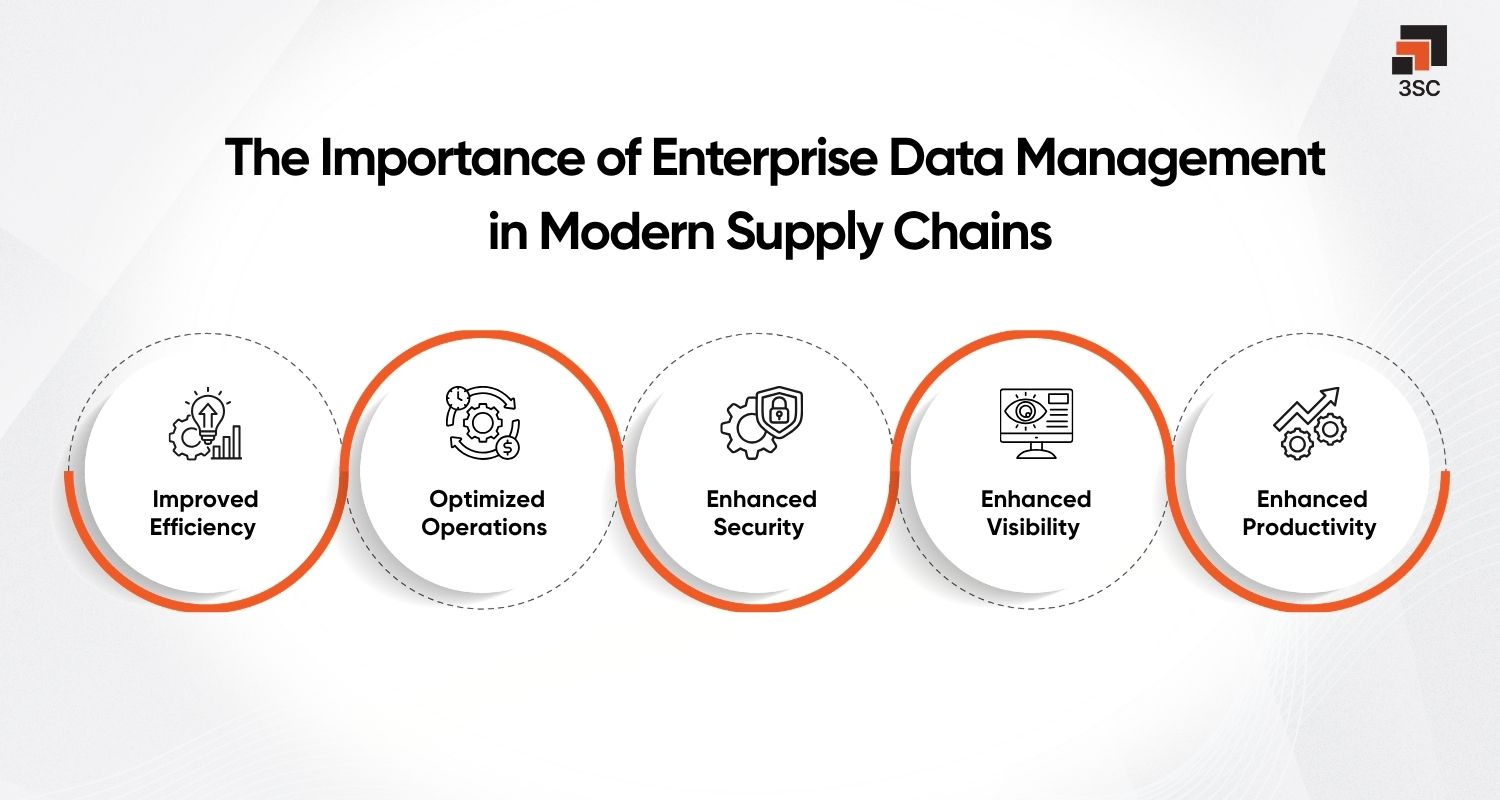
Here are a few aspects of why EDM is important in the supply chain:
- Improved Efficiency: By streamlining the process of collecting and analysing data, businesses can save time and money. This, in turn, leads to improved efficiency and better decision-making. EDM keeps all data organized and up to date, allowing businesses to quickly access the information they need.
- Optimized Operations: Enterprise data management in the supply chain helps businesses optimize their operations for maximum efficiency. This allows them to save resources, reduce costs and improve customer satisfaction. EDM also helps businesses identify areas for improvement and make changes to their processes for better results.
- Enhanced Security: By implementing an effective enterprise data management system, businesses can ensure that their data is secure and protected from cyber threats. This helps them mitigate risks and protect their operations from malicious actors. An EDM solution protects sensitive data and prevents unauthorized access.
- Enhanced Visibility: With an effective enterprise data management system, businesses can gain insights into their operations and make better decisions. This helps them identify opportunities for improvement and ensure that they stay ahead of their competition. EDM allows workflows to become more transparent and efficient.
- Enhanced Productivity: By automating processes and collecting data in real time, businesses can improve their productivity and take advantage of new technologies such as AI. An EDM system allows employees to quickly access the information they need to complete their jobs. As a result, less time is wasted 'searching' and more time is spent being productive!
Master Data Management (MDM) vs Enterprise Data Management (EDM)
Aspect | Master Data Management (MDM) | Enterprise Data Management (EDM) |
|---|---|---|
Definition | Creates a single, authoritative master record for core business data | Manages the entire data ecosystem across the enterprise |
Scope | Narrow – focuses on key business entities | Broad – includes all types of enterprise data |
Primary Goal | Establish a single source of truth | Enable end-to-end data governance and usability |
Data Type | Master/reference data (customers, vendors, products) | Master + transactional + analytical data |
Function | Standardizes and defines required data fields | Governs, integrates, secures, and manages data lifecycle |
Approach | Entity-level data standardization | Organization-wide data strategy |
Examples | Customer master (name, email, phone), Vendor master (location, supplier details) | Data governance frameworks, data pipelines, quality monitoring systems |
Key Benefit | Eliminates duplicates and ensures data consistency | Ensures data accessibility, compliance, and scalability |
Use Case | Cleaning and unifying core datasets | Managing large-scale, cross-functional data environments |
Relationship | Subset of EDM | Superset that includes MDM |
Why Data Complexity Is Reshaping Enterprise Operations
Modern enterprises generate vast amounts of data, but the real challenge lies in managing its growing complexity as it moves across systems and functions. In supply chains, decisions depend on interconnected data, from demand signals and supplier timelines to inventory and financial inputs, and when these remain fragmented, misalignment between planning and execution becomes inevitable.
This rising complexity is reshaping how operations function, making coordinated, real-time decision-making harder to achieve. Enterprise Data Management addresses this by creating a unified and consistent data foundation by using various tools.
The Tools Powering Modern Enterprise Data Management
Companies rely on tools to ensure that information such as demand forecasts, inventory levels, supplier updates, and transportation status remains accurate and accessible across the organization.
Enterprise systems such as ERP, warehouse management systems (WMS), and transportation management systems (TMS) act as the primary sources of operational data across the supply chain. They capture critical information such as demand forecasts, inventory levels, supplier updates, and transportation status.
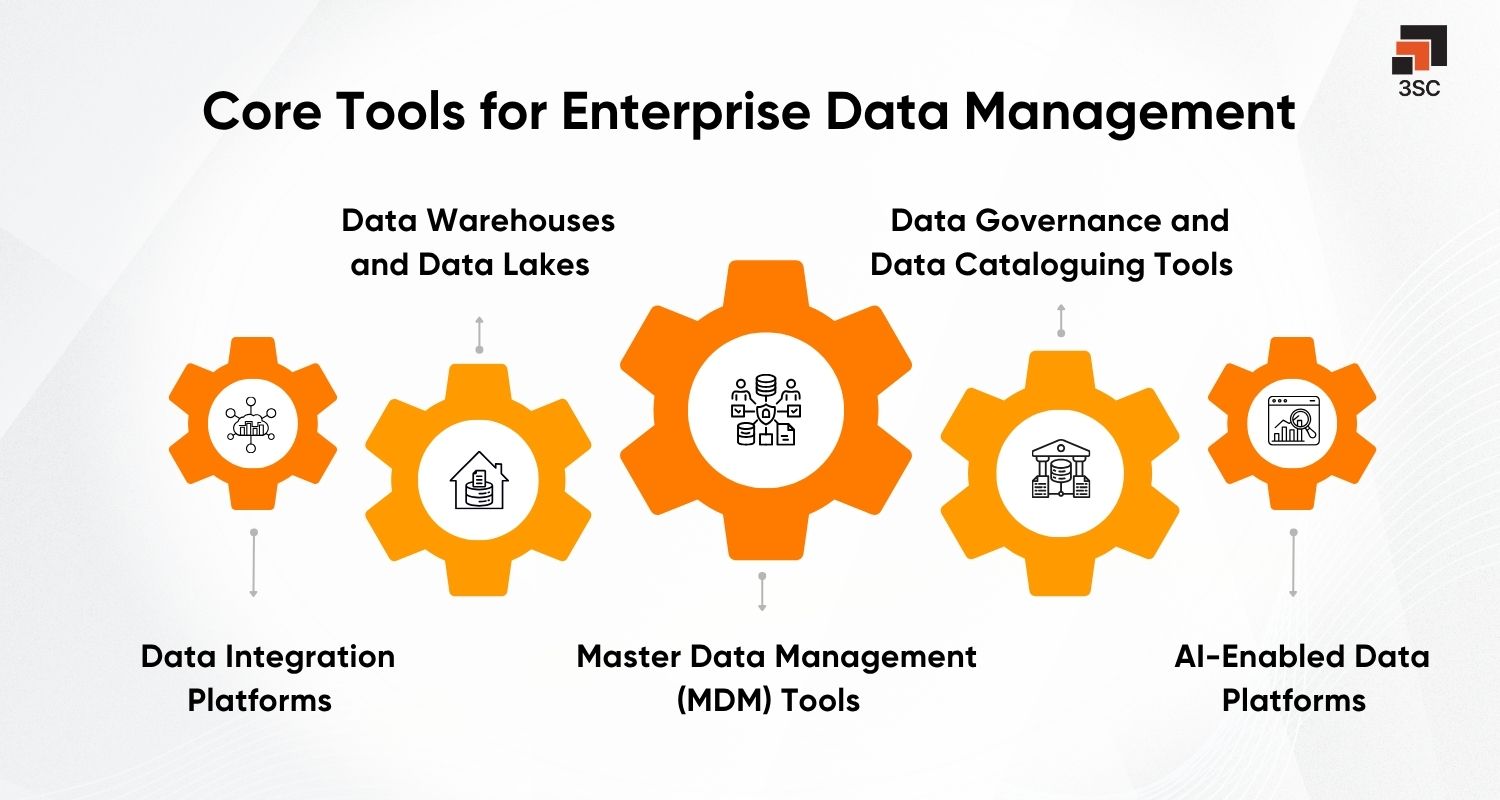
EDM builds on this foundation by ensuring that data flowing from these systems is accurate, consistent, and accessible. It connects and harmonizes data across these systems through a structured set of tools, including:
- Data Integration Platforms
- Data Warehouses and Data Lakes
- Master Data Management (MDM) Tools
- Data Governance and Data Cataloguing Tools
- AI-Enabled Data Platforms
By transforming raw data into reliable, aligned information, EDM enables organizations to operate with greater visibility, coordination, and confidence.
However, technology alone is not enough, its effectiveness depends on a strong underlying data management foundation.
Building a Practical Enterprise Data Management Strategy
To manage supply chain data effectively, organizations need a clear strategy that aligns data management with operational and business goals like:
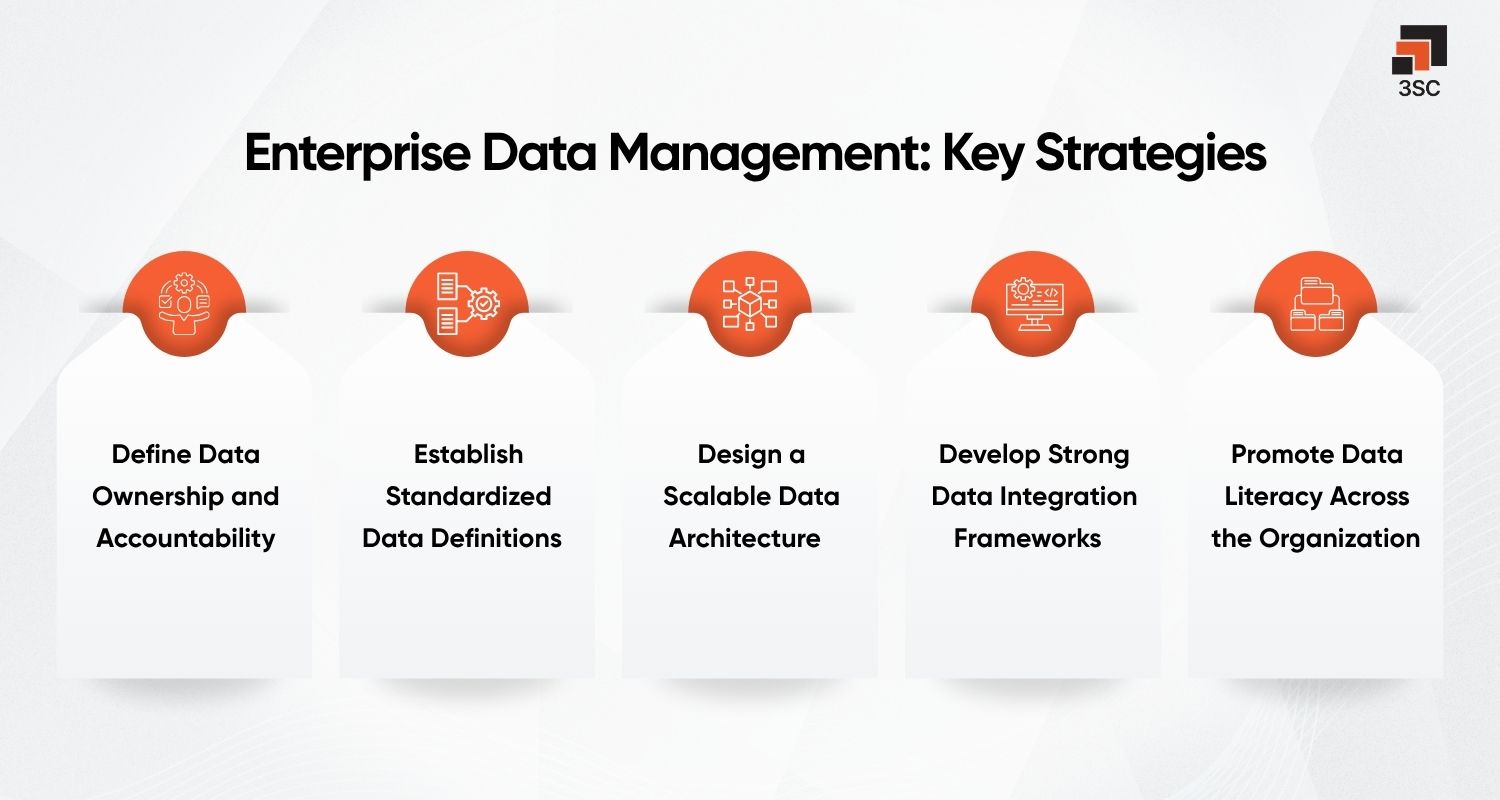
1. Define Data Ownership and Accountability
Every important dataset should have a clear owner responsible for maintaining its accuracy.
For example, procurement teams may own supplier data, planning teams may manage demand forecasts, and logistics teams may manage transportation data. When ownership is clearly defined, it becomes easier to keep information accurate and updated.
2. Establish Standardized Data Definitions
Different departments often interpret the same data differently. For instance, one team may define “available inventory” differently from another team. Standardizing data definitions ensures that all supply chain teams work with the same understanding. This improves coordination between planning, procurement, manufacturing, and distribution teams.
3. Design a Scalable Data Architecture
Supply chains continuously evolve as companies expand into new markets, introduce new products, or adopt new technologies. A scalable data architecture allows organizations to handle increasing volumes of operational data without disrupting existing systems. Cloud-based platforms often provide the flexibility needed to support growing supply chain networks.
4. Develop Strong Data Integration Frameworks
Supply chain decisions often require data from multiple systems. For example, production planning may depend on demand forecasts, supplier capacity, and inventory levels.
Integration frameworks ensure that these systems remain connected and that data flows between them automatically. This allows planners to work with updated information instead of relying on outdated reports.
5. Promote Data Literacy Across the Organization
Effective data management requires more than technology. Teams across the supply chain must understand how to interpret and use data correctly.
Training employees to work confidently with data helps organizations improve forecasting accuracy, detect risks earlier, and make faster operational decisions.
With a clear strategy defined, the next step is to translate it into consistent, day-to-day data management practices.
Best Practices for Enterprise Data Management
Successful supply chains follow certain practices that help maintain reliable and accessible data.
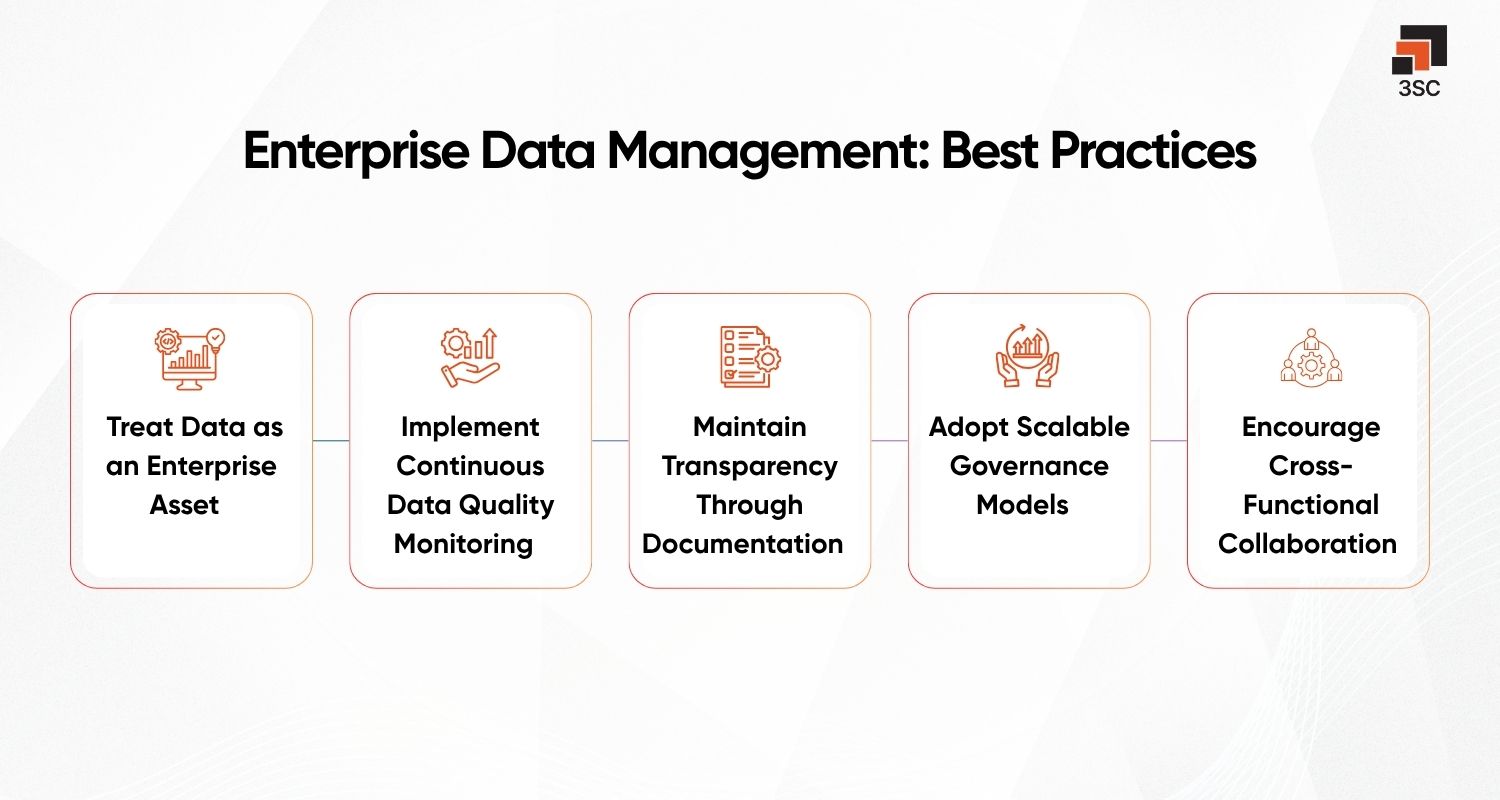
1. Treat Data as an Enterprise Asset
Data should be shared across departments instead of remaining within isolated teams. For example, demand forecasts should be visible to procurement, manufacturing, and logistics teams. When everyone works from the same data, supply chain decisions become more coordinated.
2. Implement Continuous Data Quality Monitoring
Supply chain systems constantly generate new data. Without monitoring, errors can quickly spread across planning and execution systems. Automated data checks help identify issues such as incorrect inventory levels, missing supplier information, or inaccurate demand forecasts before they affect operations.
3. Maintain Transparency Through Documentation
Documenting data sources and data flows helps teams understand where information originates and how it should be used. For instance, planners should know whether demand data comes from point-of-sale systems, distributor reports, or forecasting models. Clear documentation prevents confusion and improves trust in the data.
4. Adopt Scalable Governance Models
As supply chains grow, data governance policies must evolve to support new markets, suppliers, and technologies. Flexible governance frameworks allow organizations to maintain control over their data while still enabling innovation and operational improvements.
5. Encourage Cross-Functional Collaboration
Supply chain performance depends on collaboration between planning, procurement, manufacturing, logistics, and finance teams. When these teams share data and insights, they can respond faster to disruptions, adjust production plans more effectively, and maintain better service levels.
These practices help supply chain organizations maintain reliable data environments while preparing them for more advanced capabilities such as AI-driven planning, predictive analytics, and real-time supply chain visibility.
Conclusion
Enterprise Data Management has evolved from a technical necessity into a strategic capability that shapes how modern organizations operate.
In an environment defined by rapid data generation, global supply networks, and increasingly complex digital ecosystems, fragmented information is no longer sustainable. Enterprises must ensure that data remains accurate, integrated, governed, and accessible across every function of the business.
Achieving this requires a combination of clear strategy, robust technology platforms, disciplined governance frameworks, and a culture that treats data as a shared organizational asset.
For supply chain and enterprise leaders navigating the realities of 2026, the message is clear. The organizations that build strong Enterprise Data Management foundations today will be the ones capable of transforming data into coordinated action, informed decisions, and long-term competitive advantage.
How 3SC can help with Enterprise Data Management in the Supply Chain?
With the 3SC's SCAI EDM solution, businesses can ensure that their data is secure, organized, and up to date, allowing them to maximize efficiency and stay ahead of their competition. By implementing 3SC's EDM solution into their operations, businesses can rest assured that their data will remain well-organized, secure, and up to date. This will help them make better decisions and optimize their supply chain operations for success. At 3SC, we are dedicated to helping businesses overcome the challenges of enterprise data management in the supply chain. To get our SCAI EDM solution, contact us today!