Key Takeaways
- S&OP transforms demand and supply alignment into a structured, enterprise-wide decision system.
- Effective S&OP replaces reactive firefighting with scenario-driven, cross-functional trade-offs.
- Governance, accountability, and the right KPIs determine whether S&OP drives performance or just reports numbers.
- Modern S&OP is evolving toward continuous planning, predictive insight, and tighter strategic integration.
- The true value of S&OP lies in enabling faster, aligned, and confident decisions under sustained volatility.
In 2026, supply chains are no longer competing on efficiency alone, they are competing on decision quality.
Volatility is structural. Demand patterns shift overnight. Capacity constraints surface without warning. Margins are under constant pressure. Growth targets remain aggressive. At the same time, geopolitical tensions and ongoing regional conflicts continue to disrupt trade routes, energy markets, and supplier ecosystems.
The challenge is no longer understanding volatility, it is deciding how the organization should respond to it. In this environment, the organizations that win are not those with the most data, but those that can convert uncertainty into aligned, financially grounded decisions at speed.
What separates high-performing enterprises from reactive ones is a disciplined, cross-functional planning mechanism that connects commercial ambition with operational feasibility and financial accountability. Such a mechanism creates one shared version of the truth, forces explicit trade-offs between competing priorities, and ensures leadership commits to a single, executable plan.
Sales and Operations Planning (S&OP) is one of the most widely used frameworks designed to achieve this alignment.
What are Sales and Operations Planning (S&OP)
Sales and Operations Planning (S&OP) is a cross-functional process that aligns demand and supply into one feasible operating plan. It ensures that sales forecasts are matched with production, capacity, and inventory capabilities, creating a single, agreed view of how the business will execute.
Beyond balancing supply and demand, S&OP provides a disciplined structure for evaluating constraints, making trade-offs, and committing the organization to one plan that the business can realistically deliver.
To achieve this alignment, companies follow a structured planning cycle that integrates data, operational insight, and leadership decisions.
| Related read - Benefits of Sales & Operations Planning
What are the Key components of the Sales and Operations planning (S&OP)?
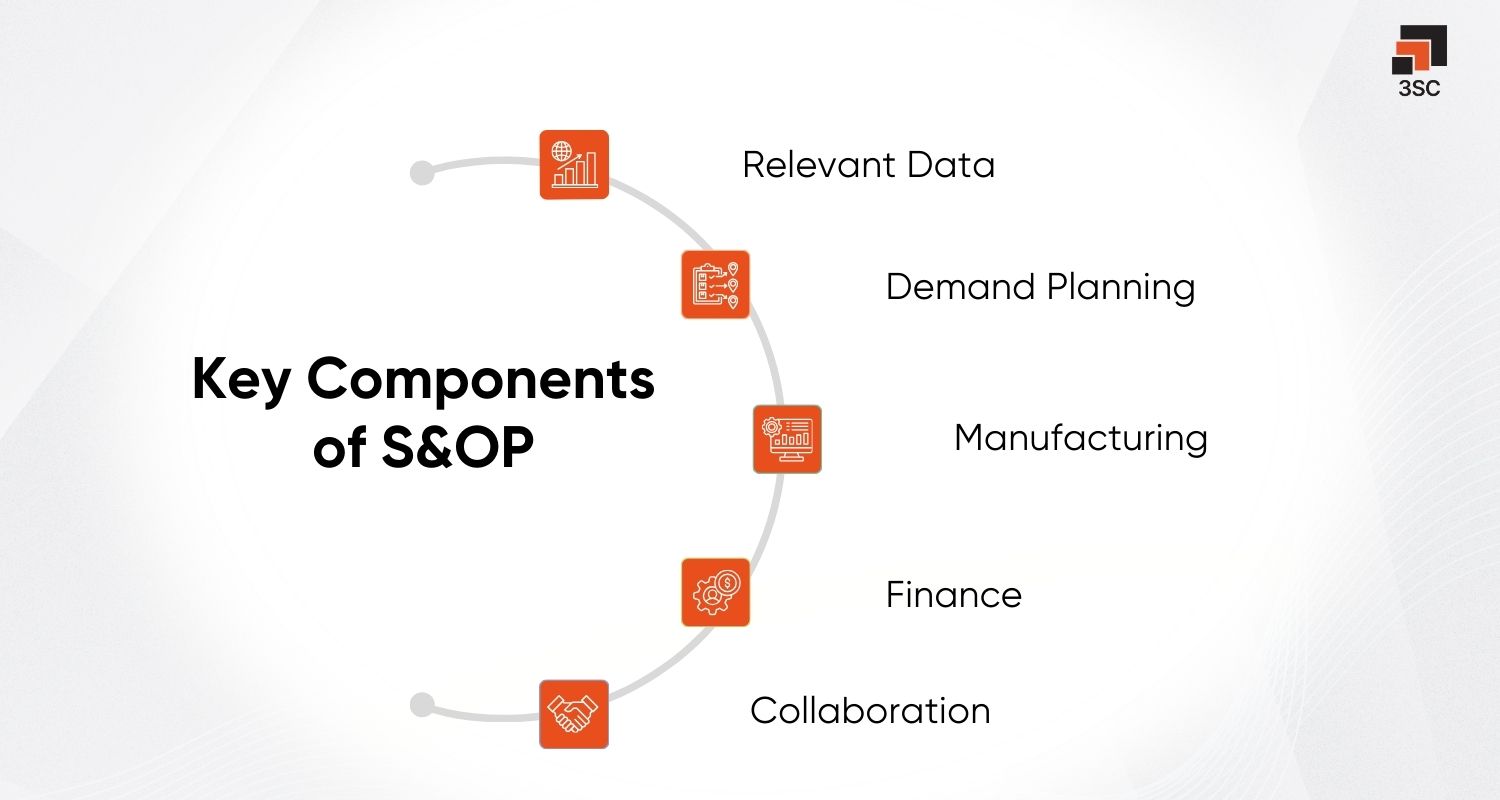
1. Relevant Data
One essential task of S&OP workflow is defining the actual demand that charts the production plans ahead. For sales and operation planning software to do its job, its first requirement is access to valid data from the organization. To gauge the upcoming industry trends and which product the customers will have their affiliation with, relevant information gathering is the foundation step.
2. Demand Planning
With data sorted out, the next step is planning for eventual demand for the upcoming timeline. Based on a company’s capacity, the time window can range from monthly to quarterly to yearly. This informed decision about the actual demand based on historical data reference directly impacts constructive and on-point action plans for manufacturing, inventory, and workforce allocation.
3. Manufacturing
Once the demand parameters are set, manufacturing is the following essential component for S&OP. From informing key stakeholders responsible for procurement and sourcing of raw materials to the workforce playing an indispensable role in production to those actively managing inventory, manufacturing makes for a chunk of the supply equation in the actual value chain function.
4. Finance
Every process is on paper until realized through the financial leg of the organization. From analyzing cost attributed to every supply chain function to actual budget allocation to looking at investment in new technology or skills upgradation of the workforce, every decision contributes to an enterprise's bottom-line revenue goal.
5. Collaboration
Essential for smooth functioning and actual goal realization of every value chain mechanism at work, collaboration, and clear communication amongst the key stakeholders through relevant information sharing allows visibility and better cooperation amongst every supply chain procedure. This collaboration also provides adaptability in processes when required, seeing how the supply chain in the world can be inconsistent owing to external factors.
The End-to-End Sales and Operations Planning (S&OP) Process
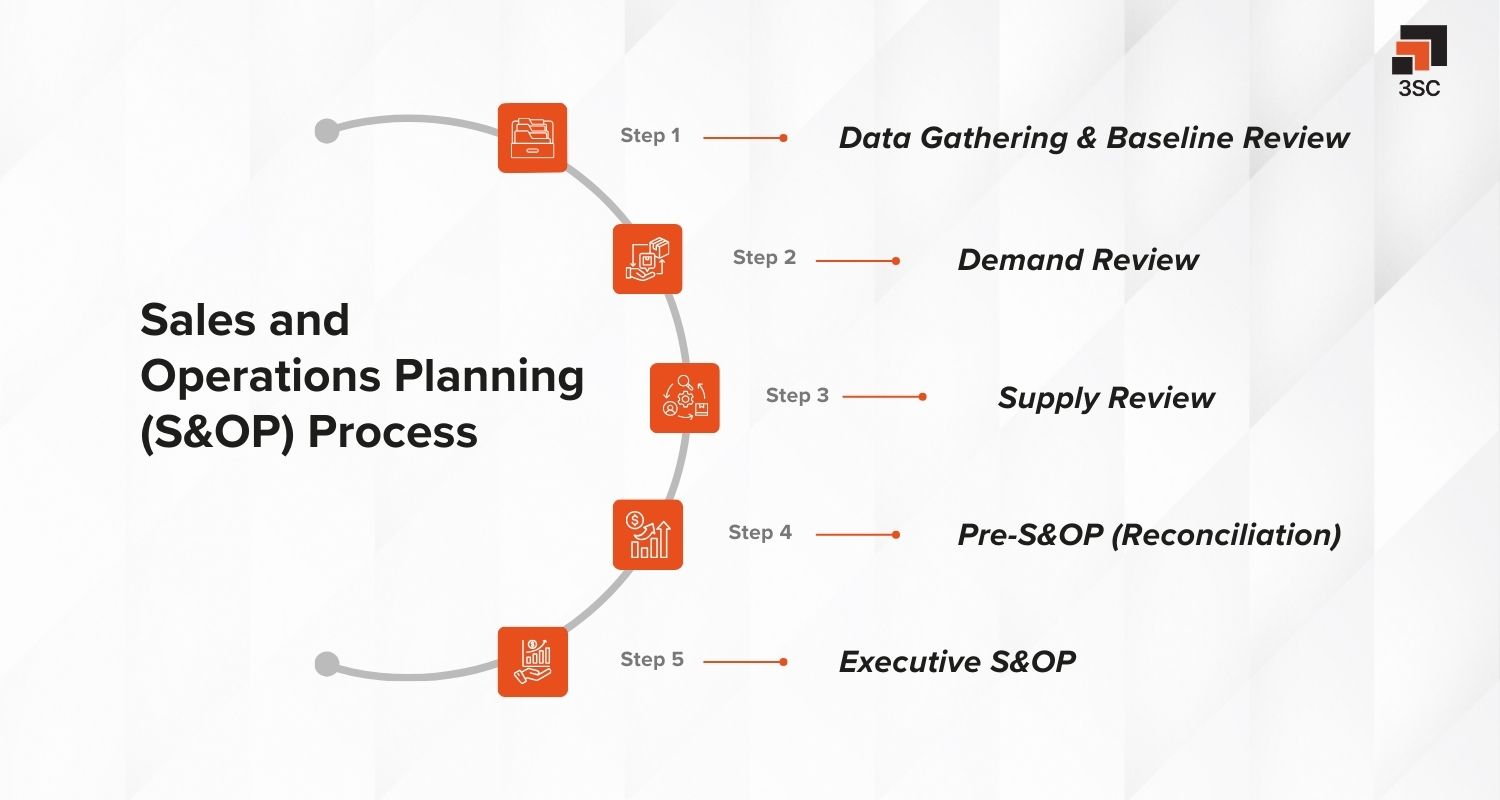
A typical S&OP cycle moves through a series of structured steps that transform data and forecasts into an aligned, executable operating plan.
Then it flows naturally into:
Step 1: Data Gathering & Baseline Review
Teams consolidate the latest historical demand signals, current inventory positions (including what’s in transit or blocked), and real capacity availability across plants, lines, warehouses, and logistics.
The purpose is to remove noise caused by inconsistent data and master-data errors, so the cycle begins with one credible baseline that highlights what changed since the last cycle and where exceptions already exist.
Step 2: Demand Review
The organization builds a single demand view that supply can reliably plan against. The statistical forecast is updated, then refined using sales intelligence, customer commitments, market shifts, promotions, and new product effects.
Demand planners challenge bias, validate spikes and drop, and ensure assumptions are explicitly documented. The output is not just a number, it’s a demand plan that commercial teams stand behind, with clear visibility of risks and the drivers behind the forecast.
Step 3: Supply Review
This step translates demand into a realistic supply response by testing feasibility across materials, capacity, and network constraints. Operations and supply chain teams convert the demand plan into production schedules, procurement requirements, and distribution plans, while identifying bottlenecks like line capacity limits, supplier shortfalls, long lead-time items, or warehouse and transport constraints.
The result is a feasible supply plan plus a transparent list of where demand cannot be met as planned and what operational levers exist to close the gaps.
Step 4: Pre-S&OP (Reconciliation)
Pre-S&OP is where alignment becomes decision-ready by reconciling demand and supply into structured trade-off options. Demand-supply gaps are quantified in terms of service impact, inventory exposure, and operational consequences such as overtime, expediting, or increased changeovers.
Teams build scenarios, typically balancing service, cost, and stability, so leadership is presented with clear choices rather than unresolved conflicts. This step produces a recommended plan, escalation items, and the actions required depending on which option is approved.
Step 5: Executive S&OP
This final stage converts analysis into commitment by securing leadership approval on one operating plan. Executives review key constraints, service risks, customer priorities, and the actions needed to execute the plan, then make the required trade-off decisions, such as allocation rules, supply rebalancing, or demand shaping changes like promo timing adjustments. The outcome is a single committed plan with clear ownership, time-bound actions, and defined triggers for mid-cycle refreshes when reality changes.
Sales and Operations Planning (S&OP) Framework: Governance Over Process
A well-designed process alone does not guarantee alignment. Many organizations run structured S&OP cycles, yet decisions stall, ownership blurs, and trade-offs remain unresolved. In fact, surveys show that while roughly 70% of global manufacturers have implemented an S&OP process, many still struggle to translate the process into effective cross-functional decision-making.
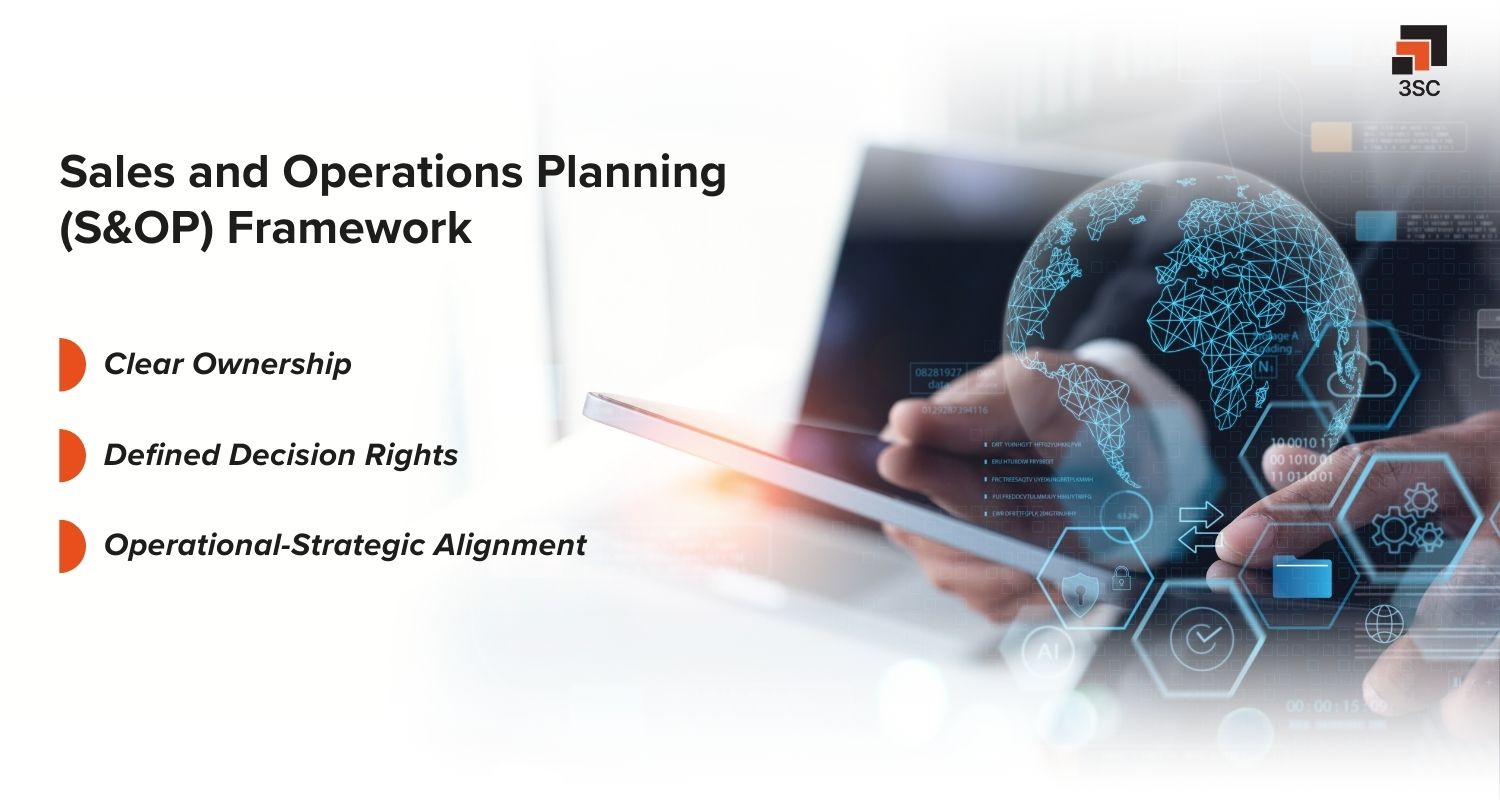
The difference between a procedural S&OP and a high impact one lies in governance. Governance ensures that every number presented leads to accountability, every gap leads to a decision, and every decision has a clear owner.
1. Clear Ownership
S&OP must define who owns what, not just operationally, but behaviorally. Demand ownership typically sits with Sales or Commercial teams, who are accountable for forecast quality and bias. Supply ownership sits with Operations and Supply Chain, responsible for feasibility and service delivery.
At the leadership level, an executive sponsor anchors the process, ensuring cross-functional alignment and resolving escalations. Without explicit ownership, S&OP meetings become discussions rather than commitments.
2. Defined Decision Rights
A mature framework clarifies decision authority before conflicts arise. When capacity is constrained, who decides which customers are prioritized? If supply cannot meet demand, who approves backlog or allocation rules? If overtime or alternate sourcing is required, who authorizes it? Clear decision rights prevent last-minute escalations and reduce cycle delays. The goal is not consensus on everything; it is clarity on who makes the call when trade-offs are unavoidable.
3. Operational-Strategic Alignment
Even when finance is not structurally embedded, operational decisions must still reflect broader business priorities. Volume plans should align with growth priorities, service expectations, and stability targets. If S&OP focuses only on balancing units without considering strategic direction, it risks optimizing locally while missing enterprise intent. Governance ensures that operational plans reinforce, rather than contradict, leadership objectives.
Without governance, S&OP remains a scheduling exercise. With governance, it becomes a structured decision system that aligns demand, supply, and enterprise priorities into one committed plan.
Core Sales and Operations Planning (S&OP) KPIs
In a mature S&OP environment, KPIs are not designed to reward individual functions, they are designed to expose alignment gaps. The purpose of measurement is not to track activity, but to highlight where demand and supply are drifting apart, where execution is deviating from plan, and where trade-offs must be made.
In 2026, effective S&OP metrics focus on stability, predictability, and responsiveness across the entire planning cycle.
1. Demand & Forecast KPIs
Demand metrics evaluate the reliability and discipline of the forward plan. Forecast Accuracy measures how closely projections match actual demand, while Forecast Bias reveals systematic over- or under-forecasting that can distort capacity and inventory decisions. The Demand Volatility Index helps quantify how unpredictable the demand environment is, allowing teams to distinguish between planning errors and genuine market shifts. Together, these metrics determine whether supply is planning against a stable signal or a moving target.
2. Supply & Service KPIs
Supply metrics assess how effectively the organization converts plans into execution.
- OTIF (On-Time-In-Full) measures service reliability against customer commitments.
- Capacity Utilization indicates whether assets are optimally loaded or dangerously stretched.
- Inventory Turns reflect how efficiently stock is being deployed across the network, while Stockout Rate exposes service gaps at the SKU-location level.
These KPIs collectively show whether the supply plan is realistic, resilient, and aligned to demand commitments.
3. Process KPIs
The strength of S&OP also lies in how well the process itself performs. Plan Adherence measures how closely execution follows the agreed plan.
Decision Cycle Time reflects how quickly the organization can move from identifying a gap to committing to a solution.
Scenario Response Time evaluates agility, how rapidly teams can model and evaluate alternatives when disruption occurs.
These indicators reveal whether S&OP is functioning as a disciplined decision system or merely a reporting routine.
Ultimately, the goal is not to track more metrics. It is to track the right ones, those that surface misalignment early, clarify trade-offs, and drive better enterprise decisions.
Real-World Use Cases: How Sales and Operations Planning (S&OP) Drives Measurable Impact
S&OP proves its value not in meetings, but in moments of constraint, growth, and disruption. Below are practical scenarios where a structured S&OP process transforms uncertainty into disciplined decision-making.
1. Managing Capacity Constraints
A manufacturing organization operating near peak capacity begins experiencing service volatility and margin pressure. Instead of reacting with across-the-board expediting, the S&OP process introduces structured scenario evaluation to bring discipline to capacity allocation.
By modelling demand prioritization options, leadership can:
- Protect high-margin SKUs
- Defer or smooth lower-margin demand
- Re-sequence production to reduce changeovers
- Allocate constrained capacity to strategic customers
The result is improved service stability and stronger margin control because capacity is deployed intentionally rather than reactively. The conversation shifts from “How do we produce more?” to “What should we produce first?”, turning constraint management into a strategic prioritization decision.
2. Launching New Products
For consumer brands, new product launches often create hidden instability: forecast optimism, cannibalization of existing SKUs, promotional spikes, and supply strain.
Through S&OP, organizations were able to:
- Model cannibalization impact on existing portfolios
- Align production ramps with promotional calendars
- Stress-test supplier readiness and lead times
- Adjust inventory positioning pre-launch
Instead of launch-driven stockouts followed by excess inventory, companies achieved smoother introductions, higher first-fill rates, and reduced post-launch corrections. The S&OP process created visibility into the operational implications of commercial ambition before execution began.
3. Managing Supply Disruptions
In periods of supplier instability, whether due to raw material shortages, geopolitical disruptions, or logistics delays, S&OP acts as a structured response mechanism.
Organizations leveraged the process to:
- Evaluate alternate sourcing options
- Reposition safety stock buffers across the network
- Implement allocation rules to protect strategic accounts
- Adjust production sequencing to manage constrained materials
Rather than firefighting daily shortages, leadership reviewed quantified scenarios and selected the least disruptive option. Service levels for priority customers were protected, while inventory and operational costs were contained.
What are the Challenges of Sales and Operations Planning (S&OP)?
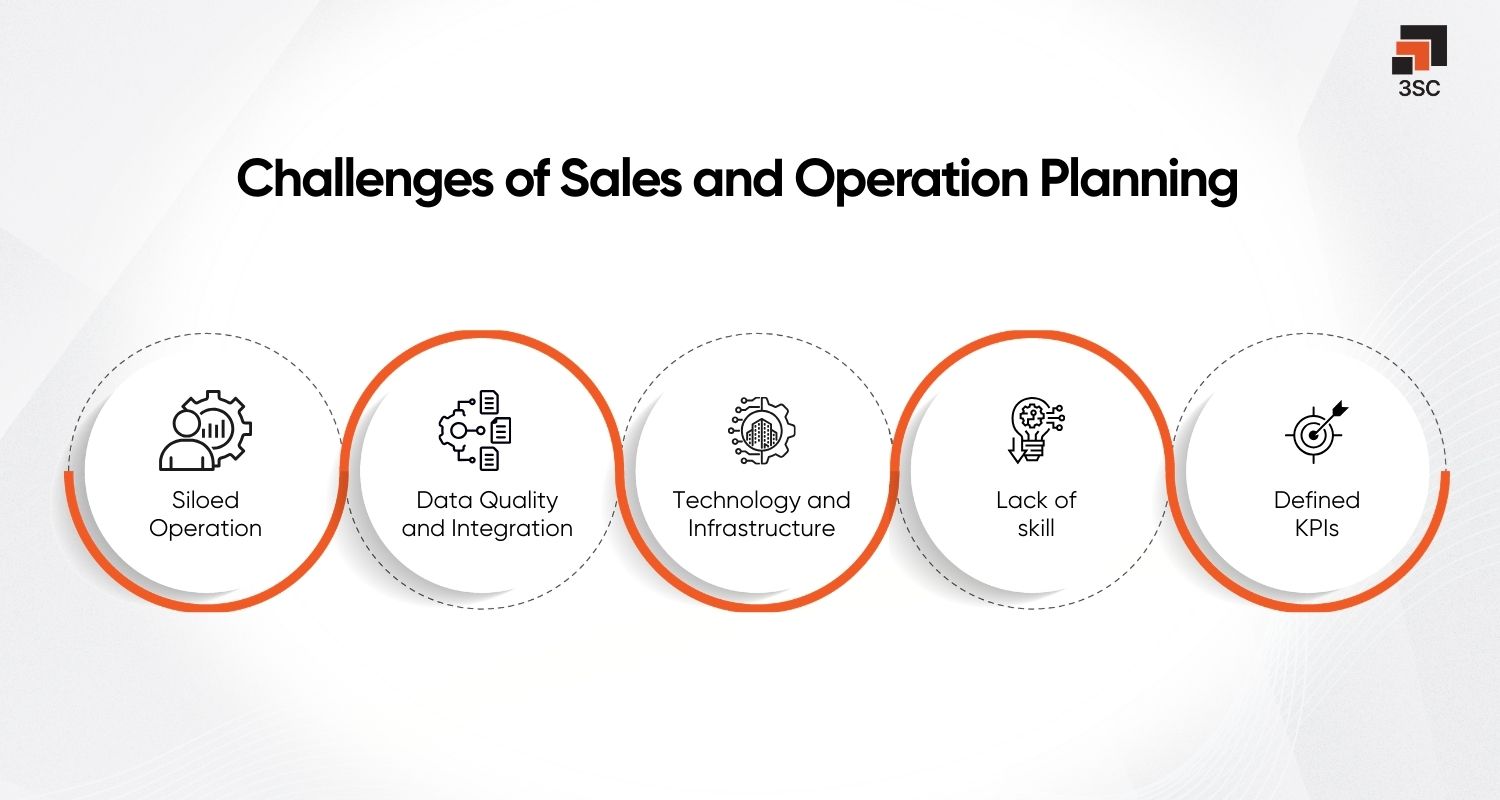
Any platform can face application interruptions due to internal and external factors. If left unaddressed, these hindrances can lead to underperforming functions across the value chain. Here's a snippet of some prominent challenges.
1. Siloed Operations
Many departments have different perspectives toward a common goal. This may sometimes lead to conflicting action plans with a siloed approach. This can be a crucial blow to a leadership's overall goals for the company. With each department working in exclusivity, the results will more or less be mediocre.
2. Data Quality and Integration
For any platform, the quality of data fed to it directly impacts the output it will generate. One of the critical challenges for a good S&OP software is its necessity to work on vetted data. If the data is quantified, then integration of the sales and operation is looked after and is hoped to work seamlessly across functionalities of the enterprise.
3. Technology and Infrastructure
The maximum impact for any organization is driven by the technological framework it works on. From its easy integration to its scalability virtues, the relevancy of the technology can easily decide the prospect it can maximize in its due course. Also contributing to efficiency is an enterprise's current infrastructure. For an S&OP platform to work seamlessly, it needs reliable and efficient tools covering essential value chain elements.
4. Lack of Skill
Sometimes, the stakeholders using the application need to upgrade their tech expertise to harbor the platform's full potential. Organizations can conduct special sessions to ensure that their investment sees fruitful results.
5. Defined KPIs
To measure the accurate impact of a Sales and Operation Platform, companies must set measurable KPIs in accordance with their need and objectives. These indicators must be set in consensus with every department to guarantee the effectiveness of the S&OP process.
Best Practices for Sales and Operations Planning (S&OP) in 2026
As supply chain complexity increases, S&OP must evolve from coordination to capability. The following best practices define high-performing planning organizations in 2026.
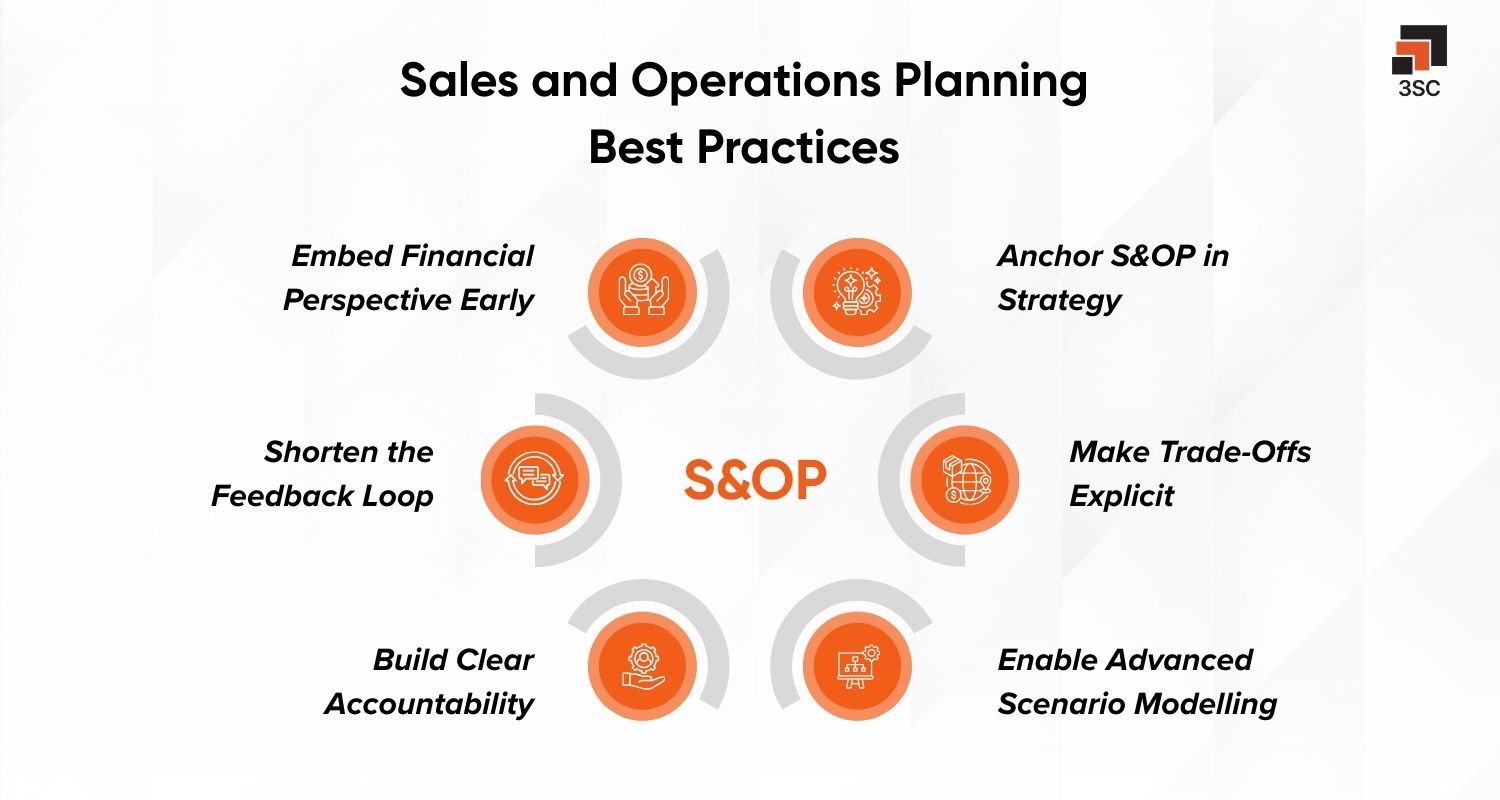
1. Anchor S&OP in Strategy
S&OP cannot exist in isolation from business priorities. Growth markets, strategic customers, innovation focus areas, and service positioning must directly shape planning decisions.
If the strategy emphasizes premium service, inventory buffers and capacity protection must reflect that. If margin expansion is the goal, SKU prioritization and allocation rules must reinforce it. Without strategic anchoring, S&OP risks optimizing operational efficiency while missing enterprise direction.
2. Make Trade-Offs Explicit
Every demand increase carries consequences:
- Capacity load changes
- Inventory investment requirements
- Service risk shifts
High-maturity S&OP processes quantify these impacts before leadership decisions are made. Rather than debating in abstract terms, scenarios clearly outline operational effort and performance implications. Transparency reduces political tension and accelerates executive alignment.
3. Build Clear Accountability
Ownership drives discipline. Forecast accuracy must be owned by Commercial leadership, not solely by demand planners. Supply feasibility and execution adherence must sit with Operations. Shared metrics reinforce collaboration, but accountability must remain clear.
When ownership is ambiguous, bias increases and corrective actions weaken. Strong governance converts metrics into behavioral change.
4. Shorten the Feedback Loop
The traditional monthly S&OP cadence is evolving. Leading organizations are introducing:
- Rolling S&OP cycles with mid-cycle refreshes
- Weekly demand sensing reviews
- Automated exception alerts for constraints
Agility is no longer optional. The ability to adjust between cycles, without destabilizing the entire plan, is becoming a structural requirement.
5. Embed Financial Perspective Early
Although S&OP focuses on balancing demand and supply, operational decisions directly impact margin, inventory, and cash flow. Involving finance early during reconciliation ensures that volume-driven plans remain commercially sound.
This is also where organizations begin evolving toward Integrated Business Planning (IBP), where financial alignment is fully embedded into planning. Early financial visibility prevents profitability erosion and reduces downstream plan corrections.
Sales and Operations Planning (S&OP) Trends in 2026 and Beyond
As volatility becomes structural rather than episodic, S&OP is evolving beyond its traditional monthly cadence and operational focus. The next phase of maturity is defined by speed, intelligence, and enterprise integration.
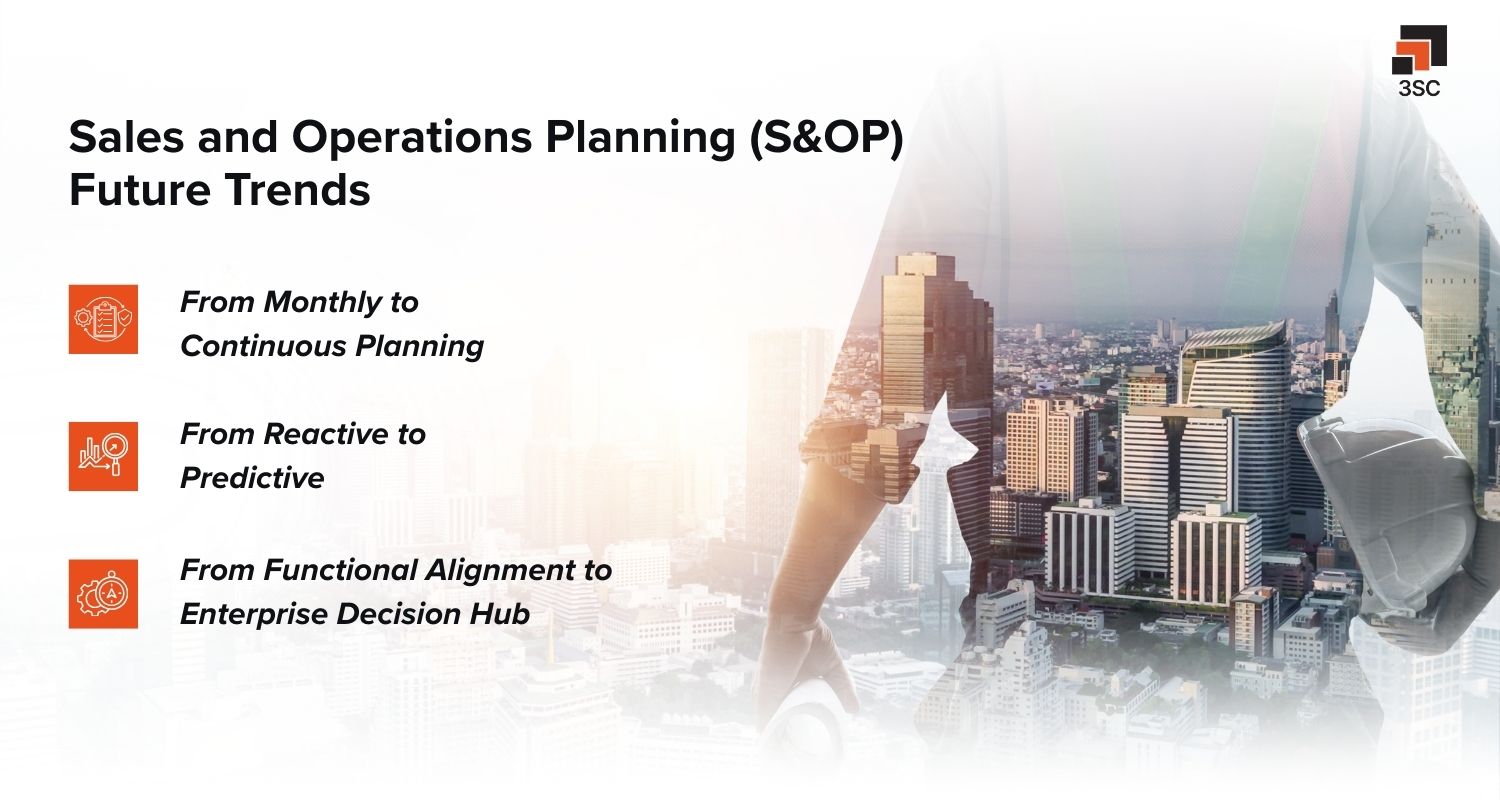
1. From Monthly to Continuous Planning
The classic monthly S&OP cycle is no longer sufficient in environments where demand signals, supply constraints, and customer priorities shift weekly. Leading organizations are moving toward continuous planning models, where event-driven updates complement formal review cycles. The result is greater responsiveness without destabilizing the broader operating plan.
2. From Reactive to Predictive
Modern S&OP is increasingly powered by predictive analytics and AI-driven demand sensing. Rather than reacting to missed forecasts or supply failures after they occur, advanced planning systems flag potential risks before they materially impact service levels. Early warning indicators, volatility patterns, supplier performance signals, lead-time shifts, allow organizations to simulate alternatives proactively. This shifts S&OP from problem resolution to risk anticipation.
3. From Functional Alignment to Enterprise Decision Hub
Historically, S&OP aligned Sales and Operations. In 2026 and beyond, it is becoming an enterprise decision platform that connects:
- Commercial growth priorities
- Supply resilience strategies
- Sustainability and ESG targets
- Capital allocation and investment planning
As organizations mature toward Integrated Business Planning (IBP), S&OP serves as the operational core that feeds broader strategic alignment. It ensures that growth ambition, risk management, and resource allocation are synchronized through one disciplined planning mechanism.
The future of S&OP is not about refining spreadsheets or extending meetings. It is about building a faster, insight-driven decision system capable of aligning demand, supply, and enterprise priorities under persistent volatility.
Conclusion
Sales and Operations Planning (S&OP) is no longer a monthly coordination forum; it is the decision discipline that determines how effectively an organization performs under volatility. When structured with clear governance, accountability, and scenario capability, S&OP converts uncertainty into aligned execution and deliberate trade-offs.
In practice, S&OP becomes the discipline that anchors supply chain planning, ensuring that demand, supply, and operational decisions move in one coordinated direction rather than fragmented responses across functions.
As supply chains become more dynamic and interconnected, S&OP will continue to evolve toward continuous planning, predictive insight, and tighter integration with enterprise strategy. The competitive edge will belong to organizations that embed it as a core decision system, not just a reporting process.
Ultimately, the future of S&OP is less about balancing numbers and more about enabling faster, aligned, and confident decisions across the enterprise.