Key Takeaways
- Scenario planning prepares supply chains for multiple possible futures.
- Scenario modelling simulates outcomes using data and analytics.
- Together, they improve decision-making and risk preparedness.
- Scenario-driven planning strengthens supply chain resilience.
- Advanced tools enable faster and more accurate scenario testing.
- Organizations gain agility by combining strategic foresight with modelling.
Supply chains today operate in an environment where uncertainty is no longer the exception. Over the past few years, disruptions ranging from geopolitical tensions and climate-related events to supplier failures and sudden demand fluctuations have repeatedly challenged traditional planning models. For supply chain leaders, relying on a single forecast is no longer sufficient.
The shift toward more advanced planning is accelerating. According to Gartner, 70% of large organizations are expected to adopt AI-based supply chain forecasting by 2030, reflecting a broader move toward data-driven and scenario-based decision-making.
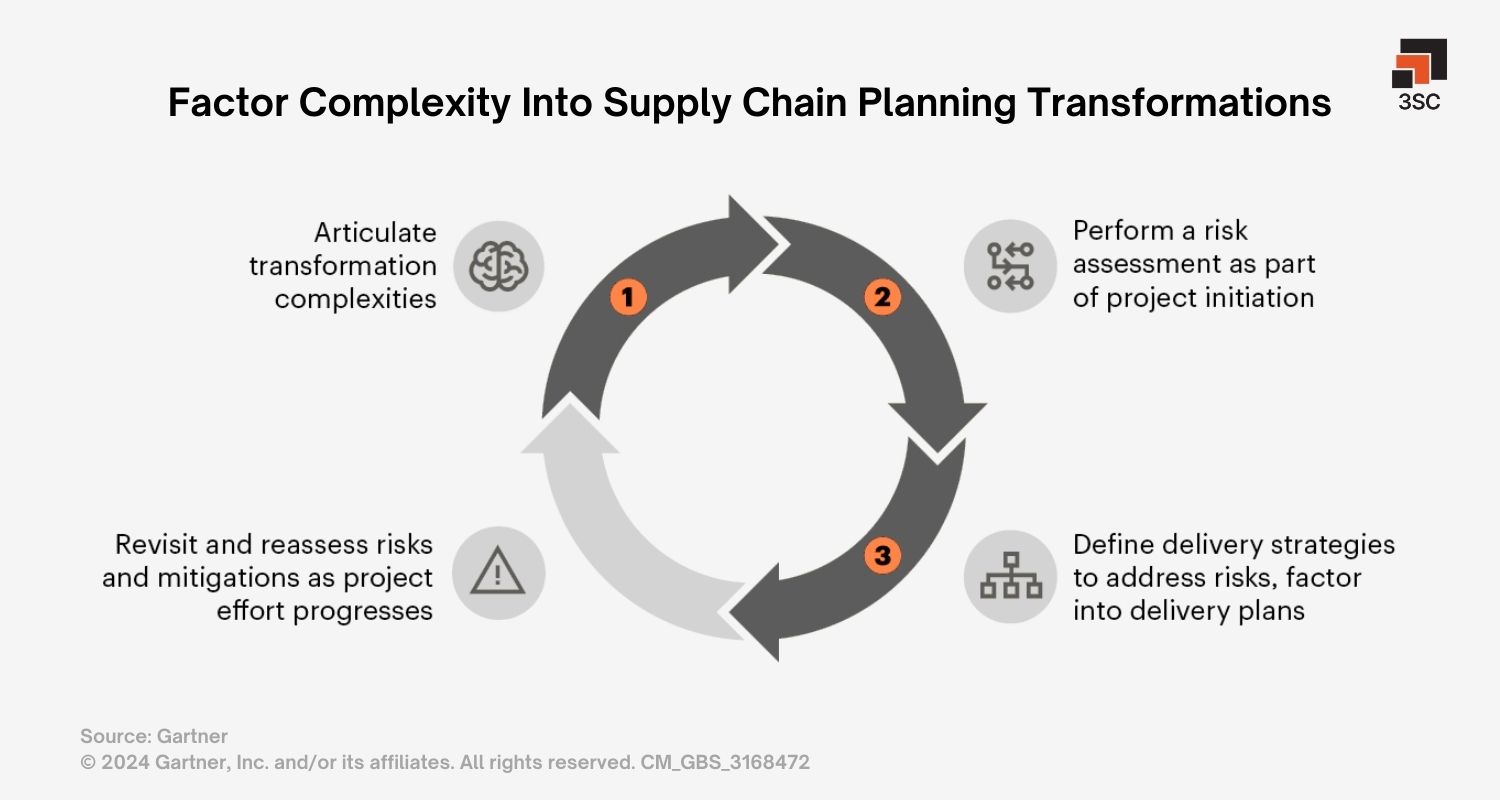
In 2026, planning has evolved into a discipline focused on preparing for multiple possible futures rather than predicting one outcome. Organizations are increasingly adopting structured approaches that allow them to anticipate disruptions, test strategic decisions, and understand how different actions may affect performance.
Two approaches often discussed in this context are scenario planning and scenario modelling. Although they are closely related, they serve different purposes in the decision-making process. Understanding how these two capabilities differ, and how they complement each other, helps supply chain leaders build more resilient and responsive operations.
Before comparing them directly, it is important to understand each concept individually.
What is Scenario Planning in Supply Chains?
Scenario planning is a strategic practice that helps organizations prepare for potential future events by imagining multiple possible outcomes and defining how the business should respond to each one. Instead of relying on a single forecast, companies explore different “what-if” situations that could affect their supply chains.
These scenarios may involve supply disruptions, sudden demand spikes, transportation delays, regulatory changes, or market shifts. By examining these possibilities in advance, supply chain teams can design contingency strategies that reduce risk and improve response speed.
For example, a manufacturer might consider scenarios where a key supplier experiences delays, demand exceeds expectations during a seasonal surge, or trade policies alter logistics routes. Each situation requires a different operational response, and scenario planning allows teams to prepare those responses before the disruption occurs.
Another advantage of scenario planning is that it encourages organizations to think beyond immediate operational challenges. By exploring multiple future environments, companies can identify strategic opportunities such as entering new markets, expanding production capacity, or adjusting sourcing strategies.
In essence, scenario planning strengthens supply chain resilience by shifting organizations from reactive responses to proactive preparation. However, once potential futures are identified, businesses must still determine how those scenarios would affect operations. This is where scenario modelling becomes essential.
What is Scenario Modelling?
Scenario modelling focuses on quantifying the impact of potential scenarios through data-driven simulations. While scenario planning imagines possible futures, scenario modelling evaluates how those futures would affect the supply chain in measurable terms.
Using analytical tools, algorithms, and digital supply chain models, organizations can simulate different operational conditions and analyse how changes in demand, supply constraints, transportation routes, or capacity availability would influence performance.
For example, a company facing potential tariff increases on imported materials may model different sourcing strategies to understand their effect on margins, production timelines, and customer deliveries. Similarly, organizations may simulate disruptions such as plant shutdowns or supplier failures to evaluate alternative sourcing or distribution strategies.
Modern supply chain platforms make this process significantly more powerful by creating digital representations of supply networks, often referred to as digital twins. These virtual environments allow planners to test multiple decisions simultaneously without affecting real operations.
Through scenario modelling, leaders can compare outcomes such as cost implications, service levels, and operational constraints. This analytical approach allows companies to choose the most effective course of action based on data rather than intuition.
Although scenario planning and scenario modelling are closely connected, they serve different roles within the broader planning process. Their differences become clearer when examined side by side.
Scenario Planning vs Scenario Modelling - An Overview
Aspect | Scenario Planning | Scenario Modelling |
Primary Objective | Explore multiple possible futures and prepare strategic responses. | Simulate and analyse the operational and financial impact of specific scenarios. |
Approach | Strategic and exploratory, often involving qualitative thinking and cross-functional discussions. | Quantitative and analytical, relying on data, algorithms, and simulations. |
Focus | Identifying risks, disruptions, and opportunities that could affect the supply chain. | Evaluating how supply chain performance changes under different conditions. |
Time Horizon | Often long-term or strategic, supporting business planning and risk preparation. | Often short to medium term, supporting tactical and operational decisions. |
Decision Type | Helps organizations prepare strategies for uncertain future environments. | Helps organizations choose the most optimal action by comparing simulated outcomes. |
Tools Used | Strategic workshops, planning frameworks, and collaborative discussions. | Advanced analytics platforms, optimization tools, and digital supply chain twins. |
Output | A set of possible future scenarios and response strategies. | Data-driven insights such as cost projections, service impacts, and operational feasibility. |
Understanding these differences helps organizations recognize that the two approaches are not alternatives but complementary capabilities. When used together, they form a powerful decision framework for navigating uncertainty.
Why Modern Supply Chains Need Both
Supply chains today are highly interconnected systems where a single disruption can cascade across sourcing, production, logistics, and customer service. In such environments, relying solely on strategic thinking or purely analytical modelling is not sufficient.
Scenario planning helps organizations identify potential risks and opportunities by exploring different future environments. It provides the strategic context needed to understand what challenges may arise and how the organization should prepare for them.
Scenario modelling, on the other hand, enables teams to test those scenarios through data-driven simulations. By quantifying operational and financial outcomes, companies can compare multiple response strategies and select the most effective option.
Together, these capabilities allow organizations to move from speculation to informed decision-making. Planning defines the possibilities, while modelling validates the feasibility of each response. This combination strengthens resilience, improves agility, and supports more confident leadership decisions.
Real-World Supply Chain Applications for Scenario Planning & Scenario Modelling
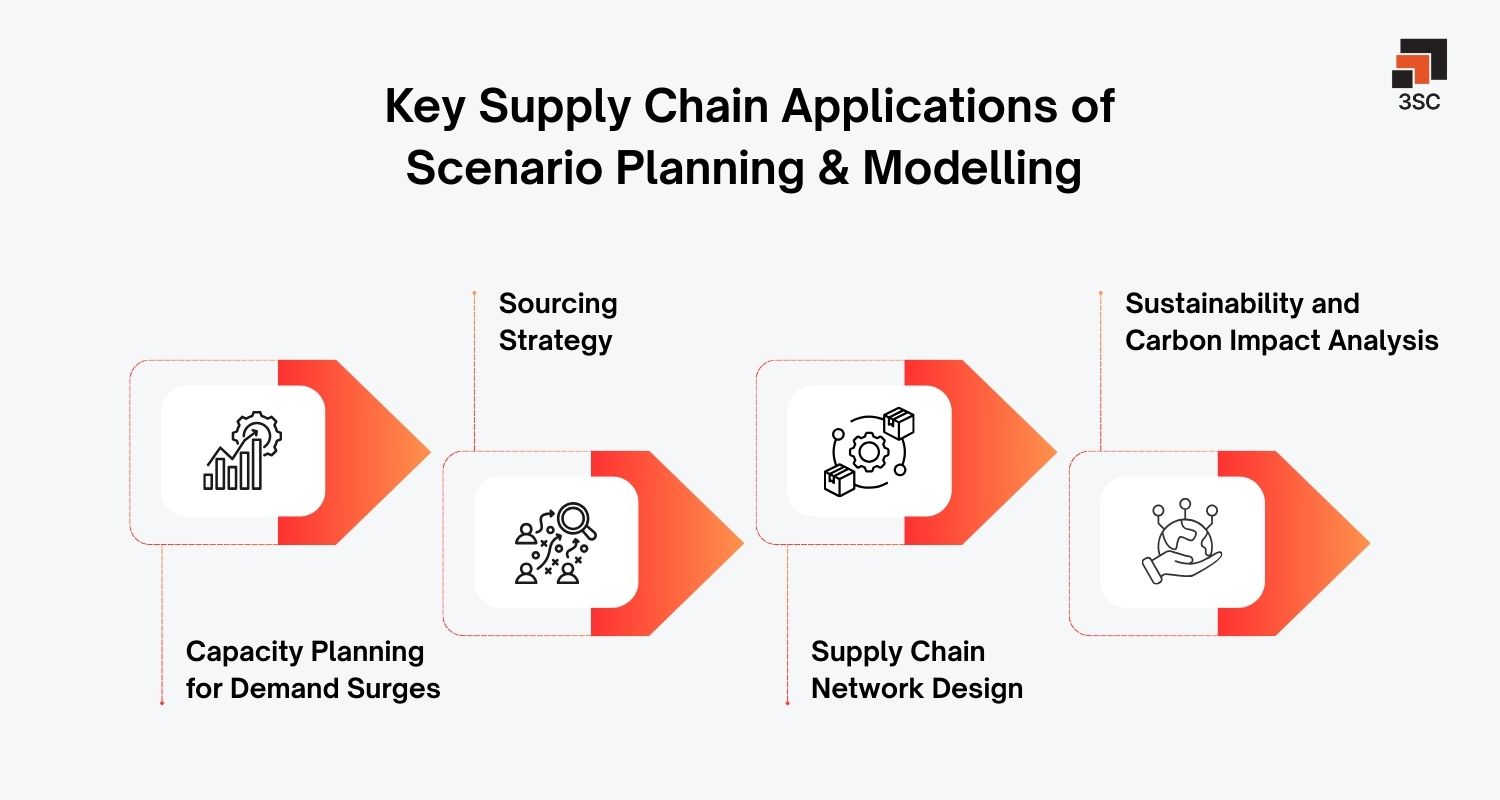
The value of scenario-driven planning becomes particularly clear when organizations apply it to real operational challenges. Some of the most common applications include:
1. Capacity Planning for Demand Surges
Companies simulate higher demand scenarios to determine whether existing production capacity, supplier commitments, and distribution networks can support increased volumes without affecting service levels.
2. Sourcing Strategy
Organizations model alternative suppliers or production locations to evaluate the impact of tariffs, supplier disruptions, or geopolitical changes on costs, lead times, and supply continuity.
3. Supply Chain Network Design
Businesses test structural changes such as closing distribution centres, relocating production facilities, or reshoring manufacturing operations to identify the most efficient and cost-effective network configuration.
4. Sustainability and Carbon Impact Analysis
Companies evaluate sustainability initiatives by modelling the operational and financial impact of reducing carbon emissions across transportation, production, or sourcing decisions.
These applications show how scenario-driven approaches enable organizations to test complex decisions in a simulated environment before implementing them in real operations.
The Role of Technology in Scenario Analysis
Advances in digital technology have significantly expanded the capabilities of scenario-driven planning. Modern supply chain platforms integrate large datasets, advanced algorithms, and simulation tools that allow organizations to evaluate complex scenarios quickly and accurately.
Supply chain digital twins create virtual representations of real supply networks, enabling planners to experiment with different conditions in a controlled environment. These models allow organizations to simulate disruptions, demand changes, and resource constraints without affecting actual operations.
Artificial intelligence and advanced analytics further enhance these capabilities by processing large numbers of variables simultaneously. Instead of manually evaluating trade-offs, planning systems can identify optimal strategies and highlight potential risks within minutes.
These technologies are transforming scenario analysis from a periodic planning exercise into a continuous decision-support capability that supports both strategic and operational decisions.
The Future of Scenario-Driven Supply Chains
As supply chains become more complex and unpredictable, the importance of scenario-driven planning will continue to grow. Organizations are increasingly shifting from static planning cycles toward more dynamic decision frameworks that allow them to respond quickly to evolving conditions.
In the future, scenario analysis will likely become a continuous capability embedded within integrated business planning processes. Supply chain leaders will be able to evaluate multiple scenarios in real time as new information becomes available.
This shift will enable organizations to respond faster to disruptions, allocate resources more effectively, and maintain operational stability even in uncertain environments.
Ultimately, companies that adopt scenario-driven approaches will gain a significant advantage. By preparing for multiple possible futures and testing decisions through advanced modelling, they can navigate uncertainty with greater confidence and agility.
Conclusion
Supply chains today face constant uncertainty, making traditional single-forecast planning approaches increasingly ineffective. Organizations must be prepared to evaluate multiple possibilities and respond quickly when conditions change.
Scenario planning enables businesses to anticipate potential disruptions and define strategic responses before they occur. Scenario modelling strengthens those strategies by evaluating their operational and financial implications through data-driven simulations.
Together, these capabilities provide a powerful framework for navigating uncertainty. Organizations that combine strategic foresight with analytical modelling can make faster, more informed decisions and build supply chains that remain resilient even in volatile environments.