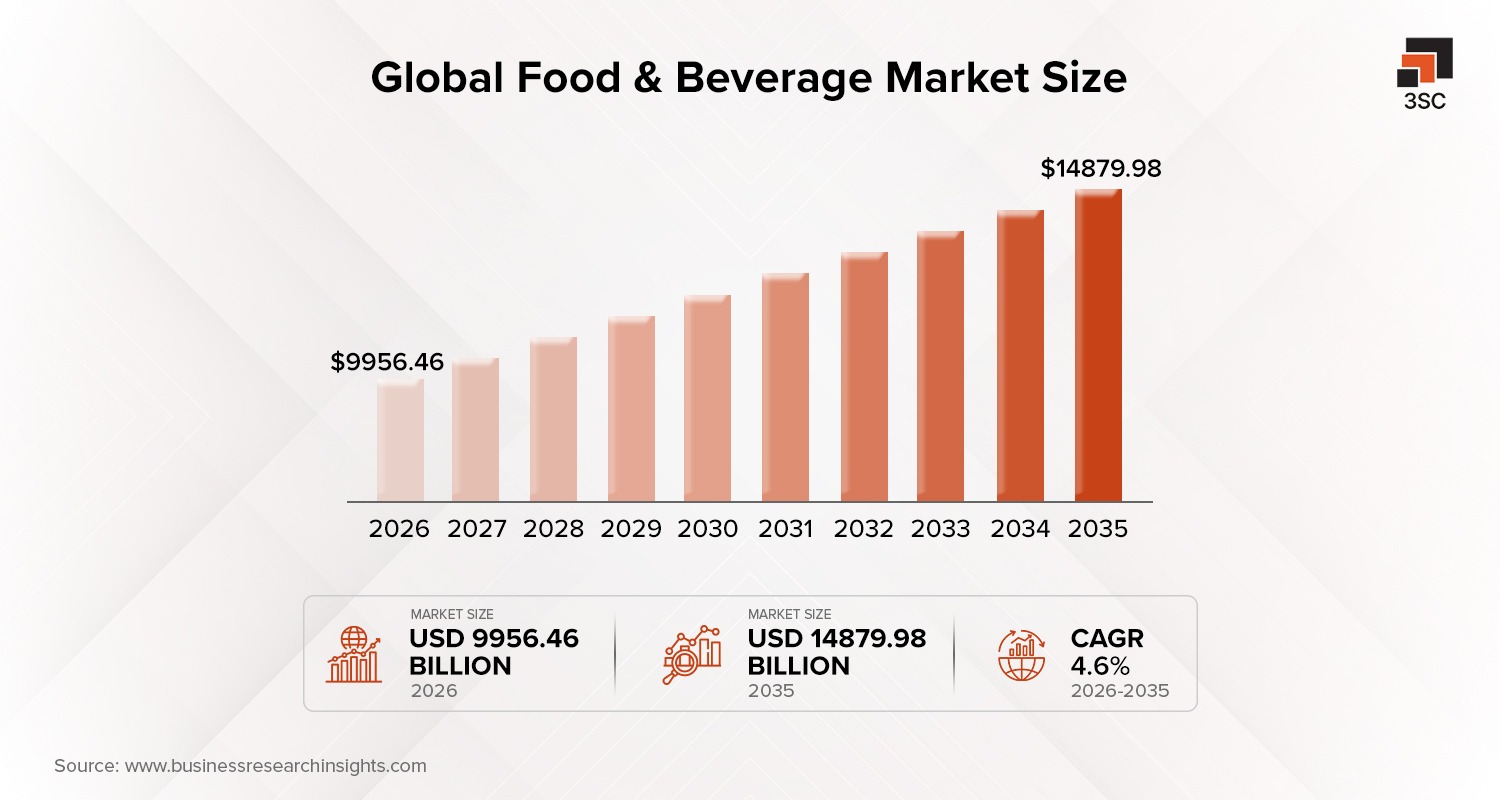
As the global Food & Beverage market expands from USD 9.96 trillion in 2026 to nearly USD 14.88 trillion by 2035, growing at a CAGR of approximately 4.6%, the pressure on supply chains is intensifying. Growth at this scale does not just mean higher volumes, it also means bringing greater complexity, faster demand shifts, tighter margins, and more frequent disruption across sourcing, production, and distribution.
In this environment, traditional operating models struggle to keep pace. Fixed planning cycles, concentrated networks, and manual decision-making are increasingly misaligned with the speed and variability of today’s F&B markets. Maintaining stability while scaling operations has become a critical challenge, not a given outcome.
To operate effectively amid continuous change, F&B companies are rethinking how their supply chains are designed and run. The following trends reflect how leading organizations are building the capabilities needed to absorb disruption, respond faster, and sustain growth as market pressures continue to rise.
Suggested Read - Key Supply Chain Trends in 2026
Top Food & Beverage Supply Chain Trends in 2026
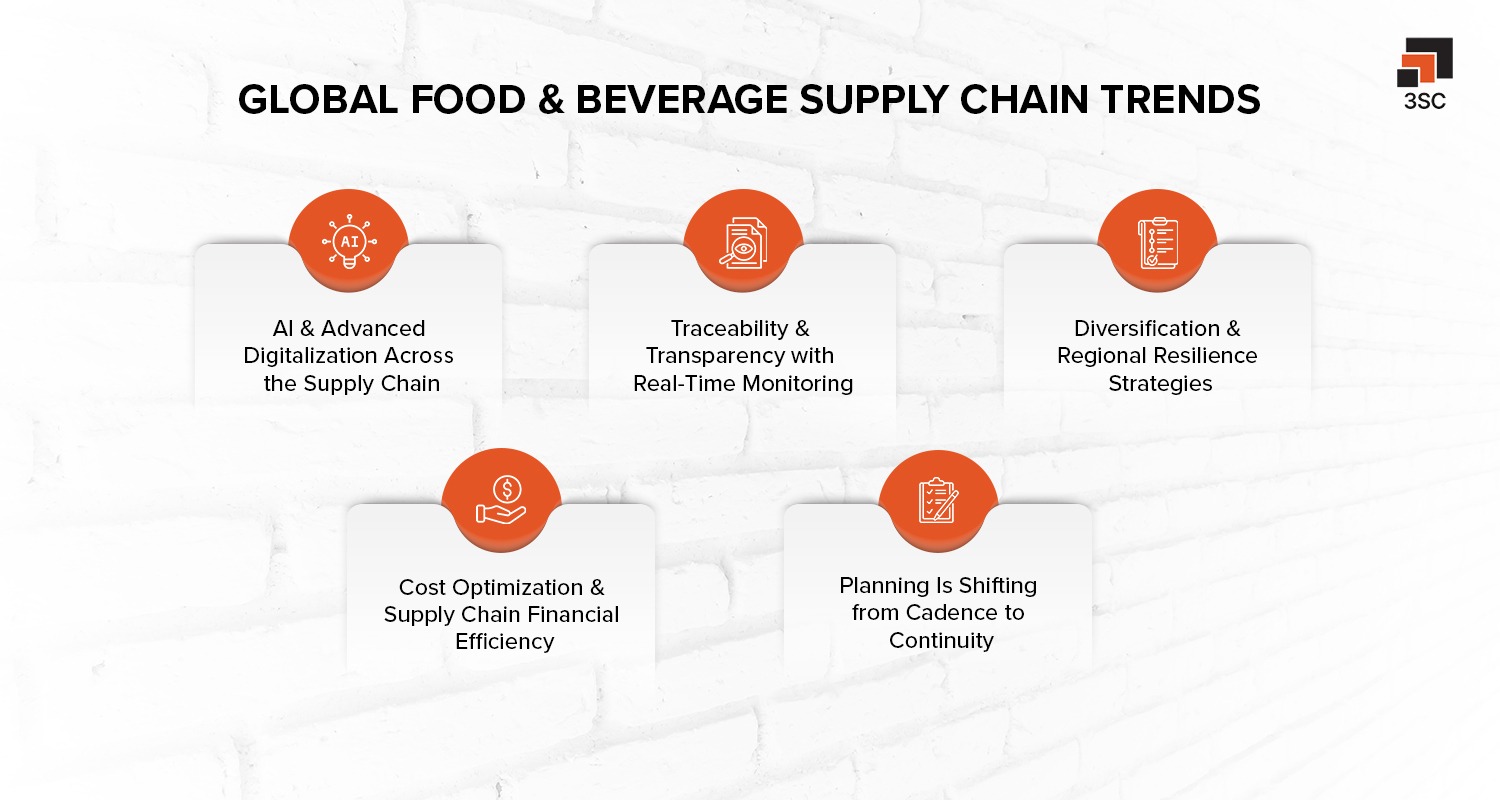
1. AI & Advanced Digitalization Across the Supply Chain
As F&B supply chains face continuous demand volatility and growing operational complexity, traditional planning and execution models have struggled to keep up. Fragmented systems, heavy manual intervention, and delayed insights mean teams often identify issues only after service levels, costs, or inventory positions are already impacted. While data availability has increased, it has not translated into faster or more consistent action, creating a clear need for more adaptive, intelligence-driven supply chain operations.
This gap between insight and execution is what accelerated the shift toward AI and advanced digitalization across the supply chain.
In response, F&B companies are embedding AI-driven analytics and automation across supply chain functions to anticipate disruptions earlier and standardize decision-making. Predictive models surface risks before they escalate, while automated workflows reduce manual effort and improve execution speed and consistency. The focus is moving beyond improving forecast accuracy toward enabling faster, more confident decisions across planning, production, and logistics.
Suggested Read - Key Challenges & Solutions in India’s Food & Beverage Supply Chain
2. Traceability & Transparency with Real-Time Monitoring
Traditional, compliance-driven traceability models began to break down as SKU proliferation, shorter shelf lives, and multi-tier supplier networks increased supply chain complexity. Fragmented systems and delayed, after-the-fact reporting meant teams lacked visibility into issues while they were forming, leading to quality risks, inventory imbalances, and service disruptions being identified only after operations were already impacted.
The lack of real-time action highlighted the need for a different traceability approach, one designed to enable intervention, not just documentation.
To support faster intervention and control, F&B companies are elevating real-time traceability into a core operational capability across their supply chain technology stack. By enabling a continuous, shared view of ingredients, batches, inventory, and movement, organizations can identify deviations early and take immediate corrective action, adjusting production plans, rebalancing inventory, or isolating risk before small issues escalate into larger operational or financial losses.
3. Diversification & Regional Resilience Strategies
Cost- and scale-driven optimization led many F&B companies to concentrate sourcing in a limited number of regions. This structural dependency increased exposure to disruption, with weather events, geopolitical issues, or logistics delays capable of stopping production with little warning. With limited backup options and slow recovery paths, companies recognized that highly centralized sourcing models were no longer resilient enough for today’s disruption-prone environment.
This vulnerability accelerated the shift toward diversification and regionally resilient supply strategies.
In response, F&B companies are redesigning their supply networks to include regional and alternative suppliers. By spreading sourcing across multiple geographies, organizations can shift volumes more quickly when disruptions occur, restore supply faster, and maintain more consistent operations without prolonged service or production impacts.
Suggested Read - Why Scaling F&B Supply Chains Need Better Decisions
4. Cost Optimization & Supply Chain Financial Efficiency
Rising margin pressure in the F&B industry has shown that traditional, periodic cost-cutting programs no longer produce sustainable outcomes. Annual initiatives and broad-based cuts tend to address visible symptoms rather than the root causes of cost leakage, such as excess supply chain complexity, misaligned production, underutilized assets, and slow decision-making. These limitations made it clear that cost management needed to move beyond episodic savings toward a more structural, financially disciplined approach.
The change in mindset has repositioned the supply chain as a driver of financial efficiency, replacing reactive cost reduction. Cost optimization is increasingly being built into day-to-day supply chain decisions across F&B organizations. By rationalizing SKUs, improving logistics and asset utilization, and tightening demand-to-supply alignment, companies are reducing hidden costs and value leakage while strengthening margins, without compromising service levels or operational stability.
5. Planning Is Shifting from Cadence to Continuity
As demand, supply, and operational constraints increasingly change on a daily basis, traditional weekly or monthly planning cycles have struggled to keep pace. Fixed cadences delay visibility into meaningful shifts, causing teams to react only after conditions have already changed. This lag leads to late interventions, increased firefighting, and costly overcorrections, highlighting the limitations of schedule-driven planning in a highly dynamic environment.
These constraints have accelerated the shift away from cadence-based planning toward more continuous, responsive models.
F&B companies are adopting signal-driven planning, where teams reassess plans and act when material changes occur rather than reforecasting on a fixed schedule. This approach improves decision timing, reduces operational disruption, and helps stabilize execution across the supply chain.
Suggested Read - AI-Powered Demand Sensing in F&B
Conclusion
The next phase of growth in Food & Beverage will not be constrained by demand, but by how effectively supply chains perform under continuous change. As complexity increases across sourcing, production, and distribution, the ability to respond quickly, maintain control, and protect margins becomes a core operational requirement rather than a supporting function.
The focus is shifting from static plans and isolated optimizations to operating models that can sense change earlier and adjust with greater consistency across the network.
As scale and volatility continue to rise, competitive advantage will be defined by execution, not intent. Organizations that embed speed, resilience, and financial rigor into everyday supply chain operations will be better equipped to absorb disruption, reduce friction, and sustain performance over time.
Ultimately, supply chains are no longer just enabling growth, they are shaping how reliably, efficiently, and confidently that growth can be achieved.