
Raw material planning helps businesses reduce procurement risk by connecting demand visibility, supplier reliability, inventory control, and market monitoring. The blog explains how companies can protect production continuity, manage cost volatility, and build a more resilient procurement strategy through proactive planning and cross-functional alignment.
Key Takeaways
- Raw material planning helps protect production, cost, and margins.
- Better demand visibility reduces shortages and overbuying.
- Material classification helps prioritize high-risk inputs.
- Supplier collaboration reduces delays and sourcing dependency.
- Selective buffers and market monitoring improve resilience.
Before a finished product reaches a customer, it begins as a set of raw materials that must arrive at the right time, in the right quantity, at the right cost, and from the right supplier.
That sounds straightforward until the market changes. A commodity price moves overnight. A supplier faces capacity pressure. A shipment takes longer than expected. Demand shifts before procurement plans can catch up. Suddenly, the challenge is not just sourcing raw materials, but protecting production continuity, cost stability, and business margins.
According to research, commodity price risk is already among the top global business risks and is expected to become even more critical by 2028. The same research found that 47% of respondents experienced losses due to commodity price risk and material scarcity in the previous 12 months, highlighting the need for stronger raw material planning and procurement visibility.
This is why raw material planning has become a critical supply chain capability. It helps businesses look beyond purchase orders and build a more reliable, responsive, and cost-conscious approach to procurement.
What is Raw Material Planning?
Raw material planning is the process of identifying, forecasting, and managing the materials a business needs to keep production running smoothly. It connects demand forecasts, production schedules, supplier lead times, inventory levels, and procurement decisions so that the right materials are available at the right time, without creating excess stock or unnecessary cost. When managed well, raw material planning becomes more than an operational process. It gives procurement teams the visibility and control needed to anticipate risks, respond to market changes, and make better sourcing decisions. This is where the right strategies become critical.
Raw Material Planning Strategies To Reduce Procurement Risk & Volatility
To manage raw material uncertainty effectively, companies need a planning approach that connects demand visibility, supplier reliability, inventory discipline, and faster decision-making.
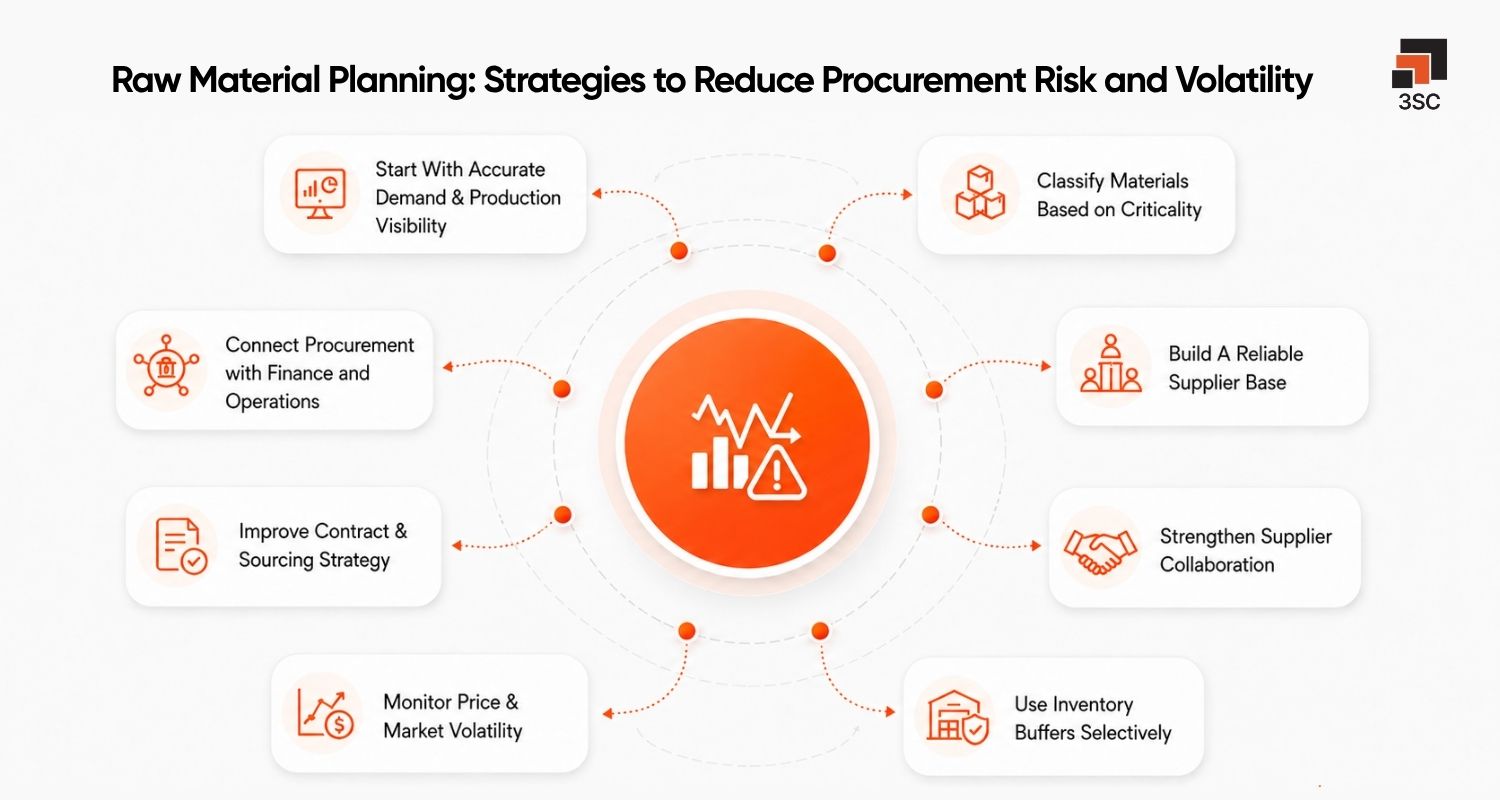
1. Start With Accurate Demand & Production Visibility
Raw material planning begins with understanding future demand. If procurement teams are working with outdated forecasts or disconnected production plans, they may either overbuy materials or face shortages when demand rises.
Demand planning, production scheduling, and procurement should work from the same planning assumptions. This helps teams identify material requirements early, align purchase timelines with manufacturing needs, and reduce last-minute buying decisions.
2. Classify Materials Based on Criticality
Not every raw material needs the same level of attention. Some materials may be easy to source, while others may have limited suppliers, long lead times, high price volatility, or direct impact on production continuity.
Businesses should classify raw materials based on risk, cost, availability, supplier dependency, and business impact. Critical materials should receive stronger planning controls, closer supplier monitoring, and backup sourcing options.
3. Build A Reliable Supplier Base
Supplier reliability plays a major role in raw material planning. Depending too heavily on one supplier or one region can expose the business to delays, shortages, and price pressure.
Companies should evaluate suppliers based on quality, delivery performance, financial stability, capacity, compliance, and responsiveness. For critical materials, it is important to develop alternate suppliers and avoid single-source dependency wherever possible.
4. Strengthen Supplier Collaboration
Raw material procurement becomes more effective when suppliers are treated as planning partners, not just vendors. Sharing demand forecasts, production plans, expected volume changes, and delivery priorities can help suppliers prepare better.
Regular supplier communication also helps companies identify early warning signs, such as capacity constraints, shipment delays, input shortages, or cost changes. This gives procurement teams more time to act instead of reacting after the risk becomes urgent.
5. Use Inventory Buffers Selectively
Inventory can protect businesses from supply disruption but holding too much stock increases working capital pressure. The answer is not to increase inventory everywhere, but to use buffers intelligently.
Critical, high-risk, or long-lead-time materials may need safety stock. Stable and easily available materials can be managed with leaner inventory levels. This balance helps companies protect production without creating unnecessary cost.
6. Monitor Price & Market Volatility
Raw material prices can change due to commodity cycles, energy costs, freight rates, currency movement, geopolitical disruption, or demand shifts. Procurement teams need regular visibility into these market signals.
By tracking price trends and supply conditions, businesses can make better decisions on contract timing, bulk purchases, supplier negotiations, and cost pass-through planning. This helps reduce margin pressure during volatile periods.
7. Improve Contract & Sourcing Strategy
Contracts should do more than define price and delivery terms. They should help reduce uncertainty. Businesses can use long-term agreements, flexible volume clauses, indexed pricing, supplier performance terms, and risk-sharing mechanisms to improve stability.
For volatile materials, sourcing strategy should also include alternate geographies, approved substitute materials, and backup suppliers. This gives teams more room to respond when disruption occurs.
8. Connect Procurement with Finance and Operations
Raw material decisions affect cost, production, inventory, cash flow, and service levels. If procurement works separately from finance and operations, decisions can become slow or misaligned.
An integrated planning process allows teams to evaluate trade-offs clearly. For example, should the business buy early to avoid a price increase? Should it hold extra inventory for a critical material? Should production be adjusted due to supplier delays? These decisions need cross-functional alignment.
Conclusion
Raw material planning is no longer a back-end procurement activity. It is a core part of business resilience. Companies that plan materials only through purchase orders and historical consumption will struggle when markets shift quickly.
To reduce procurement risk and volatility, businesses need better demand visibility, material segmentation, supplier collaboration, selective inventory buffers, market monitoring, and stronger cross-functional planning. When these elements work together, raw material planning becomes more proactive, more resilient, and more aligned with business performance.