
Key Takeaways
- Supplier risk management helps businesses identify, assess, and act on supplier risks before they disrupt operations.
- A strong SRM program starts with supplier segmentation, because not every supplier carries the same business impact.
- Centralized data, supplier portals, scorecards, alerts, and ERP integrations make supplier risk easier to monitor at scale.
- Effective mitigation requires a mix of diversification, due diligence, stronger contracts, inventory buffers, and supplier collaboration.
- The most resilient supply chains are not risk-free; they are risk-aware, prepared, and able to respond before issues escalate.
Supplier risk often builds long before it becomes visible as a disruption. It may begin with something that seems routine: a delayed shipment, a missed quality check, an expired compliance certificate, or a supplier that stops responding on time. On their own, these signals can look like operational noise. But when the supplier is tied to a critical material, a regulated product, or a key customer commitment, small warning signs can quickly escalate into a business continuity issue.
This is why supplier risk management has become a strategic priority across procurement, supply chain, quality, and operations. It gives organizations a clearer view of where risk may emerge, how severe the impact could be, and most importantly, what actions need to be taken before disruption reaches the customer.
What is Supplier Risk Management?
Supplier risk management is the structured process of identifying, assessing, monitoring, and mitigating risks across a supplier network. These risks span financial instability, operational delays, quality failures, compliance gaps, cybersecurity vulnerabilities, geopolitical events, ESG shortfalls, and concentration exposure.
In practical terms, it answers three questions:
Which suppliers are critical?
What could go wrong?
How prepared are we to respond?
It's not a procurement-only exercise. A single supplier failure can cascade across production, inventory, customer service, compliance, cost, and brand reputation, which is why effective programs involve finance, legal, quality, IT security, operations, and sustainability alongside procurement. The goal isn't eliminating every risk. In today's complex supply chains, that's not realistic. The goal is making risk visible, measurable, and manageable so the business acts early rather than reacts under pressure.
Why Supplier Risk Management Matters for Business Continuity?
Modern businesses depend on suppliers for far more than raw materials - ingredients, components, packaging, logistics, technology, contract manufacturing, data services, and specialized expertise. This makes supplier performance directly connected to business performance.
According to the BCI Supply Chain Resilience Report, 43.6% of organizations experienced supply chain disruption due to third-party failures, making supplier risk one of the single largest sources of operational exposure a business faces. When a critical supplier fails, procurement scrambles for emergency sources, operations absorb production delays, and customer-facing teams manage broken commitments. The downstream ripple is faster and wider than most organizations anticipate until they experience it.
Supplier risk management reduces this exposure by creating a more disciplined approach to supplier selection, monitoring, and response planning, supporting stronger continuity, better quality control, improved compliance, and greater visibility across the supplier base.
The Supplier Risk Management Process: From Visibility to Action
A strong program begins with segmentation because not every supplier carries the same risk and not every supplier needs the same scrutiny.
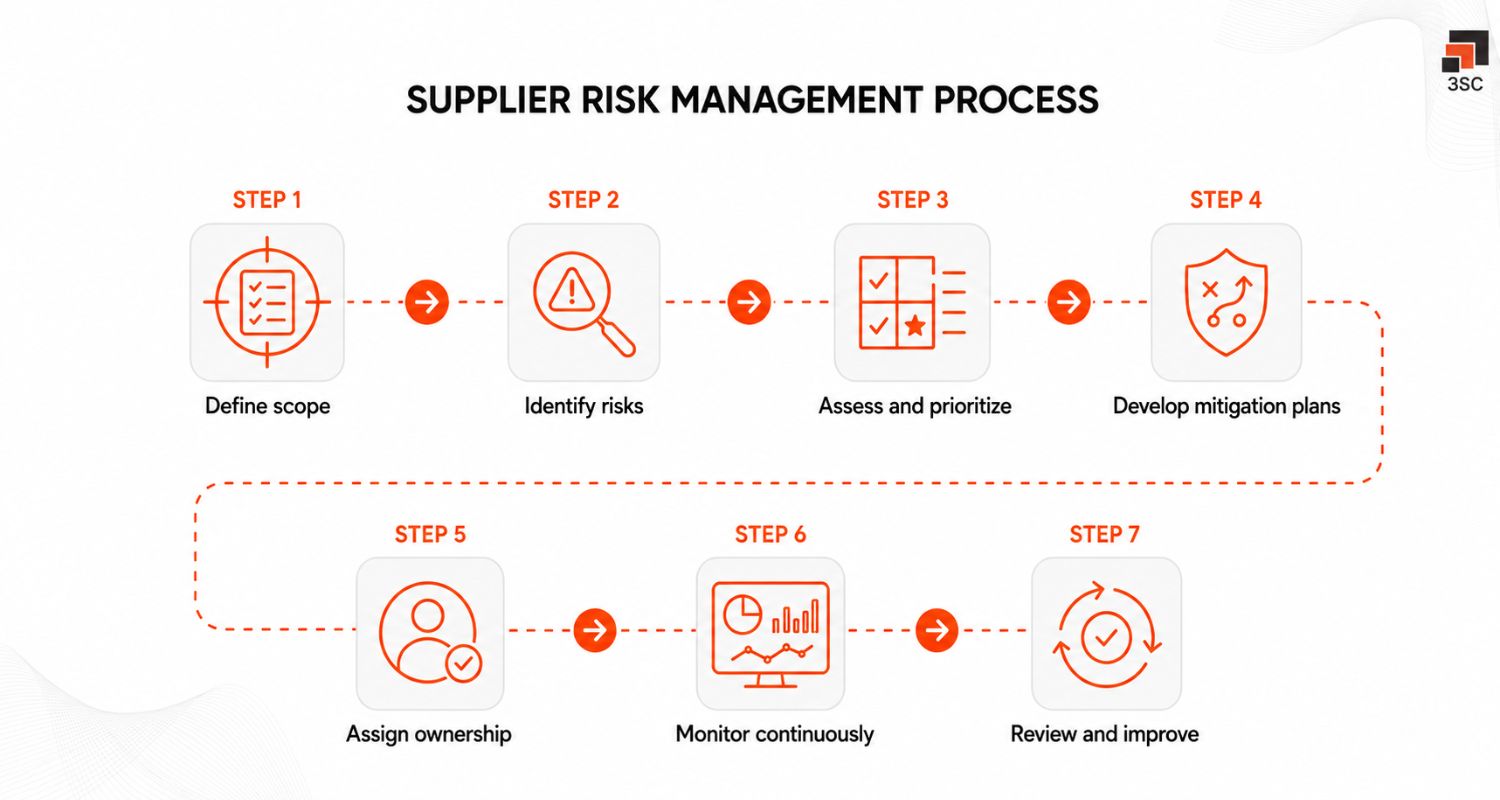
The core supplier risk management process follows a consistent arc:
- Define scope - Identify which suppliers, categories, and regions warrant attention based on criticality, dependency, regulatory exposure, and availability of alternatives.
- Identify risks - Pull from questionnaires, certifications, audits, financial data, performance history, compliance records, third-party intelligence, and internal stakeholder input.
- Assess and prioritize - Use scorecards and risk matrices to evaluate likelihood, impact, and urgency. Segment suppliers into low, medium, and high risk.
- Develop mitigation plans - Match actions to risk type: alternate sourcing, contract updates, corrective action plans, inventory buffers, closer monitoring.
- Assign ownership - Every risk response needs a named owner, a timeline, and a follow-up mechanism. Without accountability, mitigation plans stay theoretical.
- Monitor continuously - Track performance and external signals over time. Risk profiles should be reviewed regularly, not only at onboarding.
- Review and improve - Use audit findings, KPI trends, and disruption learnings to sharpen the process over time.
This turns supplier risk management from a reactive exercise into a repeatable business discipline.
Related read - What is the Supply Chain Risk Management Process?
What are the Tools that Enable Scale in Supplier Risk Management?
As supplier networks grow, manual tracking spreadsheets, email chains, disconnected folders create blind spots. Critical certifications lapse, reviews get missed, and risk data fragments across teams.
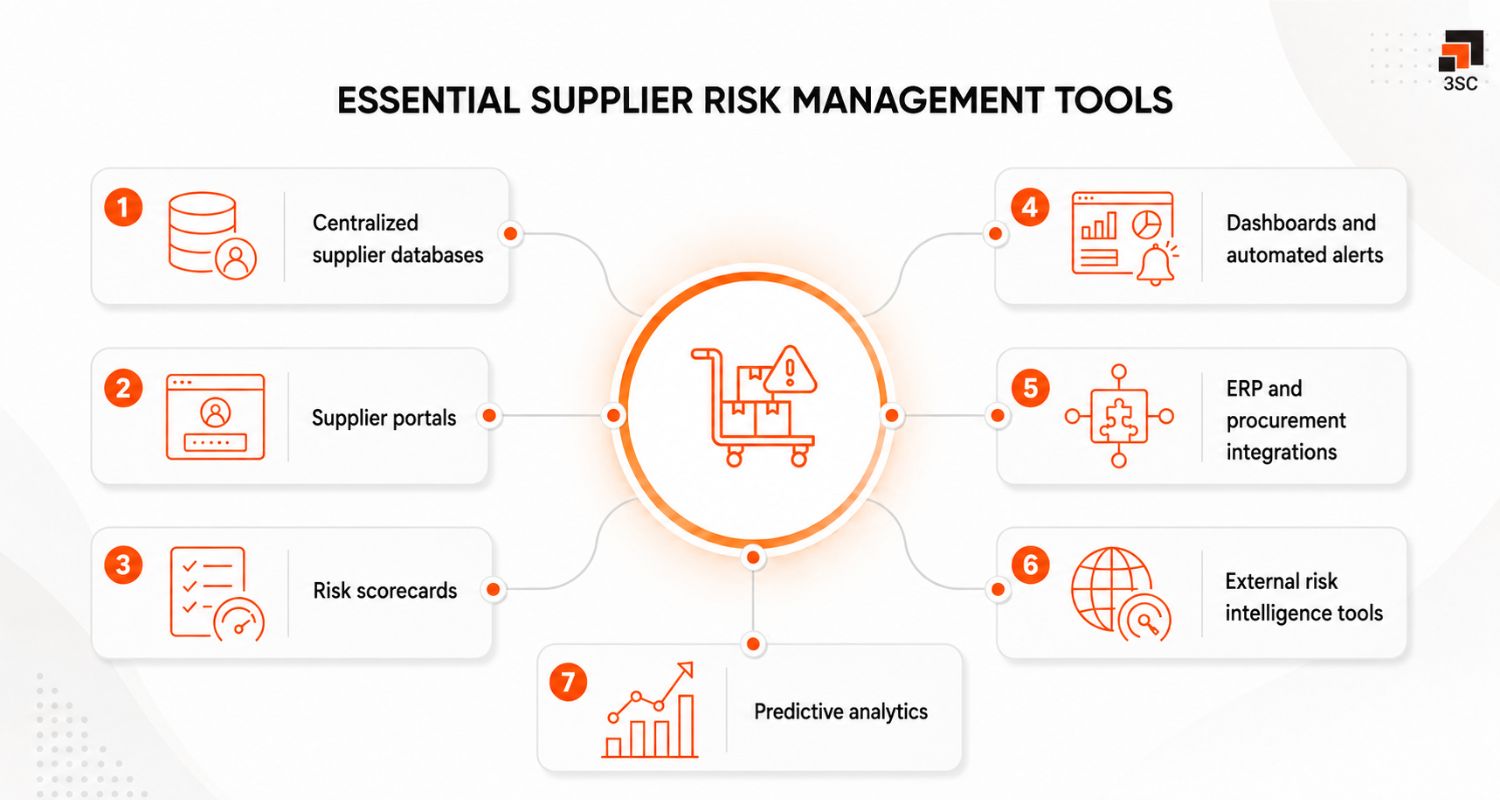
The right toolset changes this:
- Centralized supplier databases consolidate profiles, contracts, certifications, risk scores, audits, and corrective actions in one place
- Supplier portals collect documents, questionnaires, and audit responses through a controlled, auditable channel
- Risk scorecards enable consistent evaluation across financial, operational, quality, compliance, ESG, cybersecurity, and geopolitical dimensions
- Dashboards and automated alerts flag expiring certifications, overdue reviews, late deliveries, and unresolved corrective actions
- ERP and procurement integrations connect supplier approval status with purchasing, receiving, and quality controls in real time
- External risk intelligence tools monitor financial health, geopolitical shifts, regulatory changes, and ESG developments across the supplier base
- Predictive analytics surface early warning patterns from performance data and historical disruption trends, enabling action before failure, not after
The value of these tools isn't report generation. It's giving teams enough lead time to act before a supplier issue becomes operationally expensive.
What are the Strategies that work for Supplier Risk Management?
No single strategy eliminates supplier risk.
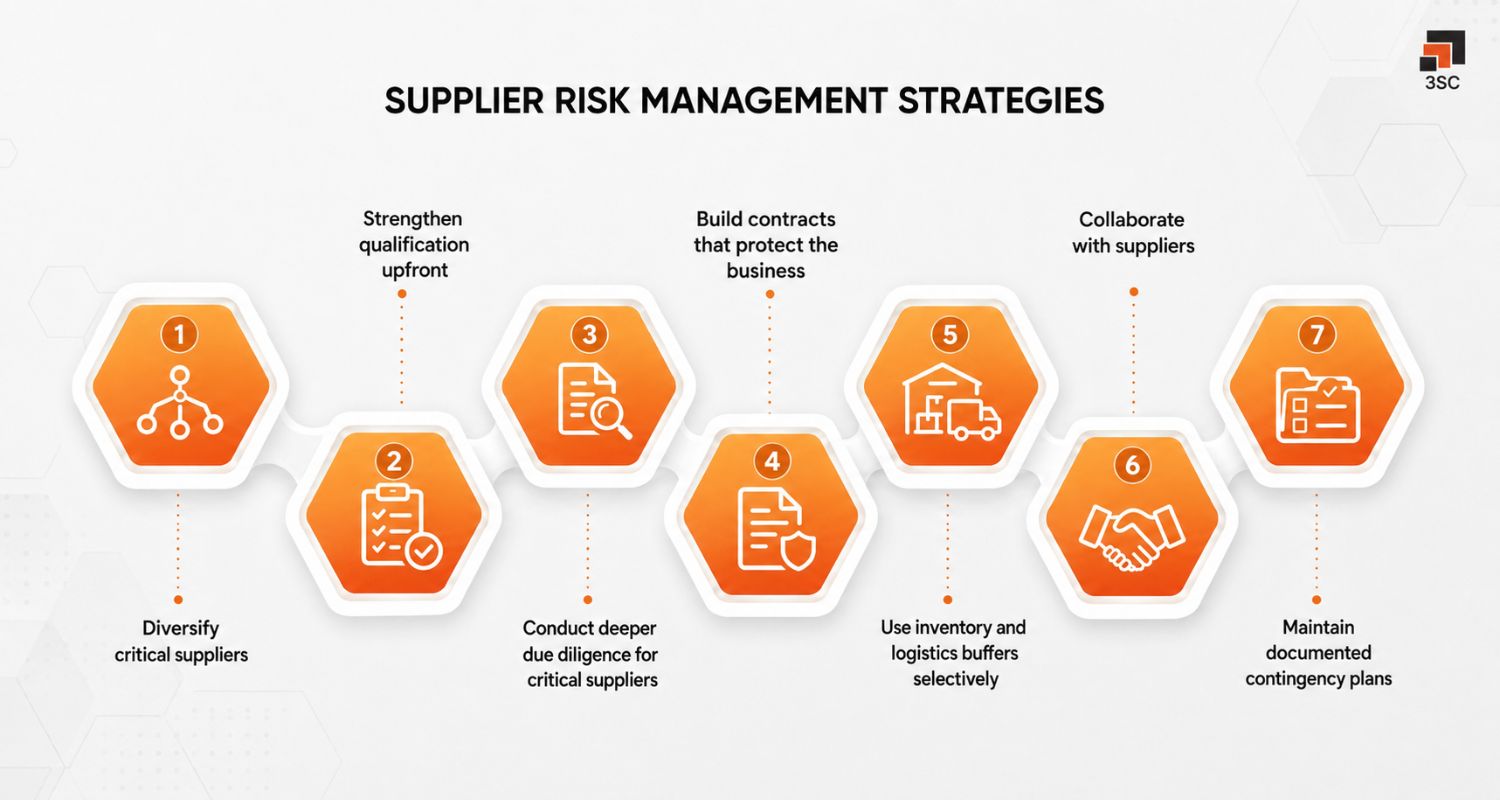
The most resilient programs combine prevention, control, and collaboration:
- Diversify critical suppliers - Dual or multi-source strategies for critical inputs reduce dependency and improve flexibility. Nearshoring and regional sourcing also reduce geopolitical and logistics concentration.
- Strengthen qualification upfront - Risk management should begin before a supplier is approved. Onboarding reviews should cover financial stability, certifications, compliance status, quality systems, cybersecurity controls, and ESG standards.
- Conduct deeper due diligence for critical suppliers - Basic documentation isn't enough for high-impact suppliers. Site audits, business continuity reviews, reference checks, and sub-tier assessments provide a far clearer picture of actual risk.
- Build contracts that protect the business - Supplier agreements should define quality standards, compliance obligations, audit rights, data security requirements, corrective action timelines, and clear remedies for non-performance.
- Use inventory and logistics buffers selectively - Safety stock and alternate transport routes help absorb short-term disruptions but should be applied deliberately, particularly for high-value or long-lead-time materials.
- Collaborate with suppliers - Regular business reviews, shared improvement plans, and clear escalation paths allow suppliers to surface early warnings before they escalate. Collaborative relationships consistently reduce both the frequency and severity of disruptions.
- Maintain documented contingency plans - High-impact suppliers should have backup sources, recovery steps, communication protocols, and named decision owners; documented and tested before they're needed.
None of these strategies require perfection from day one. The goal is to build consistency over time because a supplier risk program that is reviewed regularly, owned broadly, and acted upon decisively will always outperform one that exists only on paper.
Conclusion
Supplier risk management isn't about assuming suppliers will fail. It's about knowing where the business is exposed and preparing before disruption forces a reaction.
A strong program brings together structured assessments, reliable data, strong contracts, supplier collaboration, continuous monitoring, and clear ownership. In a volatile supply chain environment, that discipline isn't just good practice; it's a genuine competitive advantage. The most resilient supply chains aren't risk-free. They're risk-aware, well-prepared, and ready to act before a supplier issue becomes a business crisis.
Strengthen Supplier Resilience with 3SC
Supplier risk management works best when supplier visibility, risk intelligence, compliance, collaboration, and response planning are connected. 3SC helps businesses identify critical supplier risks earlier, monitor performance more effectively, and act faster before supplier issues disrupt operations, customers, or business continuity.