Key Takeaways
- Cost reduction in 2026 is no longer a narrow procurement exercise; it requires coordinated action across planning, logistics, sourcing, inventory, and network design.
- The strongest savings typically come from structural moves such as better forecasting, smarter inventory policies, transport optimization, and supplier diversification.
- Digital capabilities matter most when they improve day-to-day decisions, such as demand sensing, scenario modelling, warehouse execution, and exception management.
- For supply chain leaders, the priority is to lower cost without weakening resilience, service levels, or future adaptability.
- The most effective programs connect immediate efficiency gains with a longer-term operating model built for volatility, tariffs, labour constraints, and regionalization.
Supply chain cost pressure is no longer limited to freight rates or procurement inflation. It now extends across sourcing, production, inventory, warehousing, logistics, compliance, and customer service.
In a research study, 41% of executives said they would consider major supply chain changes even if tariff-related cost increases stayed below 20%. This shows how quickly cost pressure is influencing strategic supply chain decisions, especially as companies prepare for greater trade, tariff, and network uncertainty.
As organizations plan for 2026 & ahead, the focus shifts from reactive cost-cutting to disciplined cost transformation. Reducing inventory without improving demand planning can weaken service. Negotiating harder with suppliers without improving visibility can increase risk. Cutting transport spend without redesigning network flows can shift costs elsewhere. Sustainable savings come from connecting decisions across planning, procurement, manufacturing, warehousing, logistics, and finance.
For supply chain experts, the opportunity is not simply to spend less. It is to build a leaner, more responsive, and data-led supply chain that protects margins while improving resilience.
What Are Supply Chain Costs?
Supply chain costs are the total expenses involved in sourcing, producing, storing, moving, and delivering goods to customers. They go beyond visible costs such as procurement, warehousing, and freight, and include hidden cost drivers like poor forecasting, excess inventory, supplier delays, manual rework, expedited shipments, returns, and service failures.
Because these costs are interconnected, businesses cannot reduce them effectively by looking at one function in isolation. A forecasting gap can increase inventory, trigger premium freight, disrupt production, and eventually affect service levels. This is why the first step toward supply chain cost reduction is understanding the causes that create avoidable cost across the network.
Common Causes of High Supply Chain Costs
High supply chain costs often come from small problems that build up across different functions. Poor forecasting can lead to excess inventory, stockouts, and urgent shipments. Inaccurate master data can create planning delays, manual rework, and wrong decisions. Supplier delays can force companies to hold extra stock or use expensive last-minute options. Warehouse complexity can increase labour cost, handling time, and errors. Poor transport planning can lead to low vehicle utilization, higher freight cost, and emergency deliveries. Returns and reverse logistics can also add hidden costs that are often missed.
When each function works only on its own targets, the business may reduce cost in one area but increase it somewhere else.
12 Strategic Ways to Reduce Supply Chain Costs in 2026
The following 12 strategies outline how organizations can reduce costs in a way that is measurable, operationally practical, and future ready.
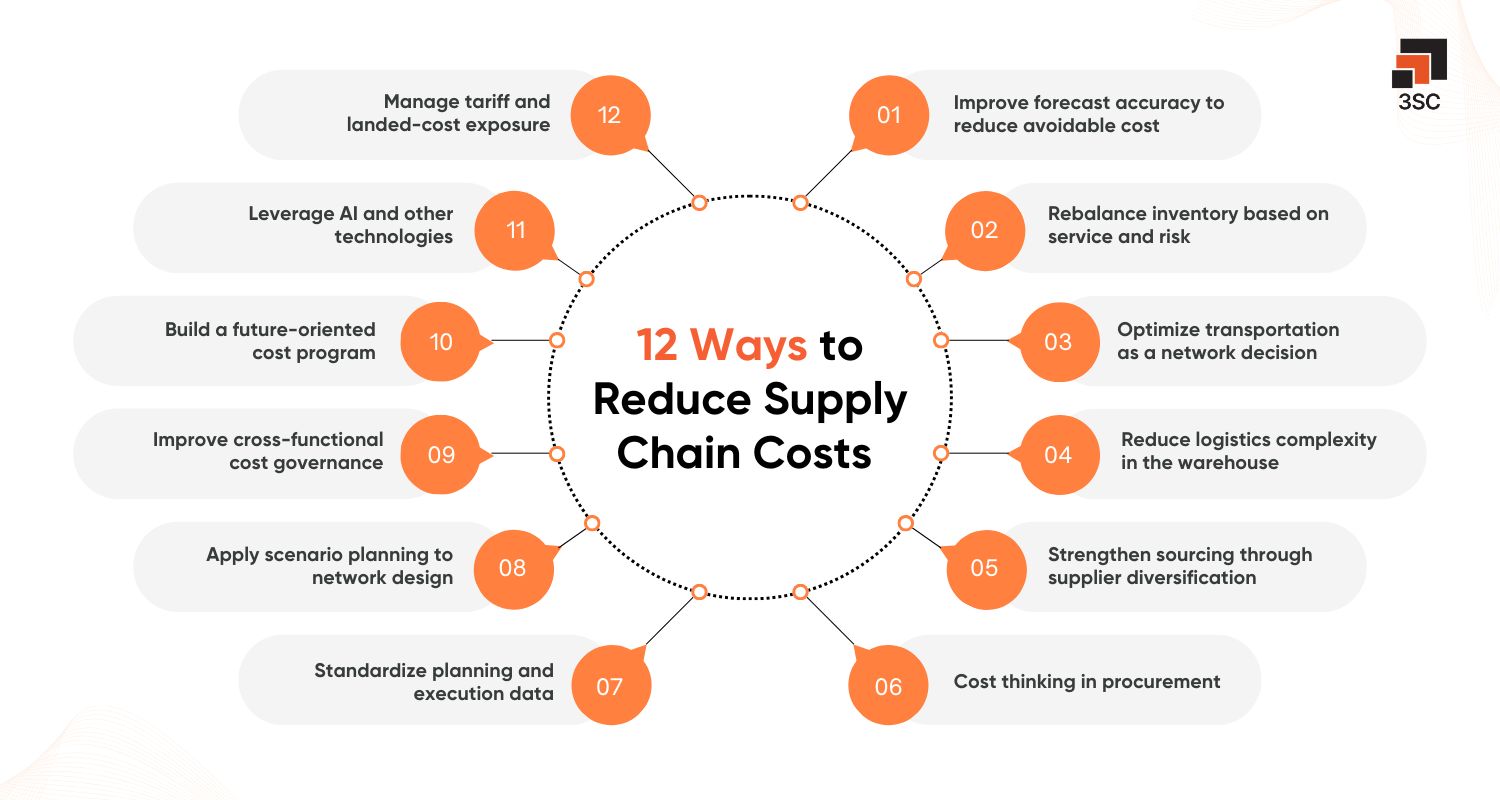
1. Improve forecast accuracy to reduce avoidable cost
Forecasting remains the first lever because poor demand signals cascade into excess inventory, premium freight, stockouts, and unstable production plans. Better forecasting does not mean chasing perfect accuracy; it means improving planning inputs enough to reduce the cost of being wrong. AI-enabled forecasting has been associated with meaningful cost improvement, especially where companies combine historical demand, external signals, and fast exception review. For 2026 planning, the advantage is not only lower cost but faster response to volatility.
2. Rebalance inventory based on service and risk
Inventory policy should reflect product criticality, demand variability, replenishment lead time, and supplier risk, not broad rules applied across the portfolio. Many organizations still carry too much stock in the wrong nodes while remaining exposed on critical items. A segmented inventory strategy lowers holding cost and write-offs while protecting service on high-risk, high-value flows. In 2026, this becomes more important as regionalization and tariff shifts make lead times less predictable across categories.
3. Optimize transportation as a network decision
Transportation savings rarely come from rate negotiation alone. The bigger gains come from load consolidation, mode shifts, route redesign, better appointment discipline, and fewer last-minute expedites. For supply chain leaders, transport should be managed as part of the end-to-end network rather than as a standalone spend category. That perspective helps teams reduce cost-to-serve while improving consistency. It also creates a stronger base for future automation in routing and dynamic planning.
4. Reduce logistics complexity in the warehouse
Warehouse cost is often driven less by labor rate and more by process complexity, poor slotting, excessive touches, rework, and inconsistent inbound and outbound flows. The most practical savings come from simplifying layout logic, improving pick path design, tightening labour scheduling, and using automation selectively where the business case is clear. Mid-scale automation is becoming easier to justify because leaders can now target specific pain points such as throughput bottlenecks, accuracy, or storage density rather than redesigning the whole facility at once.
McKinsey notes that companies plan to increase investment in warehouse automation over the next five years, with automation reaching around 25% of capital spending on average.
5. Strengthen sourcing through supplier diversification
Single-source dependence can look efficient on paper and become expensive in practice. Dual sourcing, regional diversification, and better supplier tier visibility help reduce disruption cost, price shocks, and emergency responses. This is particularly relevant in 2026, when many organizations are moving beyond a simple China-plus-one approach toward broader cost optimization and regional balance. The goal is not to multiply suppliers unnecessarily, but to protect the business from concentration risk that eventually shows up as margin erosion.
6. Use should-cost thinking in procurement
Procurement teams reduce cost faster when they understand what should drive a supplier’s price rather than negotiating only from historical spend. Should-cost analysis brings transparency to raw material exposure, process steps, logistics inputs, packaging, and service requirements. That allows teams to challenge specifications, redesign order patterns, and identify opportunities for joint value creation. In inflationary or tariff-sensitive environments, this method also improves the quality of supplier conversations.
7. Standardize planning and execution data
Many hidden costs come from fragmented master data, inconsistent definitions, and weak handoffs between planning, procurement, manufacturing, logistics, and finance. Standardized data improves decision speed and reduces rework, manual intervention, and avoidable firefighting. For advanced supply chain teams, this is the foundation for control towers, scenario modelling, and digital twins. In other words, lower administrative friction today creates better structural decisions tomorrow.
8. Apply scenario planning to network design
Network design is now a recurring management discipline, not a one-time strategy project. Tariffs, service expectations, labour availability, and regional demand shifts mean the lowest-cost footprint can change quickly. Scenario planning helps leaders compare trade-offs across plant allocation, distribution nodes, inventory placement, and supplier geography. This is where a future-ready 2026 supply chain separates itself: it does not wait for disruption to force redesign; it models cost, resilience, and service trade-offs in advance.
9. Improve cross-functional cost governance
Supply chain cost cannot be managed well when procurement optimizes price, operations optimize utilization, logistics optimizes freight, and commercial teams optimize service independently. The result is local efficiency and total-system waste. Strong cost governance aligns functions around shared metrics such as total landed cost, cost-to-serve, working capital, and service outcomes. For expert audiences, this is often the difference between isolated savings projects and durable enterprise value.
10. Build a future-oriented cost program
The best cost programs in 2026 are not defensive. They are designed to free capital, improve agility, and make the network more decision centric. The cost reduction remains a widespread structural priority, with logistics among the top target areas and many organizations pursuing meaningful savings while still planning for growth. That signals a broader shift: the future supply chain will reward leaders who connect operational efficiency with resilience, regional flexibility, and practical digital adoption.
11. Leverage AI and other technologies
AI and digital technologies can reduce supply chain costs when they act as an intelligence layer across everyday decisions.
Demand sensing can reduce waste caused by forecast errors. Transport planning tools can improve route efficiency, lower empty miles, and reduce urgent shipments. Inventory optimization can help teams balance service levels with working capital. AI agents can also reduce manual coordination by tracking exceptions, delays, and follow-ups across functions. Digital twins can support better long-term decisions by helping companies test network, capacity, and landed-cost scenarios before making major changes.
The goal is not to add more technology, but to use AI where it makes cost decisions faster, clearer, and more connected across planning, logistics, inventory, procurement, and execution.
12. Manage tariff and landed-cost exposure
Tariff volatility, changing trade rules, and shifting regional policies can quickly alter the true cost of sourcing and distribution. Supply chain teams need to look beyond purchase price and evaluate total landed cost, including duties, freight, compliance, lead time, and inventory impact. A stronger approach combines supplier diversification, trade scenario planning, and regular cost-to-serve reviews so companies can adjust sourcing, routing, and inventory decisions before margin pressure builds.
Conclusion
Reducing supply chain cost is no longer about trimming isolated functions. It is about improving the quality of decisions across the full operating model. Forecasting, inventory, transportation, warehousing, sourcing, data, and network design all interact, and the savings multiply when they are managed as one system.
For supply chain experts, the opportunity in 2026 and beyond is clear: remove redundant cost, simplify execution, and build a network that performs under uncertainty. Organizations that do this well will not only lower spend, but also improve resilience, working capital efficiency, and the ability to scale as conditions change.