Quick commerce and omnichannel demand are changing how Indian FMCG companies plan, allocate, and replenish inventory. To compete effectively, businesses need sharper SKU and pack strategies, faster dark-store replenishment, and better visibility across channels. Strong demand sensing and clear execution governance will help protect availability while controlling excess, expiry risk, and working capital.
Key Takeaways
- Quick commerce is pushing FMCG supply chains to plan closer to real-time consumer demand.
- SKU placement, pack strategy, and service levels must be tailored by channel, location, and consumption occasion.
- Dark store replenishment needs faster visibility to protect availability without creating excess or expiry risk.
- Omnichannel growth requires disciplined inventory allocation across general trade, modern trade, e-commerce, and quick commerce.
- Demand sensing and execution governance will decide how reliably FMCG companies serve the next consumer moment.
A customer opens a quick commerce app in the evening. Dinner is almost ready, but the cooking oil is over. A child asks for chocolate milk. Someone remembers that toothpaste needs to be replaced. A few taps later, the order is placed.
For the customer, the expectation is simple. The product should be available and delivered quickly.
For an FMCG company, that small order creates a much bigger question.
Is the right SKU available in the nearest dark store? Is the right pack size in stock? Is there enough inventory to protect the sale without creating excess? Is the same product also needed by general trade, modern trade, or e-commerce?
This is the new reality for Indian FMCG supply chains. Quick commerce and omnichannel demand are changing how products are planned, allocated, replenished, and governed.
Growth now depends on how quickly companies can sense demand, place inventory, and execute across channels without losing control of cost or service.
The Consumer Has Changed the Clock
For decades, FMCG supply chains in India were built around scale, reach, and replenishment discipline.
Products moved from factories to depots, distributors, retailers, and then to consumers. Planning was shaped by historical sales, distributor demand, trade schemes, and periodic replenishment. That model still matters. General trade continues to be one of the most important channels for FMCG companies in India.
But the consumer journey has expanded.
The same shopper may buy monthly groceries from modern trade, order snacks through quick commerce, purchase premium products online, and still depend on the neighbourhood kirana for daily essentials. Demand is now spread across occasions, platforms, locations, and time windows.
The shift is visible in the numbers. Quick commerce has grown from about USD 1.5 billion in 2022 to around USD 6 to 7 billion in 2024, showing how rapidly the channel is changing the operating rhythm for FMCG companies.
The message for FMCG leaders is clear. The consumer has changed the clock, and supply chains need to operate closer to real demand.
Quick Commerce is Not Just Another Sales Channel
It is easy to treat quick commerce as one more route to market. That approach can create problems.
Quick commerce changes the speed of FMCG execution. The time between demand, availability, and delivery becomes much shorter. A stockout in a dark store is very different from a stockout in a traditional retail outlet. In quick commerce, the customer can see availability immediately. If one brand is unavailable, another option is only one tap away. That means a missed stock decision can quickly become a missed sale.
At the same time, stocking every dark store heavily is not the answer. Many FMCG categories have shelf life, pack condition, freshness, and working capital considerations. The real challenge is balance.
Companies need to protect availability without creating excess. They need speed, but they also need control.
What FMCG Companies Need to Rethink
Quick commerce does not only change delivery timelines. It changes the decisions that sit behind delivery.
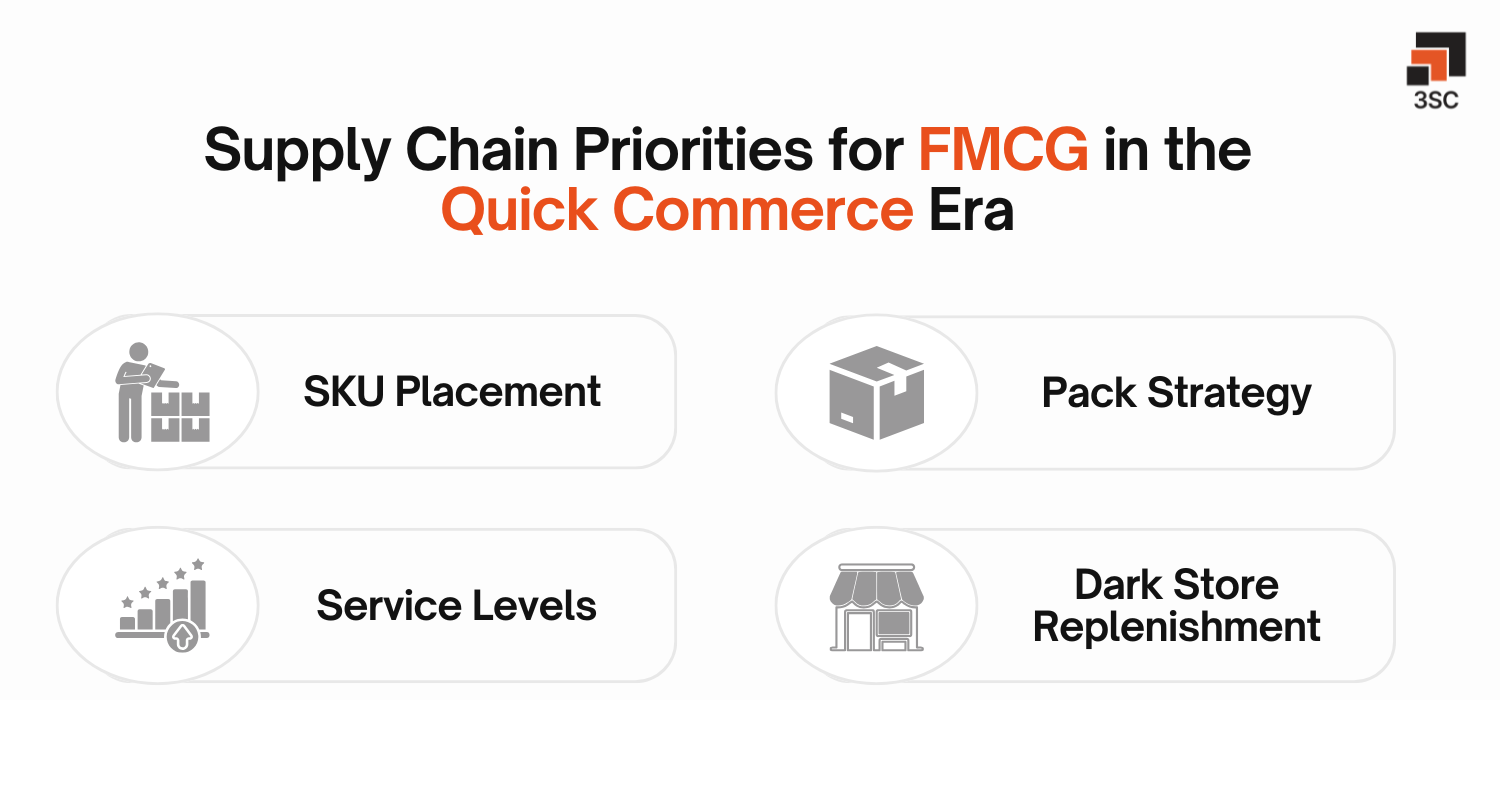
1. SKU Placement
Not every SKU needs to be present everywhere.
A dark store in Gurugram may need a different assortment from a dark store in Pune. A residential locality may behave differently from a student heavy area. A premium personal care product may move faster in one cluster, while a value pack may work better in another.
FMCG companies need to decide which SKUs belong in which locations based on local demand, consumption occasions, and channel behaviour. The question is not only whether a product sells. The better question is where it should sell.
2. Pack Strategy
Pack sizes cannot be planned with one channel in mind.
Quick commerce often supports immediate consumption, top up buying, trial purchases, and impulse orders. This can create demand for smaller packs, convenience packs, and occasion led bundles. Modern trade may still support larger packs. General trade may need value packs. E-commerce may perform better with premium variants or multi packs.
This means pack strategy becomes a supply chain decision, not only a marketing decision. Companies need to connect pack planning with manufacturing feasibility, packaging availability, shelf life, margins, and dark store space. When pack decisions are made in isolation, complexity increases. When they are connected to channel demand, they create better availability and stronger execution.
3. Service Levels
Every channel cannot always receive the same service promise.
Some SKUs may need high availability across quick commerce because they are frequently searched and easily substituted. Others may need selective placement because demand is slower or location specific.
Service levels should reflect business priority, demand velocity, margin, shelf life, and customer expectation. This helps teams avoid two common problems. The first is understocking fast moving products. The second is overstocking products that do not need high availability in every location.
A sharper service level strategy helps companies protect both sales and cost.
4. Dark Store Replenishment
Dark stores have limited space and high availability expectations.
They cannot carry every SKU in large quantities. Yet they are expected to support fast delivery across several categories. This makes replenishment one of the most important capabilities in quick commerce.
FMCG companies need to know which stores are running low, which SKUs are repeatedly unavailable, which products are ageing, and which replenishment plans are creating excess. Traditional replenishment cycles may not be enough. Teams need faster visibility into stock movement, fill rates, stockouts, and service gaps. Responsive replenishment does not mean pushing stock everywhere. It means knowing where action is needed and why.
Related read - What Are Dark Stores?
Omnichannel Demand Creates Inventory Conflict
As FMCG companies grow across channels, the same inventory is often expected to serve many demand streams.
General trade needs product availability. Modern trade has account commitments. E-commerce needs platform level service. Quick commerce needs fast replenishment. Institutional and direct channels may have their own requirements.
When inventory is abundant, this may seem manageable. The challenge appears when supply is constrained, demand spikes, or promotions overlap.
A quick commerce campaign may consume stock needed for general trade. A modern trade commitment may reduce e-commerce availability. A regional demand spike may be missed because inventory is sitting in the wrong location.
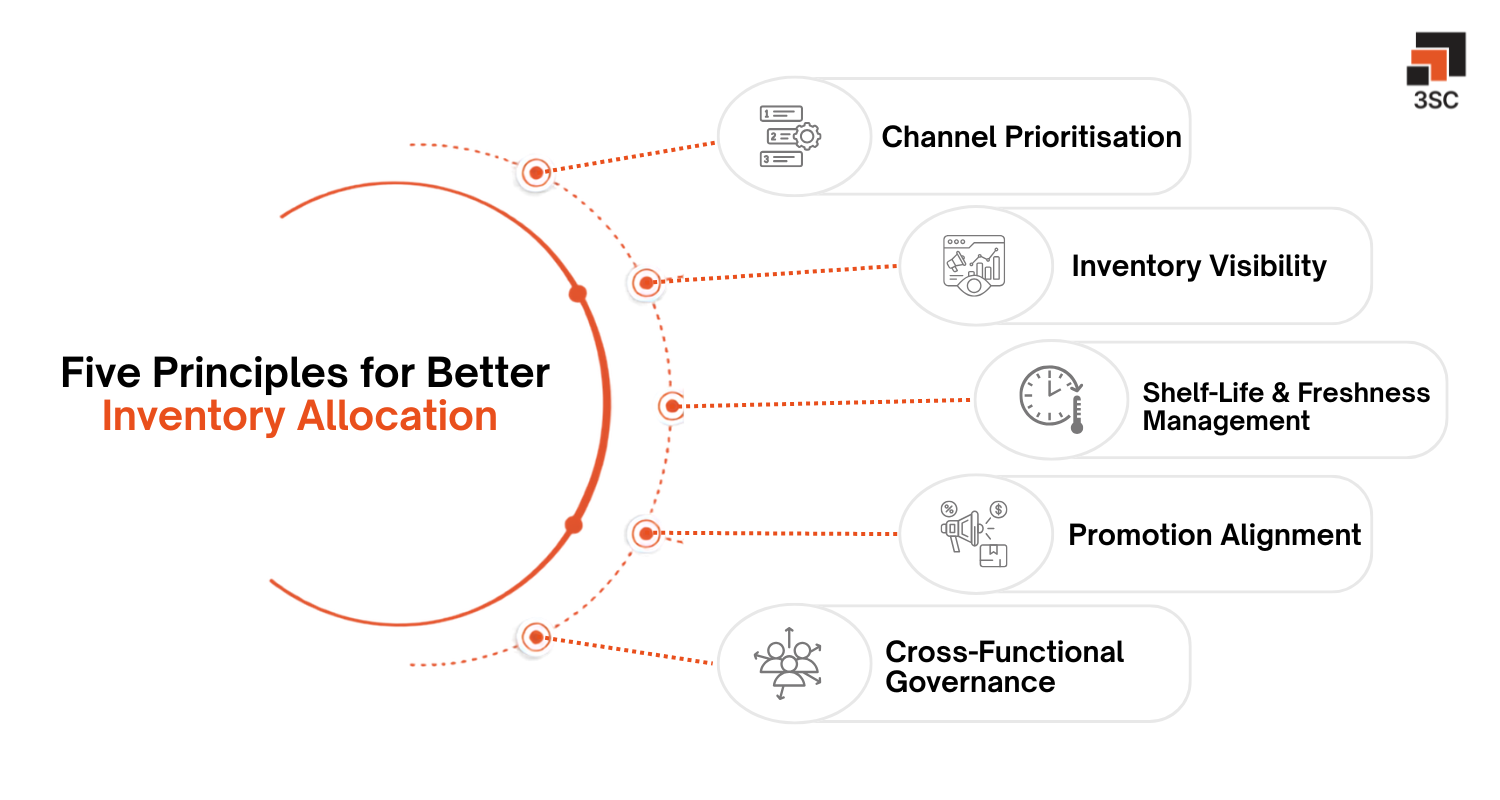
This is why omnichannel allocation needs stronger decision rules.
1. Channel Priority
Companies need clarity on which channels receive priority under different supply situations. This priority cannot be based only on urgency. It should consider business value, service commitments, customer relationships, and long-term channel strategy.
2. Inventory Position
Teams need a clear view of where inventory is available, where it is blocked, and where it can create the highest business impact. Without this visibility, allocation becomes reactive.
3. Shelf Life and Freshness
In FMCG, inventory decisions are not only about quantity. Shelf life, freshness, batch age, and expiry risk all matter. A product may be available, but it may not be suitable for every channel or location.
4. Promotion Alignment
Promotions can create sudden pressure on inventory. If supply chain teams do not have clear visibility into upcoming campaigns, stock may move to the wrong places or reach too late.
5. Governance
Allocation decisions need ownership. Sales, supply chain, finance, and channel teams should work from the same decision logic. Otherwise, every shortage becomes a negotiation. Omnichannel growth needs more than inventory. It needs disciplined allocation.
Demand Sensing Becomes the Control Point
FMCG planning has always used historical data. But quick commerce and omnichannel demand need a more current view of the market.
Demand can change quickly because of weather, festivals, local events, promotions, influencer trends, pricing changes, or platform level visibility. A product that usually sells steadily may suddenly spike in one city. A snack pack may move faster during a cricket match. A beverage SKU may see a demand increase during a heatwave. A personal care product may gain traction after a campaign.
If planning waits for monthly or weekly reviews, the opportunity may already be gone. Demand sensing helps companies read newer signals and adjust decisions faster.
It can support better SKU placement, replenishment, allocation, and service planning. It also helps teams separate real demand from short term noise. The value is not only better forecasting. The value is faster response.
When companies understand demand earlier, they can place inventory better, reduce stockouts, and avoid unnecessary excess.
Execution Governance Will Decide the Winners
Quick commerce creates speed. Omnichannel creates complexity. Together, they can overwhelm supply chain teams if decision ownership is unclear. The issue is not only whether companies have data. The issue is whether teams know how to act on it.
FMCG companies need clear answers to practical questions:
1. Who Owns Assortment Decisions?
Dark store assortment cannot be left to broad channel assumptions. Teams need defined ownership for which SKUs enter, stay, or exit specific locations.
2. Who Tracks Stockout Reasons?
A stockout may happen because of poor forecasting, delayed replenishment, platform level issues, allocation gaps, or supply constraints. Unless reasons are tracked properly, the same problems keep repeating.
3. Who Resolves Channel Conflict?
When multiple channels need the same stock, decisions should not depend on last minute pressure. There should be rules that guide allocation under constrained supply.
4. Who Reviews Expiry and Excess?
Availability matters, but excess can quietly damage margins. Teams need regular visibility into ageing stock, slow movers, and expiry risk.
5. Who Measures Service Reliability?
Fast delivery is only one part of quick commerce. The larger question is whether the product was available, replenished on time, and aligned with the expected service level.
Strong governance connects planning, sales, supply chain, finance, and channel teams. It turns visibility into action and action into consistent execution.
Building the FMCG Supply Chain for the Next Consumer Moment
The future of Indian FMCG will not be shaped by one channel alone. General trade will continue to matter. Modern trade will remain important. E-commerce and quick commerce will keep expanding their role in urban and semi urban consumption.
The real challenge is not choosing between these channels. It is serving all of them without losing control of availability, cost, freshness, and service. To adapt, FMCG companies need supply chains that are more responsive and more connected.
They need SKU allocation that reflects local demand. They need pack strategies that match channel behaviour. They need replenishment models that protect availability without creating waste. They need allocation rules that balance growth with service reliability. They need demand sensing that helps teams act before execution gaps become visible to the customer.
Quick commerce has changed the speed of consumer expectation. Omnichannel demand has changed the complexity of fulfilment.
Together, they are pushing FMCG supply chains into a new phase. The companies that succeed will treat this shift as a supply chain transformation opportunity, not only a channel opportunity.
Because in the new FMCG marketplace, the winning brand will not only be the one the consumer prefers. It will be the one that is available, in the right pack, at the right location, at the exact moment the consumer decides to buy.
Prepare Your FMCG Supply Chain for the Next Consumer Moment with 3SC
Quick commerce and omnichannel demand require more than faster delivery. They require better demand sensing, sharper inventory allocation, responsive replenishment, and stronger execution control across every channel.
3SC helps FMCG companies connect planning with real-time market signals, place the right SKUs in the right locations, and protect availability without increasing excess, expiry risk, or working capital.

Related Read & Guides
- Consumer Goods Supply Chain: Process, Challenges, Trends & Best Practices
- How CPG Reduces Stockouts, Expiry Loss & Distributions Cost with Better Planning
- Why Food & Beverage Supply Chains Need Integrated Business Planning (IBP) to Scale
- Quick Service Restaurant (QSR) Supply Chain Management: Process, Challenges & Best Practices
- Food & Beverage Supply Chain Trends