Highlights
- A structured overview of the QSR supply chain from forecasting to store execution.
- Insight into the operational and structural pressures unique to QSR networks.
- Analysis of key challenges affecting service levels, cost, and working capital.
- Strategic best practices that strengthen end-to-end alignment and decision-making.
- A forward-looking view on building agile, resilient, and technology-enabled QSR supply chains.
In the restaurant industry, consistency, speed, and availability are non-negotiable. Delivering that promise at scale requires tightly synchronized planning, responsive supply networks, and disciplined execution across locations. As demand patterns become more dynamic, sustained performance depends on how well the entire operating system stays aligned under constant variability.
This operating model is best exemplified by what the industry defines as a Quick Service Restaurant (QSR).
What is a Quick Service Restaurant (QSR)?
A Quick Service Restaurant (QSR) is a high-volume food service restaurant format built around speed, standardization, and operational efficiency. The model focuses on delivering a consistent menu with minimal wait time through streamlined kitchen processes, limited customization, optimized store layouts, and tightly controlled input costs. Service is typically counter-based or drive-through, with a strong emphasis on quick turnaround and predictable customer experience.
As QSRs are designed for scalability: Standardized recipes, portion control systems, and centralized procurement enable brands to replicate the same product quality across hundreds or thousands of locations. This operational structure supports rapid expansion while maintaining brand consistency.
Global brands such as McDonald's, KFC, Domino's, and Subway operate extensive store networks supported by centralized sourcing, approved supplier programs, and structured distribution systems. These supply ecosystems ensure uniform ingredient quality, food safety compliance, and cost control across geographies.
At its core, the QSR model combines operational simplicity at the customer interface with highly coordinated backend supply and logistics systems, enabling fast service without compromising consistency.
What Differentiates QSR Supply Chains from Other Food Service Formats?
The global QSR market exceeds $1 trillion and is projected to surpass $2 trillion in the next decade. The scale of the QSR industry highlights why its supply chains differ from traditional food service models.
Differentiating Factor | How It Shapes the QSR Supply Chain |
Standardized SKUs Across Geographies | QSRs require uniform product specifications to ensure the same taste and quality across locations. These drives centralized sourcing, approved supplier programs, and strict quality control processes. |
Multi-Temperature Product Handling | Frozen, chilled, and ambient products move simultaneously through the network. This requires multi-zone warehousing, temperature-controlled transport, and strict cold chain compliance at every node. |
Tight Store Storage Constraints | Limited backroom space means frequent, accurately sized deliveries. Replenishment must closely match consumption rates to avoid stockouts or spoilage. |
High Promotional Intensity | Limited time offers (LTOs) and seasonal campaigns introduce temporary SKUs and demand spikes, requiring agile forecasting, sourcing, and distribution adjustments. |
Hybrid Franchise + Company-Owned Networks | Centralized planning must align with decentralized execution. Data visibility, ordering discipline, and compliance consistency become critical across diverse ownership structures. |
However, the very scale and standardization that enable rapid expansion also to introduce operational complexity, making synchronization and execution far more challenging as networks grow.
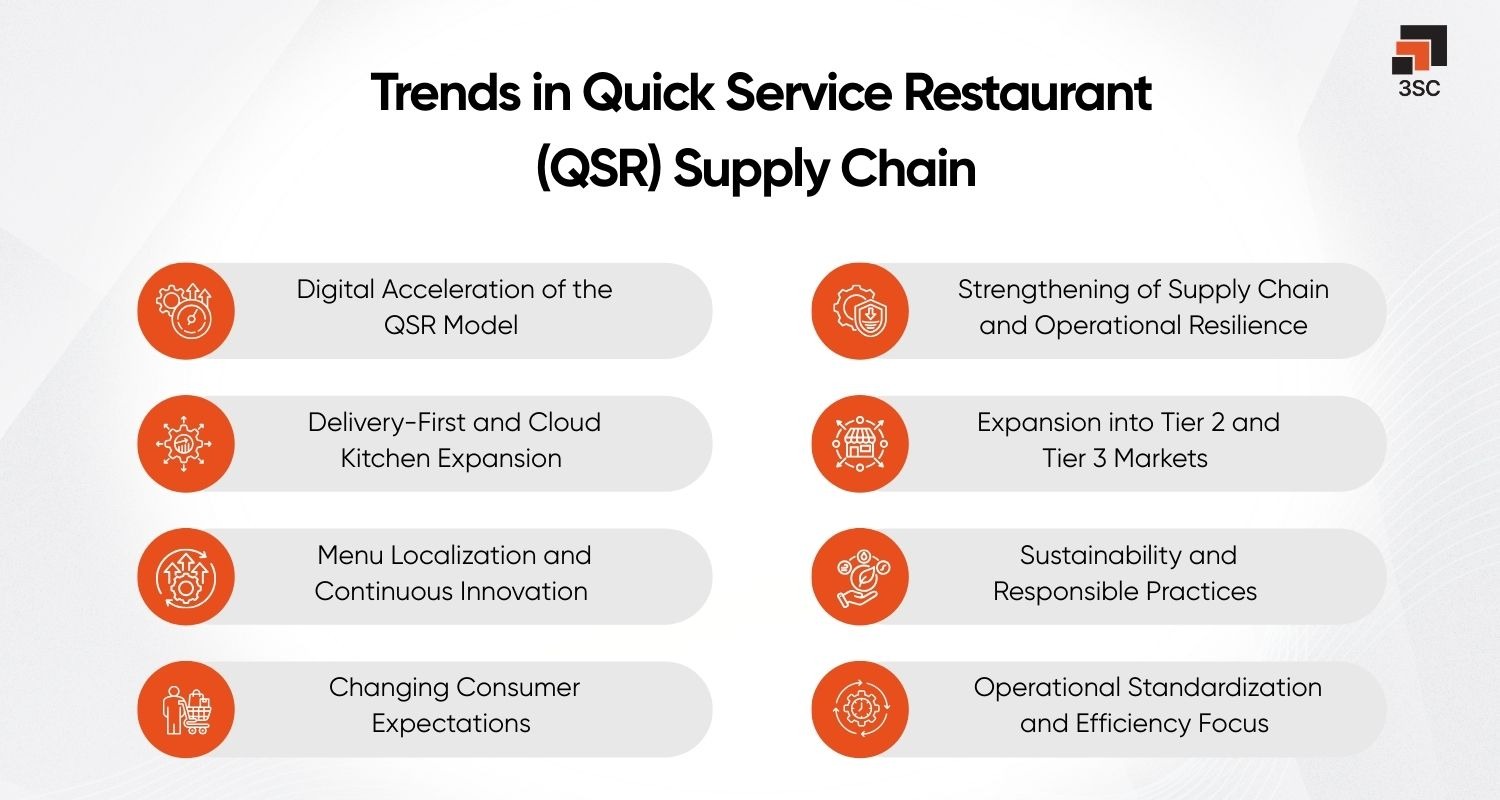
Quick-Service Restaurant Market Insights & Analysis by Mordor Intelligence
1. The quick-service restaurants market size reached USD 1.16 trillion in 2026 and is projected to increase to USD 1.74 trillion by 2031, reflecting an 8.41% CAGR over the forecast period.
5. By structure, chained/franchised outlets captured 52.34% of 2025 revenue, whereas independent operators are poised for the fastest 9.27% CAGR to 2031.
6. By service model, dine-in service generated 29.42% of 2025 sales, yet home delivery is forecast to sprint ahead at a 10.57% CAGR through 2031.
7. By geography, North America led with 32.69% of the 2025 revenue, while the Asia-Pacific region is set to advance at a 10.49% CAGR through 2031.
9. Top 5 Quick-Service Restaurant Industry Leaders are - McDonald's Corporation, Yum! Brands, Inc., Restaurant Brands International Inc., Domino’s Pizza, Inc., Starbucks Corporation.
Key QSR Supply Chain Challenges
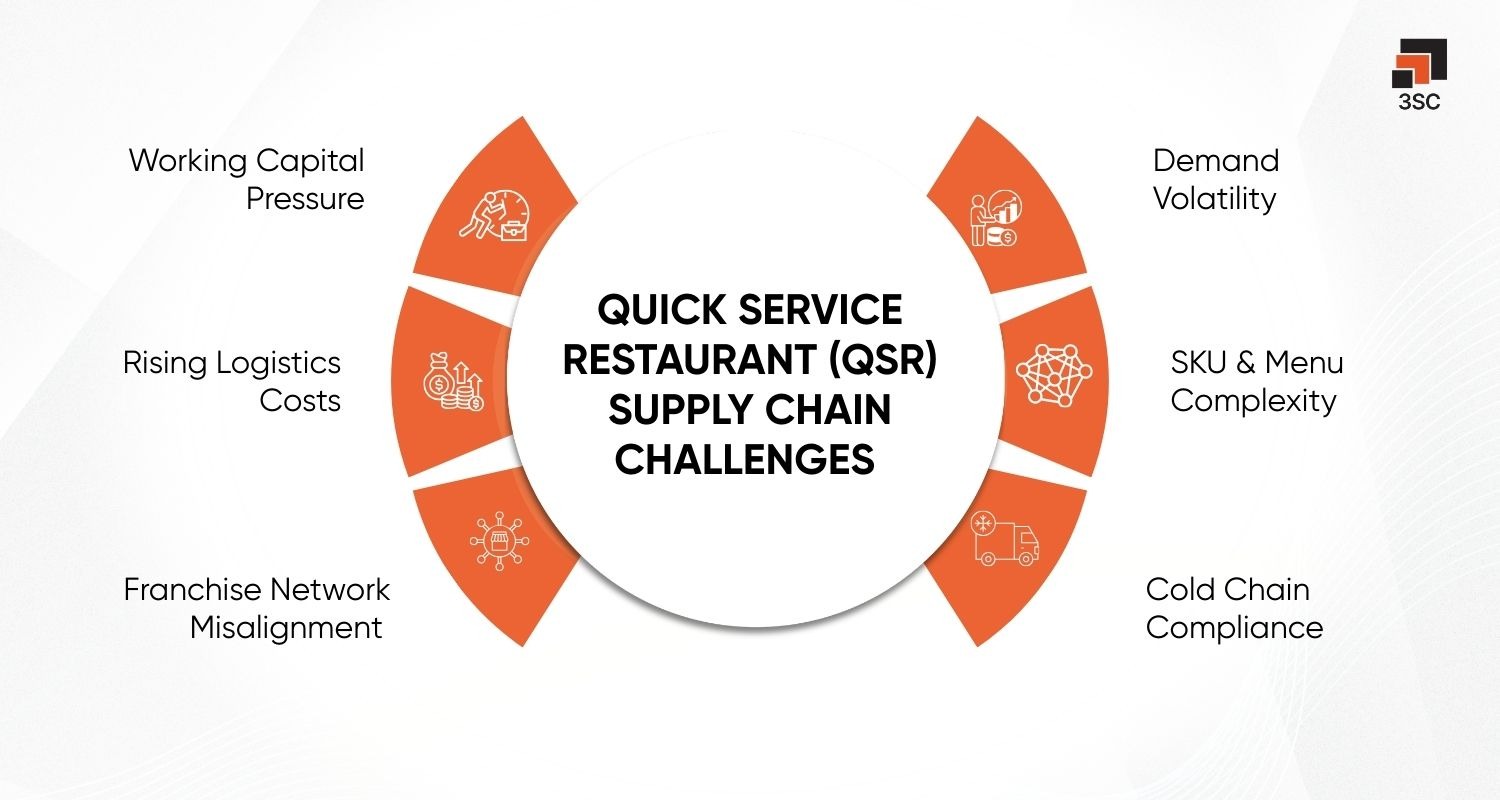
QSR supply chains face recurring structural challenges. Each one influences the others, making isolated fixes ineffective.
1. Demand Volatility
Digital ordering platforms, aggregators, promotions, and localized consumption patterns create sharp fluctuations at the store level. Since QSR planning operates on tight replenishment cycles, even short-term demand shifts can ripple upstream into procurement, production, and distribution. The challenge is not variability itself, but the speed at which the network can respond.
2. SKU & Menu Complexity
Limited-time offers (LTOs), regional menu adaptations, and continuous product innovation disrupt steady-state planning. Temporary SKUs introduce new sourcing, storage, and distribution requirements without destabilizing core inventory flows. Managing this balance between innovation and operational stability is a persistent pressure point.
3. Cold Chain Compliance
QSR supply chains depend heavily on frozen and chilled products. With multiple handling nodes, supplier, plant, DC, transport, and store, temperature control must remain consistent throughout. Even minor deviations can lead to spoilage, compliance risks, and financial losses, making cold chain visibility critical.
4. Franchise Network Misalignment
In franchise-heavy models, planning decisions are often centralized while execution occurs at store level. Data silos, delayed reporting, or inconsistent ordering discipline can reduce forecast accuracy and inventory control. Alignment between corporate supply teams and franchise operators is essential for network stability.
5. Rising Logistics Costs
Fuel price volatility, labour shortages, and expanding last-mile delivery requirements increase transportation expenses. Since QSR distribution operates on high-frequency deliveries, small cost increases compound quickly across the network, directly affecting margins.
These challenges are interconnected, & to overcome these challenges, QSRs rely on tightly structured planning processes.
The QSR Supply Chain Process
The QSR supply chain is a tightly orchestrated flow from demand planning to store-level execution.
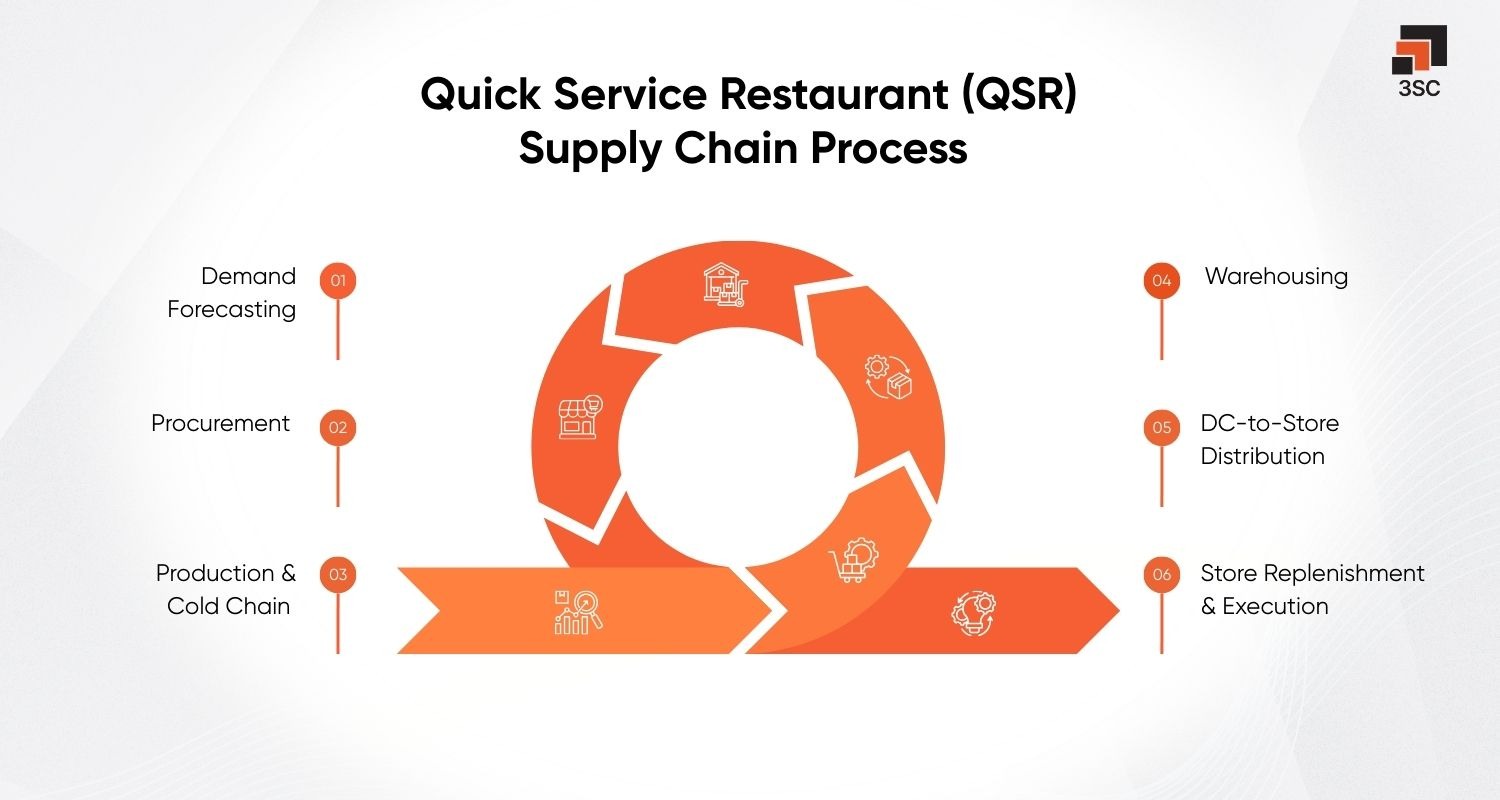
1. Demand Forecasting
The QSR supply chain begins at the store level, where demand forecasting estimates future consumption by SKU, location, and daypart. Unlike aggregated planning models, QSR forecasting must operate at a granular level because breakfast, lunch, and dinner demand patterns differ significantly, and individual stores often experience unique local variations.
Forecasts incorporate historical data, promotional calendars and limited time offers, seasonality, local events, and increasingly, digital and delivery channel trends. The objective is to create a demand signal that accurately reflects near-term consumption so that procurement, production, and distribution decisions remain aligned.
Given the time-sensitive nature of QSR operations, forecasts are frequently refreshed to adapt to changing conditions rather than relying solely on static monthly plans.
2. Procurement
Procurement converts forecasted demand into supplier commitments, ensuring that the right ingredients and materials are sourced in the required quantities and timelines. In QSR networks, procurement is often centralized to maintain product standardization and cost control across regions. This stage involves supplier selection, contract management, commodity price negotiation, quality compliance, and capacity alignment.
Given the scale at which QSR brands operate, procurement teams must balance long-term agreements for cost stability with flexibility to manage demand shifts. Close coordination between planning and sourcing functions is critical to prevent supply gaps or excess inventory accumulation.
3. Production & Cold Chain
Once materials are procured, production and processing take place either at dedicated manufacturing facilities or approved co-packers. Products are typically categorized as frozen, chilled, or ambient, each requiring specific handling protocols. The cold chain becomes central at this stage, ensuring that temperature-sensitive items maintain integrity from production through storage and transportation.
Manufacturing schedules are aligned with forecasted demand, while quality control processes ensure food safety compliance. Any breakdown in temperature control or production planning can create downstream service disruptions, making this stage highly controlled and closely monitored.
4. Warehousing
Warehousing in QSR supply chains is managed through distribution centres designed to consolidate, store, and prepare products for store delivery. These facilities often operate with multiple temperature zones to handle frozen, chilled, and ambient goods simultaneously. Inventory is received, inspected, stored, and picked according to store-level orders.
Efficient slotting, shelf-life monitoring, and inventory accuracy are critical to support high-frequency replenishment cycles. Warehouses act as balancing nodes in the network, absorbing variability between supply and store demand while maintaining product integrity.
5. DC-to-Store Distribution
From distribution centres, products move to individual restaurant locations through planned delivery routes. This stage focuses on transportation efficiency, delivery schedule adherence, and multi-temperature logistics management. Route optimization ensures cost-effective distribution, while on-time-in-full (OTIF) performance is closely tracked to protect service levels.
Since QSR stores typically operate with limited backroom storage, delivery timing and drop sizes must align precisely with store consumption rates. Reliable distribution ensures that menu availability remains consistent across the network.
6. Store Replenishment & Execution
The final stage of the QSR supply chain occurs at the store level, where deliveries are received, verified, stored, and rotated according to shelf-life guidelines. Store managers monitor consumption trends and trigger replenishment orders, often supported by automated ordering systems. Effective store-level inventory management balances availability with waste control, ensuring that products are used within their expiry windows while maintaining service readiness.
Execution discipline at this stage directly impacts customer experience, making it the visible outcome of all upstream supply chain decisions.
QSR Supply Chain Best Practices
To manage scale and variability effectively, leading QSR organizations rely on structured, decision-oriented practices that strengthen alignment across the entire network.
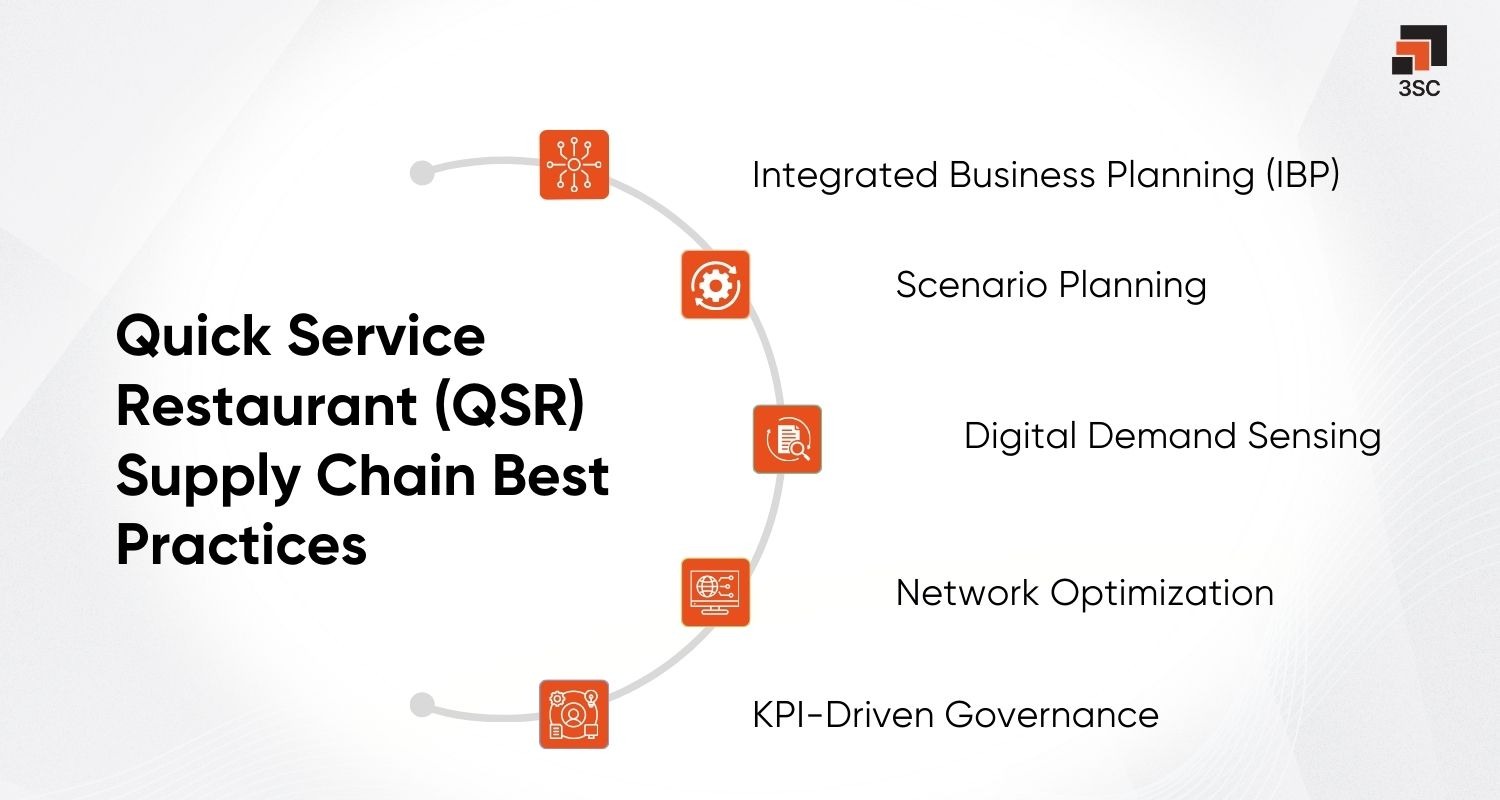
1. Integrated Business Planning (IBP)
Integrated Business Planning aligns demand forecasts, supply capacity, procurement commitments, and financial targets within a single planning framework. In QSR environments, where small demand shifts can quickly impact inventory and service levels, AI-powered IBP enhances this discipline by continuously sensing variability, modelling scenarios, and surfacing trade-offs early. It ensures that projected sales volumes, sourcing plans, and distribution capacity are synchronized in near real time, reducing reactive adjustments and operational volatility downstream.
2. Scenario Planning
Given the volatility of commodity prices, promotional cycles, and supplier performance, static plans are insufficient. Scenario planning allows organizations to model potential disruptions, such as LTO underperformance, demand surges, or logistics interruptions, and define response strategies in advance. This structured preparedness shortens decision time and improves confidence under uncertainty.
3. Digital Demand Sensing
Traditional forecasting cycles are often too slow for QSR operations. Digital demand sensing integrates near real-time data, weather inputs, and channel trends to continuously refine short-term forecasts. By reducing the lag between consumption signals and supply adjustments, organizations improve responsiveness without inflating inventory buffers.
4. Network Optimization
As store footprints expand and menu complexity increases, distribution networks must evolve accordingly. Periodic reassessment of DC locations, route structures, and transportation models helps balance cost efficiency with service reliability. A well-optimized network supports growth without compromising delivery performance.
5. KPI-Driven Governance
Clear performance metrics across forecasting accuracy, inventory turns, service levels, cold chain compliance, and cost ensure accountability across functions. KPI-driven governance transforms supply chain management from passive reporting into active performance control, enabling continuous improvement at scale.
The highest-performing QSR supply chains treat planning as a structured decision system, one that integrates data, aligns functions, and enables disciplined execution across the entire network.
Conclusion
The strength of a QSR supply chain lies in how effectively each stage connects, forecasting shapes procurement, procurement drives production flows, and distribution performance determines store availability. Competitive advantage comes from strengthening these linkages rather than optimizing individual functions in isolation.
For supply chain leaders, sustainable scale depends on making AI-powered Integrated Business Planning the structural backbone that links demand, supply, procurement, and finance into one coordinated system.
How 3SC Helps QSR Brands Improve Supply Chain Performance
3SC supports QSR brands in building tightly aligned, data-driven supply chains that improve responsiveness, cost control, and service reliability. By strengthening demand forecasting, aligning procurement and production planning, and institutionalizing Integrated Business Planning (IBP), 3SC helps reduce variability and improve decision clarity across the network. The focus extends to optimizing inventory policies, enhancing cold chain and distribution performance, and establishing KPI-driven governance frameworks that provide real-time visibility into service, waste, and cost metrics. Through structured planning transformation and execution discipline, 3SC enables QSR organizations to operate with greater agility, resilience, and performance consistency at scale.