Highlights
- Growth in F&B exposes planning gaps that siloed processes cannot sustain.
- Volatility, imbalance, and fragmentation are structural scaling barriers.
- IBP aligns demand, supply, and finance for integrated decisions.
- AI-powered IBP enables faster, data-driven responses to disruption.
- IBP provides a scalable foundation that evolves with the business.
Growth in the Food and Beverage industry rarely happens quietly. It begins with a breakthrough listing, a successful regional expansion, a festive promotion that exceeds expectations, or a new product line that resonates faster than planned. Suddenly, the numbers look promising. Volumes rise. Distribution widens. The organization feels the energy of momentum.
That expansion is not isolated. Research indicates the global food and beverage market is projected to reach nearly USD 7.4 trillion in 2026, growing at an annual rate of over 5% as consumption and distribution continue to expand worldwide.
But beneath that momentum, something else often builds: Complexity.
When Growth Starts to Feel Fragile
At first, the strain is subtle. A forecast misses slightly. A promotion performs unevenly across regions. One warehouse runs tight on inventory while another carries excess. None of it seems alarming in isolation, yet the gaps begin to widen.
Sales pushes ambitious campaigns to capture market share. Operations manage line changeovers and capacity constraints. Procurement navigates supplier variability. Finance questions whether rising volumes are protecting margins. Everyone is working toward growth, but not always within the same frame of visibility.
In F&B, volatility intensifies this tension. Demand shifts with festive cycles, regional consumption patterns, promotional spikes, and channel movement between traditional and modern trade. Supply fluctuates with agricultural yields, import delays, and logistics disruptions. Shelf-life continues counting down regardless of planning debates.
As SKUs multiply and networks expand, manual coordination becomes harder to sustain. Spreadsheets increase. Assumptions diverge. Planning turns reactive. The issue is not effort; it is structure. The planning backbone has not evolved at the same pace as growth.
The Real Barriers to Scaling in F&B
As growth accelerates, the cracks rarely appear in one place. They show up across the system. Most organizations encounter a few recurring barriers that quietly limit scale.
1. Demand Visibility Begins to Blur
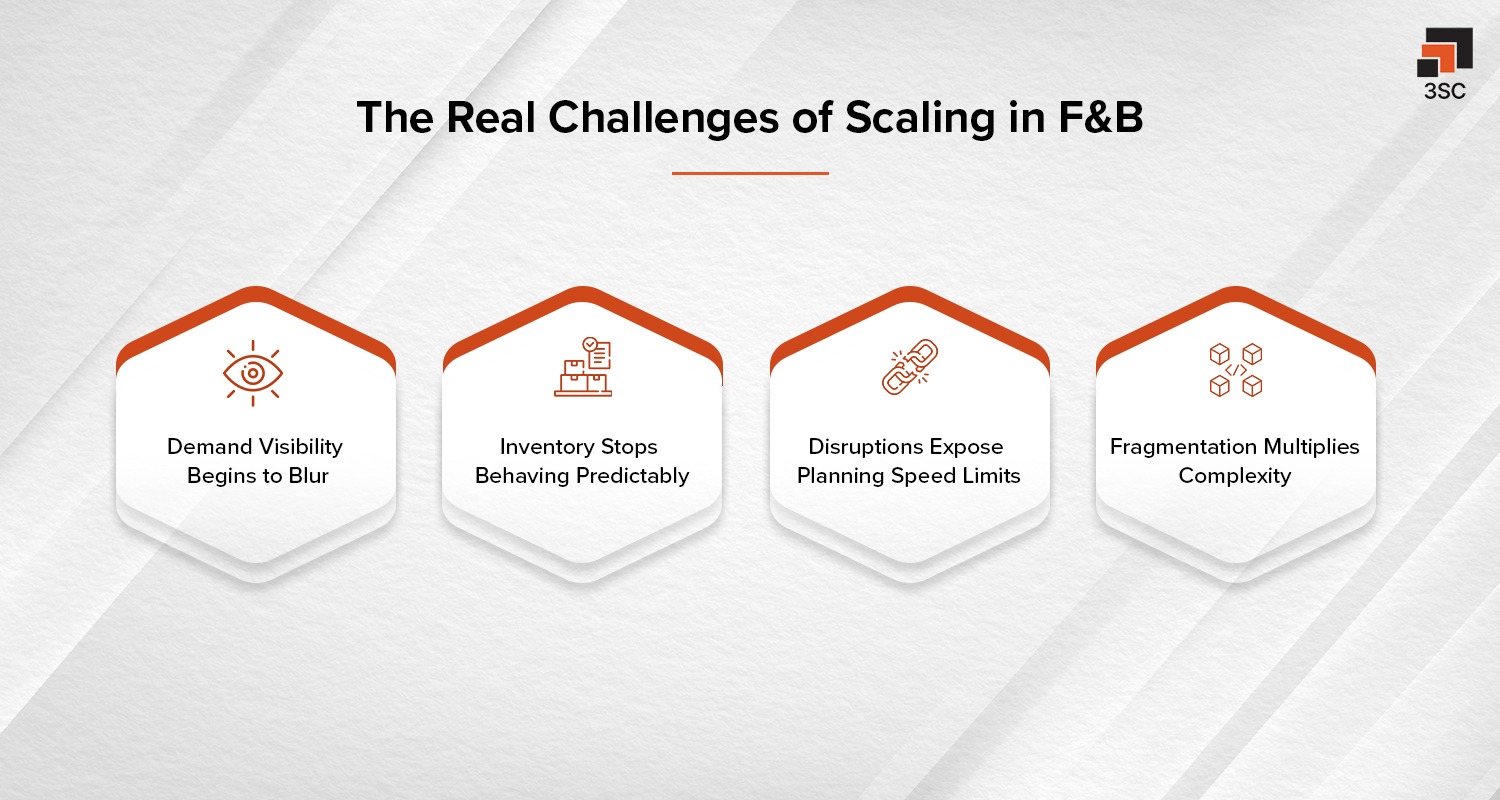
The first signs often appear in demand planning. Shipment numbers may look strong, but visibility into distributor inventory and sell-out remains incomplete. Channel nuances between traditional and modern trade start to matter more than before. Promotional lifts become harder to predict. Regional demand patterns shift faster during festive periods or seasonal spikes. When forecasts cannot fully reflect these dynamics, production plans are already misaligned before execution even begins.
2. Inventory Stops Behaving Predictably
As the network grows geographically, inventory flows become less balanced. Urban hubs might experience stockouts while regional warehouses accumulate excess. To protect service levels, safety stock levels quietly increase across locations. In a perishable category, this strategy carries hidden risk. Without shelf-life logic embedded into planning, excess inventory does not simply sit in storage, it steadily loses value.
3. Disruptions Expose Planning Speed Limits
Volatility in food and beverage rarely gives advance notice. Weather events, port congestion, import restrictions, and supplier reliability fluctuations can alter supply conditions overnight. While many organizations attempt to model different scenarios, the analysis often moves too slowly to influence real decisions. By the time an alternative plan is approved, the situation on the ground may already have changed.
4. Fragmentation Multiplies Complexity
At the structural level, fragmentation compounds these issues. Different plants may rely on separate tools. Brands or products might be planned independently. Finance evaluates financial outcomes after operational commitments are made. Periodic S&OP cycles struggle to keep pace with real-time shifts in demand and supply. Instead of creating clarity, growth amplifies the gaps between functions.
Individually, these pressures seem manageable. Together, they form a planning environment that cannot scale without structural change.
How AI-Powered IBP Transforms Scalable Growth
For growing F&B brands, when short term fixes no longer deliver stability. What required is a structural shift in how decisions are made and the speed at which they are executed across the enterprise.
From Siloed Planning to Integrated Decisions
Breaking down silos between departments has long been a priority for growing F&B organizations. Yet as complexity increases, many organizations respond by adding more planners in an attempt to manage the rising coordination burden. More headcount is expected to absorb more volatility. However, manual planning does not scale linearly. Each additional spreadsheet, local adjustment, and functional reconciliation adds friction. Instead of improving control, the system becomes more fragile.
This is when Sales & Operations Planning becomes an important step in addressing these challenges. It creates alignment around shared demand and supply numbers and brings greater coordination across planning discussions. But as complexity continues to grow, alignment limited to demand and supply is no longer sufficient. Scaling introduces financial trade-offs, capacity constraints, and risk considerations that extend beyond operational feasibility for many F&B brands.
AI-powered Integrated Business Planning changes this trajectory of growth. It moves planning from basic demand–supply alignment to fully integrated, enterprise-wide decision-making.
IBP connects demand planning, supply planning, procurement, production scheduling, inventory positioning, and financial evaluation within a single structure. Rather than treating decisions as sequential- operational first and financial later, it evaluates them holistically from the outset. The outcome is smarter decisions made with full visibility that balance growth, capacity, and margin in one unified move.
Beyond Structure: Enabling Speed in Decision-Making
IBP not only provides structure but also accelerates decision-making by shortening the distance between insight and action.
Instead of waiting for periodic review cycles, IBP ensures that planning becomes continuous and responsive for the business. Demand signals are captured earlier, exceptions are flagged automatically, and cross-functional impacts are visible in real time. When volatility emerges whether through demand spikes, supply delays, or capacity constraints decision-makers can evaluate alternatives immediately within a single integrated framework. Financial, operational, and inventory implications are assessed simultaneously, allowing the organization to act with clarity rather than hesitation.
In fast-moving F&B environments, resilience depends not only on integration, but on the ability to respond with precision and speed. AI-powered IBP delivers both by transforming volatility into informed action and enabling growth that remains controlled, coordinated, and sustainable under pressure.
Building the IBP Foundation That Grows with You
For scaling F&B businesses, Integrated Business Planning does not act merely as a layer added to existing systems. It connects all the tools, data, and processes already in place, creating a single, unified view across the enterprise.
As organizations grow more complex, this integrated backbone becomes the foundation for everything that follows. Advanced analytics, automation, risk sensing, and collaboration capabilities deliver real value only when anchored to a synchronized planning framework. With IBP at the core, new capabilities strengthen the system further, enabling scale that remains disciplined, agile, and financially aligned.
Conclusion: Scale Requires a Strong Planning Spine
Food and beverage supply chains operate in continuous motion, shaped by shifting demand, evolving consumption patterns, and dynamic supply conditions. Promotions accelerate growth or recalibrate expectations in real time. The difference between fragile growth and resilient scale lies not in effort, but in how decisions are structured.
Integrated Business Planning provides that structure. Strengthened with AI-driven intelligence and supported by modular architecture, it enables organizations to anticipate volatility, align priorities across functions, and protect margins while pursuing expansion. As the business evolves, IBP scales with it; absorbing complexity without requiring structural reinvention.
Ultimately, scaling is not about producing more units, but about orchestrating more moving parts with discipline and speed. With IBP as the planning spine, growth becomes deliberate, controlled, and repeatable; transforming complexity from a constraint into a competitive advantage.
Build a Planning Foundation That Scales with You
As food and beverage supply chains grow more complex, fragmented planning slows decisions, increases risk, and erodes margins. Discover how AI-powered Integrated Business Planning helps you align demand, supply, and finance - while staying ahead of volatility.