Key Takeaways
- European supply chains must become more adaptive and multi-sourced.
- Trade and regulatory shifts require faster, data-driven planning.
- Disruptions now arise from tightly linked global risks.
- Advanced intelligence is essential for quicker, smarter decisions.
- Resilience depends on visibility, diversification, and strong cyber safeguards.
The calendar is only weeks away from turning to 2026, and across Europe, supply chain leaders are taking a more critical look at their global networks. Long standing assumptions around stability, predictability, and cost optimisation are being reconsidered. In many operations control rooms, the atmosphere has shifted. What once appeared as routine alerts on screens now signal deeper structural fragilities. Notifications about elongated transit times, shifting regulations, supplier inconsistencies, and freight price surges have become part of the daily rhythm.
Supply chain disruption is no longer episodic but structural in Europe. According to the World Economic Forum, over 60% of European companies experienced significant supply chain disruptions in the past year, driven by geopolitics, climate events, logistics constraints, and growing regulatory complexity.
This is the new operating environment Europe is stepping into. Yet the narrative that follows is not one of apprehension. It is one of readiness and reinvention. It highlights how European organisations can turn volatility into capability and build stronger systems for the more demanding years ahead. To understand this shift, lets discover the forces reshaping global sourcing and the intelligence needed to navigate what comes next.
A New Era for European Supply Networks
A few years ago, cost efficiency and geographic concentration defined many European sourcing and manufacturing strategies. Those models are rapidly being reconfigured. Organisations are now expanding beyond traditional single region dependencies and adopting multi source structures. Rising capabilities in India, Vietnam, Mexico, Türkiye, and parts of East Africa provide new alternatives for procurement and manufacturing.
Europe itself is also rediscovering the strategic value of nearshoring, particularly as logistics constraints and labour shortages become more persistent across global routes.
However, diversification alone does not define the future. Supply networks are becoming modular, flexible, and designed for rapid reconfiguration. The aim is not simply to shift suppliers but to redesign systems so that they can adapt when external conditions change. In this emerging landscape, optionality becomes a strategic differentiator.
A Fragmented Global Market and the Acceleration of Trade Shifts
International commerce is undergoing a period of fragmentation. Tariffs affecting sectors such as electric vehicles, semiconductors, critical minerals, and renewable components are reshaping sourcing strategies. Canonical shipping corridors are being disrupted by geopolitical tensions, climate stresses, and shifting alliances.
Simultaneously, Europe is entering one of the most complex regulatory cycles in recent memory. Requirements around emissions compliance, product level traceability, corporate reporting, labour due diligence, and digital invoicing are increasing every quarter. These mandates demand supply chains with strong data foundations, transparent supplier relationships, and agile response mechanisms.
Trade fragmentation is no longer marginal. According to the World Trade Organization, trade-restrictive measures introduced since 2009 now affect nearly 12% of global imports, up from less than 5% before 2018, significantly increasing uncertainty for export-dependent European supply chains.
In this context, European organisations must adopt planning systems that evolve in tandem with the policy landscape. The capacity to adjust procurement, logistics, and distribution strategies in near real time will become indispensable.
A Deeper Look at the Expanding Threat Landscape
Preparing for the future requires a clear understanding of the risks that will shape it. The disruptive forces ahead are not isolated events but interconnected pressures that can amplify one another.
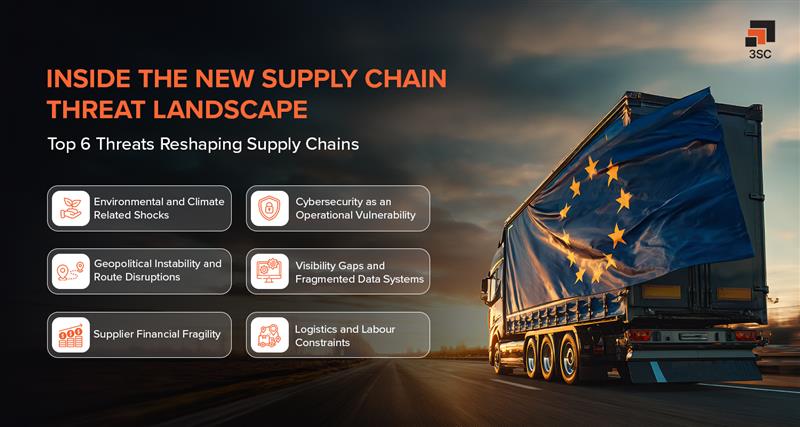
1. Environmental and Climate Related Shocks
Climate events are now both frequent and unpredictable. Water levels on the Rhine River regularly disrupt the transport of chemicals, fuels, and raw materials. Floods and storms periodically halt manufacturing operations across central Europe. Heat waves impact energy availability and limit production in multiple industries.
These events interrupt logistics flows, reduce capacity, and impose unplanned costs. Their increasing intensity makes environmental risk one of the most significant long term challenges for European supply chains.
2. Geopolitical Instability and Route Disruptions
Tensions around the Red Sea shipping corridor, evolving relationships between major economies, and the continued volatility in Eastern Europe add significant uncertainty to transport planning. Cargo rerouting increases voyage time, insurance costs, and fuel consumption, ultimately impacting margins and service levels.
3. Supplier Financial Fragility
Rising interest rates, inflationary pressures, and unpredictable demand cycles are placing strain on small and mid-sized suppliers. Supplier risk is rising across Europe. Eurostat data shows that business insolvencies in the EU increased by 13% in 2023 compared to 2022, with manufacturing, transport, and warehousing among the hardest-hit sectors, directly elevating continuity risks for multi-tier supply chains. This pressure is expected to intensify further in 2026 and the years ahead. Many are experiencing reduced liquidity and limited capacity to absorb shocks. Supplier insolvencies and abrupt production halts pose material risk to companies relying on narrow vendor bases.
4. Cybersecurity as an Operational Vulnerability
Supply chain digitalisation introduces new points of exposure. Attackers increasingly target logistics platforms, port operators, warehouse systems, and smaller vendors with weaker safeguards. The interconnected nature of modern supply chains means a breach in one system can quickly cascade across the network. Cyber readiness is now a core operational requirement, not merely an information technology concern.
5. Visibility Gaps and Fragmented Data Systems
Despite digital advances, many European organisations continue to operate with isolated systems. Data silos delay the detection of disruptions and slow down response times. Without integrated visibility, even small anomalies can grow into costly breakdowns.
6. Logistics and Labour Constraints
Driver shortages across Europe, competition for skilled operational staff, and constraints in warehousing capacity continue to challenge throughput and reliability. Without automation and digital assistance, expanding operational capacity becomes difficult.
Understanding these threats in depth is essential for designing supply chains that are both resilient and adaptive.
The Rise of Decision Intelligence and Agentic AI
As the complexity of global supply networks accelerates, traditional decision-making frameworks are proving insufficient. European organisations are now incorporating advanced intelligence layers to navigate this environment.
1. Decision intelligence integrates data, analytics, probability modelling, scenario analysis, and business context into a unified decision framework. It shifts the supply chain from reactive problem solving to proactive planning. With decision intelligence, organisations can evaluate alternative futures, assess trade-offs, and select optimal actions.
2. Agentic AI takes this a step further. These systems do not simply report information. They interpret signals, learn from patterns, simulate responses, and act on defined thresholds. They autonomously rebalance inventory, recommend rerouting options, evaluate supplier risks, or flag inconsistencies in financial or operational plans.
When decision intelligence, agentic AI, and digital twins converge, organisations gain the ability to test dozens or even hundreds of potential outcomes before committing to a strategy. This elevates supply chain management from oversight to orchestration.
What Europe Must Do Now: The Strategic Blueprint for Resilience
With the environment growing more demanding, European supply chains need to strengthen their structural and analytical capabilities. This moment calls for a blend of strategic foresight, operational discipline, and technological investment.
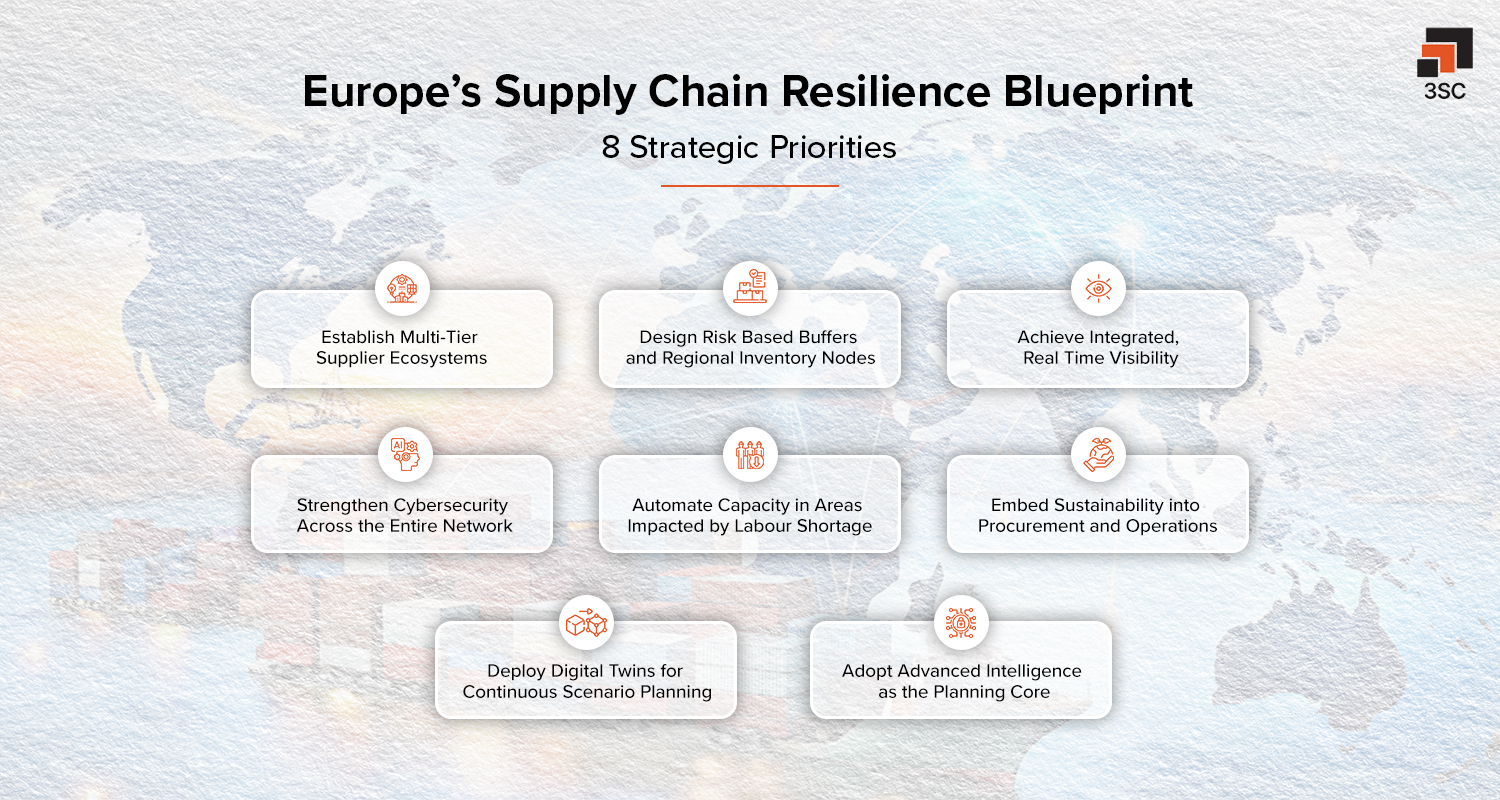
1. Establish Multi-Tier Supplier Ecosystems
Dependence on a single region or supplier is no longer viable. Organisations must map their supply networks beyond tier one and identify vulnerabilities in tier two and tier three. Multi-tier diversification reduces exposure to localised shocks and allows continuity during crises.
2. Design Risk Based Buffers and Regional Inventory Nodes
Managing inventory through intuition or isolated metrics is no longer sufficient. Organisations need risk informed buffer frameworks built from demand variability, criticality assessments, and supply volatility models. Regional inventory nodes ensure that disruptions in long distance corridors do not immediately impact customer service.
3. Achieve Integrated, Real Time Visibility
Visibility must extend across suppliers, internal operations, logistics partners, and financial systems. Integrated data environments supported by intelligent exception management help organisations detect disruptions earlier and coordinate responses more effectively.
4. Deploy Digital Twins for Continuous Scenario Planning
Modelling tariff changes, supplier failures, route closures, or demand surges through digital twins allows organisations to rehearse for disruptions before they occur. This improves reaction speed, reduces cost of error, and strengthens cross functional alignment.
5. Strengthen Cybersecurity Across the Entire Network
European organisations must enforce cybersecurity standards during supplier onboarding, adopt software bills of materials, and monitor vendor systems continuously. Cyber resilience should be embedded into procurement contracts, operational playbooks, and governance structures.
6. Automate Capacity in Areas Impacted by Labour Shortage
Automation in warehousing, yard management, and repetitive operational tasks is essential to stabilise throughput. Robotics and intelligent workflows allow supply chains to continue operating effectively despite labour constraints.
7. Embed Sustainability into Procurement and Operations
Environmental, social, and governance criteria must be incorporated into supplier evaluations, sourcing decisions, and product life cycle management. Transparency is increasingly tied to market access and regulatory compliance across Europe.
8. Adopt Advanced Intelligence as the Planning Core
Decision intelligence and agentic ai should form the analytical foundation of planning processes. These technologies enable faster reactions, more accurate forecasts, and more confident decision making across uncertain conditions.
Together, these capabilities form the architecture of a resilient European supply chain.
Conclusion: A Perspective on the Road Ahead
Heading into the year ahead, Europe’s supply chains are moving beyond episodic crises and into a phase of structural transformation. Stability will depend on the ability to anticipate, adjust, and innovate. Organisations that rely solely on historical methods or localised visibility will struggle to navigate the emerging landscape.
The next generation of European supply chains will be defined by three qualities.
They will be intelligent, capable of interpreting signals and acting with speed. They will be connected, integrating suppliers, partners, and internal teams through transparent, real-time data. And they will be resilient, designed to absorb shocks, reroute operations, and recover quickly from disruptions.
Those that begin preparing now will not only protect themselves against volatility but will set a higher benchmark for operational excellence. They will lead the transition toward a more adaptive, sustainable, and technologically empowered European supply chain model.
In an era defined by continuous change, the organisations that combine foresight with advanced intelligence will set the standard for the decade ahead.
Partner with 3SC for Intelligent, Resilient Supply Chains
At 3SC, we help businesses move beyond traditional planning with AI-driven insights, end-to-end visibility, and collaborative supply chain solutions. From reducing risks to improving agility and resilience, our expertise ensures your supply chain isn’t just prepared for today’s challenges but ready to thrive in tomorrow’s uncertainty.
Discover how 3SC can transform your supply chain into a strategic advantage.
Related Reads
- Top Supply Chain Management Trends 2026
- Europe’s Auto Supply Chain
- Logistics Analytics in 2026
- Seasonal Logistics - Challenges & Strategies
- What is Demand Planning Software
- How to Modernise the Supply Chain
- Demand Planning vs Supply Planning
- New Product Introduction in Supply Chains
- Demand Forecasting Methods