Key Takeaways
- AI agents can automate tasks while Agentic AI systems drive autonomous and goal-oriented decisions.
- Beyond rule-based automation, Agentic AI systems can adapt and act across dynamic environments.
- Agentic AI systems enable proactive and enterprise-wide orchestration.
- AI Agents are useful for repetitive and reactive tasks.
- Understanding the difference between AI Agents and Agentic AI can help businesses plan smarter and invest better.
- Early adoption of Agentic AI can help gain strategic edge and build future readiness.
The terms, AI Agents and Agentic AI are often confused to be the same but differ in structure, design, and impact on an organisation. Businesses should grasp this distinction to save themselves from underinvesting in transformation powers or overcommitting to obsolete tech.
Not all AI is created equal. Some help you automate tasks. Others can think, plan, and act—almost like a teammate. Over the past few years, I have seen the rapid shift of AI from reactive automation to proactive, offering better decision-making prowess. Across industries, businesses are no longer wondering whether AI should be implemented or not. Instead, they have pivoted to the matter of how deeply and strategically AI should be implemented and integrated across an enterprise.
Today, multiple industry-giants are using AI across diverse functionalities whether its predictive planning in supply chains, autonomous operations in finance, or hyper-personalised customer journeys in marketing. In my experience, AI is transitioning to become more capable, sophisticated, and automated, marking a critical turning point.
74% of supply chain leaders say that AI is the top driver of transformation. A race is afoot, involving all sector leaders seeking intelligent systems that can understand context, make decisions, and even initiate accurate actions with minimal or zero human oversight. AI is no longer confined to pilot projects or back-office automation, it is shifting to be more adaptive, reactive, and intelligent. As businesses are progressing in their AI journey, decision-makers should evaluate how they can leverage an AI agent, whilst planning to adopt Agentic AI to drive better strategic goals and ensure adaptability across the dynamic enterprise.
In my interactions with industry leaders across the globe, I’ve found that the key question is no longer whether to adopt AI; but how extensively it should be integrated throughout the enterprise.
This question brings us to the distinction between Agentic AI and AI agents. A difference that’s subtle in terminology, but quite significant in consequence. If you’re leading transformation in your organization, understanding this disparity can be a game-changer.
I often see people use the terms AI agents and Agentic AI interchangeably, but they’re not the same. At a glance, both terms may seem interchangeable as they both involve systems that use data to act. However, in practise, they work on different levels of complexities, autonomies, and strategic values.
Ever wondered if your chatbot is really intelligent or just fast? That’s where this distinction matters. Understanding this difference between Agentic AI vs Agents AI is a technical nuance that helps Decision makers distribute budgets, structure teams, govern risks, and steer digital transition for a future where intelligence is not only embedded but agentic.
So… What are Agentic AI and AI Agents?
If put in simple terms, AI agents are task-specific systems built to achieve a pre-defined objective powered by inputs, logics, and even machine learning models. These systems are often embedded in software to help you undergo various repetitive tasks, offer recommendations based on past data, and operate within the pre-established boundaries.
Agentic AI is an autonomous and goal-driven AI system that has the capabilities to start automatically, plan for the future, and execute complex tasks adaptively across dynamic environments. These systems sit atop AI agent(s) to make the process autonomous and well-orchestrated. Apart from being responsive, these systems are intent-driven and self-learning, making them immensely capable of recursive and responsive reasoning, susceptible to long-term usage with the powers of autonomous collaboration.
If usage of Agentic AI and AI agents is considered, an Agentic AI system for supply chains can not only predict disruptions but also replans routes, communicates with vendors, books alternative carriers, and gets back to real-time logistics monitoring and control whereas a AI agents are simple systems used by e-commerce platforms to record transactional data.
But that’s just the tip of the iceberg; the distinctions between Agentic AI and AI agents run far deeper, revealing fundamental shifts in how intelligence is applied, executed, and evolved.
AI Agents vs Agentic AI: What is Difference
It's true that both AI Agents and Agentic AI fall under the same umbrella of smart systems, but the operations, prowess, and values of both systems differ at multiple levels. While one operates like a functional tool with limited features, the other acts like a digital co-worker who’s capable of setting its goals, operate with reasoning across systems, and continuously adapts to new contexts wherever required. Here are some differences that simple definitions of Agentic AI and AI Agents do not cover. AI Agents need a command to act whereas Agentic AI identifies opportunities and initiates actions without any human intervention.
- AI Agents are developed to cater to specific and simple tasks that are often repetitive in nature, but when Agentic AI comes into plays, it builds on the same foundation and handles interconnected processes across departments and systems, enabling seamless orchestration.
- All AI Agents operate on fixed, predetermined rules, Agentic AI, on the other hand, adapts to new data, environments, and changing business contexts in real time.
- AI Agents are session-based and limited while Agentic AI uses short and long-term memory for contextual, continuous, and reliable decision-making.
- AI Agents function independently of other departments and systems, whereas Agentic AI interacts across teams, tools, and APIs to drive enterprise-wide coordination.
- When it comes to decision-making, AI Agents follow logic trees, whereas Agentic AI applies reasoning to prioritize and execute multi-step decisions autonomously.

It’s quite clear that Agentic AI and AI Agents differ in model, autonomy, scope, and beyond but what does this mean for a business?
Benefits of Agentic AI and AI Agents: Where AI Agents Shine the Most?
When AI agents were first discovered, they felt magical. For many organisations, these systems marked their beginnings in the world of AI that offered small but effective wins in the form of speed, consistency, and cost-efficiency. They helped in solving different business problems, but when these problems were dealt with, new and tougher ones emerged.
Increasing business complexities started growing beyond the grasp of automation capabilities. Whenever something unexpected or unplanned occurred, traditional AI bots started failing as they were developed to operate within a predefined limit. That’s when the industry focus shifted from automating tasks to autonomising operations. This marked as a laying stone for Agentic AI to develop on top on AI agents. However, this does not mean that AI agents are not useful anymore. Both Agentic AI and AI agents have some benefits to offer.
While AI agents offer fast and cost-effective solutions for all kinds of repetitive tasks including quick data uploading, CRM updates, and first-hand customer support. AI agents are useful in predictable workflows to deliver high precision. However, the real shift in processes comes with Agentic AI that goes beyond automation delivers autonomy benefits. In fast-paced domains of logistics and finance, Agentic AI offers human oversight for crucial and critical decisions without human intervention.
For example, a study by Mckinsey found that in any tier-1 FMCG company, implementing Agentic AI for multimodal logistics has the potential to reduce manual escalations by 60% within 6 months and thereon strengthen the entire supply chain.
Role of Agentic AI in Supply Chain Management
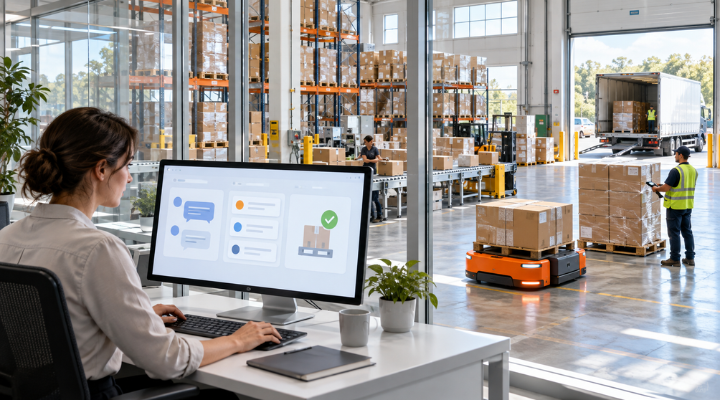
Few domains are as complex and disruption prone as supply chain management. Global dependencies, volatile demand, geopolitical instability, and climate risks all converge to create an environment where static automation simply doesn’t cut it. This is where Agentic AI steps in as a strategic orchestrator.
With global disruptions up by 38 % since 2020, Agentic AI now fills the real-time decision gap. Unlike traditional AI systems that require human-defined parameters, Agentic AI can independently sense, decide, and act across the entire supply chain ecosystem.
It doesn't wait for planners to raise a red flag but proactively identifies anomalies such as delayed shipments, capacity shortfalls, or fluctuating lead times. Thereon, it autonomously formulates and executes mitigation plans.
Let’s say a port shuts down unexpectedly. A traditional system would wait for human input. But an Agentic AI system? It immediately finds new suppliers, reroutes shipments, and updates everyone involved automatically.
It can even simulate different future scenarios to determine the most resilient course of action before problems escalate.
Moreover, these intelligent agents don’t operate in silos. They can integrate with ERP systems, supplier APIs, transportation management platforms, and demand forecasting tools to coordinate actions across multiple nodes in real time.
As enterprises pursue resilience and agility, Agentic AI enables a shift from reactive firefighting to proactive and autonomous orchestration. I have found that it empowers supply chains to be self-corrective and continuously optimizing to business needs, without needing human intervention at every decision point.
For supply chain leaders, this marks a futuristic paradigm shift: from managing operations manually to deploying a digital control tower with built-in decision-making intelligence. As supply chains demonstrate the real-world potential of Agentic AI, it's clear that we're entering a new era where AI doesn’t just support decisions but actively drives them.
Related read - Top Agentic AI Benefits
Charting a Smarter Future with Agentic Intelligence: Summing Up
As AI is advancing by the day, the path forward for our industries and businesses lies in moving ahead toward true autonomy, beyond simple automation. It's true that AI agents offer great values to businesses in terms of speed and efficiency, Agentic AI is emerging as the new face of transformation that takes efficiency to the next level and enables systems to reason, adapt, and act across dynamic environments. Together, they can take the business from basic automation to advanced and autonomous orchestration.
The supply chain management industry is already witnessing the immense impact brought in with agentic systems. However, the potential of Agentic systems extends far beyond logistics: into finance, healthcare, cybersecurity, and more.
The future belongs to enterprises that balance the complementary roles of AI agents in automating tasks today and Agentic AI in evolving operations with autonomy. Decision-makers should focus on driving innovation with governance, understand where AI agents should be deployed, and where is the need to upgrade the agent system and adopt intelligent and autonomous decision-making systems. Agentic AI isn’t just another tech trend, but a foundational shift in how enterprises will operate, compete, and grow.
Those who invest now in AI agents, and possibly Agentic AI systems, will lead the industries of tomorrow.
Position Your Business for What’s Next—with Agentic AI
The future of enterprise isn’t just automated—it’s adaptive, autonomous, and agentic.
In the present world that’s driven with volatile, rapid changes and rising complexities are not going away anytime soon. Integrating Agentic AI today isn’t just an upgrade; it’s a strategic advantage.
Start where it makes the most impact, your supply chain and let intelligence steer your business, navigate from disruptions, and deliver growth at all times. It’s not about replacing people, but empowering decisions. And the sooner you begin, the more prepared your enterprise will be for tomorrow.
If you're wondering where Agentic AI can create the most impact in your business, let’s explore it together. 3SC experts can walk you through a no-obligation use-case assessment. Start small, scale smart, and future-proof your enterprise with 3SC’s Agentic AI capabilities.