Key Takeaways
- S&OP aligns supply and demand; IBP aligns the entire business.
- IBP evolves from S&OP by integrating finance and strategy.
- S&OP drives operational coordination, IBP drives business decisions.
- IBP connects supply chain, finance, and leadership in one plan.
- IBP enables smarter trade-offs through cross-functional scenarios.
- Modern supply chains are shifting from S&OP toward IBP.
Planning has long been the backbone of supply chain management. Yet for many organizations, planning processes that once worked well are now struggling to keep pace with the complexity of modern business. In fact, nearly 94% of organizations report revenue impact from supply chain disruptions, highlighting how traditional planning approaches are being tested like never before. Demand signals shift faster, supply networks span continents, and leadership teams expect operational decisions to translate directly into financial outcomes.
In this environment, planning is no longer just about coordinating operations. It is about ensuring that the entire organization moves in the same direction, with clarity, alignment, and purpose.
For decades, Sales and Operations Planning (S&OP) has served as the primary mechanism to bring structure to this challenge. It created a shared forum where sales, operations, and supply chain teams could evaluate forecasts, balance constraints, and agree on a feasible path forward.
But as organizations have grown more complex, so have the expectations from planning itself.
S&OP: Bringing Operational Alignment
Sales and Operations Planning emerged to solve a fundamental coordination problem within organizations. Sales teams forecast demand based on market opportunities, while operations teams focus on production capacity and supply constraints. Without a structured process, these perspectives can easily diverge.
Typically conducted on a monthly cadence, the process begins with data gathering, reviewing demand signals, inventory positions, promotional plans, and supply constraints. Demand and supply plans are developed in parallel and then reconciled through cross-functional discussions, where trade-offs are evaluated and adjustments are made. The cycle concludes with an executive review that aligns leadership around a single plan.
When implemented effectively, S&OP improves forecast reliability, stabilizes service levels, and brings visibility across functions that might otherwise operate in isolation.
However, as organizations scale and business environments become more dynamic, the limitations of S&OP begin to surface. The process is primarily operational in focus, often stopping short of fully connecting decisions to financial outcomes. Plans may be aligned from a volume perspective, but not always from a value perspective. In addition, the monthly cadence can struggle to keep pace with rapidly shifting demand, supply disruptions, and evolving market conditions.
This creates a gap, between operational alignment and strategic, financially informed decision-making.
The Evolution from S&OP to IBP
Integrated Business Planning builds on the foundation established by S&OP but expands its scope to connect operations, finance, and strategy within a single planning framework.
Rather than focusing only on balancing demand and supply, IBP links operational plans to financial outcomes. Demand forecasts translate into revenue projections, supply decisions are evaluated for cost implications, and trade-offs are assessed based on their impact on margins, working capital, and growth.
While S&OP asks, “Can we execute this plan?”, IBP asks “Should we, and what does it mean for the business if we do?” This shift moves planning beyond volumes and constraints into value and outcomes.
In practice, this evolution also changes how the planning cycle operates. In addition to traditional demand and supply reviews, IBP introduces steps such as product or portfolio reviews and financial reconciliation stages. These ensure that decisions are evaluated not just for feasibility, but for their impact on overall business performance.
IBP also deepens how functions work together. Finance, commercial, and operations teams operate from a shared set of assumptions, metrics, and scenarios, creating a unified view of the business.
Importantly, IBP does not replace S&OP, it extends it. It represents a natural progression in the maturity of planning capabilities.
S&OP vs IBP: Understanding the Difference
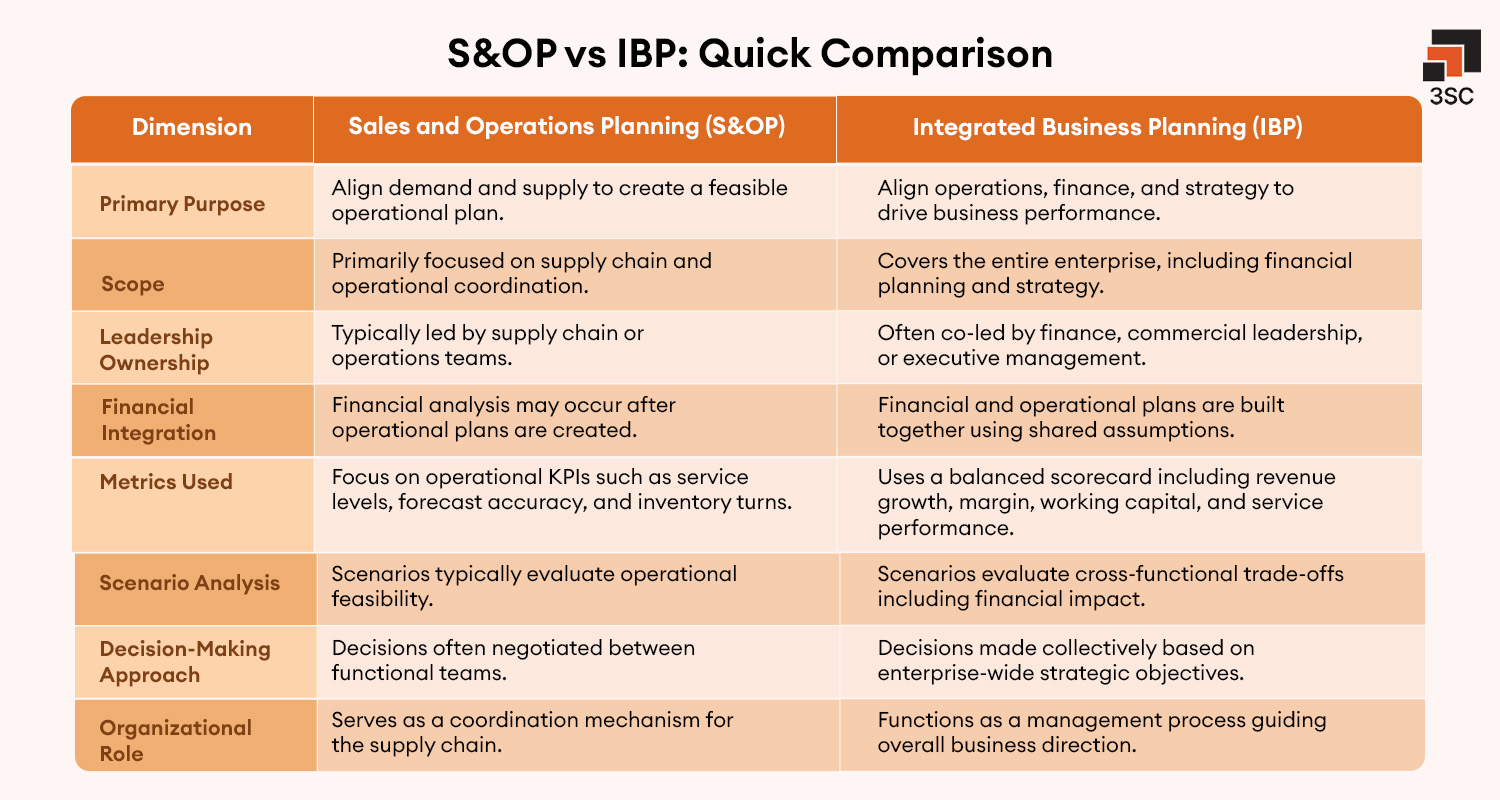
While S&OP and IBP share common roots, their scope and impact differ significantly.
Dimension | Sales and Operations Planning (S&OP) | Integrated Business Planning (IBP) |
Primary Purpose | Align demand and supply to create a feasible operational plan. | Align operations, finance, and strategy to drive business performance. |
Scope | Primarily focused on supply chain and operational coordination. | Covers the entire enterprise, including financial planning and strategy. |
Leadership Ownership | Typically led by supply chain or operations teams. | Often co-led by finance, commercial leadership, or executive management. |
Financial Integration | Financial analysis may occur after operational plans are created. | Financial and operational plans are built together using shared assumptions. |
Metrics Used | Focus on operational KPIs such as service levels, forecast accuracy, and inventory turns. | Uses a balanced scorecard including revenue growth, margin, working capital, and service performance. |
Scenario Analysis | Scenarios typically evaluate operational feasibility. | Scenarios evaluate cross-functional trade-offs including financial impact. |
Decision-Making Approach | Decisions often negotiated between functional teams. | Decisions made collectively based on enterprise-wide strategic objectives. |
Organizational Role | Serves as a coordination mechanism for the supply chain. | Functions as a management process guiding overall business direction. |
This distinction reflects a broader shift in perspective. While S&OP focuses on operational efficiency, IBP connects planning to enterprise value.
Planning Beyond 2026: A More Integrated Future
In 2026, planning moves beyond rigid monthly cycles. With the integration of real-time data streams and AI-driven orchestration, planning is evolving into a continuous, always-on capability, a dynamic pulse of the business rather than a periodic checkpoint. As volatility becomes the norm and disruptions continue to reshape supply chains, static plans lose relevance faster than ever.
The boundaries between operational planning and business planning will continue to blur. Decisions will increasingly be made in near real time, informed by synchronized data across demand, supply, and financial systems.
In this environment, the progression from S&OP to IBP represents more than a process change. It reflects a shift in how organizations think about planning itself, from a periodic exercise to an embedded, enterprise-wide capability.
For organizations navigating uncertainty, the advantage will not come from choosing between frameworks, but from building planning processes that combine operational discipline with strategic insight.
Conclusion
The evolution from S&OP to IBP marks a shift in how organizations approach decision-making.
In a more volatile and interconnected environment, planning can no longer operate within functional boundaries or focus solely on execution feasibility. It must connect decisions to outcomes, operations to strategy, and plans to measurable business impact.
The organizations that succeed will not be those that plan more, but those that plan better, continuously, collaboratively, and with a clear understanding of value.
For many, Integrated Business Planning provides the foundation to make that shift possible.