Key Takeaways
- S&OP aligns sales forecasts with operational capacity.
- SIOP adds inventory as a strategic planning element.
- S&OP focuses on alignment; SIOP focuses on optimization.
- SIOP suits businesses with complex supply chains and high inventory.
- Businesses with large inventories benefit most from SIOP.
When you walk into any supply chain planning meeting, you quickly hear a mix of acronyms like S&OP, SIOP, IBP, and more. For someone new to the field, it can feel like learning an entirely new language. Even experienced professionals sometimes wonder whether these terms represent meaningful differences or simply different labels for the same process.
But behind these acronyms lies a bigger story about how organizations plan, collaborate, and make decisions. The way a company manages demand forecasts, production capacity, inventory and other operations can determine whether it runs smoothly or constantly reacts to problems.
Understanding the difference between Sales & Operations Planning (S&OP) and Sales, Inventory & Operations Planning (SIOP) is not just a theoretical exercise. It reveals how supply chain planning has evolved and why many businesses are expanding their planning processes to include inventory as a strategic decision. To see why that matters, we first need to understand where planning challenges begin.
The Challenge of Aligning Sales and Operations
Imagine a growing manufacturing company preparing for the next quarter. The sales team forecasts strong demand and launches aggressive promotions. Meanwhile, the operations team is focused on maintaining production efficiency and managing supplier lead times. Finance, on the other hand, is watching inventory costs rise and wondering why so much capital is tied up in warehouses.
Each department is acting with good intentions, but without alignment the organization quickly faces problems. Customers may experience stockouts even while excess inventory sits in the wrong locations. Production schedules change constantly, creating inefficiencies across the factory floor. Financial targets become harder to meet because decisions are made without considering their broader impact.
These challenges are exactly why structured planning processes emerged in supply chain management. Companies needed a way to bring different functions together, align their assumptions, and agree on a single operational plan. This need for coordination eventually led to the widespread adoption of Sales and Operations Planning, commonly known as S&OP.
What is Sales and Operations Planning (S&OP): The Foundation of Collaborative Planning
At its core, Sales and Operations Planning (S&OP) is a cross-functional planning process designed to align demand with supply. Instead of each department planning independently, the organization works together to develop one coordinated view of the future.
In practical terms, this means sales teams share their demand forecasts, operations evaluates whether production and procurement can support that demand, and leadership reviews the resulting plan to ensure it supports business goals. The process typically unfolds in a recurring monthly cycle that includes data analysis, demand planning, supply planning, and executive review.
When implemented effectively, S&OP offers several benefits. It improves communication across departments, supports better forecasting, and helps organizations respond more confidently to market changes. Organizations implementing structured S&OP processes have seen forecast accuracy improve by as much as 20%, demonstrating how better cross-functional planning can significantly enhance operational efficiency. For many companies, particularly service businesses or make-to-order manufacturers, this alignment between demand and supply is exactly what they need.
Yet as supply chains grew more complex, many organizations began to realize that balancing only demand with supply is only part of the equation. The real challenge often lay in how inventory was managed within that balance.
The Hidden Role of Inventory in Planning
Inventory sits at the centre of most supply chains. It acts as a buffer between production and customer demand, absorbing fluctuations in sales and supply disruptions. Without inventory, companies would struggle to maintain consistent service levels.
But inventory also represents a significant financial investment. Every pallet stored in a warehouse ties up working capital, requires storage space, and carries the risk of obsolescence or damage. Too little inventory leads to missed sales opportunities, while too much inventory can strain cash flow and increase operating costs.
In S&OP processes, inventory is often treated as a by-product of planning decisions. If production exceeds demand, inventory rises. If demand exceeds supply, inventory falls. The process focuses primarily on balancing demand forecasts with supply capabilities.
However, as organizations gained access to more advanced analytics and better data systems, many realized they could manage inventory more deliberately. Instead of letting inventory levels emerge from planning decisions, they could actively design inventory strategies to improve service levels, reduce costs, and optimize working capital.
This shift in thinking led to the emergence of Sales, Inventory, and Operations Planning, or SIOP.
What is Sales, Inventory & Operations Planning (SIOP) and Why Was It Introduced?
SIOP builds on the foundation of S&OP but places explicit emphasis on inventory as a strategic lever in planning. While the core structure of the process remains similar, the perspective changes significantly.
In S&OP discussion, the central question is whether supply can meet projected demand. In SIOP, the conversation expands to include inventory strategy as well. Instead of asking only whether the company can produce enough products, planners also ask how inventory should be positioned to meet service targets while managing costs.
This shift has important implications for decision-making. Inventory becomes an input into the planning process rather than just an output. Companies begin evaluating questions such as whether certain products should have higher safety stock levels, whether inventory should be relocated between regions, or whether production plans should change to improve inventory turnover.
By elevating inventory to a strategic role, SIOP connects operational planning more closely with financial performance. Companies that incorporate inventory optimization into their SIOP process have reported 15–30% reductions in inventory costs and around a 25% improvement in service levels within the first year, highlighting how strategic inventory planning can significantly improve supply chain performance. Inventory is not just a physical asset; it is also cash tied up in the supply chain. Managing it effectively can improve working capital, increase service levels, and reduce unnecessary costs.
As a result, SIOP often brings finance indirectly into planning discussions through inventory management. Decisions about inventory levels influence financial metrics such as cash flow, inventory turns, and return on investment. Planning becomes not only operational but also a little financial in nature.
Key Differences Between S&OP and SIOP
By now, you might be wondering whether S&OP and SIOP are fundamentally different processes or simply two versions of the same idea. In reality, they share many similarities in structure, but the focus and outcomes of each approach differ in important ways.
Understanding these differences helps organizations decide how far they need to evolve their planning process.
1. Primary Planning Focus
S&OP concentrates on aligning demand forecasts with supply capabilities, ensuring the organization can produce or procure what it plans to sell, while SIOP expands the discussion by including inventory optimization alongside demand and supply.
2. Role of Inventory
In S&OP, inventory often emerges as a result of the plan but in SIOP, inventory becomes an active strategic decision, managed deliberately to balance service levels and financial performance.
3. Financial Perspective
S&OP mainly focuses on operational feasibility and revenue expectations, whereas SIOP connects planning decisions more directly with working capital, cash flow, and inventory investment.
4. Planning Complexity
S&OP works well for organizations with simpler supply chains or limited inventory exposure. SIOP is typically adopted by businesses that manage large product portfolios or complex distribution networks.
5. Decision-Making Depth
S&OP focuses on creating a feasible operational plan while SIOP focuses on optimizing resources and assets, especially inventory.
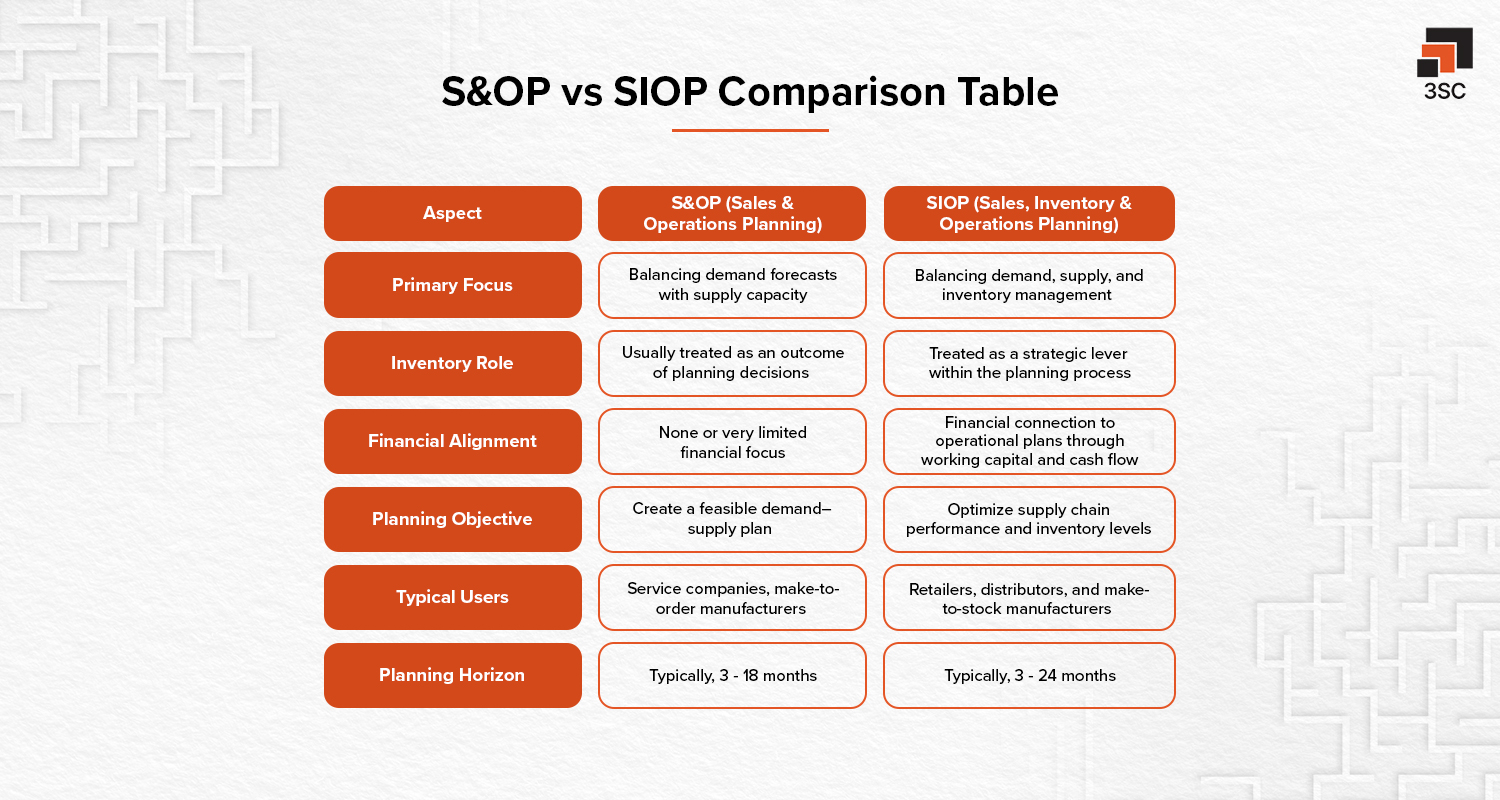
S&OP vs SIOP - Comparison Overview
Aspect | S&OP (Sales & Operations Planning) | SIOP (Sales, Inventory & Operations Planning) |
Primary Focus | Balancing demand forecasts with supply capacity | Balancing demand, supply, and inventory management |
Inventory Role | Usually treated as an outcome of planning decisions | Treated as a strategic lever within the planning process |
Financial Alignment | None or very limited financial focus | Financial connection to operational plans through working capital and cash flow |
Planning Objective | Create a feasible demand–supply plan | Optimize supply chain performance and inventory levels |
Typical Users | Service companies, make-to-order manufacturers | Retailers, distributors, and make-to-stock manufacturers |
Planning Horizon | Typically, 3 - 18 months | Typically, 3 - 24 months |
These differences may appear subtle at first glance, but they reflect a deeper shift in how companies approach supply chain management. While S&OP focuses on alignment, SIOP emphasizes optimization, particularly when inventory plays a critical role in business performance.
With that understanding in place, it becomes easier to see how these processes fit into the broader evolution of supply chain planning.
When Do You Need SIOP Instead of S&OP?
Not every organization needs to move beyond S&OP. However, as inventory complexity increases, planning must evolve from simply balancing demand and supply to actively managing inventory as a strategic asset that impacts both service and financial performance.
1. Inventory as a Core Planning Driver
For make-to-order or service-driven businesses, inventory plays a minimal role, making S&OP sufficient. However, in inventory-driven environments, inventory is no longer just an outcome of planning; it becomes a central element that shapes decisions across the supply chain.
2. Balancing Service Levels and Cost Efficiency
Retailers, distributors, and make-to-stock manufacturers constantly operate within a trade-off between product availability and cost efficiency. While insufficient inventory can lead to missed sales opportunities, excess inventory ties up working capital and limits financial flexibility, making this balance increasingly difficult to manage.
3. End-to-End Planning Visibility
As operations grow more complex, isolated planning decisions are no longer sufficient. Organizations need a clearer understanding of how choices made in demand and supply planning impact both service levels and financial outcomes. This is where SIOP adds value by bringing inventory into a more integrated, end-to-end planning framework.
4. Managing Scale and Complexity
Businesses managing large product portfolios, thousands of SKUs, and multiple markets face inherent planning challenges. Coordinating inventory across such scale requires a more structured and interconnected approach, as S&OP alone may not fully address the operational and financial trade-offs involved.
5. From Reactive Planning to Strategic Decision-Making
At higher levels of complexity, planning can no longer remain reactive. Organizations need the ability to anticipate risks, align inventory decisions with broader business objectives, and make forward-looking choices. SIOP enables this shift by transforming planning into a more strategic capability.
When inventory begins to shape both operational performance and financial outcomes, evolving from S&OP to SIOP becomes not just beneficial, but essential.
Final Thoughts
Supply chains today operate in an environment defined by uncertainty, changing customer expectations, and increasing complexity. Planning processes like S&OP and SIOP help organizations navigate that uncertainty by creating alignment and visibility across departments.
Sales and Operations Planning (S&OP) provides the foundation by ensuring demand and supply plans are coordinated. Inventory & Operations Planning (SIOP) builds on that foundation by recognizing inventory as a strategic lever that affects both operational performance and financial health. For companies with significant inventory investments, adding that “I” to the planning process can transform how decisions are made. Instead of reacting to imbalances, organizations gain the ability to manage inventory proactively and align operational plans with financial goals.
In the end, the most effective supply chains are not defined by the acronyms they use. They are defined by their ability to plan collaboratively, adapt quickly, and make decisions that balance customer service with operational efficiency.
Turn Planning into Smarter Supply Chain Decisions
S&OP helps organizations align sales forecasts with operational capacity, while SIOP goes a step further by treating inventory as a strategic lever. In an increasingly complex supply chain environment, the ability to balance demand, supply, and inventory effectively is what separates efficient operations from constant firefighting.
Connect with us to explore how stronger planning processes can help your organization optimize inventory, improve service levels, and build a more resilient supply chain.