Key Takeaways
- Continuous optimisation keeps CPG networks agile amid shifting consumer demand.
- Real-time modelling helps CPG brands balance cost, speed, and service.
- Smarter network design cuts freight costs and improves product availability.
- Data-driven planning strengthens supplier reliability and sustainability goals.
- Adaptive CPG supply chains turn volatility into a competitive advantage.
In today’s volatile business landscape, even the most well-structured supply chains face constant pressure from unexpected disruptions. Studies show that events lasting a month or more now occur roughly every 3.7 years, reducing annual profits by nearly one-third over a decade. Once rare, these shocks have become a recurring reality, testing the agility and endurance of even the most efficient networks.
The Consumer-Packaged Goods (CPG) industry operates in one such unpredictable and fast-evolving environment, where shifting consumer preferences, sudden demand surges, and mounting sustainability expectations have turned supply chain stability into a strategic imperative.
The New Reality of the CPG Supply Chain
The CPG world moves fast. What once felt like a strength; variety, speed, and scale now feel like a balancing act. Consumers are changing their minds faster than factories can produce or trucks can deliver. One week it’s a new flavour, the next it’s a new channel, while transport and energy costs keep everyone guessing.
Businesses can almost picture it like a shopper clicking “buy now,” expecting their favourite product to arrive tomorrow, sustainably sourced and perfectly packaged, all at the same price. Behind that simple click is a vast network of suppliers, plants, and retailers, all working in sync to make it happen. That’s why the old approach no longer works. Reviewing supply networks every few years feels like standing still on a moving walkway. The leaders of today’s CPG industry don’t wait for change, they build supply chains that learn, adapt, and evolve every single day.
For CPG companies competing in high-volume, low-margin markets, the ability to recover fast and sustain service levels has become the ultimate differentiator. The path forward lies in network optimisation; a dynamic, technology-driven approach that continuously improves how supply chains are designed and executed.
What is Network Optimisation?
Network optimisation is the structured process of designing and re-designing the end-to-end supply chain network suppliers, plants, Distribution Centres, transportation lanes, and service policies using data, constraints, and objectives to find the configuration that best balances cost, service, risk, and sustainability under current and projected conditions.
In practice, it means businesses can simulate choices, compare trade-offs, and implement the layout that delivers the best outcome for today, then repeat the exercise as conditions change.
Rethinking Resilience Through Network Optimisation for CPG Brands
The global supply chain is facing more disruption today than ever before. From geopolitical tensions and volatile fuel prices to shifting consumer expectations and climate-related risks, uncertainty has become the new constant. Businesses can no longer rely on static systems or periodic planning to survive. To stay competitive, they must build resilience and network optimisation is at the heart of that transformation, especially for CPG brands.
It gives supply chain leaders the tools to simulate, analyse, and reshape their networks in real time, ensuring every plant, warehouse, supplier, and route works in perfect balance. It's not a one-time project; it’s a continuous process of fine-tuning for both cost efficiency and resilience. With advanced scenario modelling, you can test countless “what-if” situations before they happen.
- What if fuel prices suddenly spike by 20 percent?
- What if a major port shuts down?
- Which supplier mix keeps costs low without risking reliability?
According to Gartner, the most advanced supply chain design tools help you evaluate all these variables at once, revealing the smartest configuration for any condition. In essence, network optimization turns guesswork into strategy, helping you turn uncertainty into opportunity.
The Core Benefits of Continuous Network Optimisation
Network optimisation delivers long-term advantages that go far beyond cost savings. It builds supply chains that are intelligent, adaptable, and aligned with business growth.
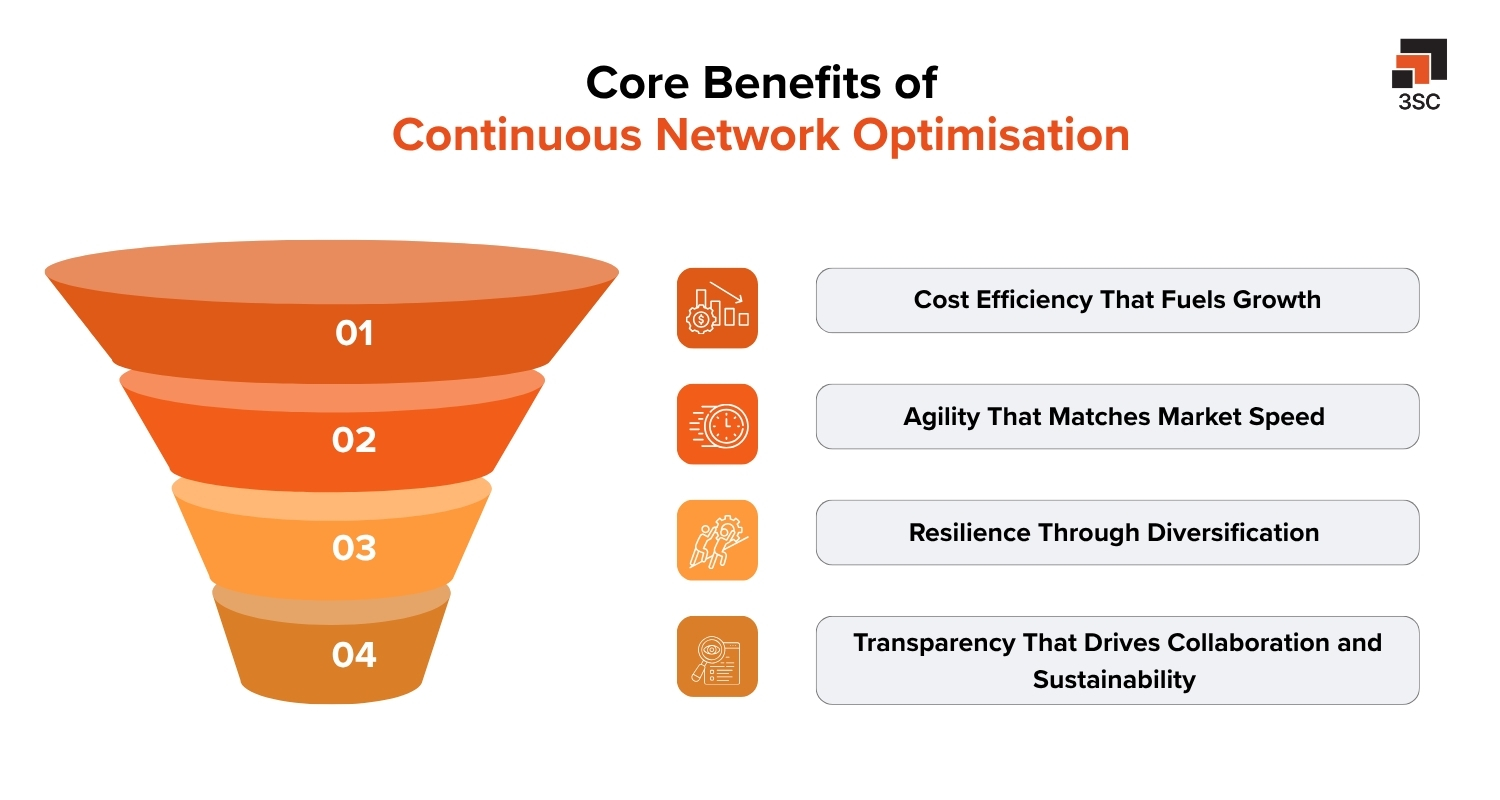
1. Cost Efficiency That Fuels Growth
In the CPG world, even small inefficiencies can drain margins. Network optimization uncovers where costs hide in transport routes, warehouse capacity, or supplier networks and reconfigures them for smarter flow. By connecting production, storage, and distribution decisions, companies can cut logistics costs, free up working capital, and channel savings into innovation, brand expansion, or sustainability. Efficiency becomes a growth engine.
2. Agility That Matches Market Speed
Consumer demand never sits still. Promotions, seasonal spikes, and lifestyle shift constantly reshape what, where, and how much people buy. With continuous optimisation, planners model product launches, regional shifts, and disruption scenarios in near-real time so factories, inventory, and deliveries stay in sync. This agility prevents stockouts and keeps brands relevant in fast-moving markets.
3. Resilience Through Diversification
Shocks are inevitable, but chaos isn’t. An optimized network is built to bend, not break. By simulating disruption scenarios from supplier shutdowns to fuel price hikes leaders can plan smarter. Diversified suppliers, alternate routes, and multi-region sourcing ensure operations don’t grind to a halt. When disruption strikes, the best networks don’t scramble they pivot.
4. Transparency That Drives Collaboration and Sustainability
Modern optimization platforms link every part of the supply chain, from procurement to last-mile delivery, creating one clear view of operations. This visibility fuels better collaboration with suppliers and logistics partners while advancing sustainability goals. By modelling greener routes, reducing empty miles, and optimizing loads, companies cut emissions without compromising service. In doing so, they build supply chains that are not only smarter but also more responsible.
In short, continuous network optimisation transforms supply chains from static systems into living, learning networks built to thrive in uncertainty.
How to Enable Continuous Network Optimisation
To make network optimisation truly continuous, organisations need to treat it as an ongoing business process rather than a technology project. McKinsey’s analysis found that organisations integrating digital optimisation into their operations are 2.5 times more likely to recover quickly from disruptions and outperform competitors in service and profitability.
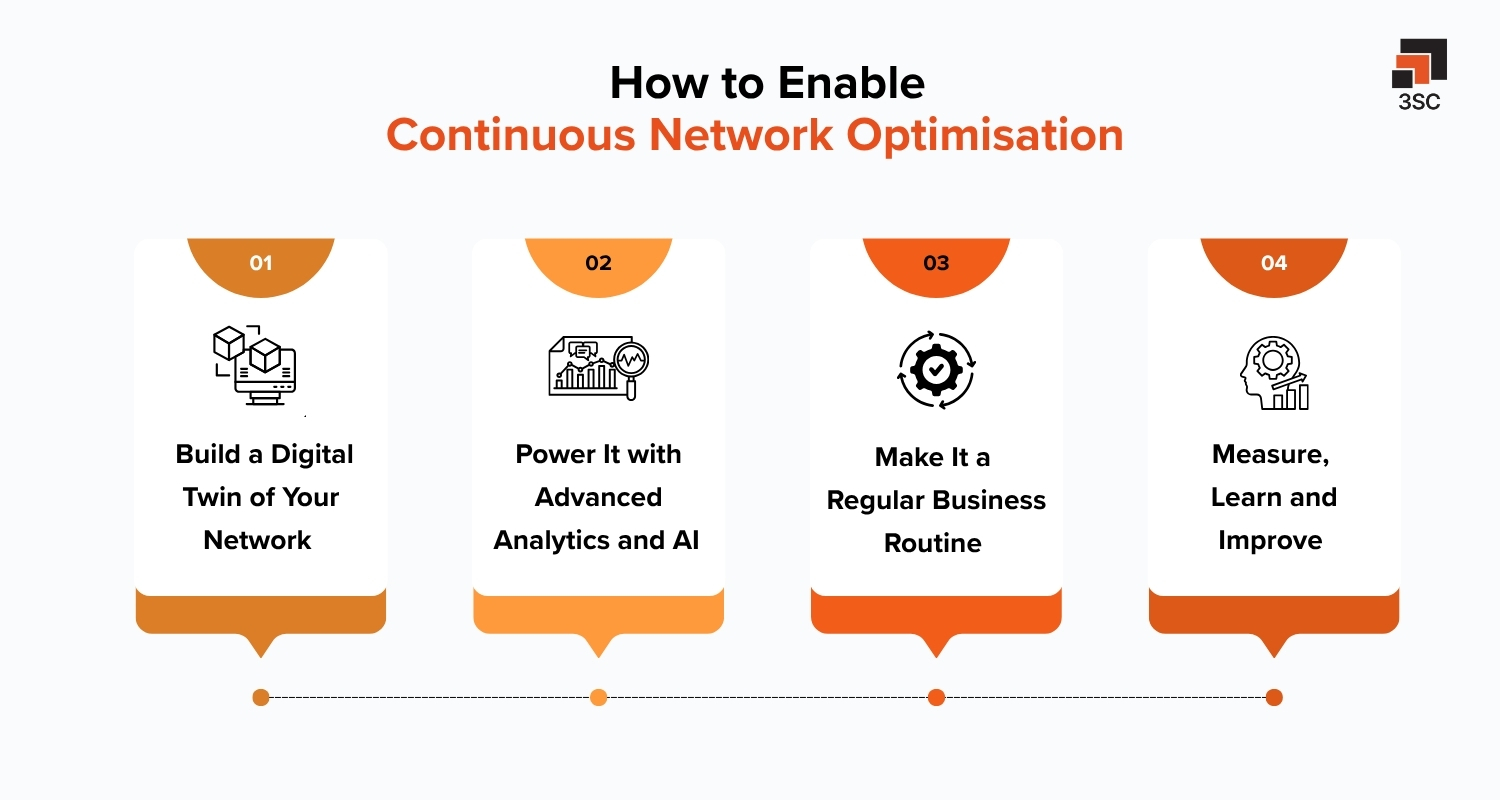
1. Build a Digital Twin of Your Network
Create a virtual replica of your supply chain that includes every supplier, factory, warehouse, transportation lane, and customer node. This digital twin lets you simulate real-world scenarios like demand surges, supplier failures, or fuel price hikes without disrupting operations. You can test decisions safely and identify the best network configuration before acting.
2. Power It with Advanced Analytics and AI
Once the digital twin is in place, analytics and AI turn it into an intelligent decision-making engine. Optimisation algorithms identify the most cost-effective designs, while machine learning predicts risks and demand shifts. Automated insights highlight where trade-offs exist between cost, service, and sustainability so leaders can act with data, not guesswork.
3. Make It a Regular Business Routine
Continuous optimisation only works when it’s built into your business rhythm. Set a regular cadence quarterly or even monthly where cross-functional teams review the latest data, run new scenarios, and adjust the network as needed. This ensures the supply chain always aligns with changing costs, capacity, and customer expectations.
4. Measure, Learn, and Improve
Establish clear KPIs to track the impact of every network change metrics like total landed cost per case, on-shelf availability, lead-time reliability, and carbon footprint. Use these results to refine the next round of optimisation, creating a continuous feedback loop. Over time, this builds a self-improving supply chain that grows smarter with each cycle.
As supply chains become more interconnected and unpredictable, continuous network optimisation isn’t just a choice; it’s the foundation for lasting resilience.
Conclusion - Building a Resilient Future
In today’s high-velocity markets, supply chain resilience is no longer about merely bouncing back, it’s about moving forward stronger. Network optimisation enables CPG companies to design systems that anticipate, adapt, and evolve in step with changing market conditions.
By continuously refining their networks, businesses can predict and prepare for future disruptions, maintain service excellence while keeping costs under control, and advance sustainability goals without compromising performance. This ongoing process builds agile, customer-centric supply chains that are equipped to meet tomorrow’s challenges. In an unpredictable world, the strongest supply chains aren’t rigid; they’re responsive and network optimisation transforms that responsiveness into a lasting competitive advantage, allowing CPG companies not just to withstand disruption but to thrive in it.
Partner with 3SC for Intelligent, Resilient Supply Chains
At 3SC, we help businesses move beyond traditional planning with AI-driven insights, end-to-end visibility, and collaborative supply chain solutions. From reducing risks to improving agility and resilience, our expertise ensures your supply chain isn’t just prepared for today’s challenges but ready to thrive in tomorrow’s uncertainty.
Discover how 3SC can transform your supply chain into a strategic advantage- 3SC | Leading AI-Driven Supply Chain Solutions & Analytics Provider
Recommended For You
- Demand Planning vs Supply Planning
- What is New Product Introduction?
- AI in Supply Chain Planning
- Risk Management in Steel Supply Chain Planning
- Freight Rate Volatility
- What is Supply Chain Planning?