Highlights
- IBP turns planning into an enterprise discipline.
- AI strengthens forecast accuracy and risk visibility.
- One integrated plan aligns demand, supply, and finance.
- IBP protects service, margin, and working capital.
- Structural rigor replaces reactive reconciliation.
If you lead supply chain in a CPG organization, you’ve likely noticed that growth changes the nature of planning. The global CPG market, valued at over USD 3.45 trillion in 2025, is projected to reach approximately USD 4.24 trillion by 2030, growing at around 4.2% annually. That scale of expansion amplifies complexity across portfolios, channels, and supply networks.
What once felt manageable through strong functional coordination begins to demand tighter alignment. Forecast discussions carry larger financial implications. Promotional plans - baseline versus uplift - influence capacity, material availability, and inventory more materially. Working capital reviews become more central to operational conversations. Service metrics such as fill rate and OTIF are no longer operational KPIs alone; they directly reflect enterprise alignment.
Nothing is necessarily broken. The teams are capable. The systems are in place.
But the margin for misalignment narrows.
In this environment, planning can no longer operate as parallel functional activities stitched together through reconciliation. It must function as an integrated enterprise discipline —connecting demand, supply, and financial commitments within one coherent framework.
That is the role Integrated Business Planning (IBP) is meant to play.
In modern CPG environments defined by volatility, promotional intensity, and margin pressure, IBP is not a process enhancement. It is the structural foundation that ensures commercial ambition, operational feasibility, and financial performance move in sync.
When Planning Becomes Enterprise-Level
In CPG, a forecast adjustment is rarely isolated.
A promotional uplift influences production sequencing, material requirements planning, supplier schedules, distribution capacity, safety stock assumptions, and gross margin realization. A sourcing delay impacts service levels, retailer penalties, and OTIF performance. A working capital target shapes replenishment policies and inventory positioning, particularly in categories exposed to shelf-life risk and markdown exposure.
These are interconnected enterprise decisions.
Without an integrated framework, organizations compensate through reactive coordination. Demand plans evolve independently. Supply adjusts to constraints. Finance reconciles performance after execution. Inventory absorbs uncertainty.
IBP integrates demand, supply and finance into one aligned planning structure. It establishes one integrated plan across functions - ensuring trade-offs are evaluated collectively before commitments cascade into execution.
That alignment protects service levels, margins, and capital simultaneously.
The Enterprise Value IBP Brings to CPG
When strengthened by embedded artificial intelligence within the planning architecture - across forecasting, exception detection, and scenario evaluation - IBP enhances enterprise performance across five interconnected dimensions.
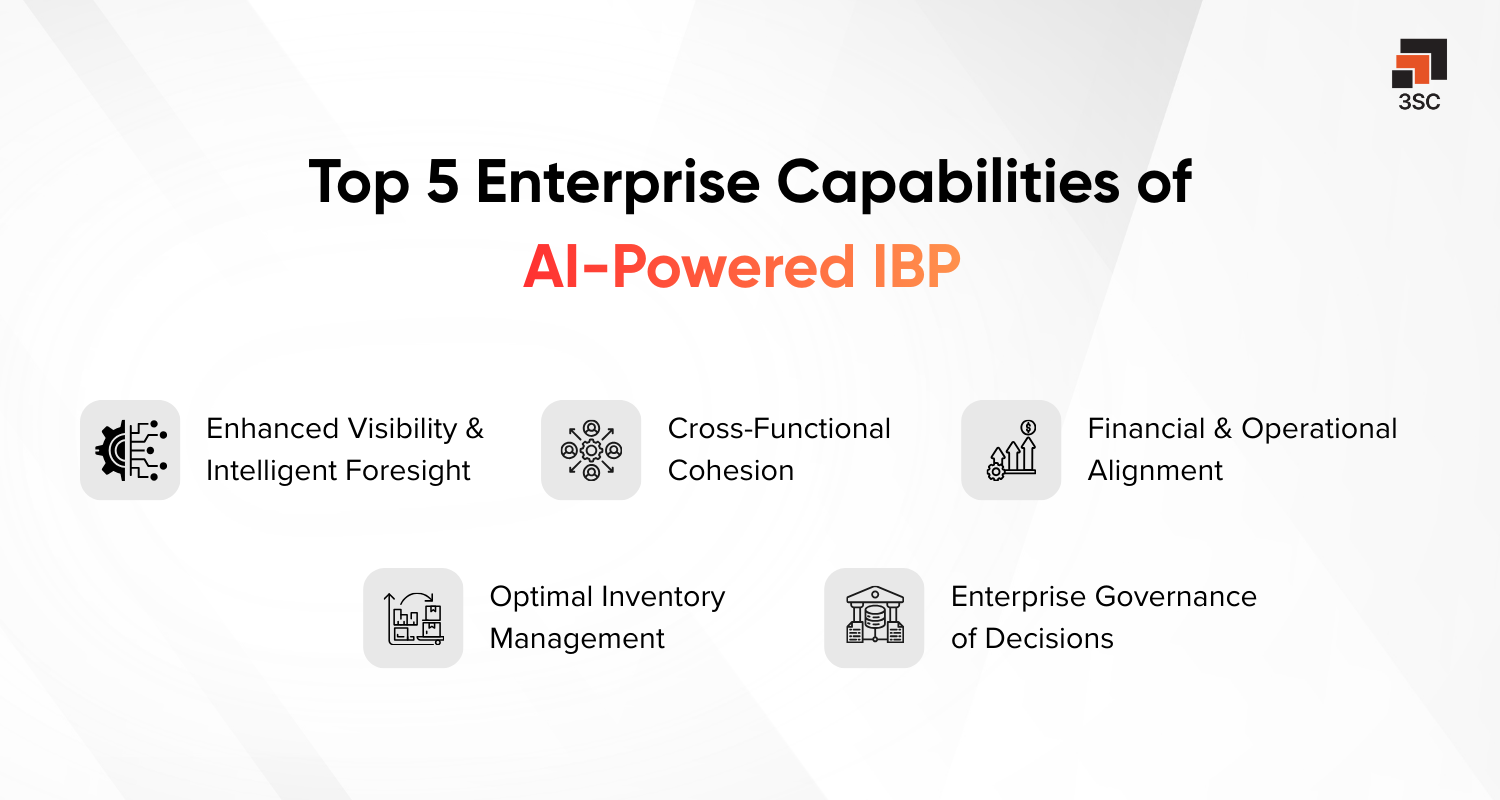
Top 5 Enterprise Capabilities of AI-Powered IBP for CPG Supply Chains
- Enhanced Visibility & Intelligent Foresight
- Cross-Functional Cohesion
- Financial & Operational Alignment
- Optimal Inventory Management
- Enterprise Governance of Decisions
1. Enhanced Visibility & Intelligent Foresight
Everything begins with credible visibility.
CPG volatility is structural. Promotions distort baseline demand. Omnichannel strategies compress decision windows. Supplier reliability fluctuates. Input costs shift rapidly.
Modern IBP platforms provide end-to-end visibility across demand signals, supply constraints, inventory exposure, and financial implications.
AI-powered demand forecasting stabilizes signals across channels, reducing forecast bias and limiting excessive manual overrides. Machine learning models detect anomalies - unexpected demand surges, capacity imbalances, supplier variability - before they escalate into service or margin impact.
Visibility does not eliminate disruption. It strengthens foresight and creates a shared understanding of risk exposure.
2. Cross-Functional Cohesion
Once visibility is shared, integration becomes possible.
Planning inefficiencies in CPG often stem from siloed cycles and metrics. Sales optimizes revenue growth. Supply chain prioritizes service levels and operational efficiency. Finance focuses on profitability and cash flow.
IBP brings these perspectives into one structured cadence. Demand assumptions, supply constraints, promotional calendars, and financial targets are reviewed within a unified framework. Trade-offs are visible across functions rather than negotiated in isolation.
The outcome is not multiple versions of the truth - but one integrated plan anchored in shared assumptions.
When reinforced by unified data architecture and AI-powered insights, reconciliation effort decreases and collaboration strengthens.
3. Financial & Operational Alignment
With integration in place, financial discipline can be embedded directly into operational planning.
In CPG, profitability is shaped by product mix, promotional intensity, cost-to-serve, and working capital efficiency. IBP integrates revenue, gross margin, and cash implications into the same planning architecture as demand and supply.
Commercial initiatives are evaluated against production feasibility, sourcing constraints, and cost structures before commitments are finalized. Variances are assessed in terms of enterprise impact rather than isolated KPIs.
Finance becomes an integrated planning partner rather than a downstream reconciler. This alignment reduces margin erosion and ensures supply chain decisions directly support enterprise profitability.
4. Optimal Inventory Management
One of the most tangible outcomes of effective IBP is disciplined inventory management.
Inventory is among the largest working capital levers in CPG - and often the first indicator of planning misalignment.
Disconnected forecasting and supply planning lead to excess safety stock, aged inventory, or service risk. IBP aligns replenishment strategies with demand variability, agreed service levels, shelf-life considerations, and capital objectives.
[Related read - Demand Planning vs Supply Planning]
When AI-ML–driven forecasting improves demand signal reliability, replenishment becomes more precise. Inventory reflects strategic positioning rather than defensive buffering.
The result is improved capital efficiency without compromising service performance.
5. Enterprise Governance of Decisions
As portfolios expand and supply networks grow more interconnected, trade-offs become more complex - service versus cost, growth versus capacity, margin versus volume.
IBP provides the governance structure within which these trade-offs are debated explicitly. Leaders evaluate integrated demand, supply, and financial scenarios before commitments are finalized. Scenario modelling embedded in the planning workflow ensures alternatives are assessed deliberately rather than reactively.
This is not simply about making faster decisions. It is about ensuring decisions are evaluated in an enterprise context before execution begins.
Why Traditional Planning Structures Struggle Today
Most CPG planning environments did not become fragmented overnight - they evolved incrementally. A demand planning system was implemented first, followed by supply planning capabilities as operations grew more complex. Finance continued running its own forecasting and budget cycles, while spreadsheets bridged gaps between systems.
For a time, this layered structure worked.
But today’s environment is structurally different. Promotions amplify demand volatility. Omnichannel models shorten decision windows. Supplier disruptions, geopolitical shifts, and input cost fluctuations introduce recurring instability. Forecast error propagates quickly across interconnected networks.
A structure built for relative stability struggles under sustained disruption. Manual overrides increase. Reconciliation effort expands. Inventory absorbs uncertainty. Leadership attention shifts from evaluating trade-offs to aligning numbers.
Modern IBP must therefore integrate artificial intelligence and embedded scenario modelling directly into its planning architecture. These capabilities strengthen demand signal credibility, surface supply risks earlier, and quantify financial impact before execution commitments are made.
At the same time, technology alone is insufficient. Master data integrity, process discipline, and clear governance remain foundational. Intelligence strengthens IBP - but structural rigor sustains it.
A Foundation for Aligned Enterprise Performance
As CPG organizations expand across portfolios, channels, and geographies, the number of interdependent decisions increases quietly but relentlessly. Demand shifts affect supply. Supply constraints affect margin. Inventory affects cash. Promotions influence capacity. Each adjustment carries enterprise-wide consequences.
Without structure, alignment becomes reactive. Trade-offs surface late. Risk accumulates in service levels, working capital, and profitability.
Integrated Business Planning provides the structural discipline to prevent that drift.
It connects demand credibility to supply feasibility. It embeds financial accountability into operational commitments. It integrates intelligence directly into planning architecture. It ensures the enterprise operates from one integrated plan rather than fragmented assumptions.
In an environment defined by volatility rather than predictability, that discipline is no longer optional.
It is about building the structural foundation that allows modern CPG organizations to operate coherently, protect margins, and sustain performance in today’s environment— even as complexity deepens.
Strengthen Your CPG Performance with Intelligent IBP
In today’s volatile CPG landscape, alignment across demand, supply, and finance is essential. 3SC’s AI-Powered IBP solutions deliver predictive insights, scenario modelling, and end-to-end visibility to drive smarter decisions.
Connect with Team 3SC to build a more resilient, integrated CPG supply chain.