Highlights
- Volatility in CPG is now structural.
- Advanced planning has not stopped value leakage.
- Decision latency is the real constraint.
- Decision intelligence clarifies trade-offs and speeds alignment.
- Faster decisions drive CPG supply chain advantage.
In the CPG world, leaders face a relentless reality. Supply chains no longer bend to even the most carefully constructed plans. Volatility has hardened into structure as channel dynamics accelerate, and consumer demand evolves at unprecedented speed.
Against this backdrop, ingredient shortages driven by geopolitical and climate shocks, along with growing supplier instability, now surface with little warning and last longer than planned. At the same time, demand signals have become increasingly erratic. Premiumization, promotion intensity, and channel volatility interact to strain already fragile networks.
Despite significant investments in advanced forecasting and Planning systems, stockouts persists, waste rises, and margins remain under pressure. The issue is not flawed planning, but decisions that arrive too late. Closing this gap requires redesigning CPG supply chains for decisiveness at scale, where decision-centric intelligence prevents complexity from outpacing execution.
CPG Has Entered a Permanent State of Complexity
Volatility in CPG is no longer cyclical; it is embedded in daily operations. Growth ambitions, digital channel expansion, and fragmented routes to market have increased decision pressure, exposing a growing gap between how fast the market moves and how quickly organizations can respond.
Food and beverage experiences frequent demand swings driven by promotion intensity and weather variability, alongside tight shelf-life constraints. To protect service levels, teams often react by building inventory or accelerating production. Over time, these responses increase waste risk and cost, especially when demand shifts faster than planning cycles can adjust.
Baby care faces uneven growth across categories and pack sizes, alongside near-perfect service expectations from modern trade and pharmacies. To protect availability, teams often rely on conservative inventory buffers. Over time, these buffers increase expiry exposure and write-offs, particularly when demand shifts unexpectedly between channels.
Beauty and personal care contend with rapid SKU expansion driven by frequent launches, e-commerce volatility, and influencer-led demand surges. These demand patterns place pressure on already complex, multi-tier supply networks for ingredients and packaging, reducing resilience when disruptions occur.
Alcohol beverages operate within tight regulatory and distribution constraints. Seasonal and regional demand peaks must be absorbed even after production decisions are fixed, limiting the ability to rebalance supply once plans are committed.
Health and Wellness too operates under strict conditions. Batch constraints, regulated inputs, and stringent service-level requirements leave little tolerance for delay or error. Even minor disruptions can have outsized consequences when decisions cannot be adjusted quickly.
Across sectors, the pattern is consistent. Complexity is increasing faster than decision velocity. CPG supply chains are not failing because they cannot plan, but because the environment now moves faster than traditional planning rhythms can accommodate.
Why Better Planning Isn’t Translating into Better Outcomes
As disruptions intensified, investing more in planning systems became the default response for most CPG organizations. Advanced forecasting tools, supply planning engines, and end-to-end platforms promised greater visibility and control. Investment followed quickly.
Gartner Research shows that 95 percent of organizations have increased their spending on supply chain analytics and expect to continue doing so, yet fewer than 25 percent are seeing meaningful analytics-driven improvement.
On paper, planning maturity has clearly advanced. Many mid-to-large CPG firms now operate with Advanced Planning systems aided by AI/ML and real-time visibility dashboards. While some metrics have improved, outcomes tell a different story. Service levels slip. Excess inventory accumulates. Promotions underperform. Value continues to leak across the supply chain.
The reason is straightforward. Plans age faster than organizations can act on them. An aligned IBP output can be overtaken within days by a promotion, a supplier delay, or a sudden demand shift. Trade-offs remain implicit, and decisions requiring cross-functional alignment stretch response times beyond what the market allows.
The Real Constraint: Decision Latency
At the heart of today’s supply chain challenges lies decision latency, the often-overlooked delay between sensing a change and acting on it. In modern CPG environments, this lag quietly erodes value long before its impact shows up in service levels or financial results.
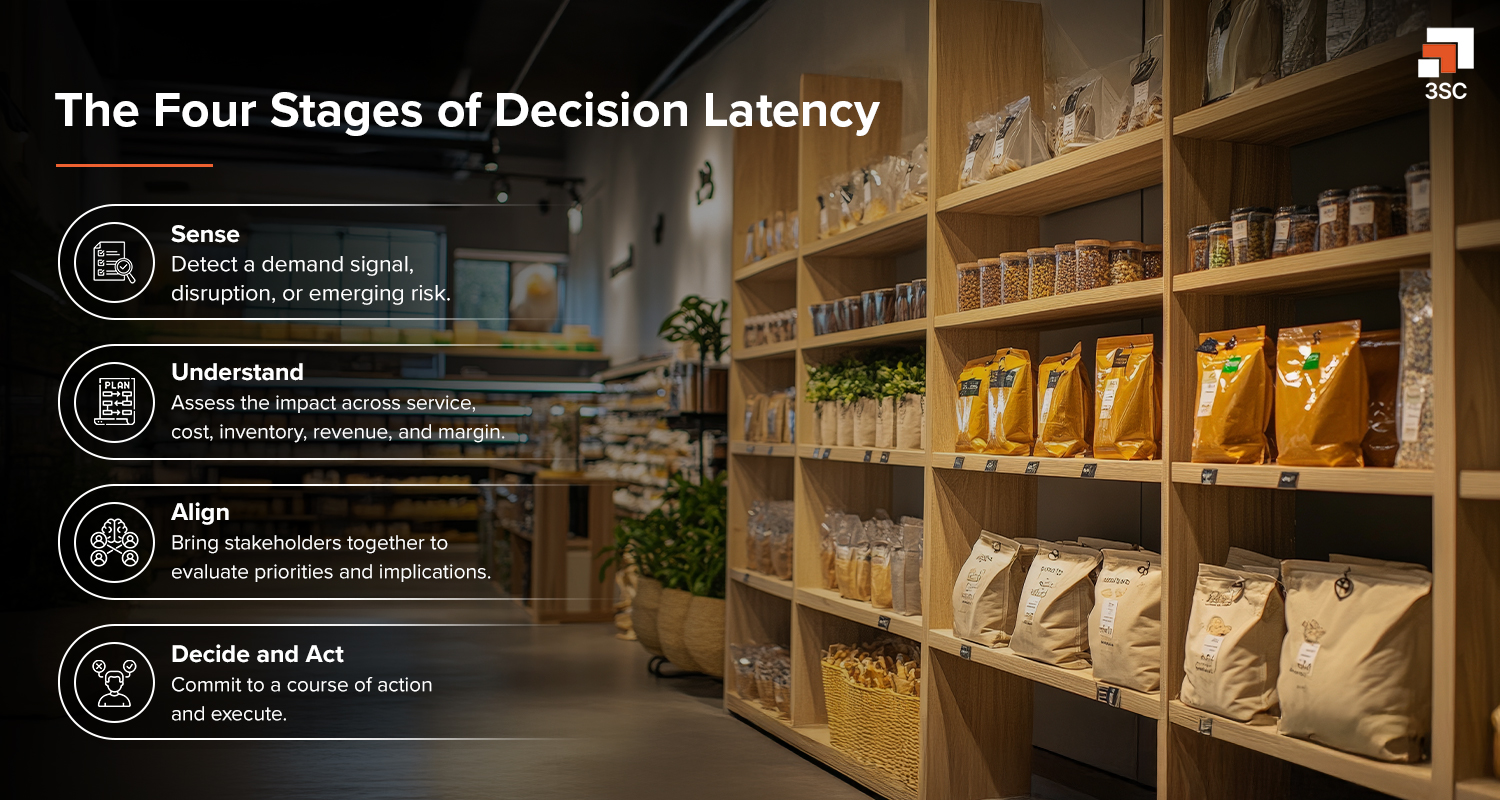
Decision latency builds across four stages:
- Sense – Detect a demand signal, disruption, or emerging risk.
- Understand – Assess the impact across service, cost, inventory, revenue, and margin.
- Align – Bring stakeholders together to evaluate priorities and implications.
- Decide and Act – Commit to a course of action and execute.
Traditional planning primarily supports the early stages by helping organizations sense change and understand potential impact. However, as volatility increases, the time spent aligning and committing to action expands; stretching response cycles beyond what the market allows.
The pattern is consistent. Signals are identified and impacts are broadly understood, but action is delayed. Early warning signs from suppliers are noted but not acted upon in time, and supplier disruptions surface only after service levels are impacted. Course corrections are debated rather than executed. Teams spend critical time refining assumptions and forecasts instead of committing to decisions. Value is lost not because issues go unseen, but because responses arrive too late.
The reality is stark. In modern CPG supply chains, value is rarely lost because decisions are wrong. It is lost because decisions arrive too late. Reducing decision latency from days to hours is no longer an operational improvement. It is a direct lever to protect margins and service.
From Planning Outputs to Decision-Centric Supply Chains
Closing this gap requires a shift from report-driven planning to decision-centric supply chains. Instead of starting with plans, organizations must begin with decisions. Which decisions matter most. Who owns them. How frequently they must be made. And which trade-offs need to be visible immediately.
This is where decision intelligence becomes critical.
Traditional planning answers an important but limited question: what could happen if assumptions hold. Decision intelligence addresses the more urgent question: what should we do now, and why. It brings structure to complex decisions by clearly framing the choice at hand and evaluating multiple response options side by side, using a consistent lens across service, cost, inventory, revenue, and margin.
By making trade-offs explicit, such as service versus cost, availability versus expiry, or revenue protection versus margin impact, decision intelligence removes ambiguity and subjective debate. Instead of producing a single recommended plan, it presents choices with quantified consequences. This clarity accelerates alignment, reduces decision paralysis, and shortens the gap between signal and action.
The core insight is simple. Decisions need to be built into how the supply chain runs, not debated upon after plans are made. CPG supply chain systems should show clear actions to take, not just scenarios to review, as decisions move from monthly cycles to near real time. The advantage comes from making faster, aligned decisions before volatility forces reactive responses.
The Next Advantage: Decisiveness at Scale
As CPG organizations scale across brands, regions, and partners, consistent and timely decision execution becomes the defining differentiator. Periodic planning gives way to continuous decision-making, where speed and alignment determine performance.
Advantage increasingly comes from faster alignment across functions, clearer trade-offs between service, cost, speed, and margin, and the ability to adjust execution in real time as conditions change.
For global CPG players operating across markets such as India, the Asia-Pacific region, and Europe, this decisiveness must scale seamlessly across complex supplier networks, channel mixes, and regulatory environments.
The conclusion is clear. In an environment of constant uncertainty, the strongest CPG supply chains will not outperform by planning better. They will outperform by deciding faster, at the moments that matter most.