Key Takeaways
- Scaling in consumer durables amplifies structural planning gaps.
- Regional volatility, SKU complexity, and service networks create interconnected risk.
- Fragmented tools cannot support multi-region, multi-brand growth.
- AI-powered capabilities deliver value only when governed through IBP.
- IBP becomes the scalable foundation that strengthens as the organization expands.
Expansion in the consumer durables sector rarely starts with scale, it starts with resonance. A product clicks with the market. Customers respond. Early demand validates the proposition.
From there, growth becomes intentional. New geographies are unlocked, additional channels are activated, retail partnerships deepen, and service networks expand. The same winning product is taken wider and farther, building installed base, strengthening aftermarket demand, and reinforcing brand confidence. Each step forward signal’s possibility, a stronger presence, higher volumes, and a more stable future.
This optimism is amplified by the industry’s trajectory. The consumer durables market, valued at $34.7 billion in 2024, is projected to reach $45.6 billion by 2028, growing at a 7.1% CAGR.
But scale brings structural complexity. As operations spread across regions and portfolios expand, demand, supply, service, and financial decisions become tightly interconnected. What once worked through basic coordination begins to strain.
And this is where organizations begin to realize that growth without structural alignment becomes a challenge.
The Challenges That Limit Scale for Consumer Durables Industry
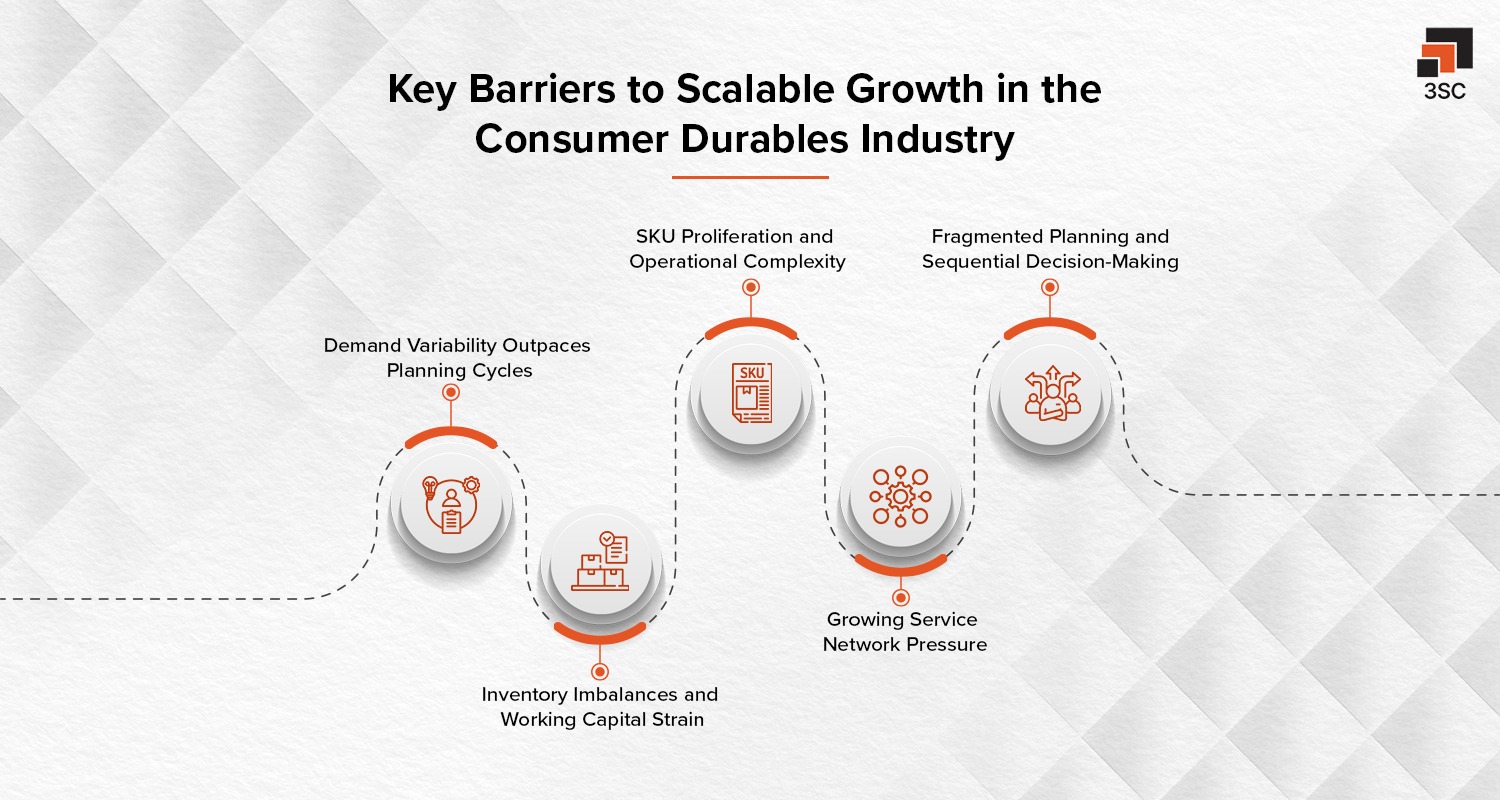
As consumer durable businesses scale, operational pressure rarely emerges in a single function. It builds gradually across the entire network, planning, supply, inventory, service, and finance, often in ways that appear manageable in isolation but become systemic when combined.
1. Demand Variability Outpaces Planning Cycles
Regional demand begins to diverge. Growth accelerates in one market while softening in another. However, supply plans and replenishment cycles are not always recalibrated at the same speed. The result is structural misalignment between demand signals and operational response.
2. Inventory Imbalances and Working Capital Strain
As misalignment persists, inventory distribution becomes uneven. Central hubs accumulate slow-moving stock, while regional markets face stockouts. To compensate, safety buffers expand quietly, increasing working capital without necessarily improving service performance.
3. SKU Proliferation and Operational Complexity
Product portfolios expand with new variants, shorter lifecycles, and higher promotional intensity. Each incremental SKU adds forecasting complexity, sequencing constraints, and production variability. Forecast discipline weakens as volatility increases.
4. Growing Service Network Pressure
As the installed base grows, service parts networks expand in parallel. Without sufficiently modelled failure-rate patterns and demand variability, parts availability becomes inconsistent. Emergency shipments increase, costs rise, and service levels fluctuate.
5. Fragmented Planning and Sequential Decision-Making
Sales, supply chain, finance, and service teams often evaluate decisions sequentially rather than concurrently. Brands and regions plan independently. What appears optimized locally may create unintended constraints elsewhere.
Together, these challenges show that better coordination alone is no longer enough, the way decisions are made needs to change.
Why a Shift Is Necessary
As organizations scale, decisions across sales, supply, finance, and service become tightly interconnected, where a change in one area quickly influences the others and creates ripple effects across the system.
When these interdependent decisions are evaluated in isolation, even with strong forecasting and advanced analytics, execution starts to drift, insights may be accurate, but outcomes become misaligned because trade-offs were never resolved collectively.
What’s required is a more deliberate way of operating. Trade-offs need to be assessed together, not sequentially. Functional implications must be considered alongside financial impact and ownership must be clear before action begins, not negotiated afterward.
Integrated decision-making creates that clarity. It ensures that priorities are aligned upfront, consequences are visible early, and execution moves in one direction instead of many.
This shift from functional coordination to integrated decision-making is crucial for scaling complexity without losing control, ensuring growth translates into performance, not friction.
From Alignment to Integrated Business Planning
While Sales and Operations Planning has played a critical role in aligning demand and supply, it brought much-needed structure, shared volume visibility, and cross functional coordination to growing businesses.
However, as consumer durable supply chains scale, the complexity expands well beyond volume alignment. Financial exposure increases. Service level commitments tighten. Regulatory traceability becomes non-negotiable. Ecosystem dependencies deepen. Capacity constraints become more granular and interconnected.
S&OP creates alignment. But scaling businesses require a broader, more integrated decision framework that can manage this added complexity with precision and foresight.
Integrated Business Planning builds on the S&OP foundation by extending coordination into a true enterprise decision system. It connects demand forecasts, sourcing constraints, production capacity, multi echelon inventory positioning, service commitments, and financial outcomes within a single governance framework.
Instead of evaluating decisions in isolation or in sequence, IBP enables them to be assessed simultaneously, with trade-offs made explicit before execution.
Take a regional promotion as an example. In a siloed environment, the primary question is whether production can support the incremental volume. Within an IBP structure, the lens widens. What is the net margin impact after factoring in freight premiums and overtime? Which SKUs or regions will be deprioritized as a result? How will inventory age and working capital shift across warehouses? What service risks surface if capacity is reallocated?
The conversation moves from “Can we produce it?” to “Should we, and under what conditions?”
The Role of AI-Powered IBP in Accelerating Decisions
Today’s VUCA world demands responsiveness. Channel shifts, promotional spikes, and supply variability move faster than traditional planning cycles can absorb. Responsiveness is no longer operational agility alone. It is a strategic capability.
This is where AI powered Integrated Business Planning becomes critical. It ensures demand signals flow directly into structured scenario modelling. Capacity is evaluated at the production line level. Multi echelon inventory impacts are simulated before buffers expand. Financial exposure is assessed in parallel with operational feasibility. Each scenario reflects margin, service, and working capital implications simultaneously.
Scenario analysis moves from theoretical discussion to executable decisions. Teams can evaluate production reallocation, inventory rebalancing, or SKU prioritization within a single governed decision cycle. The differentiator is not just speed. It is aligned speed across functions.
AI powered IBP changes the equation. It creates a unified planning baseline where operational trade-offs and financial consequences are visible together. Governance becomes structured rather than reactive. Decisions are accelerated without fragmenting accountability.
At scale, complexity continues to grow. The real advantage is not reducing it, but managing it structurally, so the system responds with discipline and confidence rather than strain.
IBP as the Structural Advantage
For Consumer durable brands IBP is not simply another capability layered onto existing systems. It becomes the foundation that allows additional capabilities to operate coherently.
As organizations introduce AI-powered forecasting tools, advanced analytics, predictive control towers, or sustainability tracking platforms, these tools require integrated governance to deliver value.
Adding new systems to fragmented planning structures often increases misalignment, as teams continue operating in silos with different assumptions and versions of data. When anchored with IBP, those same systems function within a single, coordinated decision framework, aligning demand, supply, inventory, and financial trade-offs under one governed plan.
As regions expand, portfolios grow, and service models evolve, AI powered IBP matures alongside them. It becomes more critical, not less. That is what makes it a structural advantage.
Conclusion: Coordinating Interdependence at Scale
Complexity is not temporary in consumer durable supply chains, it is structural. As businesses scale, complexity scales with them. More SKUs, more channels, more regions, tighter service commitments, sharper regulatory oversight, and rising sustainability expectations all compound interdependence across the network.
The difference between strain and strength lies in how that complexity is managed.
Organizations that rely on fragmented tools and reactive coordination will feel volatility at every layer. In contrast, businesses that invest early in AI-powered Integrated Business Planning (IBP), and build truly integrated operations across demand, supply, finance, and execution, create a system that absorbs complexity instead of amplifying it.
AI-powered IBP does not eliminate volatility. It makes it visible, measurable, and governable. It connects planning intent with execution reality. It enables faster, better trade-offs across the enterprise without losing control.
As scale increases, so does interdependence.
The winners will not be those who grow the fastest.
They will be those who coordinate growth the most intelligently, and move through complexity with clarity, discipline, and confidence.