FMCG demand is changing quickly across products, locations, and sales channels. To keep pace, companies need clearer demand visibility, better inventory positioning, flexible production planning, reliable suppliers, and faster execution. Connecting these capabilities helps businesses respond sooner, protect product availability, control costs, and fulfil customer demand before valuable sales opportunities are lost.
Key Takeaways
- FMCG demand is becoming faster, local, and more fragmented.
- Detailed visibility reveals changes hidden in overall forecasts.
- Dynamic inventory improves availability and reduces expiry risk.
- Connected planning supports faster, more reliable responses.
- Clear governance turns visibility into commercial value.
A customer notices a product on social media, compares its price on a marketplace, checks availability at a nearby store, and finally orders it through a quick commerce platform. Another customer buys the same product from a neighborhood retailer in a smaller pack. At the same time, a regional promotion creates a sudden increase in demand across one city while sales remain unchanged elsewhere.
For an FMCG company, every one of these purchases creates a signal that can affect forecasting, inventory, production, procurement, and distribution.
The challenge is that these signals now arrive faster, from more channels, and at a much more detailed level than many supply chains were designed to manage. Keeping pace requires businesses to understand how demand is changing and coordinate every operational response around that change.
Why FMCG Demand Has Become More Difficult to Plan
The pressure begins with a simple shift. Demand, now, doesn’t move through one predictable route. Traditional forecasting was built around established retail channels, stable product histories, and regular replenishment cycles. Teams could review historical sales, add seasonal assumptions, account for promotions, and prepare a monthly plan.
Today, demand can change before that plan reaches execution. Several developments are driving this complexity, such as:
1. Customers are buying across more channels
A consumer may buy from general trade one week, a supermarket the next, and a quick commerce application when convenience matters most. Each channel operates with different order sizes, fulfilment expectations, and replenishment frequencies. This means a national sales number may look stable while the demand mix changes significantly underneath it.
2. Demand is becoming more local
Weather, festivals, regional preferences, pricing, and local promotions can create sharp differences between cities and territories. A product that performs strongly in one region may move slowly in another. Planning at a broad national level can hide these local shifts until stockouts or excess inventory appear.
3. Product portfolios are becoming more complex
FMCG companies now manage more pack sizes, variants, price points, and channel specific assortments. Every additional SKU creates another demand pattern, inventory position, production requirement, and replenishment decision.
This fragmentation is increasingly visible across the FMCG market. NIQ 2025 research in FMCG market shows that the average household shops across roughly 11 different retail channels. While the overall number of channels has remained relatively stable, purchasing patterns within them are shifting significantly, with online grocery buyers increasing 40.1% and warehouse and club buyers increasing 50.7% over two years.
As consumers divide purchases across different retail formats, FMCG companies must manage increasingly distinct demand patterns, order profiles, inventory requirements, and replenishment cycles.
Building a More Granular View of Demand
A forecast may appear accurate at an overall level while hiding serious problems across individual channels, locations, and products.
Imagine that total monthly sales for a beverage remain close to plan. At first glance, the forecast appears reliable. However, modern trade sales may have declined while quick commerce demand has increased sharply. One city may be running short of smaller packs, while another is carrying excess stock of larger formats.
When these differences are combined into one number, planners see stability where the network is experiencing imbalance.
A stronger demand view should answer four questions:
What is selling?
Planning should identify demand by product, variant, and pack size rather than relying only on category level forecasts.
Where is it selling?
Demand should be viewed by region, city, distributor, store cluster, or fulfilment location, depending on how the network operates.
Through which channel is it selling?
General trade, modern trade, ecommerce, quick commerce, and direct channels often follow different demand and replenishment patterns.
Why is demand changing?
Promotions, weather, pricing, festivals, competitor activity, and digital trends can all influence buying behaviour. Understanding these drivers helps planners determine whether a change is temporary or likely to continue.
Point of sale data, distributor sales, retailer orders, promotion calendars, weather information, and historical patterns can help create this view.
The objective is not to give planners more reports. It is to highlight where actual demand is moving away from the current plan. Once demand becomes clearer, the next step is ensuring inventory follows it.
Positioning Inventory Where Demand is Most Likely to Occur
Inventory planning is often treated as a question of quantity. How much stock should the business hold? In a fragmented network, location and timing matter just as much.
An FMCG company may have sufficient inventory across the country and still lose sales because the stock is sitting in the wrong warehouse, distributor, or channel. Moving it after a shortage becomes visible may take longer than the selling opportunity allows. This is especially costly during product launches, promotional events, and seasonal peaks.
To improve inventory positioning, companies should focus on three areas:
1. Dynamic inventory policies
Safety stock and reorder levels should reflect current demand variability, supplier lead times, service expectations, and product shelf life. A fast-moving SKU serving quick commerce should not follow the same inventory policy as a slower product supplied through a regional distributor.
2. Network level inventory visibility
Planners need to see available stock across plants, warehouses, distributors, and fulfilment points. This allows them to determine whether inventory should be replenished, transferred, or reserved for a priority customer.
3. Shelf life and expiry control
For food, beverages, personal care, and other time sensitive categories, excess inventory carries an additional risk. Stock placed in the wrong location may require discounting, redistribution, or disposal before it is sold.
Better inventory positioning protects product availability, but it works only when production can adjust to the new demand pattern.
Aligning Production with Changing Demand Patterns
Consider a personal care brand that sees a sudden increase in demand for a smaller pack size after a regional promotion. The forecast changes, but production is already scheduled around larger packs. The required bottles and labels have been allocated elsewhere, line capacity is committed, and planned changeovers leave little room to react.
The demand signal is visible, but the production system cannot respond at the same speed.
This is a common challenge in businesses managing high SKU counts, multiple pack formats, short promotional windows, and frequent changes in channel demand. A shift in the forecast should quickly show what it means for production capacity, materials, labour, sequencing, and customer service.
A connected production response should consider:
1. Available line capacity
Planners need to know which lines can produce the required SKU and pack format, how much capacity is actually available, and whether another plant can absorb additional volume without disrupting existing commitments.
2. Changeover requirements
Switching between flavours, formulations, pack sizes, labels, or packaging formats can reduce throughput and increase downtime. Production sequencing therefore needs to balance market urgency with batch economics and changeover efficiency.
3. Material readiness
Finished-goods demand cannot be converted into production unless the right ingredients, bottles, pouches, labels, caps, cartons, and secondary packaging are available at the same time.
4. Shelf life and production timing
For food, beverages, personal care, and other shelf-life-sensitive categories, producing too early can increase ageing and expiry risk, while producing too late can result in missed promotions and empty shelves.
5. Maintenance and labour constraints
Nominal capacity may look sufficient on paper, but planned maintenance, cleaning requirements, shift patterns, and workforce availability can change what the plant can actually produce.
Scenario planning helps teams compare practical alternatives. They may shift production to another line, increase a high-demand pack size, reduce a slower-moving variant, change the production sequence, or protect inventory for a priority retailer or market.
The best response is not necessarily the one that produces the most volume. It is the one that protects availability while balancing service, shelf life, changeover cost, capacity, and margin. That flexibility, however, depends on having the right materials available when demand changes.
Strengthening Supplier Readiness and Material Availability
A demand spike for a finished product often creates pressure much further upstream. Higher production of a beverage may require more concentrate, bottles, caps, labels, and corrugated cartons. A personal care promotion may increase demand not only for formulation ingredients but also for pumps, tubes, sleeves, and promotional packaging.
These materials frequently have different lead times, minimum order quantities, qualification requirements, and supplier capacities. Packaging can become especially critical because a product may be technically ready to manufacture but still unable to reach the market without the correct pack format or artwork.
Supplier planning should therefore focus on the inputs that can restrict FMCG market responsiveness.
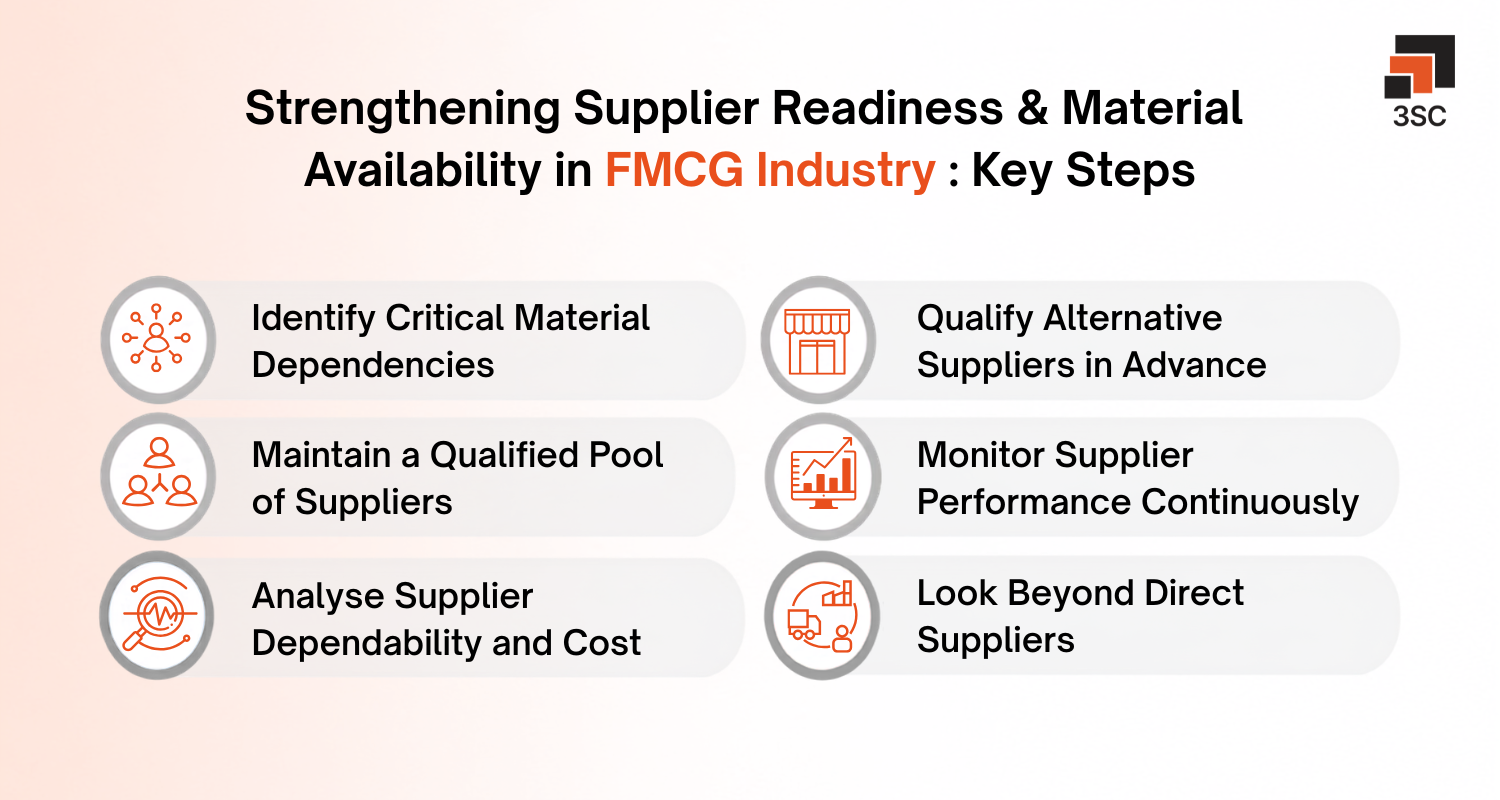
1. Identify critical material dependencies
Classify ingredients, packaging components, and specialised materials according to lead time, substitutability, sourcing concentration, approval requirements, and their impact on high-volume or high-margin SKUs.
2. Maintain qualified alternatives
Alternative suppliers should be approved before they are needed. Quality checks, production trials, tooling requirements, specifications, commercial terms, and available capacity should already be understood.
3. Evaluate reliability alongside cost
The lowest purchase price may become expensive if late deliveries cause production losses, missed retailer commitments, or promotional stockouts. Supplier decisions should consider reliability, flexibility, quality consistency, lead-time variability, capacity, and total landed cost.
4. Build flexibility around packaging
Packaging often changes by SKU, channel, geography, promotion, and pack size. Teams should closely monitor specialised bottles, labels, printed cartons, flexible packaging, and other materials that can prevent an otherwise available product from being produced.
5. Monitor supplier performance continuously
Changes in lead times, quality performance, available capacity, logistics conditions, or upstream shortages should be visible early enough for procurement and planning teams to respond.
6. Understand upstream dependencies
A bottle supplier may depend on a resin producer, while a food ingredient supplier may rely on crops affected by weather or harvest cycles. Visibility beyond tier-one suppliers helps identify risks before they become production constraints.
Connecting these upstream signals with demand and production plans gives teams more time to protect supply before shortages reach the shelf.
Coordinating Faster Supply Chain Decisions and Execution
In fast-moving categories, identifying a problem is only useful if the business can act before the selling window closes.
Suppose demand for a promotional SKU rises unexpectedly in one region while a packaging shipment is delayed. The business may need to decide whether to transfer stock from another warehouse, change the production sequence, reserve inventory for a key retailer, substitute supply from another plant, or revise replenishment quantities.
These decisions become difficult when demand, inventory, production, procurement, and distribution teams are working from different systems and planning cycles.
A connected decision environment should help teams see which SKUs, locations, retailers, and orders are affected and understand how long they have to respond. Planners can then compare alternatives based on service impact, inventory availability, shelf life, production feasibility, cost, and commercial priority.
Clear governance is equally important. A promotion-related stockout, ageing inventory alert, supplier delay, or retailer service risk should have a defined owner, escalation path, and response timeline.
The value of visibility is not in seeing more exceptions. It is in resolving the exceptions that can affect availability, waste, service levels, and sales while there is still time to act.
Conclusion: Build the Supply Chain Around the Customer’s Pace
Consumer demand increasingly moves across channels, locations, pack sizes, price points, and occasions. A promotion can accelerate demand in one market, a smaller pack can outperform in another, and an online or retail channel can create a very different replenishment pattern from the one originally planned.
Supply chains cannot control these shifts, but they can become better at recognising and responding to them. That requires a more detailed view of demand, inventory positioned closer to where products are likely to sell, production plans that account for real plant and packaging constraints, stronger material readiness, and faster coordination across planning and execution.
The objective is not perfect prediction. It is to detect meaningful change early enough to make a better decision before a shelf goes empty, a promotion ends, inventory ages, or a customer switches to another brand.
In categories where products move quickly and selling windows can be short, responsiveness becomes a commercial capability. The strongest supply chains will be those that translate changing demand into coordinated decisions across production, materials, inventory, and fulfilment before the opportunity is lost.
Turn Faster FMCG Demand into Coordinated Action with 3SC
3SC helps FMCG companies connect demand, inventory, production, suppliers, and execution in one decision environment. With better planning through Integrated Business Planning, faster scenario planning, and clear exception management, teams can respond to changing demand sooner, improve product availability, reduce excess inventory, and protect customer commitments across channels and locations.
Recommended Read & Guide