Key Takeaways
- MEA FMCG planning is moving beyond forecast-led cycles.
- Live signals now matter as much as forecasts.
- Exception-led planning focuses attention on real business risks.
- AI-powered IBP enables faster, connected decisions.
- Agentic AI helps turn alerts into action with human control.
In the Middle East and Africa, FMCG planning is reaching an inflection point. For decades, the forecast-driven model gave organizations structure: a monthly consensus plan, aligned demand and supply assumptions, and executive review through S&OP or IBP. But in 2026, the gap between planning cycles and market reality has become too wide to ignore.
Gartner benchmarking cited by ISM World shows that the median demand forecast error in food and beverages is approximately 25%, while durable consumer products can reach around 50%. For FMCG leaders operating in MEA, where currency volatility, Ramadan-driven demand spikes, import dependency, informal trade dynamics, and fragmented last-mile execution all influence availability, this level of error is not theoretical. It directly affects service, inventory, margin, and customer trust.
For FMCG leaders operating in MEA, this volatility is amplified by high dependence on imported raw materials and finished goods, distributor-led visibility gaps, and strong event-led demand patterns around Ramadan, Eid, and local promotions. Modern trade and traditional trade can also behave very differently within the same market, making one forecast view insufficient for fast operational decisions.
In MEA FMCG, the issue is no longer whether the forecast is accurate. The issue is whether the business can detect and respond fast enough when the forecast starts becoming wrong.
Why forecast-centric models are no longer enough
Traditional planning models were built for stability: demand teams created the forecast, supply aligned capacity and inventory, finance validated the numbers, and leadership reviewed trade-offs through monthly S&OP or IBP cycles. That model worked when disruptions were occasional and assumptions held for several weeks.
That is no longer the MEA reality. Currency shifts, retail promotions, weather changes, logistics delays, channel fragmentation, and fast-changing consumer behaviour can alter demand and supply conditions within days.
The forecast remains important, but it cannot be the only trigger for decisions once market reality begins to shift. Exception-led planning allows businesses to use the forecast as a planning reference while continuously monitoring where actual demand, supply, inventory, or logistics performance is moving away from what was expected.
What exception-led operations look like
Exception-led operations shift leadership attention from reviewing everything to acting on what matters most. The forecast remains the baseline, but deviations from the forecast become the trigger for action.
Instead of asking teams to manually review every SKU, location, customer, and route, an exception-led model continuously monitors live data and flags only the deviations that cross meaningful business thresholds.
This model depends on three connected capabilities:
1. The organization needs active signals rather than passive dashboards - Traditional BI often tells leaders what happened yesterday. Demand sensing and AI-powered monitoring show what is changing now across POS sell-through, distributor inventory, orders, production constraints, supplier confirmations, logistics ETAs, pricing, and promotions.
2. The business needs thresholds that separate noise from material deviation - Not every change requires executive attention. A low-value SKU with minor variance should not be treated the same as a strategic SKU at risk of stockout in a priority account. The best exception models prioritize by revenue exposure, service risk, customer importance, margin impact, working capital, and waste.
3. Every alert needs a response workflow - An alert without an owner or action path is just another notification. A mature exception-led model defines who owns the decision, what options should be evaluated, which approvals are required, and how execution will be tracked. This is how organizations move from insight to action.
The role of AI-powered IBP
AI-powered IBP provides the connected decision layer that makes exception-led operations scalable. Instead of treating IBP as a monthly alignment forum, leading FMCG organizations are turning it into a live performance control environment that connects demand, supply, inventory, commercial, logistics, and finance signals.
BCG has reported that AI-driven IBP platforms can reduce planning cycle times by 30% to 40% and support faster organization-wide responses to change. BCG also links effective AI-enabled IBP to outcomes such as 2 to 4 percentage points of annual revenue increase, 2 to 3 percentage points of cost reduction, and 15% to 30% lower inventories on average.
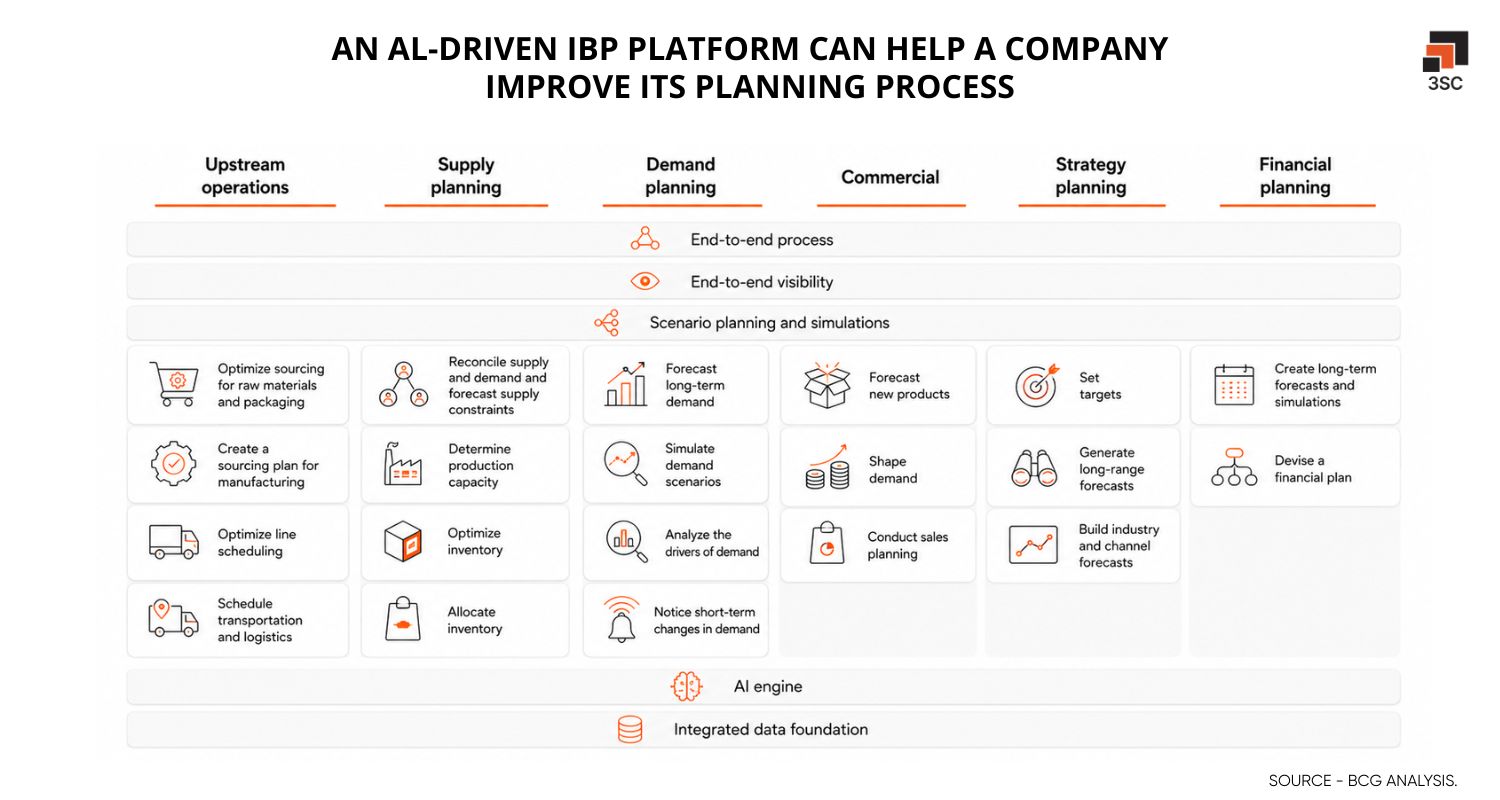
For a CSCO, the value is not simply better forecasting. It is faster control. AI-powered IBP allows leaders to understand the operational and financial implications of a decision before it is executed. A planner can compare whether to expedite from an alternate supplier, reallocate stock from a lower-priority region, adjust a promotion, or maintain the current plan — with visibility into service, cost, margin, and working capital impact.
This is where planning becomes performance management.
Where Agentic AI changes the equation
For FMCG leaders in MEA, Agentic AI embedded in IBP enables four concrete shifts:
1. From static alerts to autonomous triage.
AI agents continuously scan live data streams such as POS sell-through, distributor inventory levels, supplier confirmations, logistics ETAs, production constraints, and promotion performance. Instead of showing every movement in the business, they classify exceptions by severity, urgency, and commercial impact. Leaders see what needs a decision, not everything that changed.
2. From scenario modelling to decision memory.
One of the least visible barriers to planning maturity is the absence of institutional memory around decisions. Agentic AI can capture why a decision was made, which assumptions supported it, who approved it, and what outcome followed. Over time, this creates a feedback loop that improves future exception responses.
3. From periodic financial review to real-time P&L visibility
In an AI-powered IBP environment, every operational decision can be translated into financial impact before execution. A reorder, route change, production adjustment, or promotional correction can be assessed against margin, cost-to-serve, working capital, and service implications. This is especially valuable in MEA markets where import costs, currency movements, and customer priorities can quickly change the economics of a supply decision.
4. From siloed planning to concurrent cross-functional execution
The traditional IBP failure mode in large FMCG organizations is sequential alignment: commercial teams complete their view, supply teams respond, and finance validates impact later. Agentic AI enables concurrent planning by allowing functions to work from the same live data model. Exceptions surface simultaneously across commercial, supply, logistics, and finance, while response workflows move in parallel rather than waiting for the next review cycle.
The Future Outlook: continuous planning with human control
By 2026 and beyond, FMCG winners in MEA will not be the companies with the most detailed plans. They will be the companies that can sense change early, separate meaningful exceptions from noise, and act faster than competitors.
Forecast-centric planning helped organizations create structure. Exception-led planning helps them maintain control when reality moves faster than structure. AI-powered IBP and agentic AI will make this shift practical by connecting signals, recommendations, workflows, and governance into one decision layer.
The goal is not to abandon planning. It is to make planning more responsive, more intelligent, and more connected to execution. In FMCG, that is where growth, availability, working capital, and waste reduction increasingly converge.
3SC helps organisations move from forecast-driven planning to faster, exception-led decision-making through AI-powered IBP, demand sensing, control tower visibility, and Agentic AI-powered response workflows. By connecting live demand, supply, inventory, logistics, and financial signals, we enable FMCG leaders to identify high-impact exceptions early and act with speed and control. This makes its solutions especially relevant for MEA markets, where volatility, import dependency, channel complexity, and service expectations demand more connected and responsive planning.