
Recently, enterprise AI has been framed by a question: where can a chatbot help? Conversational interfaces make planning data accessible. But supply chains are constrained by more than access. They depend on the ability to coordinate planning, procurement, inventory, logistics and finance before action windows close.
Supply chain AI is now moving from chatbots that answer questions, to agents that investigate and act within defined limits, to outcome-based systems organised around completed work. The goal is not an unmanned supply chain but making routine, high-volume decisions move faster and under controls that leaders can explain, audit and improve.
Chatbots improved access, not execution
The first wave of generative AI made interaction with enterprise information more natural. Rather than navigating reports, filters and dashboards, a planner could ask why forecast accuracy fell, request a summary of late shipments or retrieve a policy without knowing where it was stored. Used with reliable data, this improves speed and accessibility.
Yet a supply chain does not improve simply because a team has received a better answer. Someone must still determine whether a demand movement is structural, assess inventory and capacity implications, agree a response with relevant functions and update the right systems. A chatbot can accelerate the investigation, but it does not close the decision loop and then the work remains fragmented across planning tools, enterprise resource planning platforms, spreadsheets, email and supplier or carrier portals.
Today most chatbots and copilots can improve an individual user's productivity, but their value is constrained when the workflow remains unchanged. An exception that requires four handoffs and three system updates cannot be fixed by a more fluent interface.
Agents extend AI beyond the interface
An AI agent is useful when it works toward a defined operational objective rather than merely responding to a request. It can assemble relevant context, use authorised tools, complete a sequence of actions, verify the result and route an exception to the appropriate person. In supply chain, this may mean examining a replenishment exception, checking inventory across locations, applying business rules and preparing or posting an approved response.
That does not make an agent a free-roaming decision maker. The most credible design is policy-bound: it works within declared thresholds, permissions and escalation paths, records the inputs and actions that led to an outcome and stops when a decision exceeds its authority. Traditional automation remains valuable for stable, low-complexity steps. Agents add value where information is variable, context matters and the process crosses systems or teams.
This distinction is more than terminology. Gartner has already warned that some supply chain offerings use agentic language for capabilities that are still conversational support or recommendations. A system that cannot take a governed action, verify the result or hand off a meaningful exception has not materially changed execution. Leaders should evaluate agents by the work they complete, the boundaries that govern them and the evidence they produce.
Autonomy must be matched to the decision
Not every supply chain decision should have the same level of agency. Repetitive decisions, such as replenishment parameter changes for stable products or routine order prioritisation, are strong early candidates because their inputs, rules and cost of error can be understood. Strategic decisions such as network design, inventory policy, capital allocation or cross-enterprise negotiation demand broader judgement and remain human-led.
The practical path is progressive. At launch, an agent may recommend an action and require approval. Once it has consistently met agreed accuracy, timeliness and exception-handling standards, it can take bounded actions while people review samples or intervene when thresholds are breached. Trust is earned through visible operational evidence, not a claim that the technology is autonomous.
Gartner forecasts that by 2030 only 5 percent of organisations using supply chain planning automation will make at least 10 percent of their planning decisions autonomously. The constraint is not only model capability; it is also data quality, decision ownership, integration, workforce readiness and the need to protect high-consequence decisions. Treating autonomy as a continuum gives organisations a more realistic roadmap.
Outcomes change what enterprises buy and measure
The next shift is from buying an AI feature or counting deployed agents to defining a business outcome that must be delivered. An outcome is a discrete unit of work with a clear definition of done, quality and turnaround expectations, a documented escalation route and a measurable value lever.
Consider a replenishment plan. The outcome is not that an agent has reviewed demand signals. It is that a plan is ready for the relevant SKUs, follows agreed policies, has been approved or posted in the designated system and carries a record of any exceptions. The same principle applies to a supplier invoice: it is processed when it is matched, coded and posted, or sent to a named approver with the reason attached.
This way of defining work changes both governance and economics. Operations leaders can see what was delivered, where an exception occurred and whether service levels were met. CFOs can connect spending to completed work and agreed business measures rather than to a licence or a volume of prompts. CIOs can protect systems of record while allowing agents to work across them through controlled integrations. For procurement, an SLA and service credits can create accountability that a generic AI pilot rarely provides.
It also focuses architecture on the right problem. The agent is only one element in a connected environment of trusted data, integration, workflow orchestration, permissions, evaluation and audit. In an enterprise context, the ability to act safely across systems is often more consequential than the model's conversational quality.
The leadership agenda is workflow redesign
Research suggests the gap between experimentation and scaled value remains substantial. McKinsey found that 23 percent of respondents were scaling an agentic AI system somewhere in their enterprise in 2025, while another 39 percent were experimenting. It also found that AI high performers were nearly three times more likely than peers to have fundamentally redesigned workflows. Agents do not create material value when simply added to old ways of working.
For leaders, the starting point should be a decision or workflow that matters, not an invitation to trial an agent. Define the completed outcome, baseline performance, data and systems required, acceptable failure cost and the person accountable for exceptions. Then set the appropriate human oversight and measure whether the workflow is becoming faster, more reliable and more economically efficient. Gartner's forecast that spending on supply chain software with agentic AI capabilities could grow from less than $2 billion in 2025 to $53 billion by 2030 signals the scale of the shift, but spending alone will not determine success.
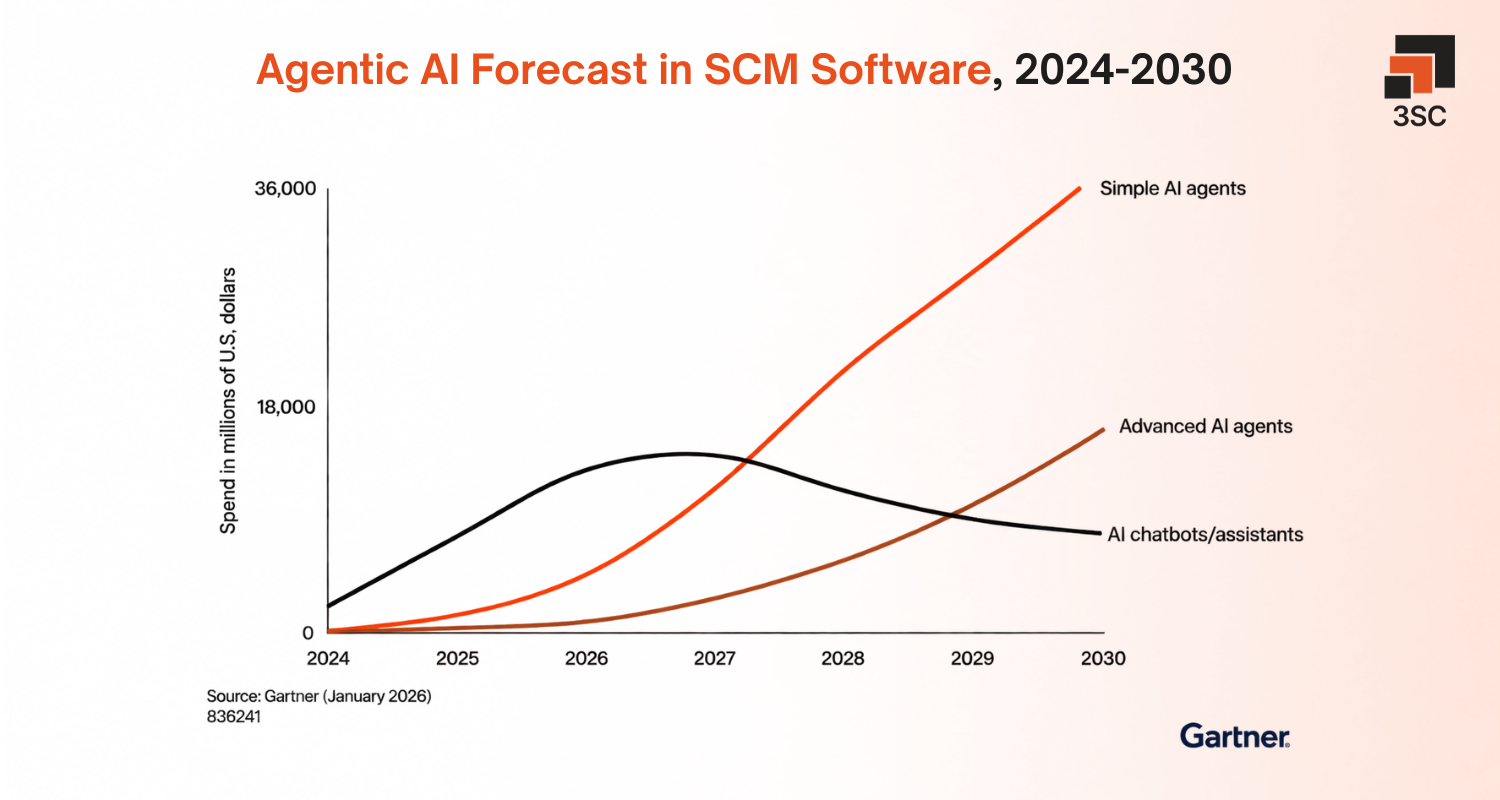
Chatbots will remain a useful front door to knowledge. Agents will increasingly carry defined tasks across enterprise systems. Outcomes will become the language in which leaders judge whether either has created value.
At 3SC, innovation and technology have consistently shaped our approach to solving complex supply chain challenges. We see Outcome as a Service (OaaS) as a natural evolution of this thinking, where the focus shifts from deploying technology and automating individual tasks to delivering measurable business outcomes.
As supply chains enter this next phase, we believe the real value of Agentic AI will lie in how effectively governed agents can work within existing enterprise systems, exercise judgement within defined boundaries, and translate decisions into completed work.
The future of supply chain intelligence is not about pursuing autonomy for its own sake. It is about enabling the right level of autonomy, maintaining accountability, and ensuring that every action contributes to a measurable result.