Key Takeaways
- Cost, compliance, and resilience must be designed together.
- True cost needs visibility beyond purchase price.
- Supplier dependency is a hidden business risk.
- Nearshoring needs a clear scenario-led business case.
- Governance turns resilience into faster action.
Across Europe, industrial supply chain leaders are working through a difficult set of trade-offs.
Energy remains a major cost concern. Carbon and compliance rules are becoming more demanding. Supplier dependency is under closer review. Nearshoring is being discussed more seriously, but the business case is rarely simple.
For a supply chain leader, these issues are connected. A sourcing decision affects cost and compliance. A logistics decision affects service and emissions. A network decision affects resilience, working capital, and customer reliability.
The pressure is especially sharp because EU industrial gas and electricity prices, while lower than crisis peaks, remain 2-4 times higher than in the EU’s main trading partners, according to the European Commission’s 2025 energy prices and costs report.
For European industrial companies, the task is clear: build resilience without losing financial discipline. Cost, compliance, and resilience must be designed together.
The Cost Question Has Changed
For many years, industrial supply chains were designed around efficiency. Companies consolidated suppliers, reduced inventory, optimized freight, and shifted production to lower-cost regions.
That model worked when global trade was relatively stable. But today, the meaning of cost has changed.
A supplier may offer a lower purchase price but carry longer lead times, limited switching options, or weaker compliance visibility. A distant production location may reduce manufacturing cost while increasing inventory, freight exposure, and response time. A lean inventory model may protect working capital in normal conditions but create service risk when demand changes or inbound supply is delayed.
The lowest visible cost is not always the lowest total cost.
This is where European industrial companies need a clearer cost-to-serve view. Not every customer, product, region, or route creates the same cost or risk. Some customers require tighter delivery commitments. Some products depend on fragile supplier networks. Some routes carry higher carbon or customs complexity. Some markets require stronger documentation and traceability.
When these differences are hidden, leaders are forced to make broad decisions for very different business realities.
A stronger cost-to-serve model helps reveal where margin is protected, where complexity is being subsidized, and where resilience investment is commercially justified.
Compliance Has Moved into Supply Chain Design
Compliance is no longer just a reporting or audit matter. It now shapes supply chain decisions much earlier. Carbon rules, sustainability reporting, supplier due diligence, product traceability, data governance, and sector-specific regulations influence supplier selection, transport choices, market access, and execution risk.
For industrial companies, compliance is part of service reliability.
If compliance is reviewed after sourcing decisions are made, risk is already built into the network. If documentation gaps appear during shipment, they become operational delays. If carbon impact is calculated after the route is chosen, the business has missed the chance to optimize.
The practical shift is to bring compliance into planning and execution.
Leaders need to know which suppliers create exposure, which materials need stricter controls, which lanes increase carbon impact, and which markets require stronger proof. With that visibility, compliance becomes less reactive and more strategic. It helps protect continuity, customer trust, and access to priority markets.
Supplier Dependency Carries a Hidden Cost
Supplier dependency can remain invisible for years, until disruption exposes its true business cost. A single-source supplier may perform well for years. A specialized component may seem secure because there has been no recent disruption. A distant supplier may continue to look attractive because the purchase price is low.
The real cost appears when something breaks.
Production schedules change. Premium freight increases. Customer commitments become harder to meet. Teams spend days searching for alternatives. Finance sees the impact after operations has already absorbed the disruption.
It matters deeply for European industrial supply chains, where many sectors depend on specialized materials, engineered components, industrial chemicals, machinery parts, and cross-border supplier ecosystems. These networks cannot always be replaced quickly.
The answer is not to duplicate every supplier. That would add cost without necessarily improving control. The better approach is to identify where dependency creates material business exposure.
Which suppliers support critical products? Which components have long qualification cycles? Which vendors are exposed to geopolitical, climate, logistics, or compliance risk? Which supplier failure would affect revenue, uptime, or customer service?
Once leaders can answer these questions, resilience becomes more precise. Some categories may need dual sourcing. Some may need strategic inventory. Some may need regional alternatives. Some may need supplier development or stronger commercial governance.
Supplier risk management is not a separate risk exercise. It is part of understanding the real cost of doing business.
What Supply Chain Leaders Are Planning Now
For Supply chain decision-makers, the agenda is becoming more practical and more strategic at the same time. They are not only planning for better transport rates, improved supplier performance, or lower inventory. They are planning for a supply chain that can protect the business under pressure without becoming too expensive to run.
In many European industrial companies, this means five priorities are moving higher on the leadership agenda:
Supply Chain Leader’s Priority | What It Means in Practice |
|---|---|
Reassessing the network | Reviewing where to source, manufacture, store, and serve demand from, based on cost, risk, service, and compliance. |
Reducing critical dependency | Identifying single-source suppliers, long qualification components, and materials where disruption would directly affect production or revenue. |
Improving cost-to-serve visibility | Understanding which products, customers, lanes, and regions are profitable after logistics, inventory, service, and compliance costs are included. |
Building scenario discipline | Testing the impact of energy cost changes, supplier failure, demand shifts, carbon cost, or regulatory changes before decisions are made. |
Strengthening execution governance | Defining who decides, when to escalate, and how teams act when disruption affects cost, service, or compliance. |
This is a different kind of supply chain leadership.
The focus is not only on reacting faster. It is on preparing better. Supply Chain executives are looking for a clearer view of where the business is exposed, which trade-offs matter most, and which investments will actually improve resilience without weakening margins. A supply chain that looks efficient in stable conditions may struggle when volatility rises. A supply chain built for resilience at any cost may become too expensive to sustain.
The leadership challenge is to find the balance before the business is pushed into emergency decisions.
The Design Levers That Matter
Balancing cost, compliance, and resilience requires more than isolated fixes. It requires a connected view of how the supply chain is designed, measured, and governed.
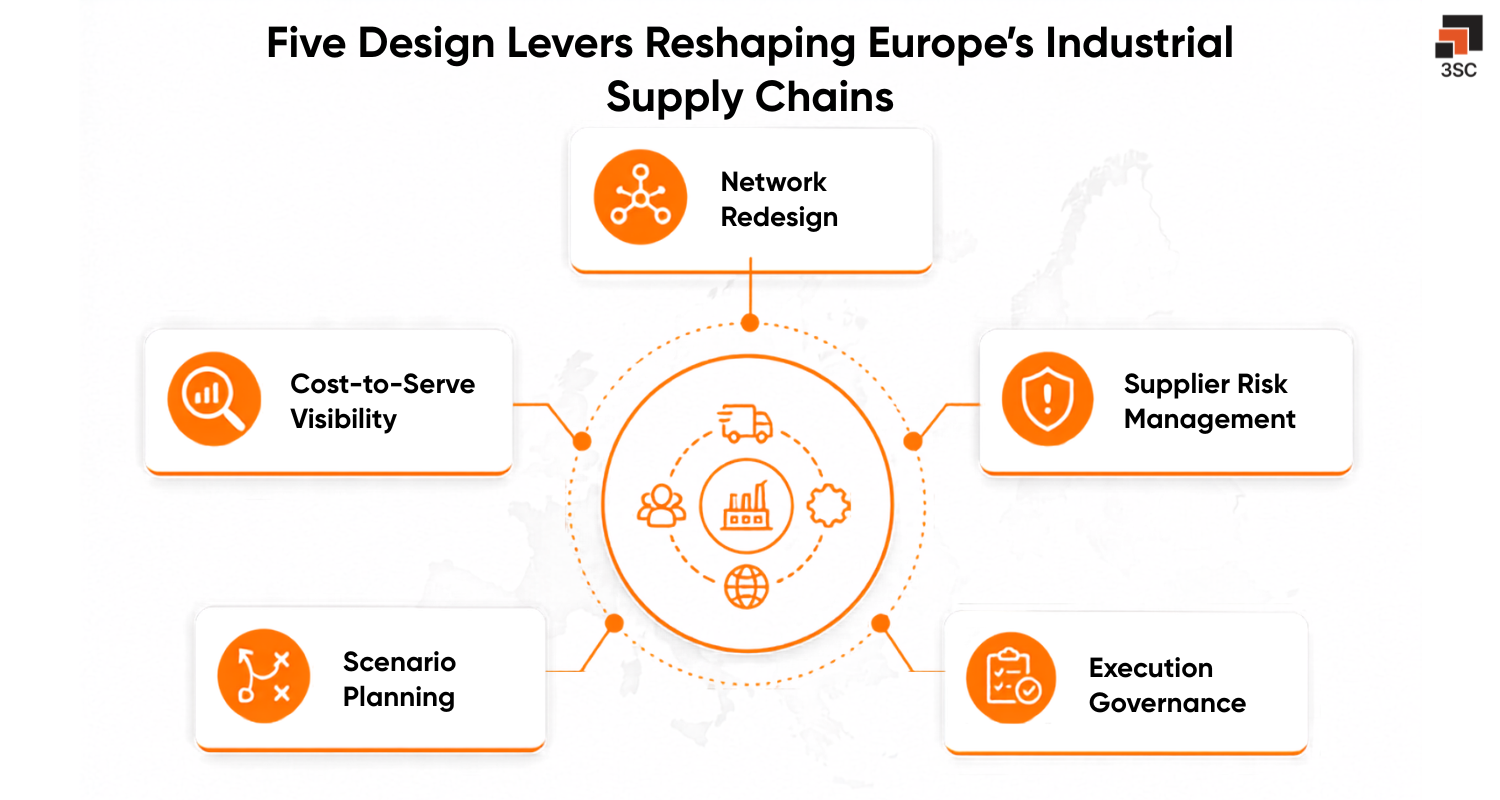
1. Network Redesign
Companies need to reassess where they manufacture, source, store, and serve demand from.
The answer may not be full reshoring. It may be a smarter mix of regional suppliers, global scale partners, selective local capacity, and flexible distribution models.
2. Cost-to-Serve Visibility
Leaders need to understand true profitability after logistics cost, inventory, compliance effort, service requirements, and disruption risk are included.
This helps separate profitable complexity from complexity that quietly erodes margin.
3. Supplier Risk Management
Supplier decisions should include dependency, switching time, location risk, compliance exposure, and business impact, not only price and past performance.
This makes resilience more targeted and financially disciplined.
4. Scenario Planning
Before changing the network, leaders need to test what happens if energy costs rise, demand shifts, a supplier fails, carbon costs increase, or regulations change.
Scenario planning gives leadership a way to compare options before committing capital.
5. Execution Governance
Resilience works only when teams know how to act.
Clear escalation rules, decision rights, and cross-functional workflows help procurement, plants, logistics, finance, and compliance respond with speed and discipline.
Together, these capabilities help companies avoid broad and expensive resilience moves. They make it easier to invest where risk is material and remove complexity where it is not adding value.
Nearshoring Needs a Strong Business Case
As companies reassess supplier exposure and network risk, nearshoring is moving higher on Europe’s industrial supply chain agenda.
It can shorten lead times, improve control, reduce exposure to distant disruptions, and support regional customer requirements. But it is not automatically cheaper or simpler. A regional supplier may still depend on upstream materials from outside Europe. A local production move may raise labour or energy cost. A closer warehouse may improve service while increasing fixed cost. A new manufacturing footprint may reduce one risk while creating another.
These trade-offs make scenario planning essential.
Leaders need to ask what happens if demand weakens, energy prices rise again, a supplier loses certification, customers require stronger traceability, or carbon costs change the economics of a route. In many cases, the strongest answer will be a hybrid network.
Some products may need regional sourcing. Some may remain global because scale still matters. Some critical materials may need buffers. Some customer segments may justify higher service investment, while others need a leaner model. Scenario planning gives leaders the evidence to make these choices before capital is committed.
Governance Turns Plans into Performance
Many industrial companies already have dashboards, supplier reports, transport updates, and compliance checks.
The issue is that these signals often sit across different teams and systems.
Procurement sees supplier delays. Logistics sees freight exceptions. Plants see production risk. Finance sees margin pressure. Compliance sees documentation gaps. Customer teams see service impact.
If these signals are handled separately, response slows down.
Execution governance creates the operating rhythm for action. It defines when a delay should be escalated, who approves premium freight, when inventory should be reallocated, which compliance issue should stop a shipment, and which decisions need leadership attention.
Without this governance layer, resilience remains a boardroom ambition. With it, teams can act faster, protect service, control cost, and prevent disruption from spreading across the network.
The Way Forward
European industrial supply chains are entering a phase where competitiveness will depend on decision quality as much as operational efficiency.
Cost cannot be managed properly without understanding risk. Compliance cannot be treated as an afterthought. Resilience cannot depend only on buffers, duplicated capacity, or emergency response.
The companies that move ahead will connect these priorities into one operating model.
They will redesign networks with cost and risk in view. They will understand cost-to-serve at a granular level. They will manage supplier dependency before it becomes disruption. They will use scenarios to test decisions before committing capital. They will govern execution across functions so that action is coordinated when pressure rises.
For European industrial leaders, the goal is not to choose between cost, compliance, and resilience.
The goal is to build supply chains where all three support each other. Resilience is valuable when it is financially sustainable. Cost control is meaningful when it can withstand disruption. Compliance becomes stronger when it is built into the way the supply chain is designed and run.
Build More Resilient Industrial Supply Chains with 3SC
3SC helps industrial companies connect supplier risk, cost-to-serve visibility, scenario planning, and execution governance in one integrated operating view. This enables teams to identify exposure earlier, evaluate trade-offs with greater confidence, and respond faster across sourcing, plants, logistics, finance, and compliance.
With 3SC, businesses can strengthen resilience, improve cost control, reduce critical dependencies, and make more informed supply chain decisions across the network.