European FMCG supply chains need to balance service levels, cost, and sustainability through better connected planning. Stronger demand sensing, smarter inventory positioning, efficient logistics, supplier collaboration, and sustainable packaging decisions can help companies protect availability, reduce waste and working capital, lower transport costs, and respond faster to changing market conditions.
Key Takeaways
- Better demand visibility reduces the need to protect service through excess inventory.
- Inventory should be positioned and rebalanced according to where demand is actually changing.
- Earlier planning gives logistics teams more options to reduce freight cost and emissions.
- Sustainability decisions should be assessed across sourcing, packaging, production, inventory, and logistics.
- Connecting planning and execution helps FMCG companies manage service, cost, and sustainability as part of the same decision process.
For European FMCG companies, maintaining service has always depended on getting a few fundamentals right. Products need to be available, inventory needs to be in the right place, and replenishment has to keep pace with demand.
What has changed is the number of pressures sitting around those decisions.
Costs remain under scrutiny. Sustainability targets are becoming more specific. Packaging regulation is changing. Retailers continue to expect dependable service, while consumers are quick to switch when a product is unavailable.
This creates a difficult operating environment. A company can protect availability by carrying more stock, but that raises working capital and storage costs. It can use faster transport to protect a delivery, but that increases freight spend and emissions. It can make packaging more sustainable, but the change may affect production, suppliers, or transport efficiency.
These are not separate conversations for FMCG businesses. They are connected decisions that affect the same supply chain.
The Inventory Challenge in European FMCG
Inventory is one of the easiest ways to protect service. If demand is uncertain, holding extra stock gives planners a buffer. If a supplier is late, that buffer can prevent disruption. If a promotion performs better than expected, the business has more product available to respond.
But the problem starts when inventory becomes the answer to every uncertainty.
Extra stock ties up capital, takes up warehouse space, and increases the risk of markdowns or obsolescence. In food, beverage, personal care, and other categories where shelf-life matters, the downside is even more visible. Products can age before they are sold, forcing companies to discount them, transfer them, or write them off.
The real question is whether the business needs more stock or simply needs better visibility of what is changing.
If demand is moving quickly in one market, the answer may be faster demand sensing. If one warehouse is holding too much while another is running short, the answer may be rebalancing. If a supplier is creating repeated uncertainty, the answer may be better risk visibility and sourcing flexibility.
This distinction matters because overall inventory can look healthy while service still suffers.
A business may have enough stock across Europe but still struggle with availability because that inventory is sitting in the wrong markets. One region may be carrying several weeks of excess while another is approaching a shortage.
In that situation, producing more stock can add cost without solving the real problem. A better approach is to make inventory more responsive to what is actually happening in the network.
Managing Changing FMCG Demand Across Europe
European FMCG demand does not move in one predictable pattern. Promotions, weather, and changing consumer behaviour can all create shifts that are difficult to capture in a single monthly forecast.
While historical data still matters, it becomes more useful when it is combined with recent market signals. Point of sale data, current retailer orders, promotion calendars and recent sales movement can all help planners understand where demand is beginning to change.
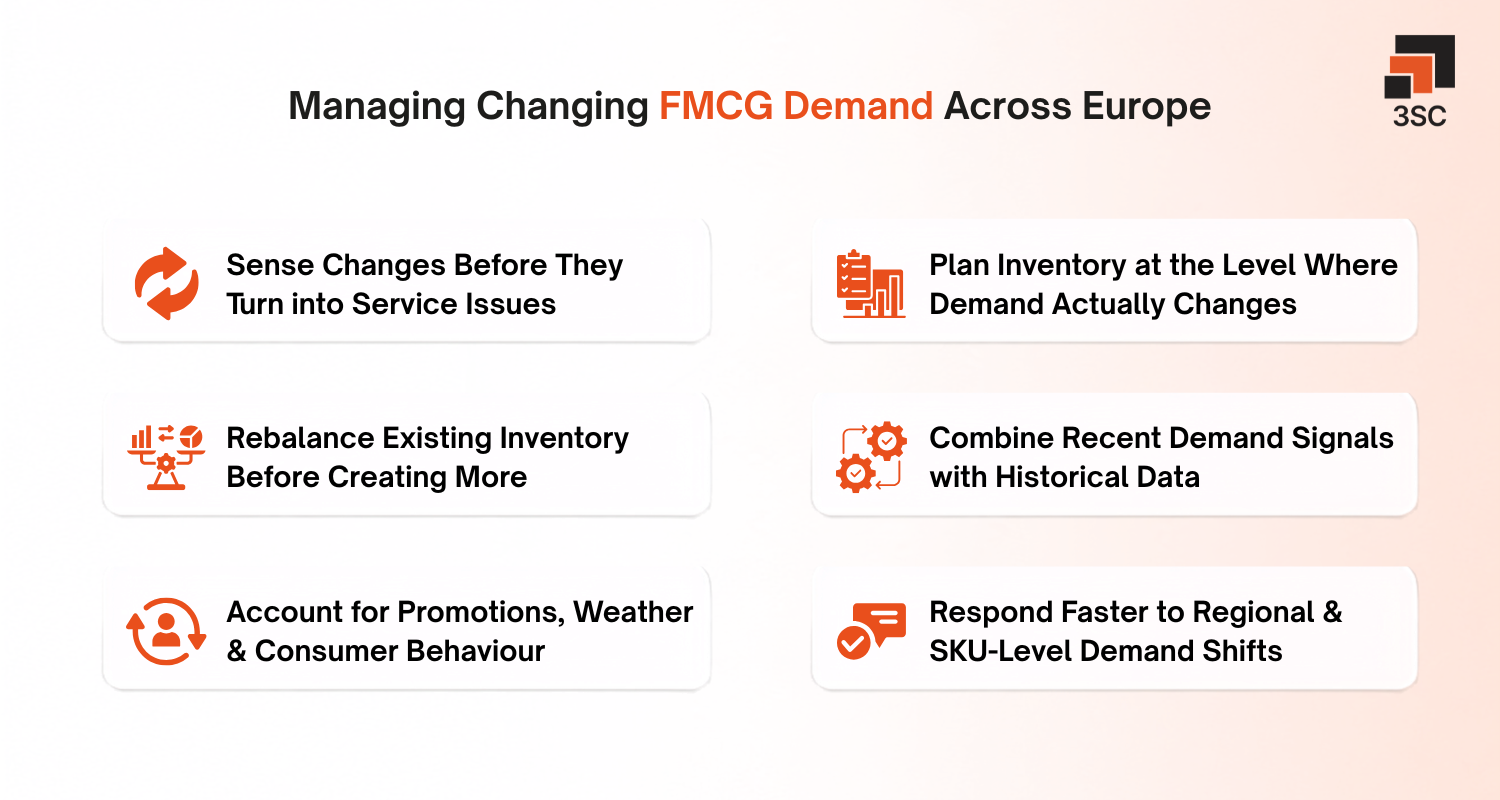
The challenge becomes greater when planning across multiple European markets, where differences in market size, product preferences, and seasonal demand can affect how the same product performs from one country to another. A regional view can therefore hide important local variations. Planning needs to account for these differences so that teams can respond appropriately in three key areas:
1. Sense Changes Before They Turn into Service Issues
The earlier a demand shift becomes visible, the more options the business has. If planners can see that demand is building in a particular region, replenishment can be redirected before shelves begin to empty. Production can also be adjusted before the shortage becomes urgent. This reduces the need for expensive last-minute action.
2. Plan Inventory at the Level Where Demand Actually Changes
A national or regional forecast can sometimes hide what is happening at SKU, retailer, or channel level. A category may appear stable overall while individual products are moving in very different directions.
More granular planning helps teams identify where inventory should increase, where it can remain unchanged, and where excess may already be developing. This is especially important for FMCG businesses managing broad portfolios across several European markets.
3. Rebalance Existing Inventory Before Creating More
When one market is running short, the first response does not always need to be another production run. If another location has excess stock, transferring that inventory may protect service more quickly and with less working capital.
Shelf life should also be part of this decision. Inventory with limited remaining life may need to move towards markets where demand is stronger rather than remain in a slower location.
This is where demand planning and inventory planning begin to support both cost control and waste reduction at the same time. Once these decisions are made earlier, logistics has more room to operate efficiently as well.
Once inventory is better aligned with demand, the next opportunity is to reduce the cost and inefficiency of moving it across the network.
Lowering Logistics Cost and Emissions Together
Transportation is one of the clearest areas where financial and sustainability goals can align.
Half-filled vehicles, unnecessary kilometres, repeated deliveries, and emergency shipments all cost money. They also increase emissions. Many of these logistics problems can start much earlier in the planning process.
If a shortage is discovered only when a customer order is already at risk, premium freight may be the only realistic option. Identifying the same risk several days earlier could allow stock to be rebalanced from another warehouse, a shipment to be combined with an existing load, or production to be adjusted.
The difference comes down to time.
Better route planning, shipment consolidation, delivery scheduling, and vehicle utilization can reduce logistics cost, but they work best when planning teams provide enough notice. This is also where sustainability becomes more practical.
A company does not always need a separate initiative to reduce transport emissions. In many cases, reducing operational waste achieves both outcomes.
Fewer unnecessary trips reduce fuel consumption. Fuller vehicles improve cost per unit moved. Better inventory positioning reduces emergency transfers. More accurate demand planning reduces the number of reactive shipments required later.
For European FMCG networks, this link between planning and logistics is important because the sustainability impact of a transport decision is often determined before the truck leaves the warehouse.
Sustainability is Reshaping European FMCG Supply Chain Decisions
Sustainability is becoming a more practical supply chain consideration for FMCG companies in Europe, particularly around packaging.
The EU Packaging and Waste Regulation introduced new requirements for packaging across the EU from 12 August 2026. According to the European Commission, packaging waste could grow by 19% by 2030, while plastic packaging waste could increase by as much as 46%. This makes packaging an increasingly important part of supply chain planning for FMCG companies.
However, the impact goes beyond just packaging itself. Changes in size, weight, or format can affect production, storage, transportation, and handling. What works from a sustainability perspective also needs to work operationally.
The same thinking applies to sourcing. Working more closely with suppliers can give companies earlier visibility into constraints, material availability, and potential supply risks.
Making these decisions well depends on having the right information available early. Better forecasting can show how demand may change, while traceability and scenario planning can help teams understand the wider impact of sourcing or packaging decisions before acting on them.
Bringing this information into planning earlier can help companies consider sustainability alongside service, cost, and operational requirements.
Conclusion
Balancing service, cost, and sustainability in European FMCG supply chains does not come from solving each one separately. They all depend on the same decisions.
How much inventory to hold. Where to position It. When to produce. Which supplier to use. How goods should move. What packaging format works across the network. Making these choices together makes it easier to manage the trade-offs.
Demand can be identified earlier. Inventory can be moved before more is created. Logistics teams can plan before urgency limits their options. Suppliers can be involved before constraints become disruptions. Sustainability considerations can be built into sourcing, packaging, and transport decisions rather than reviewed after the fact.
There will still be moments when one priority has to take precedence. The difference is whether the business sees that trade off clearly and makes the decision deliberately.
For European FMCG companies, that is where stronger supply chain performance will come from. Not from carrying more stock or adding more layers of planning, but from making better connected decisions across service, cost, and sustainability.
Build a More Responsive FMCG Supply Chain with 3SC
Connect demand, inventory, planning, logistics, and risk with 3SC’s Demand AI, Inventory AI, Integrated Business Planning, Intelligent Transport Management, and Supply Chain Control Tower solutions to improve service levels while managing cost and sustainability across the network.
Talk to 3SC to see how better-connected planning and execution can help your supply chain respond faster and operate more efficiently.