Key Takeaways
- EU CPG planning is under pressure from retail volatility, private-label growth, e-commerce complexity, and shifting consumer demand.
- Forecast accuracy still matters, but it cannot protect performance when market signals change after plans are approved.
- Continuous rebalancing helps leaders adjust inventory, supply, logistics, and service decisions before disruption reaches the customer.
- AI-powered IBP connects demand signals, operational constraints, and financial impact to support faster scenario decisions.
- The future of CPG planning is adaptive, with competitive advantage shaped by how quickly businesses respond after the plan is set.
A CPG plan can look right when it is approved and still be wrong by the time it reaches execution.
In Europe’s retail market, demand is shifting across channels, promotions, private label, and customer orders faster than traditional planning cycles can respond. For supply chain leaders, the challenge is no longer only to build a more accurate forecast. It is to keep the business balanced when the market moves after the plan is set.
The pressure is visible across the value chain. Shifting consumer preferences, faster e-commerce adoption, sustainability demands, rising raw material costs, and more complex retail distribution models are reshaping the landscape. Food and beverages remain the dominant CPG category, with supermarkets and hypermarkets leading distribution, but online retail is growing rapidly, adding variability to demand signals and fulfilment expectations.
Private label reached 40% value share across EU markets in 2025, with 46% of European consumers actively seeking additional savings. CPG companies are simultaneously contending with low or negative volume growth in many categories, rising promotional demands, and innovation failure rates above 75%.
The market has simply moved faster than the planning cycle could absorb. For EU CPG supply chains, the priority is no longer only better forecasting. It is faster rebalancing: the ability to adjust inventory, supply, logistics, and service decisions before disruption reaches the customer.
Europe's CPG planning environment has become harder to control
Across Europe, retailer behaviour has become more dynamic. Large grocery chains adjust order patterns more frequently to manage stock, price perception, and promotional intensity. Discounters continue to influence category pricing. Private-label growth puts additional pressure on branded manufacturers. Consumers spread demand across more channels, including large-format stores, local convenience, online grocery, and marketplace fulfilment.
A CPG business may enter the month with the right forecast at aggregate level and still face disruption at the customer, channel, SKU, or location level. These are rarely single large events. They are small, compounding changes: one retailer pulls orders after a promotion ends early, another lifts demand after a competitor adjusts pricing, and a private-label push erodes branded volumes in one market while a different channel continues to grow. Individually, each may look manageable. Together, they can quickly change the operating outlook.
Forecast accuracy has a ceiling when the market keeps moving
Forecast accuracy remains essential, but it has inherent limits when market signals keep shifting after decisions have already been made. Inventory is positioned based on expected demand, production plans are built around volume assumptions, transport is booked against shipment expectations, and service commitments are made to key customers. When demand moves, each of those decisions is affected.
A promotion that overperforms creates service risk. One that underperforms leaves excess inventory. A retailer order shift creates pressure in one warehouse while another sits underused. The question is no longer only: how accurate was the forecast? The more pressing question is: how quickly can we adjust when the signal changes?
Continuous rebalancing is becoming the new planning advantage
Continuous rebalancing keeps the plan as the anchor while allowing the business to adjust decisions within agreed guardrails as new signals emerge.
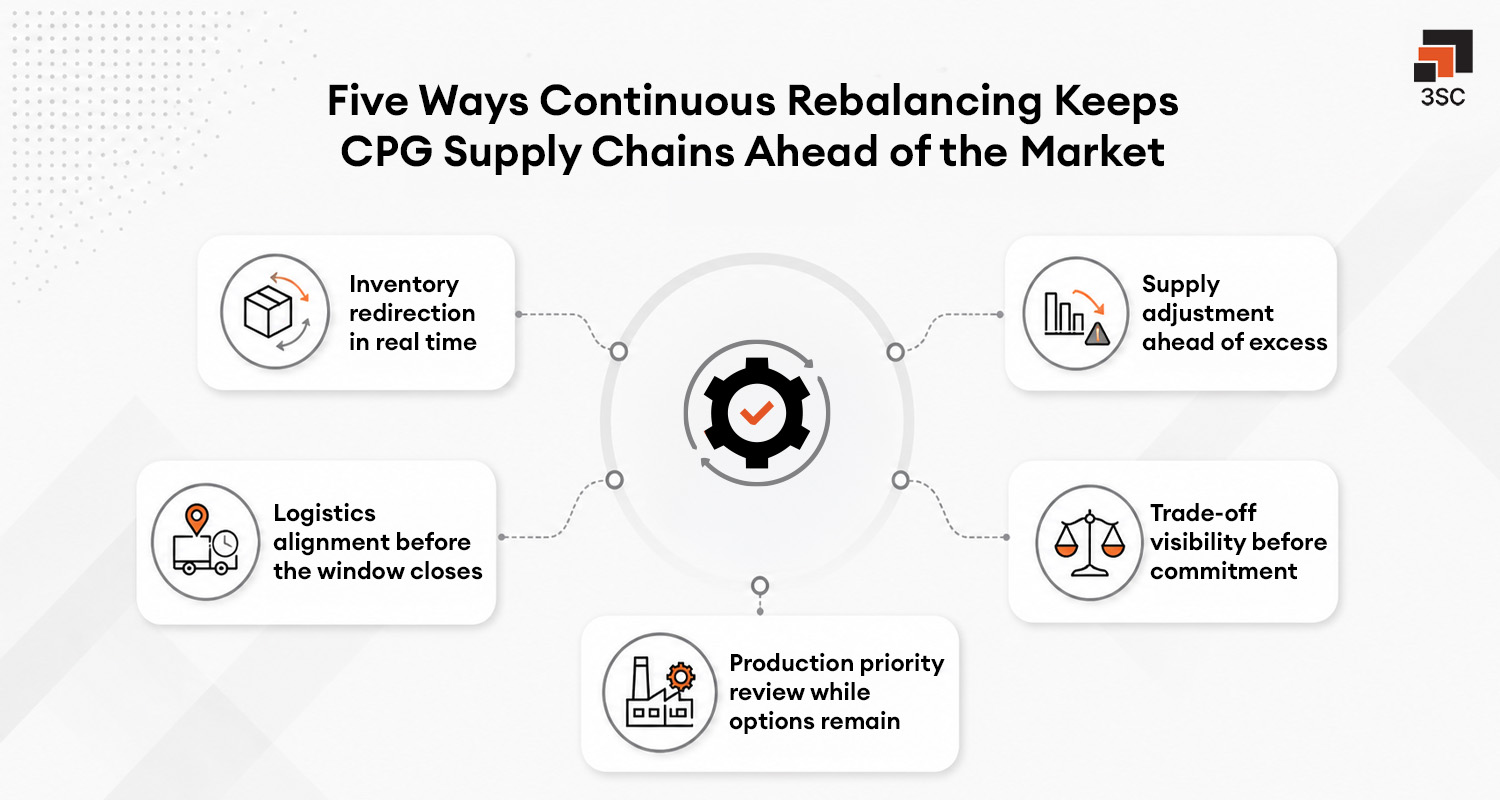
In practice, that looks like:
- Inventory redirection in real time. When a promotion overperforms, stock can be rerouted to high-demand locations before shortages appear, without waiting for the next planning cycle to catch up.
- Supply adjustment ahead of excess. When a channel slows, production and replenishment volumes can be pulled back early, preventing inventory from building to a point where markdown or write-off becomes the only option.
- Logistics alignment before the window closes. When a retailer shifts order timing, warehouse and transport plans can be updated proactively, avoiding the cost and disruption of last-minute rescheduling.
- Trade-off visibility before commitment. When service risk rises, teams can model the impact across customers, margins, and costs before deciding, rather than reacting under pressure with incomplete information.
- Production priority review while options remain. When private-label pressure shifts branded demand, manufacturing schedules can be reassessed early enough that meaningful choices still exist.
For CPG leaders, that shift changes what planning value looks like. The measure is no longer forecast accuracy or plan adherence alone. It is the ability to reduce lost sales, lower emergency logistics costs, limit excess and obsolete inventory, protect service levels, and preserve margin when demand shifts after the plan is approved.
AI-Powered IBP: Connecting Signals to Decisions
To rebalance faster, companies need more than dashboards. They need planning systems that connect market signals to operational choices in near real time.
This is where AI-powered Integrated Business Planning becomes increasingly relevant. Traditional IBP helped businesses align demand, supply, finance, and commercial priorities across one structured cycle. AI-powered IBP adds another dimension: sensing change earlier, analysing impact faster, and surfacing decision options across functions before the window for a good choice close.
As volatility is highly fragmented, signals arrive from retailer orders, point-of-sale data, promotion performance, inventory levels, logistics constraints, pricing shifts, and channel movements. Individually, each may appear manageable. Together, they can change the operating outlook quickly, and traditional planning teams rarely have the bandwidth to interpret them at pace.
AI-powered IBP changes the rhythm. It can highlight demand changes at customer, SKU, and channel level; flag promotion underperformance early; identify where inventory and service risks are building; surface capacity conflicts; and show the financial impact of different supply choices. It also enables faster scenario analysis, giving leaders a clearer view of what each response will cost before resources are committed, whether the decision is to expedite stock to protect service, shift production toward higher-margin SKUs, hold inventory for strategic customers, or reallocate supply across markets.
In Europe's multi-market environment, where regulatory expectations, sustainability targets, and logistics constraints layer on top of commercial complexity, the ability to compare those options quickly is not a convenience, it is a structural advantage.
AI-powered IBP is valuable because it gives leaders a cleaner, faster view of where attention is needed, so teams spend less time finding the problem and more time deciding what to do about it.
Resilience monitoring helps leaders see stress before failure
Many supply chains still identify problems too late. Resilience monitoring changes the timing, giving leaders a live view of where the supply chain is becoming vulnerable, before the damage is done.
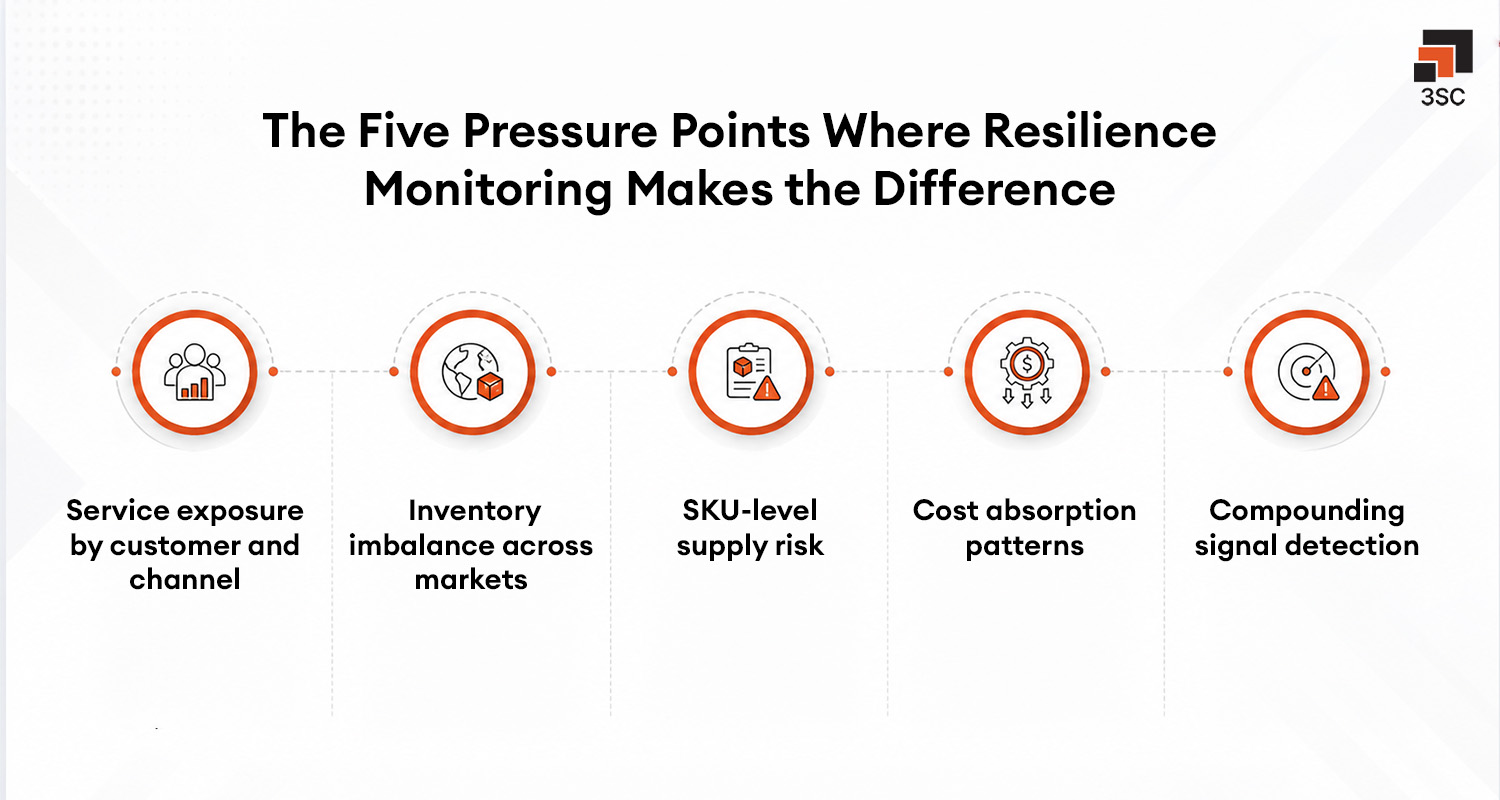
The capability works across five pressure points:
- Service exposure by customer and channel. Leaders can see which commitments are under strain before an order is missed, allowing intervention while fulfilment is still achievable rather than damage control after the fact.
- Inventory imbalance across markets. Excess building in one region and shortages developing in another become visible simultaneously, enabling reallocation decisions before either situation becomes critical.
- SKU-level supply risk. Availability gaps can be identified at the product level early enough to adjust sourcing, production sequencing, or safety stock before the gap reaches the shelf.
- Cost absorption patterns. Where the business is spending to protect service, through expediting, emergency freight, or unplanned production runs, becomes visible as a trend, not just a line item discovered in the month-end review.
- Compounding signal detection. A single order change, promotion deviation, or channel shift may look manageable in isolation. Resilience monitoring connects these signals so that when they are converging into a larger risk, leaders can see it and act before the pressure becomes acute.
That shift, from detecting failure to anticipating stress, is what separates supply chains that manage volatility from those that are managed by it.
The future of CPG planning is adaptive, not static
By 2026 and beyond, EU CPG supply chains will need to operate with a fundamentally different planning mindset. The goal is no longer to create a perfect plan and defend it through execution. It is to create a strong plan and keep it relevant as conditions change.
That is a meaningful shift. Planning cycles must connect more tightly to execution. Commercial, supply, finance, and operations teams need faster access to a shared view of risk and opportunity. Technology must support decision-making, not just reporting. And leaders must accept that volatility is not an exception to the plan, it is a permanent feature of the planning environment.
Forecast accuracy, disciplined demand planning, clean data, and cross-functional alignment will all still matter. But they will not be sufficient without the ability to sense change early, evaluate trade-offs quickly, and adjust with confidence.
In a retail environment that moves this fast, the plan may be right on the day it is approved. What determines competitive position is what happens in the days and weeks after.