Key Takeaways
- Sourcing now requires geopolitical awareness, not just cost analysis.
- Tariffs and compliance costs are cutting into margins across industries.
- Resilience through agility and diversification is now essential.
- Supply chains must be designed with geopolitical foresight built in.
Supply chains built for efficiency are now colliding with policies built for power. The U.S. introduced a sweeping shift, penalising not just direct imports from China, but indirect sourcing too. This quiet clause sent shockwaves through global logistics, turning supplier choices into geopolitical decisions. What was once about cost and scale is now a test of alignment, agility, and strategic foresight.
Coming from the supply chain domain, I’ve witnessed many shifts, pandemics, port shutdowns, material shortages, even wars. Each brought its own kind of disruption, forcing us to adapt and recalibrate.
But none have reshaped the fundamentals as drastically as the recent tariff transformations. The global supply chain environment has undergone a profound shift, driven less by operational inefficiencies and more by the redefinition of trade policy itself. Tariffs, once considered stable tools of commerce, have now become instruments of strategic influence, redrawing supplier maps, realigning production hubs, and exposing every node in the network to geopolitical scrutiny.
The shift became unmistakable when a 10% blanket tariff was imposed on most imports, and more pointedly, targeted duties reaching as high as 145% were levied on critical imports from China, including strategic components across technology, energy, and manufacturing sectors.
Additionally, under the Trump administration, an extra 25 percentage points were added to tariffs on Indian goods, raising the total levy to 50%,. This escalation further intensified challenges for Indian brands reliant on export-driven growth.
These constant changing tariffs are marking a turning point, not only in cost structures but in the underlying logic of global sourcing. For global enterprises, quicky adapting to this new changing reality is no longer prudent, but imperative.
Impact of Trump’s Tariffs on Global Businesses
To be honest, the transformation of global supply chains began in earnest with the disruptions triggered by COVID-19. The pandemic exposed the vulnerability of hyper-optimized, just-in-time models and highlighted the risks of overreliance on single geographies, to the businesses globally.
In response, businesses had to rethink their approach, introducing buffers, diversifying suppliers, and investing in visibility tools. However, many of these shifts at the time were tactical- focused more on short-term continuity than long-term structural change.
For global businesses 2025 came with a structural change with the U.S. tariff overhaul. The introduction of new tariffs and global trade policies created immediate cost shocks. Landed costs not just rose sharply, they squeezed margins forcing companies to rework pricing, supplier contracts, and financial projections. Sourcing from traditional low-cost regions, particularly China is now, becoming increasingly complex, not just economically but geopolitically.
This shift is clearly triggering a wave of supplier re-evaluation and diversification. Companies today actively exploring alternatives in Southeast Asia, Eastern Europe, and Latin America to reduce concentration risk and improve policy alignment to save themselves from this political exposure.
Meanwhile, the updated rules of origin and expanded liability for indirect sourcing are imposing a new compliance burden. Today it is important for businesses need to invest in end-to-end supply chain mapping, documentation, and digital traceability to remain compliant and reduce exposure to sudden and hidden tariff penalties.
Now the goal is clear: businesses must build supply chains that are faster, more agile, and politically as well as operationally sustainable in a fragmented global trade environment. The real question, then, is how supply chain leaders can take the right steps to achieve this resilience while sustaining profitability in an increasingly complex market.
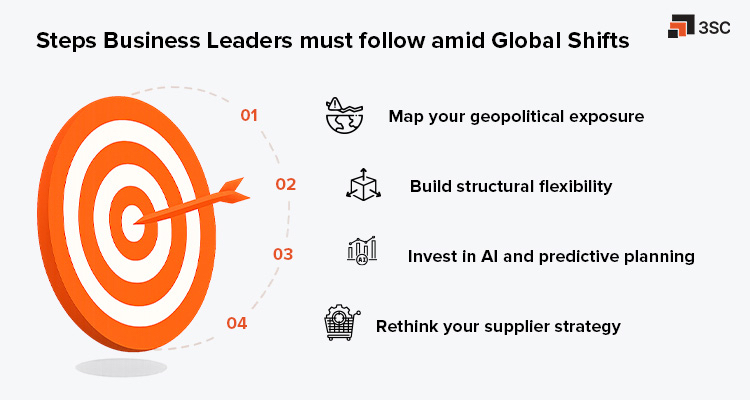
Next Moves for Supply Chain Leadership Amid Global Shifts
This is the moment for businesses to move beyond reactive firefighting and ahead with decisive leadership and long-term redesign. For decision makers and strategy heads, the following actions are no longer optional, they're urgent:
- Map your geopolitical exposure: across supplier networks, trade lanes, currencies, and digital dependencies. Understand not just who you buy from, but who they’re connected to.
- Build structural flexibility: through multi-sourcing, nearshoring, and digitally enabled visibility. Supply chain redundancy is no longer waste, it’s insurance.
- Invest in AI and predictive planning: not as innovation theatre, but as operational infrastructure. Real-time scenario modelling and disruption forecasting are foundational for agility.
- Rethink your supplier strategy: with resilience, trust, and alignment at the centre. Margins matter, but continuity matters more.
Global trade is shifting from being cost-driven to being shaped by power, policies, and geopolitics. In this environment, supply chains must evolve beyond efficiency to become informed, adaptable, and built with foresight. This means embedding flexibility, intelligence, and optionality into networks to handle disruption without losing competitiveness which is no longer just operational support.
Those who lead with intent will not only weather what’s coming, but they’ll also shape it.