Key Takeaways
- The UK–India FTA opens new doors in exports but adds compliance complexity.
- US sanctions are disrupting key sectors like pharma, auto, and IT.
- Exporters face shipment delays, renegotiations, and rising costs.
- Traditional S&OP is too rigid for today’s fast-moving trade landscape.
- Risk intelligence flags disruptions early across policies and suppliers.
- Resilient supply chains require agility, foresight, and connected planning.
India’s economic engine is firing on all cylinders. With a projected GDP growth rate of 6.8% in FY 2025, today the country continues to position itself as a global manufacturing and services powerhouse. Sectors such as pharmaceuticals, textiles, automotive, IT services, food processing, and chemicals are not only contributing significantly to domestic economic expansion but are also increasingly integrated with global value chains.

Exports continue to be a key driver of this expansion. This is while $437 billion in merchandise exports were coupled with $340 billions of services exports in 2023/24. Each sector contributes uniquely:
- Pharmaceuticals: More than $25 billion a year, including in generics and vaccine exports.
- Apparel and Textiles: About $40 billion, mainly to the US and EU.
- Automotive & Components: More than $20bn, focused on the UK, US and Africa among others.
- IT Services: Just under $150 billion, with the largest investments going to the US and Europe.
- Chemicals & Specialty Chemicals: $40+ billion, especially in advanced economies.
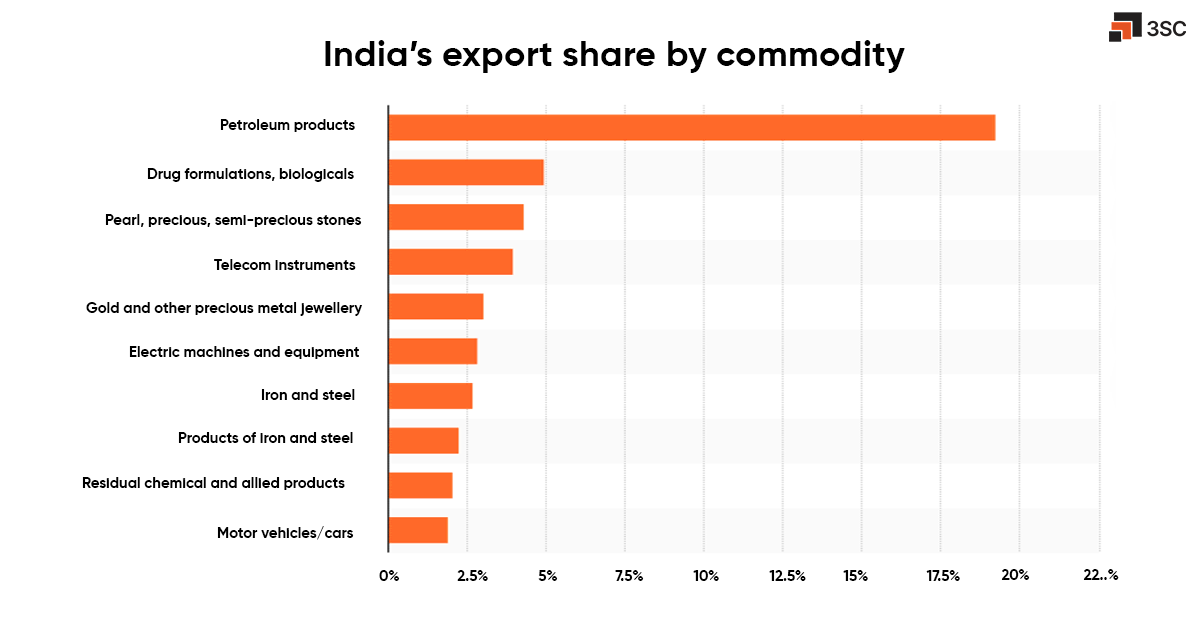
But those numbers mask a more volatile reality: Indian supply chains today are acutely vulnerable to policy changes, geopolitical realignments and trade disruptions. And there are at least two new developments – the UK–India Free Trade Agreement (FTA) as well as the US tariff penalties linked to Russia–India relations – that could transform the trajectory of trade and supply chain resilience for corporations in the South Asian subcontinent.
Related Read - Top IBP Strategies to fix Europe’s broken Supply Chain
UK–India Trade Deal 2025: A Milestone with Caveats
The UK–India Free Trade Agreement, which was agreed this July, after 14 rounds of negotiations, is said to be a game-changer. The agreement is intended to lower tariffs, smooth customs clearance and open new areas for the two economies to work together.
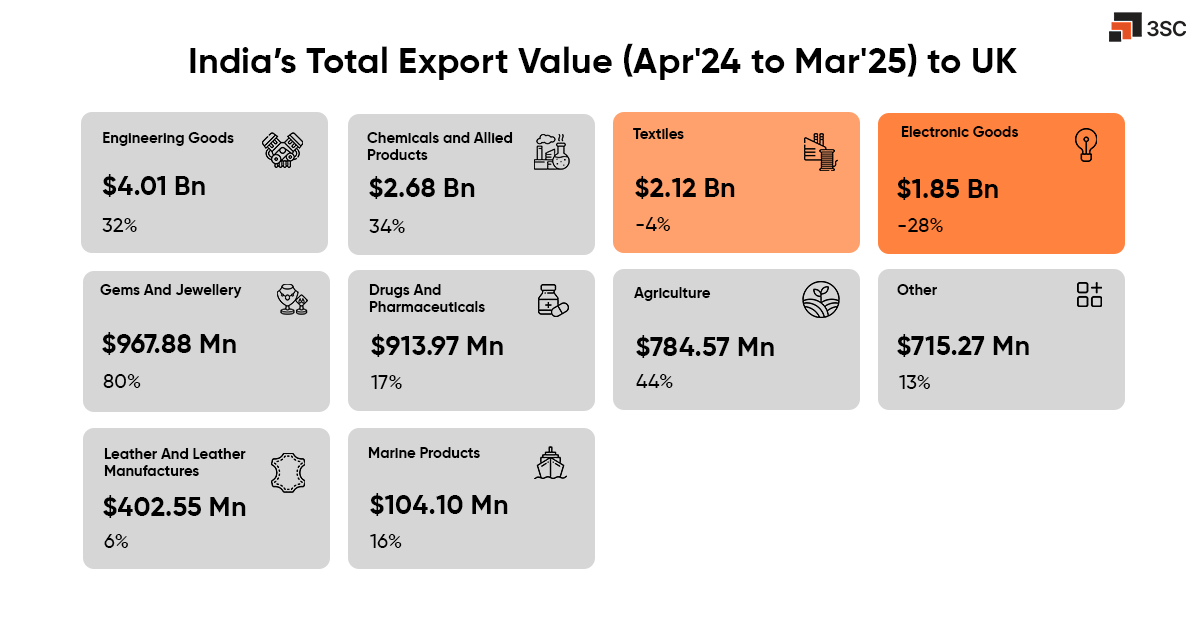
Opportunities by Sector:
- Textiles and apparel: Leader (9.6 % to near zero) Indian exporters to exploit UK retailers at more competitive pricing on large scale.
- Automotive: Indian two-wheeler and electric vehicle component suppliers get enhanced market access.
- Food & Beverage: Reduced Sanitary and phytosanitary measures make it possible to export processed food as well as spices.
- IT and professional services: Easier entry for Indian tech cos, consultancies in other countries with services liberalisation.
However, challenges persist:
Compliance Overload: With new origin certification demands and ESG-linked conditions, the administrative burden may weigh too heavily on small and mid-size exporters.
Currency Volatility: The rupee-pound volatility, coupled with the UK’s Brexit era deceleration in economy, may lead to diversion from immediate gains.
Related Read - How Iran–Israel Conflict Hits EU Supply Chains?
The US–India Tension: Tariff Penalties and the Russia Factor
While British trade relations are seen in a more optimistic light, trade matters with the U.S. are not so clear for India. The US began additional levy for targeted tariffs on certain Indian goods from July 2025, alleging that India is maintaining energy as well as defence relationship with Russia, including the use of Russian oil in India’s refineries and procurement of weaponry.

Sectors Impacted
- Pharmaceuticals: FDA approvals are slowing down; non-tariff barriers are being deployed.
- Engineering Goods & Auto Components: Tariff surcharges of 7–12% on select exports are being levied.
- Chemical Products: Select formulations are under scrutiny for dual-use (civilian + military) potential.
- IT Services: Increased visa scrutiny and compliance audits for Indian IT firms.
But why the Russia Angle Matters?
India and Russia have maintained robust defence and energy ties. With over 60% of India’s military assets originating from Russia and increasing crude oil purchases through rupee-rubble settlements, India has taken a pragmatic but non-aligned stance. However, this positioning is creating growing discomfort among Western partners keen on isolating Russia post the Ukraine conflict.
Related Read - How India’s Supply Chain Disrupted by Iran-Israel Crisis?
The outcome? A growing divergence between strategic autonomy and trade penalties, forcing Indian exporters into complex recalibrations.
Real-Time Impact: What It Means for Indian Businesses
While policy experts are still debating the long-term implications of shifting trade dynamics, Indian businesses are already experiencing immediate disruptions. Exporters to the US are dealing with unexpected contract re-negotiations as new tariffs drive up costs, leading to delays and cancellations.
In a rush to avoid further penalties, many companies are front-loading shipments, causing inventory pileups, stock misalignments, and cash flow pressure. This reactive approach is exposing gaps in warehouse and distribution planning.
Meanwhile, firms dependent on European or US-origin machinery are facing sourcing disruptions due to intensified documentation and clearance checks. These uncertainties are making long-term planning difficult, as traditional Sales & Operations Planning (S&OP) proves too rigid to respond in real time.
The Strategic Response: Making Your Supply Chain Agile and Your Planning Intelligent
In today’s volatile trade environment, where uncertainty has become the new constant. For Indian businesses navigating shifting tariffs, geopolitical flashpoints, and evolving bilateral agreements, Integrated Business Planning (IBP) and dynamic risk management are fast becoming essential.
How IBP Adds Clarity Amid Chaos?
Integrated business planning (IBP) helps companies bring finance, procurement, demand, and supply plans together into one, integrated plan and connect it to operational and financial metrics. This synchronisation in breaking down 'functional' silos means that strategic decisions can be made with end-to-end support. "In a world where shifts are occurring in global demand patterns and supply routes with increasing frequency, IBP allows businesses to perform scenario simulations, posing tough "what if" questions about tariff increases, port delays or regulatory changes, before they escalate into real-life disturbances.
What is more, thanks to the risk management layer of IBP, you will have a real-time intelligence by which your business is also conditioned to act early by identifying and retaliating against any potential threat. Companies can constantly screen the latest news or policy changes across geographies, flag dependencies on high-risk suppliers (especially in politically sensitive areas like Russia) and get early warnings on logistics bottlenecks.
Related Read - Indian Logistics Industry: Trends, Challenges & Growth
Conclusion: Building Resilience in the Midst of Global Flux
The UK–India Free Trade Agreement may open new opportunities, while US tariff penalties introduce fresh hurdles. Together, these developments highlight a broader reality, India’s position in global trade is being actively reshaped by geopolitical shifts, bilateral diplomacy, and evolving regulatory landscapes.
For Indian businesses, this isn’t just a matter of foreign policy, it’s a question of operational readiness. The ripple effects are already being felt in sourcing decisions, export cycles, logistics plans, and cash flows. In such an environment, agility and foresight become strategic necessities.
Today, businesses need to embrace Integrated Business Planning (IBP) paired with real-time risk management to navigate growing complexities in global trade. This combination moves them beyond reactive firefighting, enabling the creation of planning systems that are adaptive, scenario-driven, and built for resilience.
Ultimately, the challenge for Indian enterprises is not merely to withstand these changes, but to evolve through them. A future-ready supply chain is one that anticipates risks, aligns decisions across functions, and grows stronger in the face of disruption.