Supply chain intelligence becomes essential when disconnected planning, emerging risks, slow decision-making, and manual execution limit business performance. Integrated Business Planning (IBP) aligns operational priorities, while risk intelligence improves disruption preparedness. AI-powered planning supports faster, more adaptive decisions, and Agentic AI helps coordinate execution. Together, these capabilities strengthen supply chain resilience, operational efficiency, and business outcomes.
Key Takeaways
- Disconnected planning across business functions can create conflicting priorities and weaken overall supply chain performance.
- Even mature IBP processes need risk intelligence to anticipate disruptions and assess their operational impact.
- AI-powered planning helps businesses respond to changing conditions and evaluate operational trade-offs more effectively.
- Agentic AI can reduce manual coordination and improve the execution of supply chain decisions across connected systems.
- Supply chain intelligence investments should build on existing capabilities and focus on delivering measurable business outcomes.
Supply chain teams have access to more information than ever before. ERP systems manage transactions, planning platforms generate forecasts, and dashboards track operational performance. With so much information available, you would expect making decisions to be easier.
But consider what happens when a key supplier misses a delivery. Procurement is aware of the delay, planning needs to assess its impact on production, and logistics must determine whether alternative arrangements are possible. Each team has part of the information, but bringing it together to decide what to do next can take hours or even days.
And this is where the challenge begins. As supply chains grow more complex, even well-equipped teams can struggle to keep pace with the decisions their operations demand.
So how do you know when your existing intelligence system needs another layer?
Four Signs Your Supply Chain Needs Another Layer of Intelligence
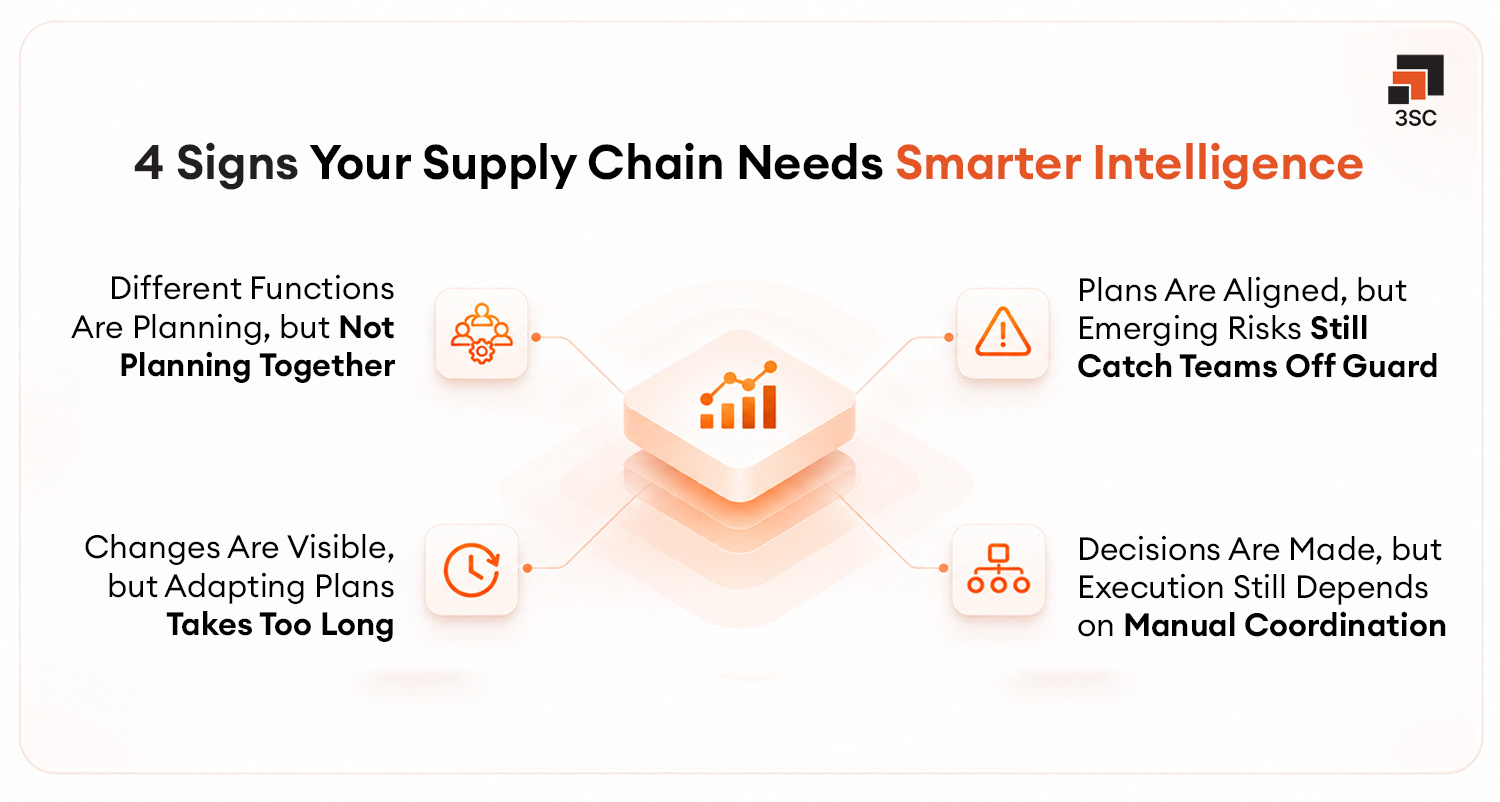
1. Different Functions Are Planning, but Not Planning Together
A supply chain plan can look perfectly achievable until different functions begin working toward it. Demand projections may support ambitious sales targets, while production capacity and financial priorities tell a different story.
This disconnect often becomes apparent during planning reviews, when teams realise their individual assumptions do not support the same business objectives. What follows is a series of revisions, negotiations, and compromises as everyone tries to bring their plans into alignment.
Even when each function is performing well against its own targets, the business may still struggle with rising costs, operational inefficiencies, or inconsistent service levels.
Bringing these priorities together is essential, but an aligned plan can still be vulnerable to developments outside the organisation's control.
2. Plans Are Aligned, but Emerging Risks Still Catch Teams Off Guard
Your organisation may have a well-established planning process, with operational and financial priorities aligned. But what happens when a geopolitical development, supplier disruption, or sudden market change threatens those plans?
Although teams may receive alerts about emerging disruptions, understanding their potential impact across operations often takes time. A risk identified in one part of the supply chain may have consequences for several interconnected activities that are not immediately apparent.
According to McKinsey, companies take an average of two weeks to plan and execute a response to a supply chain disruption. This highlights how the gap between identifying a risk and taking corrective action can leave businesses exposed, even when planning processes are already in place.
By the time the full exposure becomes clear, opportunities to prevent or minimise the impact may have narrowed.
Even when risks are recognised early, another challenge remains: determining how existing plans should change in response.
3. Changes Are Visible, but Adapting Plans Takes Too Long
Identifying a change in business conditions is one thing. Deciding how to adjust an existing plan without creating problems elsewhere can be far more complicated.
A sudden shift in demand or an unexpected capacity constraint may require teams to reconsider production priorities, resource allocation, and customer commitments. Each possible adjustment comes with different implications for costs, service, and operational performance.
When assessing these alternatives requires repeated planning runs, manual calculations, and discussions across functions, the response can take longer than the situation allows.
And even after teams agree on the most suitable response, the challenge continues. The decision still needs to be implemented across the business.
4. Decisions Are Made, but Execution Still Depends on Manual Coordination
Even when teams identify the right course of action, implementing it across the supply chain can be more complicated than expected. A decision made during a planning review may involve several functions, each responsible for completing a different part of the process.
What follows is often a series of approvals, system updates, and follow-ups to ensure that everyone is working toward the agreed outcome. When these activities are managed manually, delays can build up between teams, making it difficult to track progress or identify where action is pending.
Over time, this creates a growing gap between what the business decides and what actually gets implemented. Even the most effective planning decisions can lose their value when execution cannot keep pace.
How Can Businesses Build the Next Layer of Supply Chain Intelligence?
Identifying these gaps is the first step. The next question is where businesses should invest to address them. For organisations already using ERP, IBP, and advanced planning systems, replacing existing technology may be unnecessary. The greater opportunity could lie in adding capabilities that address specific limitations in their current operations.
The right investment depends on what the existing technology can already do and where decision-making continues to fall short.
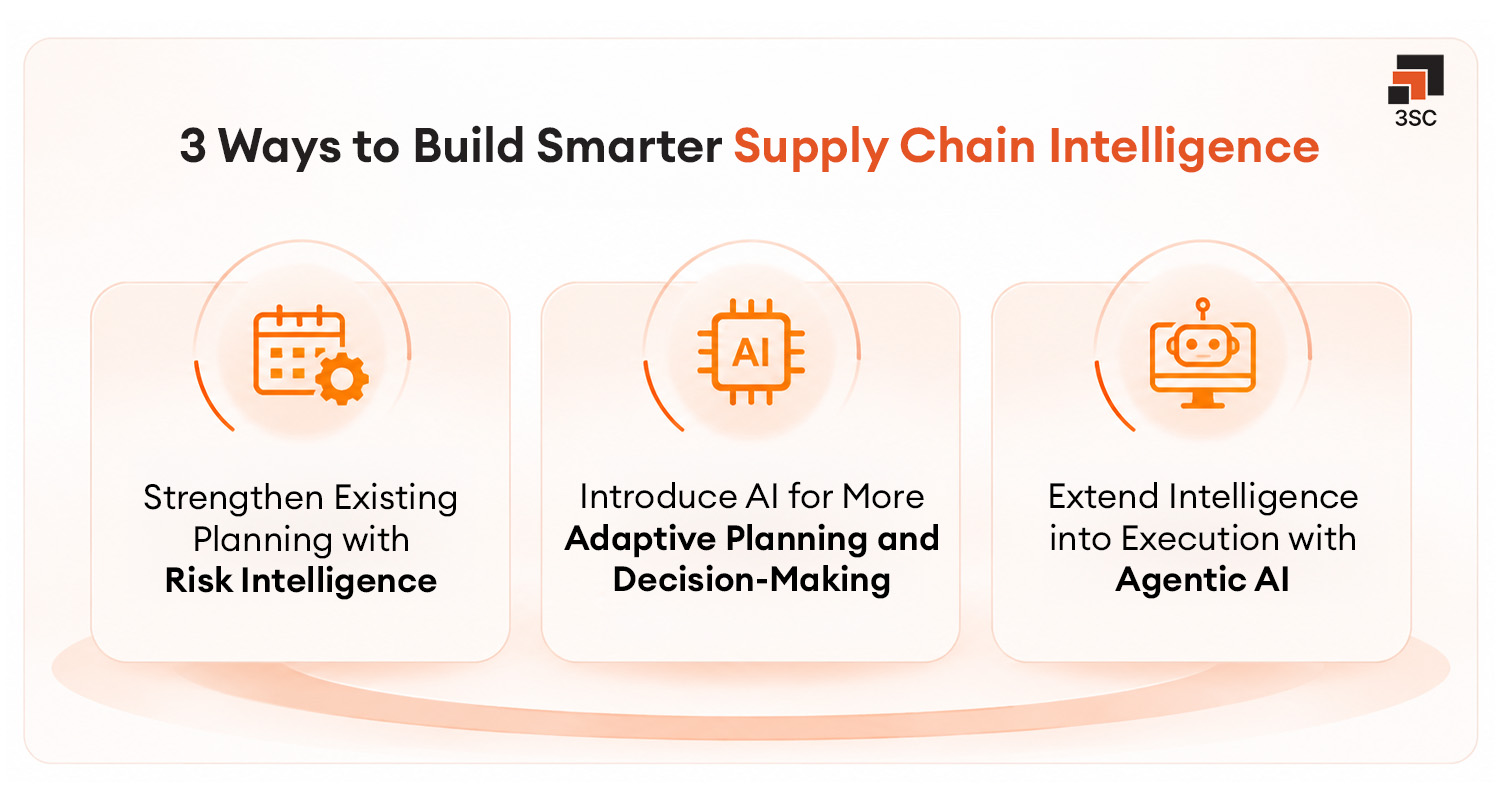
1. Strengthen Existing Planning with Risk Intelligence
Businesses with established IBP capabilities may already have demand forecasts, supply plans, and financial objectives aligned. However, these plans can still be exposed to supplier disruptions, geopolitical developments, and unexpected capacity constraints.
Adding supply chain risk intelligence can help organisations identify emerging threats, assess their potential operational impact, and evaluate mitigation options before disruptions affect customer commitments. This becomes particularly valuable when existing planning processes have limited visibility into external risks.
2. Introduce AI for More Adaptive Planning and Decision-Making
For businesses still relying primarily on historical forecasting methods and predefined planning rules, integrating AI can be a valuable next step.
AI-powered demand sensing, inventory optimisation, and intelligent scenario simulation can help teams identify changing patterns, evaluate trade-offs, and adjust plans as new information becomes available. These capabilities can strengthen existing planning platforms without requiring organisations to rebuild their technology landscape.
3. Extend Intelligence into Execution with Agentic AI
Even with advanced planning and analytical capabilities, businesses may find that turning recommendations into action requires considerable manual coordination.
Agentic AI can help bridge this gap by investigating exceptions, coordinating defined workflows, and initiating permitted actions across connected systems. This can improve response times and free planners to focus on decisions that require their expertise.
Effective adoption, however, depends on reliable data, clear decision boundaries, and appropriate human oversight.
As these capabilities mature, businesses can also explore a broader shift in how they consume supply chain technology. Outcome-based service models offer the possibility of paying for agreed operational results rather than managing additional tools and workflows internally. While this approach requires clear performance measures and accountability, it reflects a growing interest in connecting technology investments more directly with business value.
Ultimately, the goal is to build on existing investments and introduce intelligence where it can deliver meaningful improvements in planning, decision-making, and execution.
Conclusion: What Supply Chain Leaders Should Prioritise
For supply chain leaders, the need for another layer of intelligence should be evaluated through the performance of everyday decisions.
Can teams identify the causes of operational problems without extensive manual investigation? Can they prioritise exceptions according to business impact, evaluate alternatives quickly, and coordinate corrective actions across functions?
If these activities continue to depend heavily on individual expertise, disconnected information, and repeated manual intervention, there may be an opportunity to strengthen the organisation's decision-making capabilities.
Investing in additional intelligence should therefore begin with identifying where decisions become slow, fragmented, or difficult to execute, and determining what improvements would deliver the greatest business value.
The competitive advantage will come from how consistently supply chain teams turn information into decisions, and decisions into measurable operational outcomes.
Ready to Build a More Intelligent Supply Chain?
Discover how 3SC's AI-powered supply chain solutions can help you strengthen planning, improve decision-making, and respond to disruptions with greater confidence. Connect with our experts to explore the right intelligence capabilities for your business.