Key Takeaways
- Efficiency without adaptability makes supply chains fragile.
- Risk intelligence enables real-time, proactive decision-making.
- Early detection, scenario planning, and cross-functional action are its core strengths.
- It drives faster responses, lower inventory, and better customer outcomes.
- Risk-intelligent supply chains don’t just survive, they lead.
To stay ahead, supply chains must move beyond reactive measures and adopt a more intelligent, proactive approach. Risk intelligence enables this shift by driving faster decisions, smarter planning, and real-time adaptability across the network. It transforms disruption from a threat into a lever for leadership and long-term advantage.
For decades, supply chains were designed around one principle: efficiency. Leaner inventories, faster deliveries, lower costs. Predictability was the foundation, and the goal. But the world has changed. From pandemics and cyberattacks to trade wars and climate disruptions, the modern supply chain faces relentless shocks. Each disruption exposes the same underlying truth: a supply chain built solely for efficiency is one built on fragility.
The competitive edge lies not just in resilience, but in risk intelligence, the ability to see around corners, respond in real time, and adapt with precision. Risk intelligence is more than a toolset; it’s a mindset that enables organisations to shift from reactive crisis management to proactive, strategic planning. It turns volatility into a driver of value, transforming supply chains from operational backbones into strategic differentiators.
What Makes Risk Intelligence Different and Essential for Supply Chains
Traditional risk management tends to be reactive and fragmented. It focuses on immediate threats like delayed shipments or single-point supplier failures and often overlooks systemic vulnerabilities hidden deep within Tier 2 or Tier 3 networks. While this may offer temporary relief, it falls short in a world where disruption is continuous and complex.
Risk intelligence, on the other hand, takes a fundamentally different approach. It empowers organisations to anticipate, assess, and act on threats in real time, before they escalate into crises. By integrating data visibility, AI-driven predictive analytics, scenario modelling, and automated decision-making, it provides proactive, end-to-end risk governance.
Modern risk-intelligent platforms continuously monitor thousands of signals, from geopolitical tensions and weather anomalies to supplier KPIs and logistics performance. They recommend optimal responses before issues disrupt operations, enabling companies to shift suppliers, reroute inventory, or rebalance stock well in advance.
True resilience is built on end-to-end visibility, extending beyond Tier 1 to include lower-tier suppliers, contract manufacturers, and logistics partners. Gaining this depth of insight is essential to uncover hidden vulnerabilities and enable agile, risk-informed decision-making across the entire supply chain.
By embedding risk intelligence into supply chain decision-making at every level, companies move from reacting to disruptions to leading with foresight. This is not just about reducing risk, it's about transforming unpredictability into a strategic advantage.
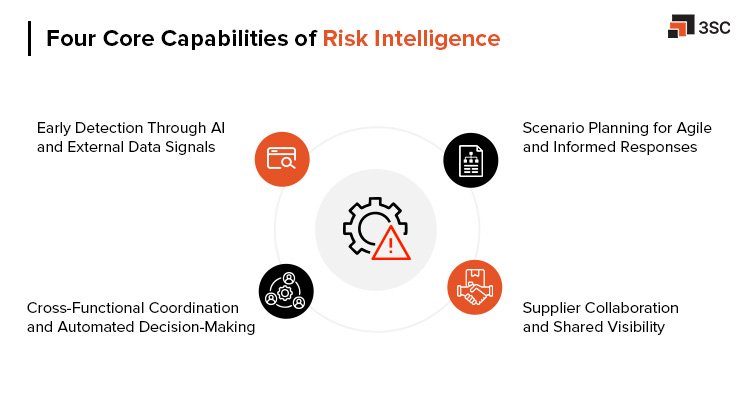
Risk Intelligence in Action: Four Core Capabilities
Effective risk management today requires more than just awareness; it demands foresight and agility to become intelligent. These four core capabilities enable supply chains with risk intelligence to anticipate disruptions, respond with speed, and maintain continuity in an increasingly volatile environment.
1. Early Detection Through AI and External Data Signals
At the heart of risk intelligence lies the ability to detect threats early, before they materialise into costly disruptions. Traditional monitoring systems often rely solely on internal data or lagging indicators. In contrast, AI-powered risk intelligence platforms ingest and analyse a wide spectrum of structured and unstructured data sources, including:
- Port and customs delays
- Supplier behaviour and shipment history
- Real-time weather alerts
- News feeds and geopolitical event trackers
According to IBM, AI-enhanced supply chains are 50% more responsive to disruptions because they can correlate signals that a human planner might miss. For example, a sudden social media spike about a port strike in Hamburg could trigger an alert for rerouting shipments, long before delays officially occur.
This early-warning capability empowers planners to make pre-emptive decisions, such as switching suppliers, scaling production at alternate sites, or rerouting logistics, before customer experience, inventory health, or working capital are impacted.
2. Scenario Planning for Agile and Informed Responses
Risk-intelligent systems don't just predict disruptions; they prepare organisations to respond with confidence. This is made possible through scenario modelling or "what-if" simulations.
For example, planners can model scenarios like:
- A regional lockdown
- Trade route disruptions or new tariffs
- Supplier shut down for maintenance
- Change in lead times due to route changes
These simulations help supply chain leaders evaluate the cost, impact, and feasibility of various response strategies. They enable the creation of pre-approved playbooks for different types of events, reducing decision latency during crises.
Related read - Why Scenario Planning Crucial for Business Success?
As Through Put Inc. emphasises, this “muscle memory” allows teams to act, not just react, ensuring business continuity even in volatile conditions. Such planning transforms firefighting into foresight, enabling more agile, dynamic, and risk-aware supply chain operations.
3. Cross-Functional Coordination and Automated Decision-Making
The real power of risk intelligence emerges when it orchestrates action across the entire supply chain ecosystem. Most supply chain disruptions cut across departments, yet many organisations remain siloed, with procurement, logistics, inventory, and finance operating on fragmented data.
Risk-intelligent platforms break these silos by delivering a single source of truth, aligning all departments on the same risk signal. When a disruption is detected:
- Procurement can shift orders to alternate suppliers
- Logistics can reroute freight or rebook carriers
- Inventory teams can rebalance stock across nodes
- Production teams can seamlessly accommodate rush orders
Automation plays a key role here. Advanced systems not only flag risks, but they also automatically recommend or execute predefined responses, drastically reducing response time.
This kind of integrated decision-making minimises manual interventions, accelerates execution, and makes the entire value chain more resilient and synchronised, even during high-pressure periods.
4. Supplier Collaboration and Shared Visibility
The strength of risk intelligence is amplified when it extends beyond internal teams to include external partners, especially suppliers. In many cases, risks emerge not from internal delays, but from misalignment across the extended supply network. Yet, supplier relationships often operate in isolation, with limited visibility and reactive communication.
Risk-intelligent systems foster collaborative planning by enabling shared access to real-time inventory levels, demand forecasts, and supply constraints. When both the brand and its suppliers have visibility into each other’s stock positions and demand plans, they can:
- Anticipate shortages or excesses well in advance
- Adjust procurement and replenishment cycles proactively
- Avoid last-minute firefighting and emergency shipments
- Align production and delivery timelines to actual demand
This level of collaboration builds trust, improves service levels, and removes the guesswork from supplier coordination. Most importantly, it shifts the supply chain from being vulnerable to becoming anti-fragile, able to absorb shocks, adapt quickly, and emerge stronger from disruption.
Business Benefits: From Resilience to Differentiation
Risk intelligence does far more than prevent losses. It delivers tangible, measurable improvements across every layer of the supply chain.
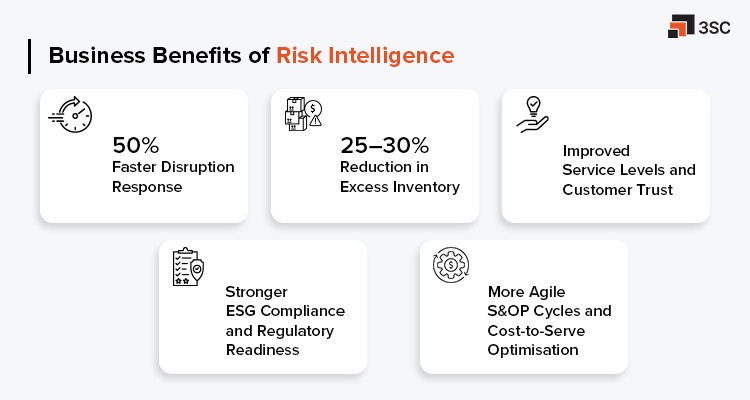
Organizations that embed risk intelligence into their operations gain the ability to respond faster, plan smarter, and execute with greater precision, leading to both operational excellence and competitive differentiation. Key Benefits Include -
1. 50% Faster Disruption Response
Companies leveraging AI and real-time risk signals can detect, interpret, and respond to disruptions twice as fast, reducing downtime, stockouts, and customer dissatisfaction. (Source - IBM)
2. 25–30% Reduction in Excess Inventory
Smarter demand sensing and risk-adjusted planning reduce inventory buffers while still ensuring availability, freeing up working capital and improving cash flow. (Source - SuperAGI)
3. Improved Service Levels and Customer Trust
With fewer delivery delays and better order fill rates, companies build reliability into their customer experience, directly impacting loyalty and market share.
4. Stronger ESG Compliance and Regulatory Readiness
Risk intelligence platforms identify environmental and compliance risks across the supply chain. By integrating emission factor repositories aligned with EPA, DEFRA, GLEC, and IPCC, companies can measure carbon impact, ensure regulatory compliance, and drive smarter, low-emission decisions.
5. More Agile S&OP Cycles and Cost-to-Serve Optimisation
Integrated risk insights improve the agility of Sales & Operations Planning (S&OP), enabling rapid rebalancing of supply-demand plans and smarter cost trade-offs.
Related read - Key Benefits of Sales and Operation Planning
In a world where supply chain disruptions can quickly spiral into brand damage, being risk-intelligent is no longer a protective measure, it’s a brand and growth enabler.
Conclusion
The strength of a supply chain is no longer measured by how well it holds up under pressure, but by how intelligently it adapts to it. Risk intelligence is not a one-time investment or a software layer, it’s a capability that rewires how organisations think, plan, and respond across every level of the value chain.
It empowers businesses to make faster, smarter, and more connected decisions, not just during crises, but every day. And as global dynamics continue to shift, those decisions will be the difference between staying afloat and surging ahead.
The future of supply chain leadership won’t be defined by who can recover the fastest, but by who can predict, prepare, and pivot with precision. Risk intelligence makes that future not just possible, but profitable.
Future-Proof Your Supply Chain with 3SC
At 3SC, we help businesses move beyond reactive planning with AI-powered risk intelligence that delivers real-time visibility, early warning signals, and agile decision-making. Our integrated supply chain intelligence platform is built to turn volatility into competitive advantage, so you don’t just recover from disruption, you lead through it.
Whether you're looking to strengthen resilience, reduce excess inventory, or improve service levels across your network, 3SC’s end-to-end solutions are designed to help you act faster, plan smarter, and stay ahead.