Key Takeaways
- Analytics turns supply-chain data into smarter decisions.
- Clean, reliable data is essential for accurate insights.
- Predictive analytics improves forecasting and reduces risks.
- Real-time and prescriptive analytics drive continuous optimisation.
- Analytics-powered supply chains are more efficient, resilient, and competitive.
Supply chains today generate an unprecedented volume of data across suppliers, production lines, inventory points, logistics networks, and customer touchpoints. When this data is transformed into actionable intelligence, it becomes a strategic asset, enabling faster, more accurate, and more confident decision-making across the enterprise.
In a global environment defined by volatility, rising customer expectations, and increasingly complex operating networks, visibility alone is no longer sufficient. Organizations need intelligence: the ability to forecast demand accurately, identify risks before they escalate, optimize resources dynamically, and respond to disruptions with speed and clarity. This is where analytics transitions from a reporting tool to a foundational driver of supply-chain resilience and competitiveness.
Moreover, the global predictive analytics market is projected to grow from $18.89 billion in 2024 to $82.35 billion by 2030, at a remarkable 28.3% CAGR, underscoring how rapidly enterprises are embedding predictive capabilities into their digital supply-chain ecosystems. Such exponential growth reflects a clear reality: analytics is no longer optional, it is becoming central to how future-ready supply chains operate, compete, and scale.
The Data-Quality Imperative: Why Accuracy Determines Analytical Value
High-quality data is the foundation of any effective analytics framework. Without reliable, consistent, and standardized data, even the most sophisticated algorithms and models will produce inaccurate or incomplete insights.
Supply-chain ecosystems pull information from multiple sources, ERP systems, warehouse and transportation management platforms, supplier portals, point-of-sale systems, and external data feeds. These inputs often differ in structure, frequency, and quality. Consolidating them requires disciplined data governance, standardized master data, and mechanisms for real-time data capture.
Organizations that invest in data validation, live inventory visibility, and unified performance metrics create the conditions necessary for accurate forecasting, precise inventory optimization, and robust risk modelling.
The value of analytics, from demand planning to scenario analysis depends directly on the quality of the underlying data.
Predictive Analytics: Anticipating Events Before They Occur
Once data from multiple sources is consolidated and structured, predictive analytics becomes a strategic enabler across the supply chain. By integrating historical trends, real-time signals, and advanced machine-learning models, organizations can forecast demand shifts, identify emerging risks, and optimize operational planning.
1. Demand Forecasting & Demand Sensing
Traditional forecasting relies primarily on historical patterns and seasonality, which is insufficient in today’s volatile markets. Demand sensing enhances accuracy by incorporating real-time inputs such as sales trends, localized events, market signals, and weather conditions.
Organizations adopting predictive forecasting methodologies consistently report improved forecast accuracy and measurable reductions in stockouts and excess inventory.
|| Recommended Read - AI-Powered Demand Sensing in F&B Industry
2. Inventory Optimization
Predictive analytics supports the shift from static reorder points to dynamically calculated inventory thresholds. This allows companies to maintain optimal stock levels, reduce holding costs, and enhance working-capital efficiency while meeting required service levels.
3. Risk Management and Contingency Planning
Modern supply chains are exposed to a wide range of disruptions, including geopolitical instability, natural events, supplier failures, and transportation delays. Predictive analytics strengthens resilience by monitoring early warning indicators and supporting scenario-based contingency planning.
|| Recommended Read - Predictive Modeling and Their Types
By strengthening forecasting accuracy, anticipating demand shifts, and revealing early signs of disruption, predictive analytics equips organisations with the forward-looking intelligence they need. But knowing what may happen is only the first step. To act on these insights effectively, and choose the best possible response, supply chains must move beyond prediction into optimisation. This is where prescriptive and real-time analytics take over, turning foresight into precise, actionable decisions.
Prescriptive and Real-Time Analytics
Prescriptive analytics advances this further by identifying the optimal decisions based on business constraints, objectives, and real-time operational variables.
Through advanced optimization models and AI-driven decision engines, supply-chain teams can simulate scenarios, assess trade-offs, and align actions with both operational and financial targets.
As real-time data becomes increasingly available through IoT sensors, tracking systems, and automated warehouse platforms, analytics evolves from periodic reporting to continuous, adaptive optimization. This capability enables organizations to operate leaner, respond faster, and maintain resilience without increasing operational overhead.
|| Recommended Read - What is Real-Time Risk Monitoring
Measuring Success: KPIs, Benchmarks & The Analytics Scorecard
By synchronising data, decision engines, and execution workflows, analytics allows supply chains to pivot quickly, allocate resources intelligently, and stay resilient through disruption. The result is a system that is faster, more accurate, and structurally more agile, consistently outperforming in volatile environments.
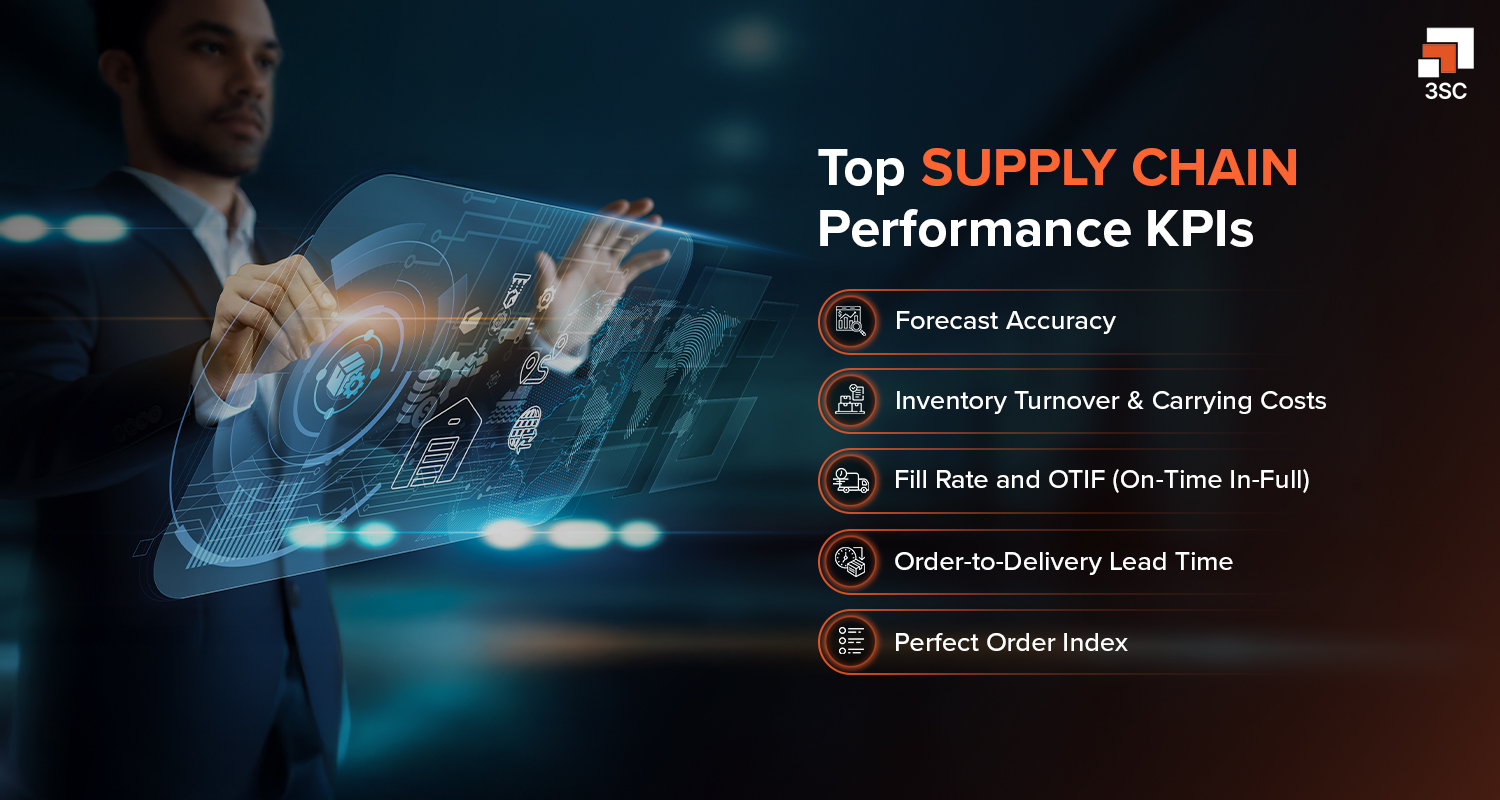
Key performance indicators enhanced by analytics include:
1. Forecast Accuracy
Forecast accuracy measures how closely projected demand aligns with actual demand. Higher accuracy reduces uncertainty, prevents overproduction, and minimizes stockouts. Analytics improves this metric through advanced modelling, demand sensing, and real-time signal integration, enabling more reliable planning and resource allocation.
2. Inventory Turnover & Carrying Costs
Analytics supports continuous optimization by identifying slow-moving items, calculating optimal reorder levels, and improving stock mix across locations. This drives better working-capital performance and reduces operational waste.
3. Fill Rate and OTIF (On-Time In-Full)
Fill rate measures the percentage of customer demand met immediately from available inventory. OTIF assesses the ability to deliver complete orders within the promised timeframe. Analytics enhances these service metrics by improving demand forecasting, optimizing replenishment, monitoring real-time constraints, and ensuring alignment between supply capabilities and customer expectations.
4. Order-to-Delivery Lead Time
This metric tracks the total time taken from the moment an order is placed to when it is delivered. Analytics reduces lead time by identifying bottlenecks across ordering, production, picking, packing, and transportation. It also enables predictive insights that allow organizations to proactively address capacity issues and logistics delays.
5. Perfect Order Index
The Perfect Order Index measures the percentage of orders delivered without errors, complete, on time, damage-free, and with accurate documentation. Analytics supports this by integrating data across systems, monitoring process deviations, and automating error detection. As a composite metric, it provides a holistic view of supply-chain execution quality.
Organizations that effectively operationalize analytics consistently report reduced working-capital requirements, lower levels of waste, fewer stockouts, and optimised logistics costs, resulting in measurable operational and financial gains.
The Strategic Advantage: Why Analytics-Powered Supply Chains Outperform
Analytics-driven supply chains outperform because they don’t just interpret the past, they shape what happens next. Prescriptive analytics converts complexity into clear, data-backed actions, enabling decisions that adapt to real-time conditions and business priorities.
1. Cross-Functional Integration
Shared data and unified KPIs empower cross-functional teams to make faster, coordinated decisions, driving operational agility and strengthening resilience through early risk detection and collective action.
Alignment across procurement, logistics, finance, sales, and operations enhances demand–supply balance, improves fulfilment accuracy, and elevates the overall customer experience.
2. Driving Cost Efficiency & Strategic Competitiveness
Data-literate teams interpret insights effectively, challenge assumptions, and apply analytics to real decisions, driving cost efficiency through smarter forecasting, optimised inventory, and reduced operational waste.
Building analytical capability enables long-term competitiveness, empowering teams to leverage scenario modelling, strategic planning, and continuous improvement for stronger, insight-led performance.
3. Robust Data Governance
Accurate, validated, and consistent data enhances service reliability by improving demand planning, stock availability, and overall execution performance across OTIF, perfect-order accuracy, and lead times.
Strong governance builds decision confidence by ensuring data integrity across systems, making insights dependable and optimisation scalable, repeatable, and sustainable.
Conclusion
As supply chains become more interconnected and inherently volatile, the role of analytics is shifting from operational support to strategic necessity. Organizations that build the capability to transform data into intelligence gain the clarity to navigate uncertainty, the agility to adapt quickly, and the advantage to stay ahead of competitive pressures. Analytics does more than optimize processes, it reshapes how supply chains think, plan, and respond.
The companies that will lead in the coming decade are those that treat analytics not as a project or a set of tools, but as a core organisational mindset. It requires disciplined data practices, strong cross-functional collaboration, and leaders who are prepared to embed analytical thinking into every decision. As the predictive analytics market accelerates in scale and sophistication, the businesses that embrace this shift now will set the benchmark for resilience, customer responsiveness, and cost efficiency.