Artificial intelligence is reshaping supply chain management through continuous planning, advanced risk assessment, and increasingly autonomous execution. As businesses prepare for 2027, reliable data, connected systems, and workforce readiness will become essential to successful AI adoption. These developments can help organisations make informed decisions, strengthen operational resilience, and achieve measurable improvements in supply chain performance.
Key Takeaways
- Reliable data, integrated systems, and clear governance will be essential for scaling AI across supply chain operations.
- Continuous planning and scenario modelling will improve decision making and help businesses respond to changing conditions.
- Agentic AI will enable greater automation and coordinated execution while maintaining appropriate human oversight.
- Connected supply chain ecosystems and evolving workforce capabilities will strengthen collaboration and operational responsiveness.
- AI investments will increasingly be measured through improvements in inventory, fulfilment, cost efficiency, and business performance.
Imagine starting your Monday morning with news that a major shipping route has been disrupted. A critical supplier is facing delays, transportation costs are rising, and customer orders are already committed.
Your team has access to sophisticated planning systems, detailed dashboards, and years of operational data. Yet understanding how the disruption will affect production, inventory, and customer commitments still requires hours of coordination across departments.
This situation captures one of the biggest challenges facing supply chains today. Businesses have invested heavily in digital capabilities, but the ability to turn information into timely, coordinated decisions remains uneven.
AI is beginning to change how businesses address this challenge. Its applications are expanding beyond forecasting and analytics into scenario evaluation, risk management, and increasingly autonomous execution.
For Chief Supply Chain Officers (CSCOs), this evolution brings new opportunities, along with important questions about technology readiness, organisational capabilities, and measurable business value.
So, what developments deserve attention in the year ahead?
Supply Chain AI in 2027: Key Trends Shaping the Future
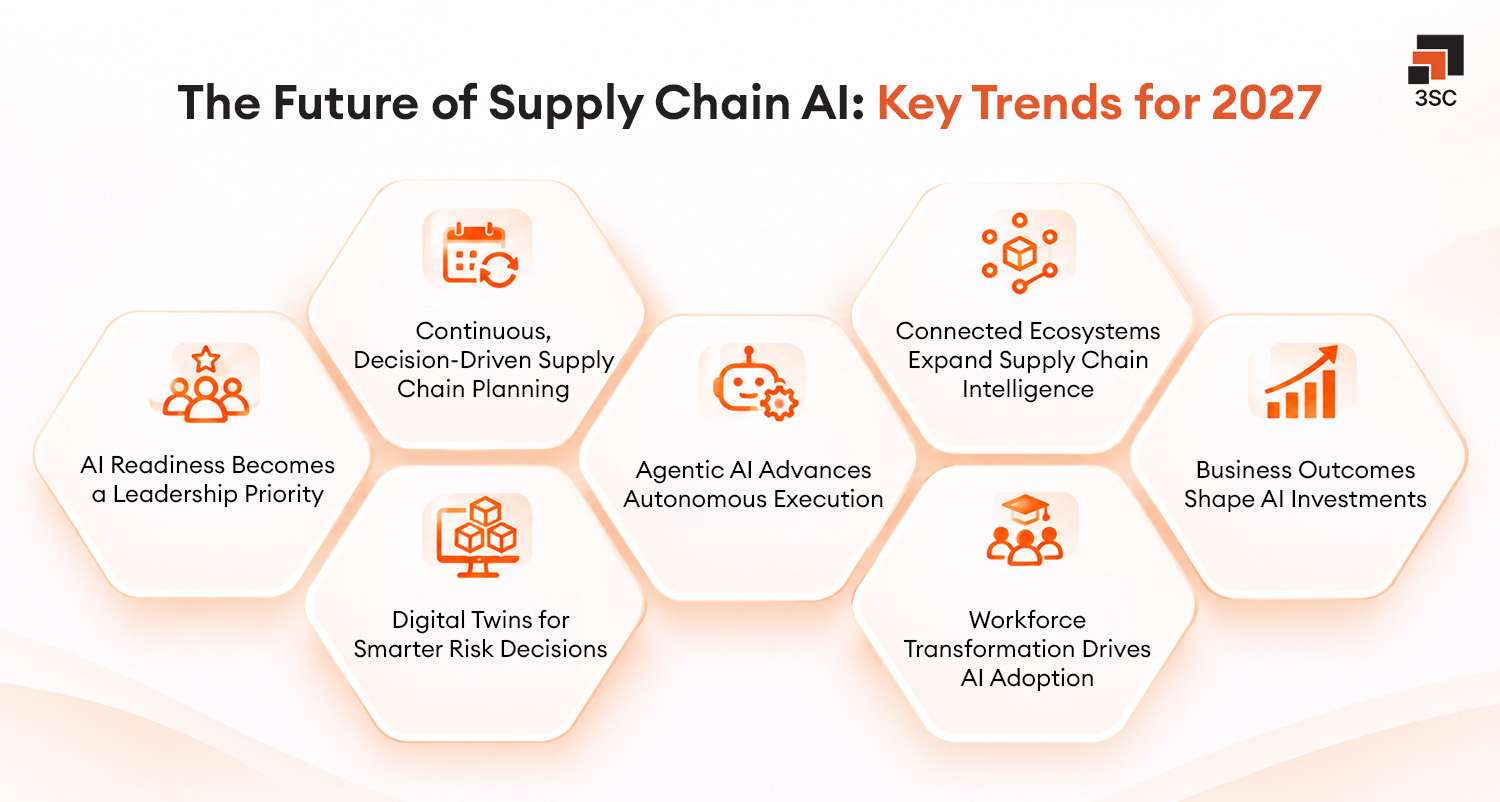
1. AI Readiness Will Become a Leadership Priority
The effectiveness of AI depends heavily on the systems and information supporting it. Yet many supply chains still operate with disconnected applications, inconsistent master data, and fragmented workflows.
According to a Gartner, 56% of CSCOs identified integration with legacy systems as a major challenge, while 50% cited limited internal AI expertise.
These challenges highlight why AI readiness must extend beyond technology investment. Consistent master data, system integration, and clearly defined information ownership are essential for generating reliable recommendations and enabling them to be used across functions.
With stronger foundations in place, businesses can begin applying AI to one of their most critical activities: planning.
2. Supply Chain Planning Will Become More Continuous and Decision Focused
Supply chain planning has traditionally relied on established cycles in which forecasts are reviewed, resources are allocated, and plans are approved. While these processes provide structure, changing market conditions can quickly affect the assumptions behind them.
AI can help businesses respond by continuously analysing demand signals, supplier performance, inventory positions, and operational constraints. This allows planning teams to identify emerging gaps earlier and evaluate adjustments while there is still time to act.
It also strengthens coordination between demand planning, supply planning, and Sales and Operations Planning, where decisions must account for competing business objectives.
The real development lies in the ability to understand how each planning decision affects costs, capacity, and customer service. But even the most responsive planning process must account for events that cannot be predicted with certainty. This is where scenario intelligence becomes increasingly important.
3. Digital Twins and Scenario Modelling Will Strengthen Risk Decisions
Geopolitical tensions, supplier disruptions, and transportation uncertainty continue to expose vulnerabilities across interconnected supply chains.
According to UNCTAD's, shipping disruptions have increased voyage distances, transportation costs, and uncertainty across global trade networks.
These developments make it important to understand how disruptions could affect different parts of the supply chain before deciding how to respond.
AI supported digital twins and scenario modelling can help businesses assess potential consequences across production, inventory, transportation, and customer commitments. They also make it possible to compare alternative responses while considering financial and operational constraints.
This supports more informed decisions about cost, service reliability, and operational flexibility. However, selecting the most suitable response is only part of the challenge. Businesses also need the ability to implement those decisions before conditions change again.
4. Agentic AI Will Bring Greater Autonomy to Supply Chain Execution
As AI becomes more deeply integrated into planning, its role in execution is also expanding.
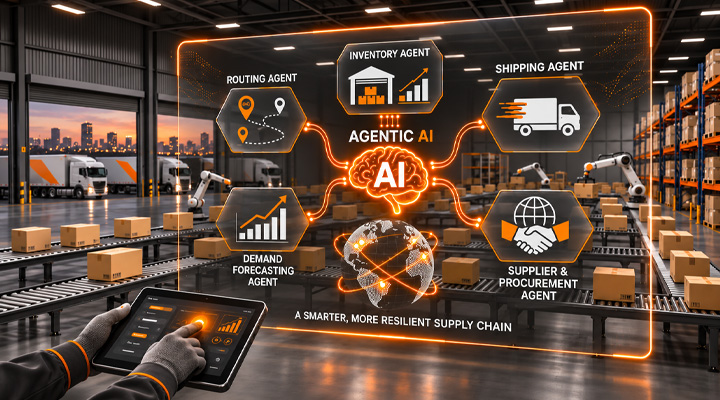
Agentic AI enables intelligent systems to carry out defined tasks, interact with enterprise applications, and coordinate workflows within established business controls. These capabilities could support replenishment decisions, shipment coordination, procurement activities, and exception management.
The World Economic Forum highlights how autonomous AI could improve supply chain resilience while emphasising the importance of governance and human oversight.
This introduces an important distinction between decisions that can be automated and those requiring human judgment. Routine operational activities may offer opportunities for greater autonomy, while decisions involving significant financial or business consequences need appropriate oversight.
As execution becomes more intelligent, its effectiveness will increasingly depend on the ability to coordinate information and actions across the wider supply chain network.
5. Connected Ecosystems Will Extend Intelligence Beyond Enterprise Boundaries
Supply chain decisions are deeply interconnected, often depending on information and actions from suppliers, manufacturers, logistics providers, and distribution partners.
Even sophisticated internal AI systems have limitations when critical information remains unavailable across these relationships.
Greater data interoperability and collaboration can help organisations identify supplier constraints, anticipate delivery disruptions, and coordinate responses across trading partners.
In its roadmap for building a supply chain AI foundation, Gartner identifies AI enabled trading partner ecosystems as an important component of future supply chain transformation, supported by shared data frameworks, integrated workflows, and transparent governance.
As businesses extend intelligence beyond their internal operations, they will also need to reconsider how employees interact with increasingly connected and autonomous systems.
6. Workforce Transformation Will Determine How Successfully AI Scales
The growing role of AI in planning and execution will gradually change how supply chain teams operate. Planners will be able to spend more time evaluating exceptions and alternative decisions, while procurement and logistics professionals will increasingly work with automated processes and AI generated recommendations.
These changes require capabilities in analytical reasoning, AI supervision, and decision governance, alongside an understanding of how intelligent systems influence operational outcomes.
A Gartner survey found that 47% of surveyed supply chains had reduced headcount over the previous two years, primarily due to AI, underscoring the scale of workforce changes already underway.
Preparing employees through relevant training, redesigned responsibilities, and clear accountability will be essential to making these capabilities effective in daily operations. The success of this transformation, however, will ultimately be determined by the improvements it delivers to the business.
7. Measuring Business Outcomes Will Become Central to AI Investment Decisions
As businesses continue investing in AI, expectations around measurable returns are becoming more demanding.
Gartner research highlights concern that incremental productivity improvements from individual AI applications may fall short of broader enterprise expectations. This places greater importance on connecting AI investments with defined operational and financial objectives.
Better forecasting should improve inventory performance and product availability. Earlier disruption detection should help reduce recovery costs. More coordinated execution should support reliable fulfilment and greater operational productivity.
Evaluating these outcomes also makes it easier to identify which capabilities are delivering value, where adjustments are needed, and which initiatives are ready to scale. The ability to demonstrate these improvements will increasingly influence how AI strategies evolve.
Conclusion: Preparing for the Next Phase of Supply Chain AI
The future of Supply Chain AI will be shaped as much by leadership decisions as by technological advancement.
Building a more intelligent supply chain requires reliable data, connected planning, stronger scenario capabilities, responsible automation, and a workforce equipped to use these capabilities effectively.
These developments are closely connected. Stronger data foundations support better planning, scenario intelligence improves decision quality, and autonomous execution helps translate those decisions into operational results. Together, they create opportunities for greater resilience, efficiency, and business performance.
The challenge now is to connect these capabilities into an operating model that consistently delivers measurable value. The measure of progress will be how effectively supply chains translate intelligence into better decisions, reliable execution, and stronger business performance.
Build a More Intelligent and Resilient Supply Chain with 3SC
Discover how 3SC's AI powered supply chain solutions can help your business improve planning accuracy, strengthen risk management, and streamline operational execution. Connect intelligence across your supply chain to make informed decisions, respond faster to disruptions, and deliver measurable improvements in business performance.