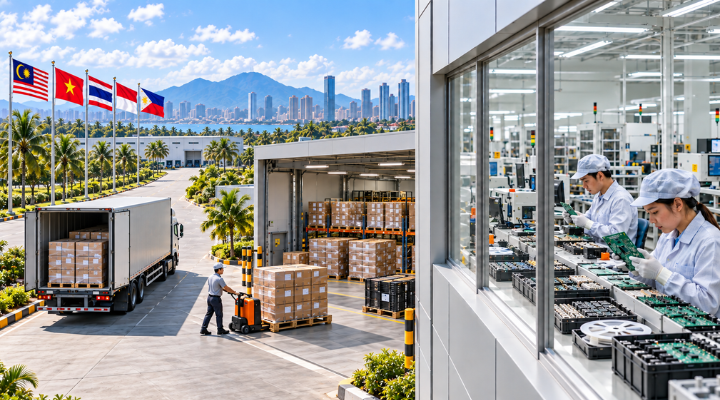
Southeast Asia is becoming a major electronics manufacturing hub, with companies expanding production across multiple markets to gain flexibility and access specialized capabilities. This shift also creates greater supply chain complexity across suppliers, inventory, planning, and logistics. To build resilience, supply chain leaders need stronger visibility, connected planning, risk-based inventory strategies, and deeper supplier mapping across the regional network.
Key Takeaways
- Southeast Asia is emerging as a more distributed and specialized electronics manufacturing network.
- Expanding production across more locations can increase flexibility but also creates new dependencies across suppliers and logistics.
- Supply chain visibility needs to extend beyond Tier 1 suppliers to identify critical upstream risks.
- Planning and inventory decisions need to be connected across locations instead of managed in isolation.
- Resilience will depend on how effectively sourcing, production, inventory, logistics, and supplier risk are coordinated across the network.
Electronics manufacturing is gradually taking on a new shape across Southeast Asia. As companies look to diversify production and build more flexible networks, the region is becoming an increasingly important part of the global manufacturing landscape.
That momentum is also visible in where investment is moving. ASEAN attracted a record $243.9 billion in foreign direct investment in 2025, reinforcing the region’s growing role in global production.
But as manufacturing spreads across a wider footprint, the supply chain behind it becomes more complex. More locations can create flexibility, but they also introduce new dependencies across suppliers, transport, inventory, and planning.
For supply chain leaders, the challenge is not just where to manufacture, but how to make the entire network work as one connected system.
Southeast Asia’s Manufacturing Network is Taking Shape
Southeast Asia is developing as a connected manufacturing network rather than one large alternative production base. Each country brings different capabilities to the electronics value chain:
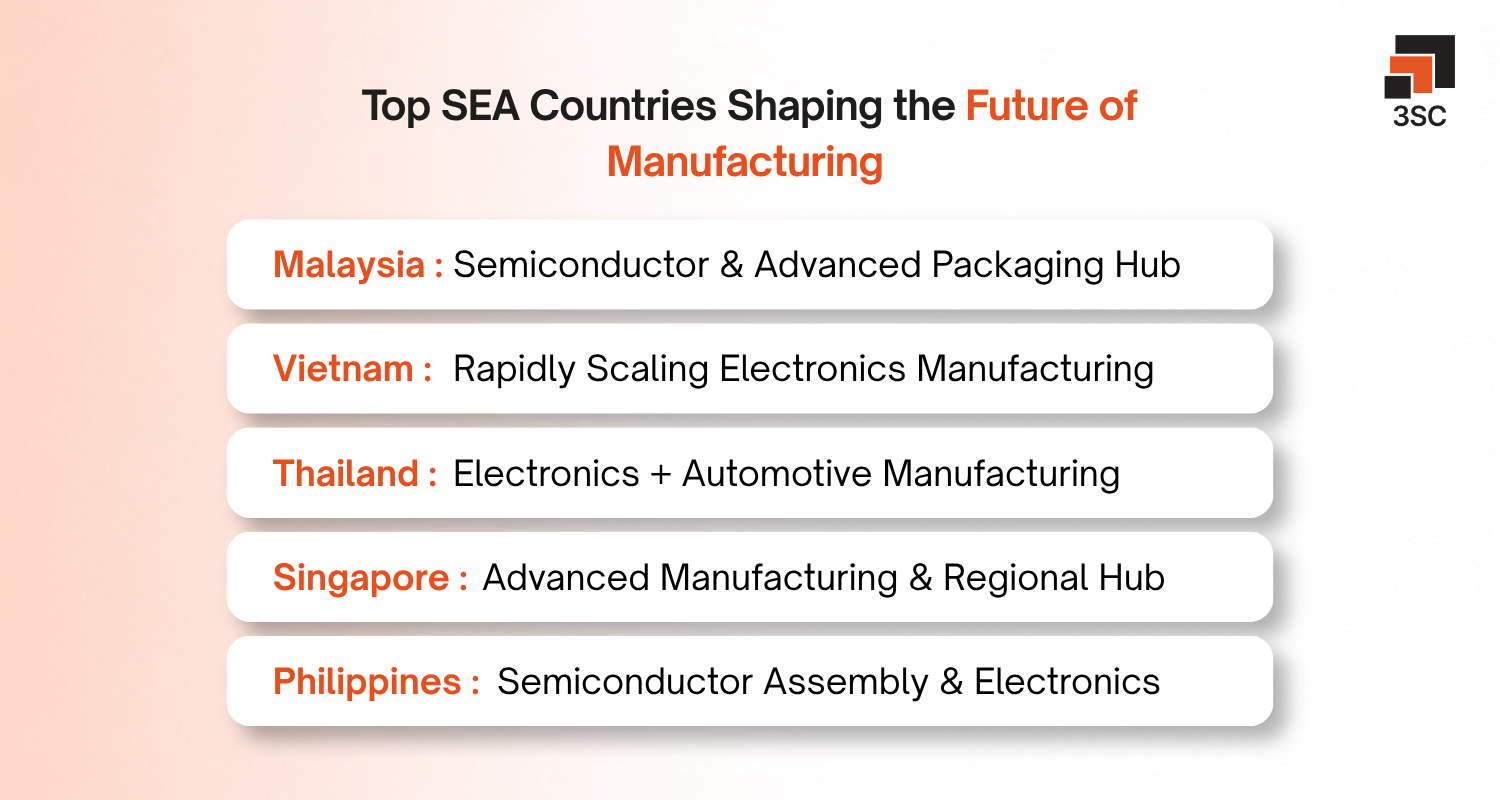
1. Malaysia: Semiconductor Depth
Malaysia has built deep capabilities around semiconductors, including assembly, testing, packaging, and increasingly advanced manufacturing activities. Its established ecosystem gives manufacturers access to experienced suppliers, engineering capabilities, and supporting infrastructure, making it an important part of the region’s semiconductor network.
2. Vietnam: Growing Electronics Scale
Vietnam has developed significant electronics assembly capacity and continues to attract manufacturing investment. Its large industrial clusters, export connectivity, and proximity to established Asian component suppliers have supported this growth, while the country is also expanding its ambitions in semiconductors.
3. Thailand: Electronics Meets Industrial Manufacturing
Thailand combines electronics manufacturing with a mature automotive and industrial ecosystem. This gives the country a strong position in areas where electronics increasingly intersect with automotive, industrial equipment, printed circuit boards, sensors, and related manufacturing.
4. Singapore: Advanced Manufacturing and Regional Coordination
Singapore plays a more specialized role across advanced manufacturing, engineering, research, and regional logistics. Its position within Southeast Asia also makes it an important hub for higher-value manufacturing activities and regional supply chain coordination.
5. Philippines: Semiconductor Assembly and Electronics Production
The Philippines remains an important part of semiconductor assembly and electronics manufacturing in the region. Its established role in the electronics value chain adds another manufacturing capability to Southeast Asia’s increasingly distributed network.
Together, these strengths give companies more flexibility to place production where the right capabilities already exist. But a more distributed footprint also creates more connections and dependencies. The challenge is making those locations operate as one network.
The Supply Chain Challenges Behind a More Distributed Network
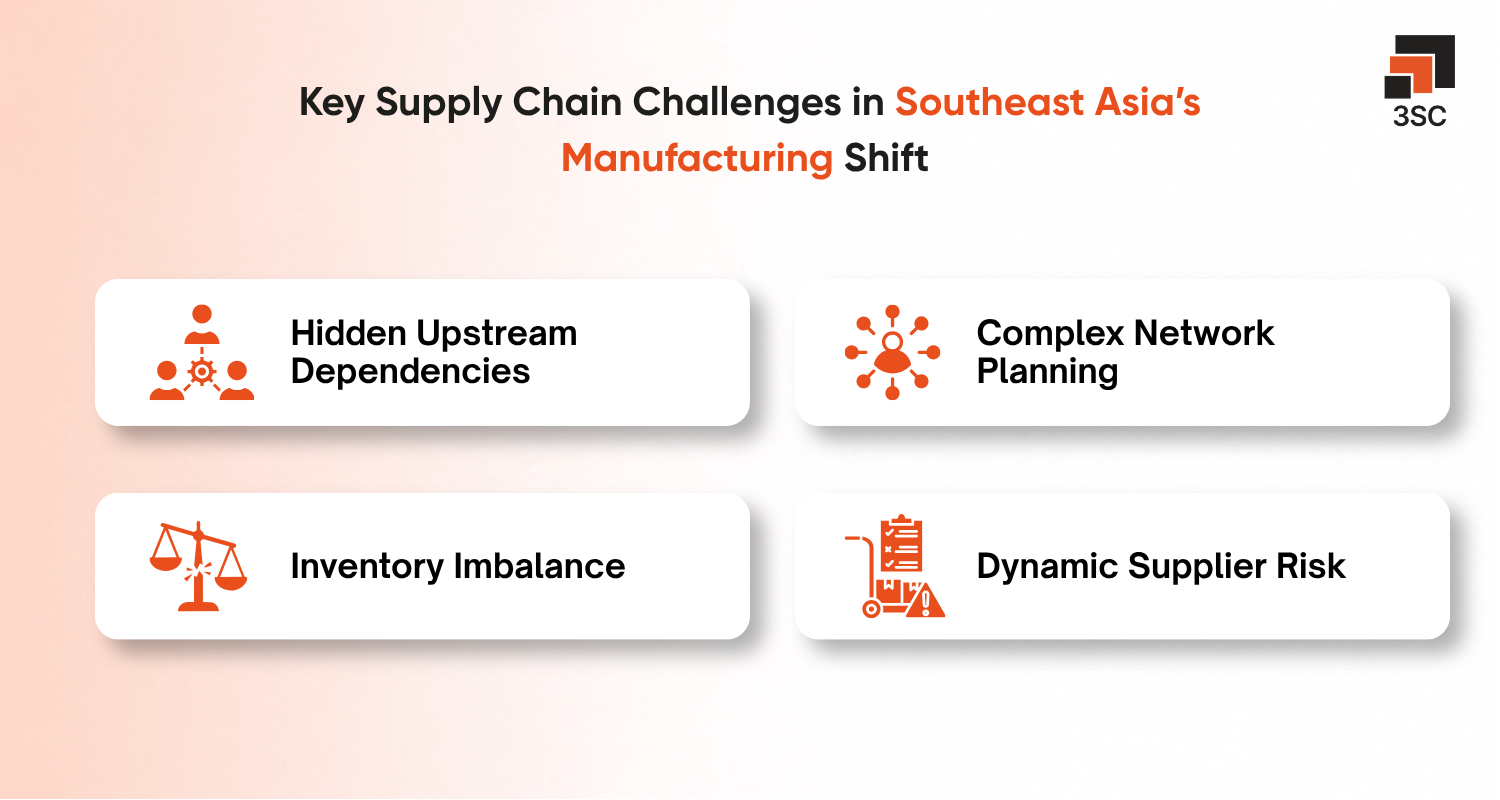
Let’s look at the key challenges shaping Southeast Asia’s electronics manufacturing supply chain:
1. Hidden Upstream Dependencies
A finished electronics product may now be assembled in Vietnam, but some of the semiconductors, displays, connectors, printed circuit boards, or specialist components feeding that factory may still come from China, Taiwan, South Korea, Japan, Malaysia, or elsewhere in the region.
The factory may have moved, while many of its underlying dependencies have not.
This makes visibility below Tier 1 suppliers increasingly important. Supply chain leaders need to understand which upstream suppliers support production, where critical components originate, and where sourcing alternatives are limited.
A disruption several steps upstream can still stop final assembly even when the factory itself is operating normally.
2. Complex Planning Across the Network
Consider an electronics product assembled in Vietnam using semiconductor components processed in Malaysia and specialist parts sourced elsewhere in Asia before finished products are shipped to Europe and North America.
A delay in one component can affect production in another country. A sudden demand change may require supplier orders to change, inventory to be repositioned, production to be rescheduled, and logistics capacity to be secured.
The challenge becomes greater when demand plans, supplier updates, production schedules, inventory positions, and transport information sit in separate systems or spreadsheets.
3. Inventory Imbalance Across Locations
Holding more stock everywhere may appear to be a simple way to protect against longer lead times and cross-border dependencies. But applying the same buffer across every component increases working capital without necessarily protecting the areas where disruption would have the greatest impact.
A critical semiconductor with limited sourcing alternatives requires a different inventory strategy from a component available from several regional suppliers.
Manufacturing shifts can also change where finished goods should be held, making inventory positioning an important part of network design.
4. Dynamic Supplier Risk
A broader manufacturing footprint means more suppliers and partners need to be monitored.
Annual supplier assessments alone may not provide enough warning when capacity constraints, component shortages, transport disruption, financial pressure, regulatory changes, or quality issues can develop much faster.
Supply chain teams need a more current understanding of whether suppliers can support the plan as conditions change.
These challenges are closely connected, with changes in one part of the network often affecting another.
What Southeast Asia’s Manufacturing Shift Requires from Supply Chain Leaders
Managing this complexity requires a more connected approach across planning, sourcing, inventory, and supplier management.
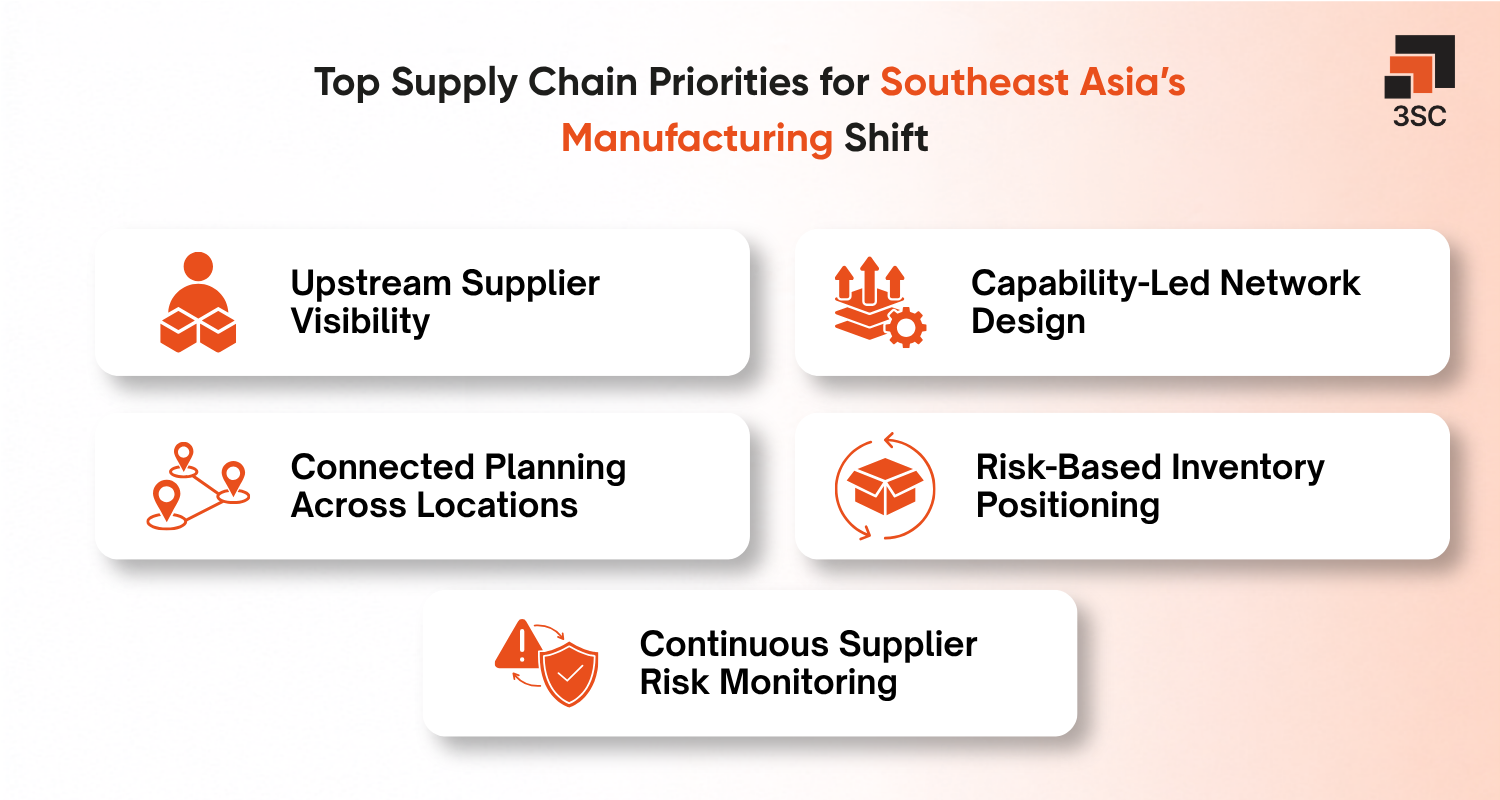
Let’s look at what supply chain leaders can do differently:
1. Upstream Supplier Visibility
Supplier mapping should follow the actual flow of materials rather than stopping at the supplier named on the purchase order.
Teams need to identify which upstream suppliers feed their manufacturers, which components have limited alternatives, where production stages are geographically concentrated, and which transport routes connect them.
This provides a clearer picture of what has genuinely been diversified and where concentration risk still remains.
2. Capability-Led Network Design
Manufacturing decisions should consider what each market is best equipped to support rather than relying primarily on labour cost comparisons.
Vietnam offers growing electronics scale, industrial clusters, export connectivity, and expanding semiconductor ambitions.
Malaysia brings decades of semiconductor experience, including engineering, testing, packaging, and supporting infrastructure.
Thailand combines electronics with mature automotive and industrial supply chains, making it particularly relevant for areas such as automotive electronics, industrial controls, printed circuit boards, and sensors.
The strongest regional strategy may therefore involve several countries playing complementary roles rather than selecting one location to handle everything.
3. Connected Planning Across Locations
As production becomes more distributed, planning needs to operate as one connected process.
When demand changes, planners should be able to understand whether component supply can support it. When a supplier reports a delay, teams should know which production orders and customer commitments are exposed. If one manufacturing location loses capacity, they should be able to assess whether another location can absorb some of the volume.
Connecting these decisions helps prevent a local issue from becoming a wider network problem.
4. Risk-Based Inventory Positioning
Inventory policies should reflect supplier concentration, replenishment time, demand variability, component criticality, and available alternatives.
Instead of increasing buffers across the entire network, businesses can place protection where disruption would create the greatest operational or customer impact.
The same thinking should extend to finished goods, regional hubs, distribution centers, and allocation policies as the manufacturing footprint changes.
5. Continuous Supplier Risk Monitoring
Supplier risk needs to reflect current conditions rather than relying primarily on periodic assessments.
Bringing supplier performance, capacity signals, lead-time changes, shipment status, quality information, and external risks into the same decision process can help teams identify changes earlier.
The important question is not only whether a supplier was considered reliable when the contract was signed, but whether that supplier can support what the business needs now.
The goal is to move beyond a collection of manufacturing locations and build a network that can respond as conditions change.
Building a Network That Works as One
Southeast Asia is giving electronics manufacturers more ways to diversify production, access specialized capabilities, and build greater flexibility into their supply chains. But adding more manufacturing locations does not automatically make the network more resilient.
What matters is how well those locations work together. A disruption in one market can quickly affect all operations and customer commitments elsewhere. Without a clear view of those connections, a more distributed footprint can easily become a more difficult one to manage.
Supply chain leaders therefore need to think beyond individual plants or suppliers to understand the wider impact of a change and act before it spreads.
As Southeast Asia becomes more important to global electronics manufacturing, resilience will depend less on how many locations a company has and more on how effectively those locations are coordinated. A distributed network is only as strong as the decisions that connect it.
Build a More Connected Electronics Supply Chain with 3SC
Connect demand, inventory, planning, logistics, and risk with 3SC’s Demand AI, Inventory AI, Integrated Business Planning, Intelligent Transport Management, and Supply Chain Control Tower solutions to create a more connected, responsive, and resilient electronics supply chain.
Talk to 3SC to see how better-connected planning and execution can help your supply chain respond faster and operate more efficiently.