
Over the last decade or so, many of us invested heavily in structured planning. We built S&OP discipline where silos once dominated. We evolved toward Integrated Business Planning to connect commercial ambition with operational capability and financial outcomes. We standardized cadence, governance, and accountability across the enterprise.
Those were the right decisions.
Structured planning brought order. It created a shared language between functions. It improved capital allocation and service performance. It gave leadership teams confidence in enterprise commitments. Organizations that never built that foundation are under far greater strain today.
But planning systems are built around assumptions about how the world behaves. And the world has changed.
We now operate in what is commonly called a VUCA environment — volatile, uncertain, complex, ambiguous. In practical terms, volatility is persistent rather than cyclical. Uncertainty appears mid-quarter, not just during annual planning. Complexity is no longer only about network scale; it is about tighter interdependencies across suppliers, production, distribution, and markets. Ambiguity exists simultaneously across trade policy, sourcing risk, cost structures, and demand patterns.
When many of our planning architectures were designed, change moved slower than the planning cadence. Monthly cycles were sufficient to reconcile assumptions and align trade-offs. Disruptions occurred, but they were often contained within manageable time horizons.
Today, impact moves faster.
A sourcing issue influences production sequencing within days. A demand shift reshapes distribution and inventory posture quickly. External events ripple through service levels, margins, and working capital in compressed timeframes. The interdependencies have always existed. What has changed is the velocity at which they interact.
Having spent most of my career inside supply chains, I’ve seen this pattern repeatedly. What many organizations are experiencing today is not planning failure. It is environmental mismatch. The system is functioning as designed; the terrain it operates in has shifted.
Consider it this way.
If you are navigating a city using a printed map from a decade ago, the map itself is not wrong. The roads it shows existed. They worked. Many still do.
But the city has evolved. Construction reroutes traffic daily. New flyovers create faster alternatives. Some routes that once moved smoothly are now permanently congested. Traffic conditions change hour by hour.
You can still reach your destination using that old map. But you are making decisions without visibility into live conditions. You cannot see where delays are building or where better routes now exist.
Most leaders would upgrade to a real-time GPS - not because the original map was flawed, but because the environment it was built for is no longer static.
Planning sits in that exact position.
The answer is not to dismantle what we built. Structured planning remains foundational. Governance, cross-functional alignment, and disciplined cycles are still essential. But they are no longer sufficient on their own.
In my experience, evolution begins not with just new technology, but with an honest assessment. Here are 5 steps I have seen helps businesses strengthen their enterprise performance:
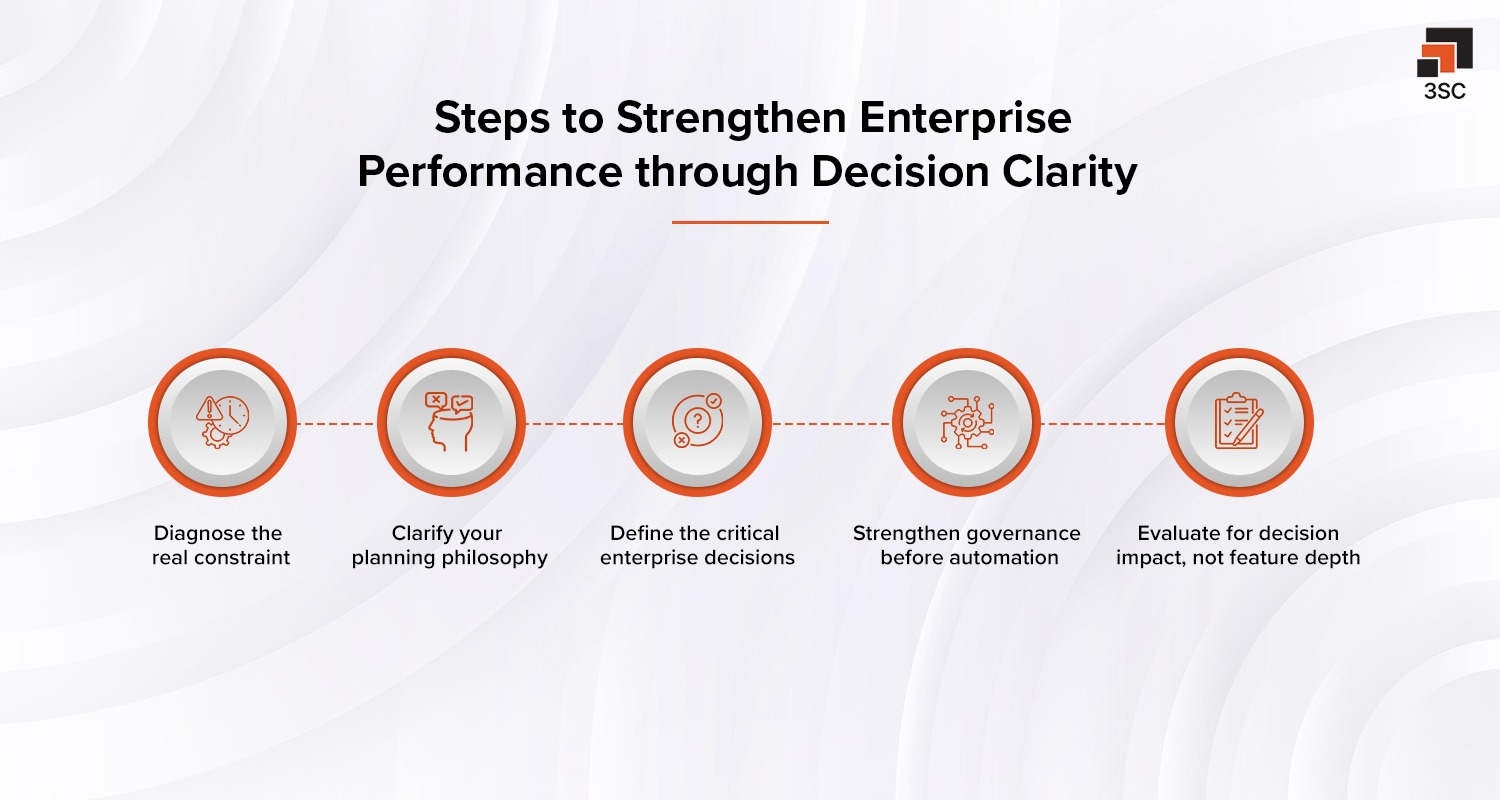
1. Diagnose the real constraint.
Before evaluating platforms or redesigning processes, identify what is truly limiting performance. Are plans misaligned - or are decisions delayed? Are outcomes suffering because the system lacks capability, or because it takes too long to interpret change and act on it? In volatile environments, the constraint is often decision latency rather than system functionality. Automating a slow decision process produces faster reporting, not better outcomes.
2. Clarify your planning philosophy.
Is your model optimized for a single “best plan,” assuming relative stability? Or is it designed to enable structured trade-offs under uncertainty? If your cadence is monthly while disruption unfolds weekly, the philosophy and the environment are misaligned. Technology cannot compensate for a planning design that no longer reflects operating reality.
3. Define the critical enterprise decisions.
Identify the decisions that materially affect service, margin, and capital — allocation during shortages, promotional commitments, capacity shifts, inventory buffers, sourcing alternatives. For each one, establish clear ownership, explicit triggers, and defined response windows. When these fundamentals are unclear, digitization amplifies ambiguity rather than reducing it.
4. Strengthen governance before automation.
Decision rights, escalation paths, and economic guardrails must be explicit. Without governance discipline, new platforms simply digitize confusion. Structure should absorb volatility, not expose organizational fault lines when pressure rises.
5. Evaluate for decision impact, not feature depth.
When engaging vendors, shift the lens from feature breadth to decision compression. How quickly does the platform shorten decision cycles? How effectively does it reduce reconciliation loops? How well does it embed insight into operational workflows? Planning upgrades should be measured by impact on enterprise responsiveness, not by functionality counts.
Upgrading planning is not a technology refresh. It is a redesign of how the enterprise makes decisions under volatility. The platform should enable that redesign, not attempt to substitute for it.
Ultimately, this is a leadership conversation.
In stable environments, competitive advantage often came from precision and efficiency. In more volatile environments, advantage increasingly comes from structured adaptability - the ability to adjust course without destabilizing the organization.
Your planning systems did not fail. They delivered stability in a world that rewarded predictability.
The responsibility now is not to replace that foundation, but to strengthen it - so that planning evolves from static alignment to dynamic navigation.
That evolution begins with clarity.
And it requires leadership willing to design for the world as it operates today.