Key Takeaways
- While freight payment occurs after delivery, settlement is finalised before shipping.
- Freight payment relies on manual invoicing; settlement uses automation or removes invoices entirely.
- Pre-agreed terms in freight settlement help reduce billing disputes.
- Automation and e-POD technology enhance the speed and accuracy of settlement.
- Freight settlement is better suited for high-speed, high-volume logistics operations.
Freight payment and freight settlement are often used interchangeably, while both processes deal with carrier transactions, understanding their differences is crucial for cost control and supply chain efficiency.
The supply chain and logistics industry is undergoing a fundamental transformation, driven by both increasing disruptions and rapid advancements in automation. As automation takes hold, even the most routine processes are being re-examined through a more strategic lens.
One such process is how freight is financially managed. What was once a straightforward task of Freight Payment has evolved into a more dynamic, transparent, and data-driven approach known as Freight Settlement with over 68% of logistics firms automating freight audit and payment processes to improve accuracy, reduce costs, and gain end-to-end visibility.
This shift isn’t just about changing terms but reflects a deeper change in how companies think about managing freight. Freight Settlement enables better visibility, accuracy, and control over transportation costs, making it a key enabler for more resilient and efficient supply chains.
To understand this shift more clearly, it’s important to begin with a closer look at how Freight Payments actually works.
What is Freight Payment?
Traditionally, paying for freight has been a slow and manual process. After a shipment is delivered, the carrier sends an invoice based on the trip. The shipper then compares that invoice with their own rate records to make sure everything matches. This step is known as “match-pay.”
It sounds simple, but it involves a lot of back-and-forth, checking files, correcting mismatches, and confirming details. This not only takes time but also increases the risk of mistakes, delays, and payment issues. For many companies, this method has become too time-consuming and error-prone, leading them to explore more efficient ways to handle freight costs.
Recognising the inefficiencies of this traditional method, many companies are now shifting toward a faster, more streamlined approach—Freight Settlement.
What is Freight Settlement?
Freight settlement is a process where the shipper and carrier agree on the transportation cost before the shipment begins, eliminating the need for post-delivery invoicing and enabling faster, more accurate payments. Unlike the traditional match-pay method, this approach brings greater clarity, reduces manual effort, and minimises disputes. It shifts the focus from auditing after delivery to aligning expectations before the shipment moves.
Freight settlement works in three simple stages:
Stage 1: Settling the Price
At the start, the shipper and carrier agree on a rate for the shipment and decide which system they’ll use for payment. This agreement means no manual invoicing is needed. If the shipper’s payment process is used, the carrier gets paid automatically once the delivery is done. If the carrier’s system is used, invoices are sent and paid without the usual back-and-forth reviews.
Since the rate is already agreed upon, payment happens automatically saving a lot of time, reducing paperwork, and cutting costs per transaction.
Stage 2: Agreeing on Extra Factors
Next, the shipper and carrier discuss potential factors that might affect the final cost of the shipment. These could include traffic delays, long loading or unloading times, time of day, bad weather, or special handling requirements. They may also consider waiting time at pickup or delivery points, the type of freight being moved, route complexity, or any added risks involved. By planning for these possibilities in advance, both parties can agree on fair terms and avoid cost surprises later. This step helps create pricing clarity and reduces the chances of disputes after delivery.
Stage 3: Confirmation and Data Sharing
Finally, once the shipment is delivered, proof of delivery triggers the automatic payment. The carrier shares digital records such as pickup and delivery times, transit details, and route information. To support this, many companies now use modern electronic proof of delivery (e-POD) systems that allow for real-time updates, image attachments, comments, and even basic dispute management.
This step ensures full transparency and confirms the service was completed as agreed. With everything pre-set and data clearly shared, payments are processed instantly, no delays, no confusion, just smooth and reliable freight operations.
Together, these stages make freight settlement a faster, more transparent, and cost-efficient alternative to traditional freight payment, helping businesses simplify operations and stay ahead in a dynamic logistics environment.
Related read - How Freight Settlement Process Works?
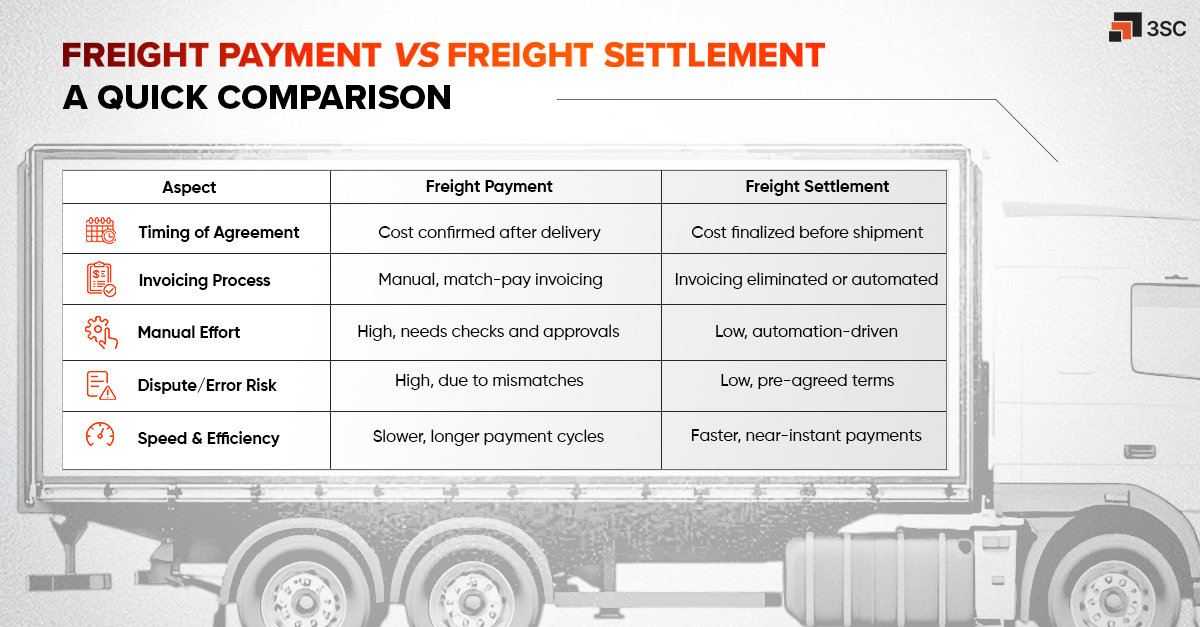
Difference between Freight Payment and Freight Settlement
Basis of Distinction | Freight Payment | Freight Settlement |
Timing of Agreement | Cost is confirmed after delivery. | Cost is finalised before shipment starts. |
Invoicing Process | Manual invoicing using match-pay (invoice vs rate comparison). | Invoicing is eliminated or automated. |
Payment Trigger | Starts after invoice review and approval. | Triggered automatically upon proof of delivery. |
Manual Effort | High—requires checking, approvals, and file handling. | Low—relies on pre-agreed terms and automation. |
Error/Dispute Risk | High—due to mismatched rates or delays in approval. | Low—pricing and terms are pre-agreed, reducing disputes. |
Handling Extra Cost Factors | Often not discussed in advance; causes issues later. | Agreed in advance (e.g. delays, waiting time, weather) for smoother pricing. |
Technology Involvement | Minimal—mostly manual or basic digital tools. | High—uses automation, digital systems, e-POD, sometimes blockchain. |
Dispute Management | Frequent and time-consuming. | Rare and faster due to upfront alignment. |
Speed and Efficiency | Slower, with longer payment cycles. | Faster, with payments processed quickly or instantly. |
Best Suited For | Traditional setups or low-volume shipments. | Modern, fast-moving supply chains needing speed and visibility. |
Freight payment and freight settlement are key components of transportation finance, understanding their distinction is crucial for streamlining logistics operations and avoiding payment discrepancies.
Conclusion
Freight payment and freight settlement represent two distinct methods for managing logistics costs, and each serves a purpose based on the context of the business. Freight payment, with its more traditional post-delivery invoicing and auditing processes, can be a practical fit for companies with straightforward shipping needs or those in the early stages of digitising their operations. On the other hand, freight settlement with its focus on pre-agreed rates, automated validation, and real-time data offers a more streamlined and proactive approach suited for businesses dealing with higher volumes, complex networks, or a need for greater speed and visibility.
Choosing between these methods isn’t about which one is universally better, it’s about which is better for your business at this point in time. Factors like company size, operational maturity, system integration capabilities, and strategic priorities all play a role. What works for a growing mid-sized firm may differ from the needs of a large multinational enterprise.
Ultimately, there’s no one-size-fits-all answer. The decision should be guided by where the organisation is today, where it wants to go, and which method aligns best with its current and future supply chain goals.
Ready to take control of your freight billing and settlements?
With 3SC’s automated Billing & Settlement module, you can digitise freight cost verification, eliminate manual mismatches, and gain full transparency into logistics spend. Say goodbye to invoice disputes and hello to faster settlements. Start your digital transformation today—unlock efficiency, accuracy, and real-time financial clarity.
Your supply chain deserves better. Let 3SC make it happen.