Europe’s medicine shortages are rooted in concentrated manufacturing, price-driven procurement, fragmented national systems, and limited supply visibility. Expanding inventory may provide temporary relief, but it also increases expiry, storage, and capital pressure. A stronger response combines diversified sourcing, resilient procurement, coordinated stock allocation, and earlier risk detection.
Key Takeaways
- Medicine shortages often begin far upstream.
- Excess stock cannot fix concentrated supply risk.
- Diversification needs separate suppliers and geographies.
- Procurement must value resilience alongside price.
- Better visibility enables faster, targeted responses.
A patient walks into a pharmacy with a prescription for an antibiotic. The pharmacist checks the system, calls another branch, and explains that the medicine may not arrive for several days. Elsewhere in Europe, the same product may be sitting in a warehouse.
This is how Europe’s medicine shortage problem appears: local at the point of care, yet connected to decisions made across factories, procurement offices, distribution networks, and national health systems.
The instinctive response is to order more, raise safety stock, and fill warehouses before the next disruption. Yet Europe cannot build medicine security by asking every hospital, wholesaler, and pharmacy to hold more inventory. It must understand why the shortage occurred and decide where a buffer will genuinely help.
The Shortage Begins Long Before the Shelf is Empty
When a medicine disappears from a pharmacy shelf, the disruption may have started months earlier. Generic medicines move through tightly connected networks. An active pharmaceutical ingredient may come from one country, travel to another for formulation, and then enter several European markets through different packaging and distribution routes.
When production is concentrated among a small group of suppliers, a quality failure, plant shutdown, regulatory issue, or export restriction can affect many countries at once. This is especially visible in low priced, off patent medicines such as antibiotics, painkillers, saline products, and other widely used treatments.
Procurement systems have often rewarded the lowest price. Over time, this encouraged manufacturers to remove spare capacity, reduce supplier duplication, and operate with little room for disruption.
The European Parliament reported that more than 50 percent of notified medicine shortages are caused by manufacturing problems, including shortages of active substances.
The empty shelf is therefore the final signal, not the first. By the time a hospital sees the shortage, the opportunity for an earlier response may already have passed.
Why More Inventory Feels Safe but Creates New Pressure
For a hospital or pharmacy, ordering more stock is the fastest response to a shortage. It is easier than changing suppliers, expanding production, or reforming procurement, and it offers immediate reassurance when patient access is at risk.
But precautionary ordering can inflate demand signals and create a bullwhip effect across the supply chain. Manufacturers may struggle to distinguish genuine need from defensive buying, making scarce supply even harder to allocate.
Larger buffers also bring expiry, storage, and working capital costs. In Europe’s fragmented market, one country may hold surplus while another still faces a shortage.
Inventory can buy time, but it cannot remove the underlying dependency. Once the buffer is exhausted, the same structural weakness can trigger another shortage.
How Europe Can Build Resilience Without Building Excess Stock
Addressing medicine shortages requires a coordinated response that strengthens supply at every stage, from sourcing and procurement to inventory allocation and early risk detection.
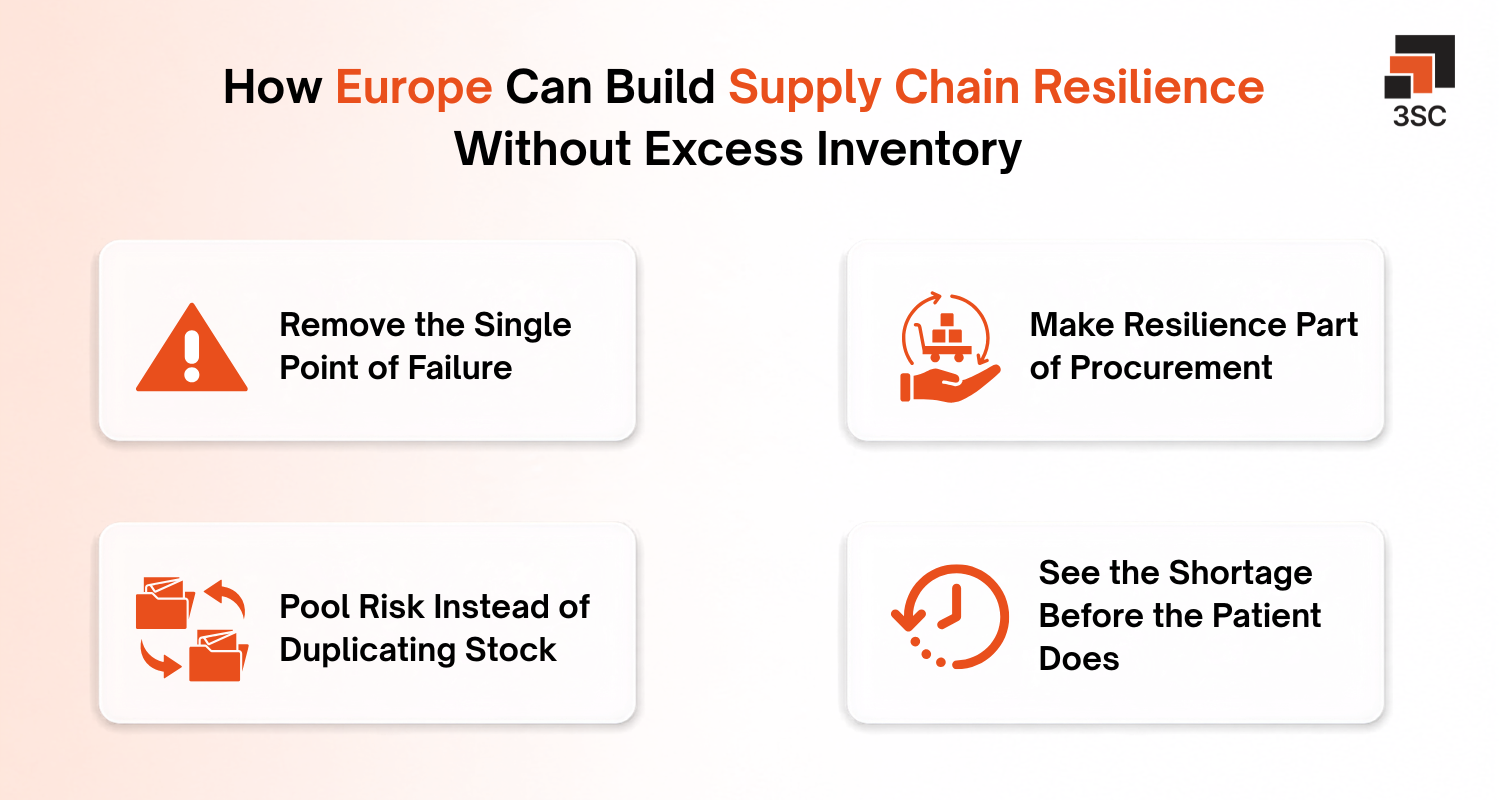
1. Remove the Single Point of Failure
The first structural response is supply diversification. For every critical medicine, planners and policymakers need visibility beyond the contracted supplier. They need to know where the active ingredient is produced, which sites manufacture the finished product, whether different suppliers share the same upstream source, and how quickly an alternative can be qualified.
Two suppliers do not create resilience when both depend on the same factory. Genuine diversification requires separate production routes, different geographic exposure, qualified backup capacity, and clear switching plans.
Europe’s Critical Medicines Act is moving policy in this direction. A provisional political agreement reached by the European Parliament and the Council on 12 May 2026 includes strategic projects intended to create, modernise, or expand EU manufacturing capacity for critical medicines and their active substances.
The agreement still requires formal approval before the rules enter into force. New capacity will take time to build, but it can reduce the length and severity of future disruptions instead of repeatedly financing inventory against the same fragile structure.
2. Make Resilience Part of Procurement
Diversification will remain difficult if purchasing decisions continue to reward price without recognising supply risk.
A low unit price can become expensive when supplier failure leads to emergency freight, substitute treatments, or delayed patient care. Tender evaluations should therefore consider manufacturing location, continuity plans, redundancy, quality performance, and capacity commitments.
The provisional Critical Medicines Act agreement introduces resilience requirements in public procurement for critical medicines. It also provides ways to encourage EU manufacturing when supply depends heavily on a limited number of third countries.
This changes the signal sent to manufacturers. When dependable supply is valued alongside price, producers have a stronger reason to maintain backup capacity, qualify alternate sources, and invest in reliable facilities. Procurement can then strengthen resilience instead of quietly removing it.
3. Pool Risk Instead of Duplicating Stock
Even with stronger sourcing and procurement, temporary shortages will still occur. Europe must therefore improve how available supply is coordinated across member states. Collaborative procurement can aggregate demand, strengthen purchasing leverage, and reduce competition between countries during constrained supply.
Under the provisional agreement, the European Commission would begin a procurement procedure when five or more member states request it. The framework also supports information sharing and voluntary reallocation of contingency stocks. This creates more efficient protection.
Europe can coordinate selected stocks, see where shortages are emerging, and move supply toward the greatest need.
Strategic inventory still belongs in the model, especially for medicines whose absence would create an immediate threat to patient care. The difference is that stock should be targeted, transparent, and linked to redistribution rules.
4. See the Shortage Before the Patient Does
A resilient network also depends on earlier signals. Manufacturers may see a production delay. Suppliers may know a shipment will miss its date. Hospitals may detect higher consumption.
When these signals remain separated, Europe reacts after availability has already deteriorated. Connected visibility can bring them together. Supply teams can compare demand changes with production capacity, inventory by location, quality holds, supplier commitments, and transport constraints.
They can then identify which medicines are at risk and decide whether to reallocate supply, qualify a substitute, adjust production, or release a strategic reserve.
This is where inventory becomes precise. The buffer is directed toward a defined exposure rather than increased across the entire portfolio.
Together, these measures shift Europe’s response from broad stock accumulation to more precise supply protection. The next step is making that model work in practice.
The Planning and Technology Capabilities Behind a More Resilient Medicine Supply Chain
Policy changes, diversified sourcing, stronger procurement, and better stock coordination create the foundation for resilience. But organisations also need the right planning and decision-making capabilities to identify risk earlier, evaluate available options, and act before shortages become critical.
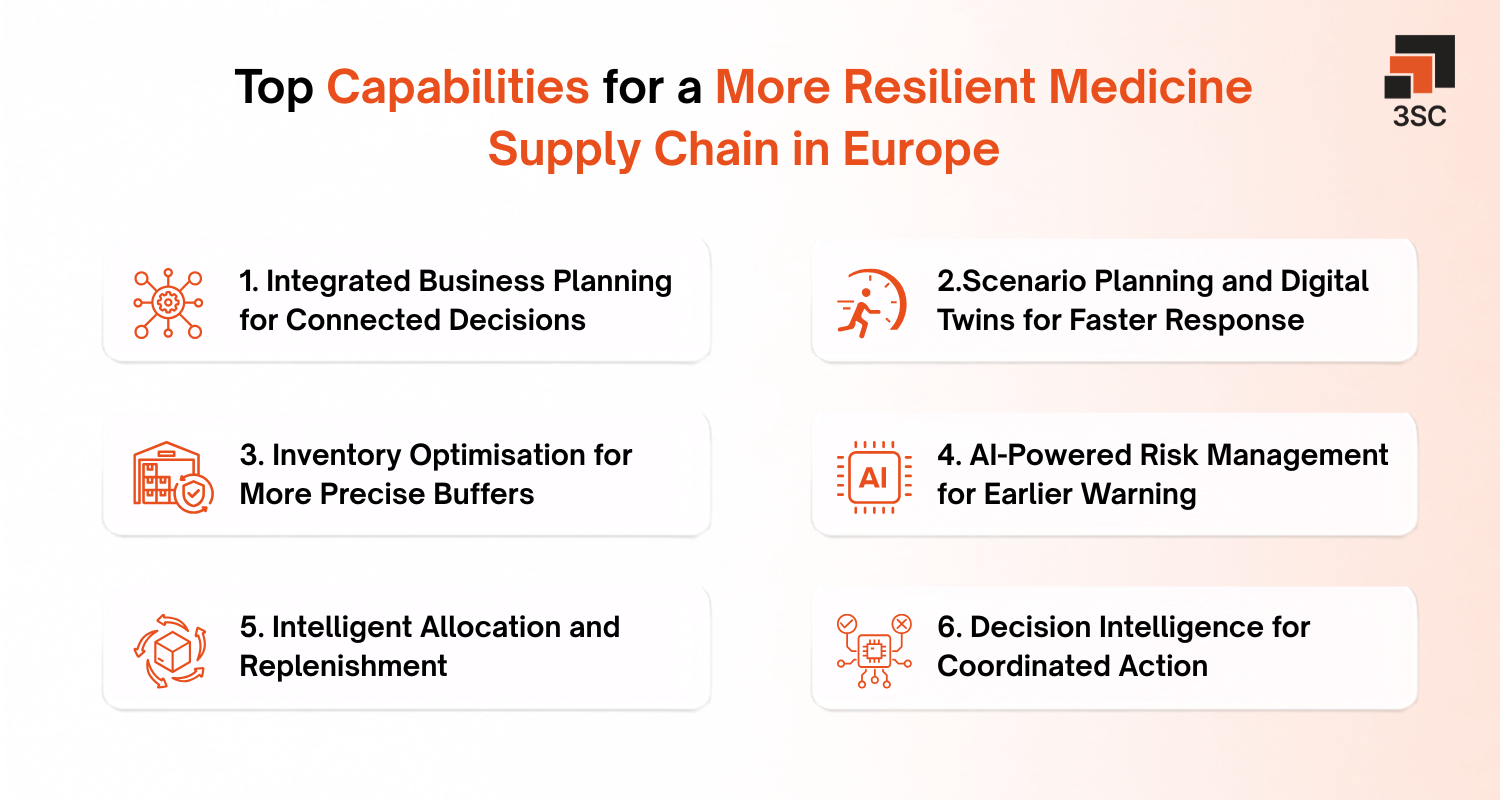
1. Integrated Business Planning for Connected Decisions
Integrated Business Planning (IBP) can connect demand, supply, inventory, production capacity, and procurement within one planning framework.
Instead of each function responding separately to a potential shortage, teams can assess the wider impact of a disruption and make coordinated decisions around production, sourcing, allocation, and inventory.
This is especially important when a shortage in one market may require supply to be redirected from another.
2. Scenario Planning and Digital Twins for Faster Response
Scenario planning and digital twin capabilities can help organisations test the impact of disruptions before making operational changes.
Teams can simulate situations such as a supplier shutdown, production delay, quality hold, transport disruption, or sudden increase in demand and compare different response options.
This allows planners to understand the trade-offs between service levels, inventory, capacity, cost, and risk before selecting the most appropriate response.
3. Inventory Optimisation for More Precise Buffers
Inventory optimisation can help determine where additional stock is genuinely required instead of applying higher safety stock across an entire portfolio.
Inventory policies can take into account medicine criticality, demand variability, supplier lead times, replenishment frequency, expiry risk, and the availability of alternative sources.
The result is a more targeted buffer strategy that protects critical medicines without unnecessarily increasing inventory everywhere.
4. AI-Powered Risk Management for Earlier Warning
AI-Powered risk management can continuously monitor signals across suppliers, manufacturing sites, logistics networks, geopolitical developments, and other external sources.
When these signals are connected with supply chain data, organisations can understand not only that a disruption has occurred, but also which medicines, markets, suppliers, and production plans are likely to be affected.
Earlier visibility gives teams more time to activate alternate suppliers, adjust production, reallocate stock, or secure transportation capacity.
5. Intelligent Allocation and Replenishment
When supply is constrained, allocation and replenishment planning can help determine where limited inventory should go.
Rather than distributing stock using fixed rules, organisations can consider demand, medicine criticality, inventory availability, service requirements, lead times, and shortage severity.
This allows available medicines to be directed toward the markets and locations where supply risk is highest.
6. Decision Intelligence for Coordinated Action
Visibility identifies the risk, but teams still need to decide what action to take.
Decision intelligence and AI-assisted planning can help evaluate available options, identify trade-offs, and support decisions across sourcing, production, inventory, and distribution.
This creates a more connected operating model in which risks can be detected earlier and response decisions made faster.
These capabilities can turn resilience from a set of separate initiatives into a more connected operating model, helping medicine supply chains move away from broad precautionary stock building and toward more precise protection.
The objective is not to eliminate inventory or assume that every shortage can be prevented. It is to use inventory, supplier capacity, production capacity, and transportation resources more intelligently so that risks can be identified earlier, their impact reduced, and medicines directed to where they are needed most.
Conclusion: The Stronger Path to Medicine Security
Europe will not solve medicine shortages by filling more warehouses. That approach may delay the impact of a disruption, but it does not make the system less vulnerable.
Real security comes from knowing where the risks sit, reducing dependence on fragile supply routes, and moving available medicines quickly when pressure builds. Inventory should support that system, not compensate for its weaknesses.
The measure of resilience is therefore simple: can Europe keep medicines available when the supply chain is under stress?
That is the shift that matters. From storing more stock to building a system that can see risk earlier, respond faster, and protect patient access when it matters most.
Build Stronger Medicine Supply Resilience with 3SC
3SC helps pharmaceutical supply chains identify upstream dependencies, detect emerging disruptions, and coordinate faster responses across suppliers, production, inventory, and distribution. With connected visibility and risk-led planning, organisations can protect medicine availability while reducing the need for broad, costly, and inefficient inventory buffers.