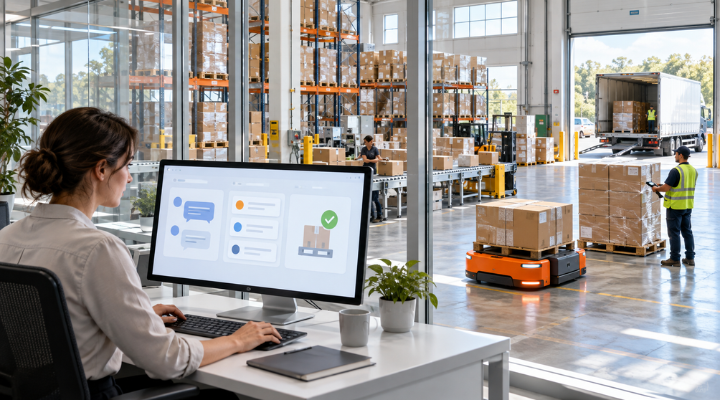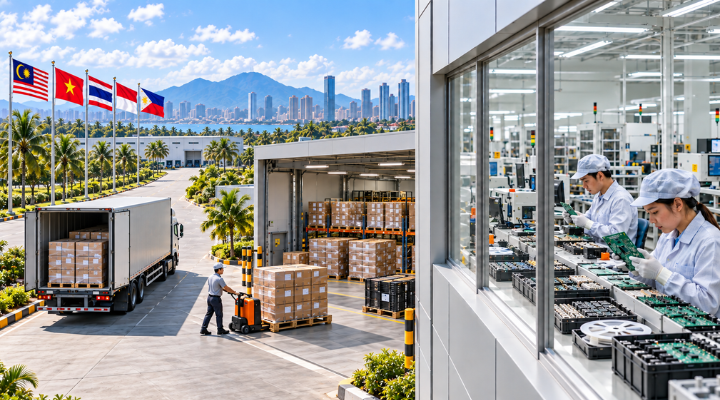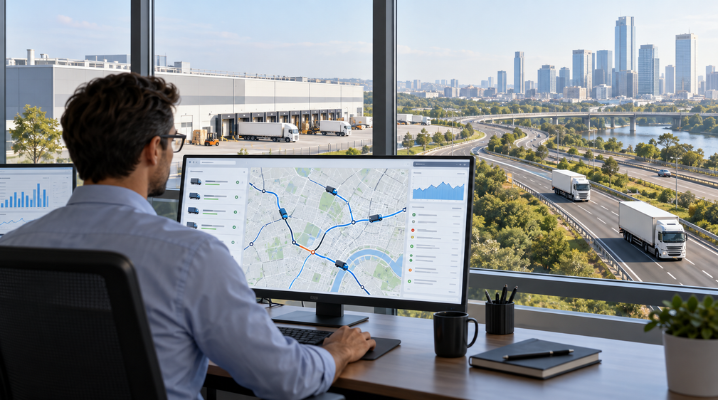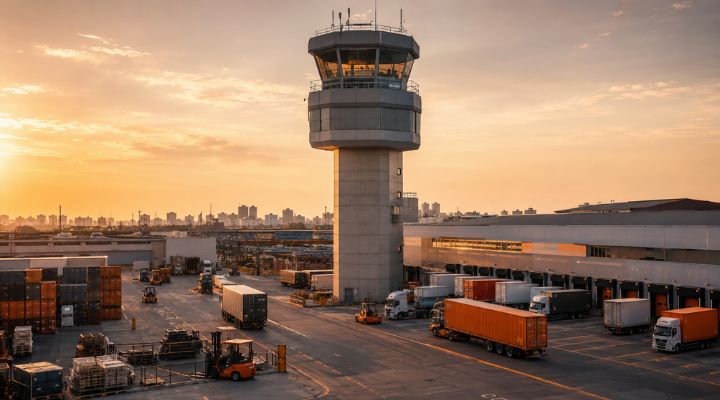
A supply chain control tower is a connected operating layer that gives businesses end-to-end visibility across suppliers, plants, warehouses, carriers, and customers. It turns fragmented supply chain signals into actionable insight, helping teams improve disruption management, inventory control, service performance, collaboration, and decision-making speed.
Key Takeaways
- A supply chain control tower connects data across systems to provide a shared view of planning and execution.
- It identifies critical exceptions, assesses their wider impact, and recommends appropriate responses.
- Different control towers address transportation, inventory, fulfilment, supply assurance, or end to end operations.
- Its value comes from faster decisions, stronger collaboration, lower costs, and improved customer service.
- Successful implementation requires reliable data, clear decision authority, defined workflows, and phased adoption.
It is Monday morning, and the production schedule looks achievable. A few hours later, procurement learns that a critical shipment has been delayed in transit. Logistics can see the delay, but production is still working with the original arrival date. Customer service, unaware of the risk, continues to confirm delivery commitments.
Nothing has stopped yet. There is still inventory in the network, production is still running, and customer orders have not been missed. But the time available to prevent disruption is shrinking.
This is how supply chain problems often grow. The first signal appears in one system, its wider impact remains hidden, and every team responds with only part of the picture. Addressing this gap requires a way to connect those separate signals before their impact spreads. This is where a supply chain control tower comes in.
What is a Supply Chain Control Tower?
A supply chain control tower is a centralized operating capability that connects data, technology, people, processes, and decision authority. It provides a shared view of supply, demand, inventory, production, logistics, orders, and external risks.
Calling it a dashboard is too narrow. A dashboard tells you what is happening. A mature control tower also explains why it matters, which orders or customers could be affected, and what response should be considered.
Think back to the delayed shipment. The tower does not move the cargo. It connects the delay with inventory, production requirements, alternative supply, transport capacity, and customer priorities. Visibility becomes valuable only when it leads to a decision, and that principle defines the control tower.
Why is Traditional Supply Chain Visibility Not Enough?
Most businesses already have systems for planning and execution. An ERP holds transactions, a WMS manages warehouse activity, a TMS supports transportation, and partner portals provide external updates. Yet these systems often present separate views of the same operation.
When teams must reconcile spreadsheets, emails, calls, and reports before acting, the supply chain moves faster than the decision process. A warning may be visible in one function while its consequences remain hidden elsewhere.
A supply chain control tower creates a common operational picture. It connects events across functions and shows their likely effect on service, cost, capacity, or revenue. That shared context moves the organization from fragmented awareness to coordinated control.
How Does a Supply Chain Control Tower Work?
To understand how a control tower turns visibility into action, let us follow the process from data collection to response tracking.
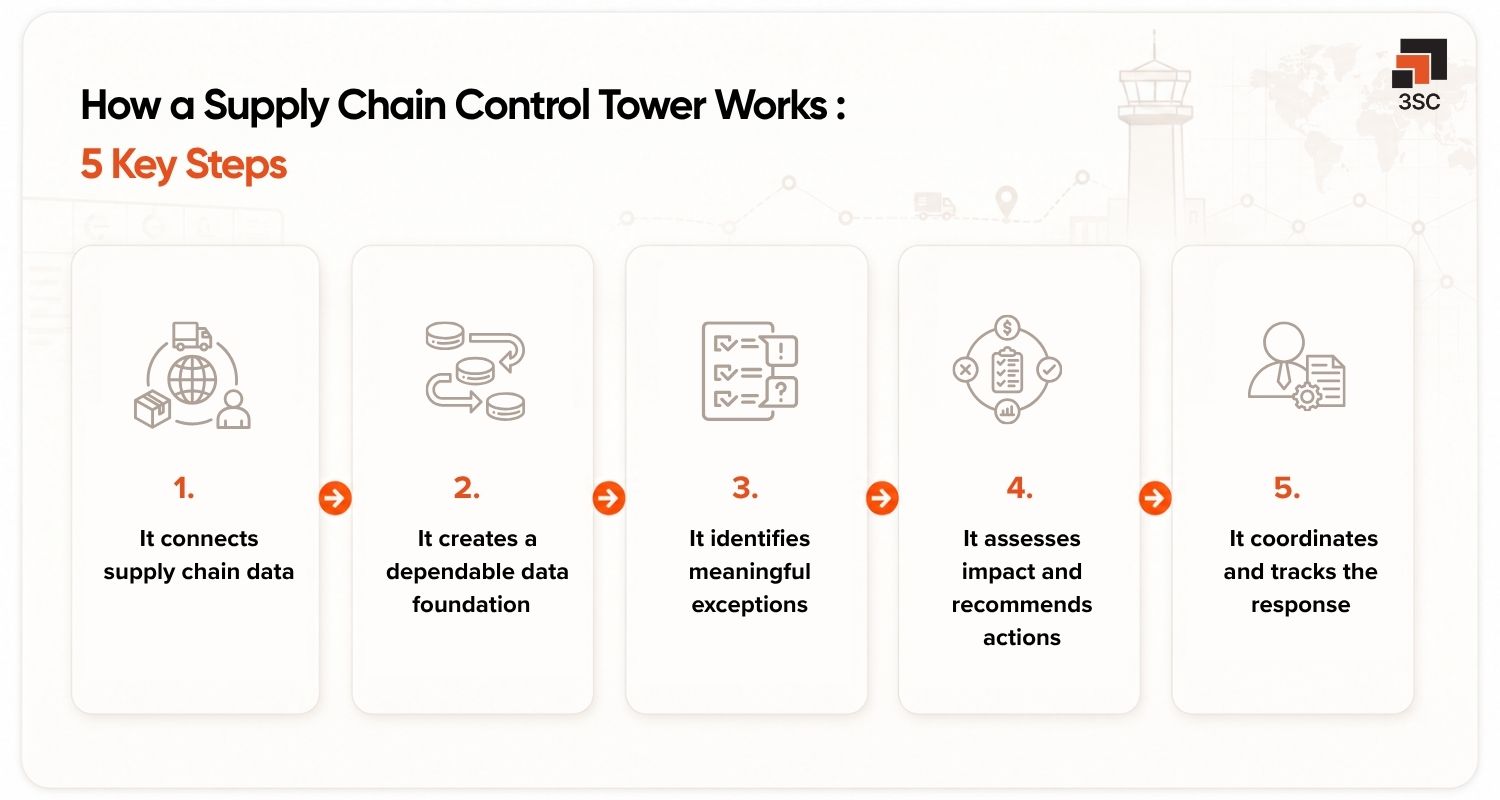
Each stage is explained below:
1. It connects supply chain data
The control tower gathers information from ERP, WMS, TMS, planning platforms, supplier systems, carrier networks, IoT devices, and relevant external sources such as weather and port conditions. It brings these signals into a common environment, so teams do not have to search across multiple systems. This connected data provides the foundation for understanding what is happening across the supply chain.
2. It creates a dependable data foundation
Information from different sources often follows different formats, definitions, and update cycles. The control tower cleanses, standardizes, and matches this data to create consistent records for orders, shipments, inventory, suppliers, and production requirements. Without this foundation, even advanced analytics can produce unreliable conclusions.
3. It identifies meaningful exceptions
The control tower continuously compares actual activity with plans, commitments, and defined performance thresholds. Routine events remain in the background, while delays, shortages, capacity constraints, and orders at risk are highlighted. This allows teams to focus their attention on situations that require intervention instead of monitoring every activity manually.
4. It assesses impact and recommends actions
Once an exception is detected, the control tower evaluates how it could affect connected operations. Predictive analytics estimate what may happen next, while prescriptive tools recommend responses such as reallocating inventory, changing a production sequence, selecting another supplier, or rerouting a shipment. Teams can then compare options based on service, cost, capacity, and customer impact.
5. It coordinates and tracks the response
Digital playbooks can assign ownership, define escalation paths, and guide teams through an approved response. Actions remain visible to the relevant stakeholders, reducing repeated communication and unclear handoffs. The system then measures whether the response protected service, controlled cost, and contained the disruption.
Together, these stages create a continuous cycle of visibility, analysis, action, and improvement. However, the way this cycle is applied depends on the type of control tower an organization requires.
What Are the Different Types of Supply Chain Control Towers?
Control tower requirements differ according to the function, network, and operational priorities of the business.
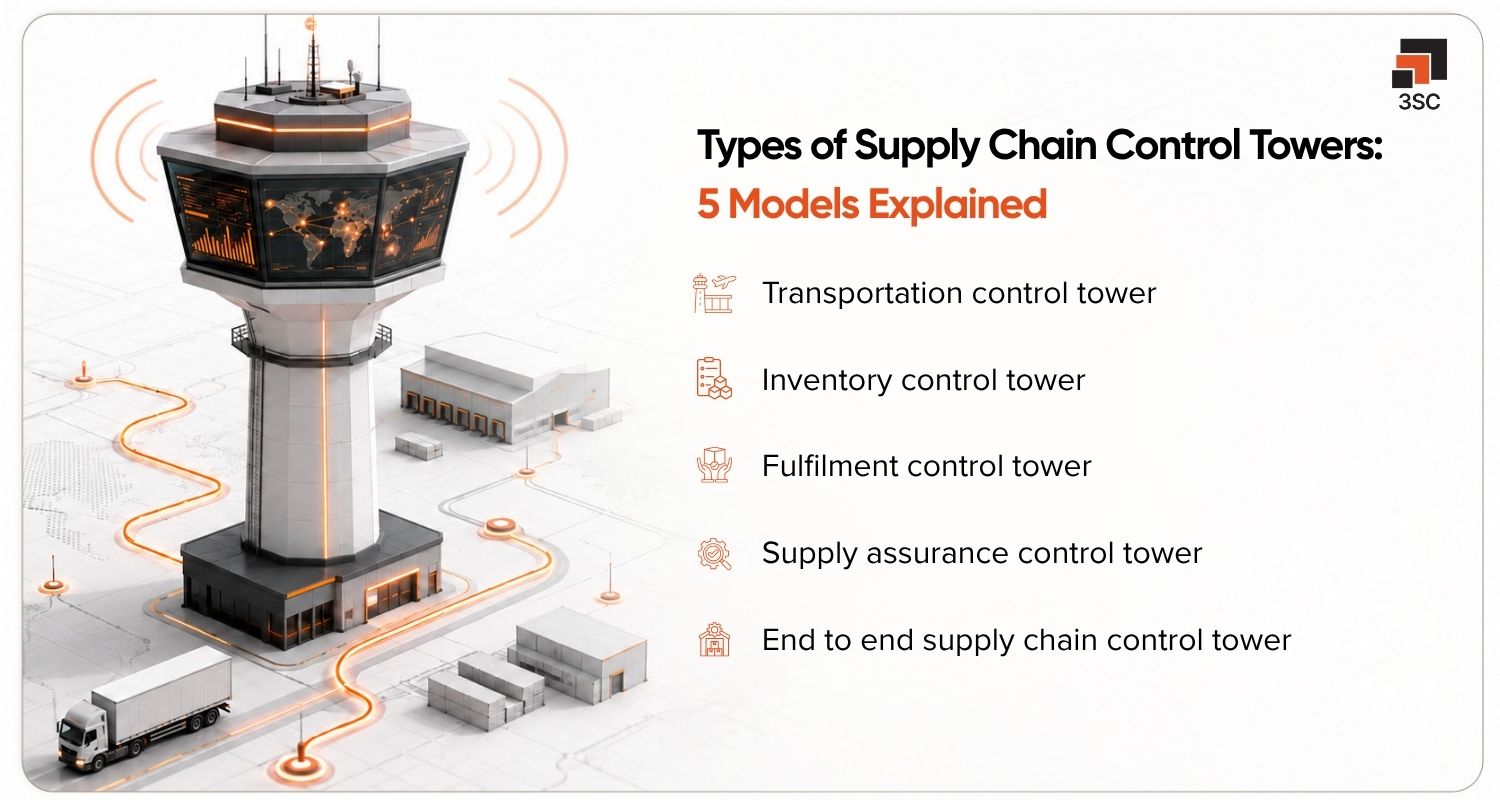
The main types and their specific areas of focus are outlined below.
1. Transportation control tower
A transportation control tower monitors inbound and outbound movements across carriers, routes, and shipping modes. It tracks delivery milestones, freight costs, transit times, carrier performance, and transport exceptions. When a delay occurs, teams can assess alternative routes or carriers before the issue affects production or customer delivery.
2. Inventory control tower
An inventory control tower provides visibility into stock across warehouses, plants, stores, and goods in transit. It helps teams identify shortages, excess inventory, slow moving stock, and allocation risks. By connecting inventory positions with demand and replenishment requirements, it supports more informed movement and stocking decisions.
3. Fulfilment control tower
A fulfilment control tower follows customer orders from confirmation through delivery. It monitors order status, delivery commitments, shipment progress, service levels, and cost to serve. If an order is likely to miss its commitment, the tower helps teams identify the cause and coordinate the most appropriate response.
4. Supply assurance control tower
A supply assurance control tower focuses on material availability and supplier performance. It monitors purchase orders, supplier capacity, lead times, quality concerns, and procurement risks that could affect production. This gives procurement and planning teams more time to secure alternative supply or adjust production requirements.
5. End to end supply chain control tower
An end-to-end control tower connects demand, supply, inventory, production, logistics, and fulfilment within one operating view. It incorporates information from internal functions and external partners to reveal dependencies across the network. This broader context helps leaders understand how a decision in one area may affect service, cost, and capacity elsewhere.
Understanding these different types helps an organization choose the right scope for its needs. Once that scope is clear, it becomes easier to understand the business benefits the control tower can deliver.
What Are the Benefits of a Supply Chain Control Tower?
So, what changes when supply chain information and decisions are brought together?
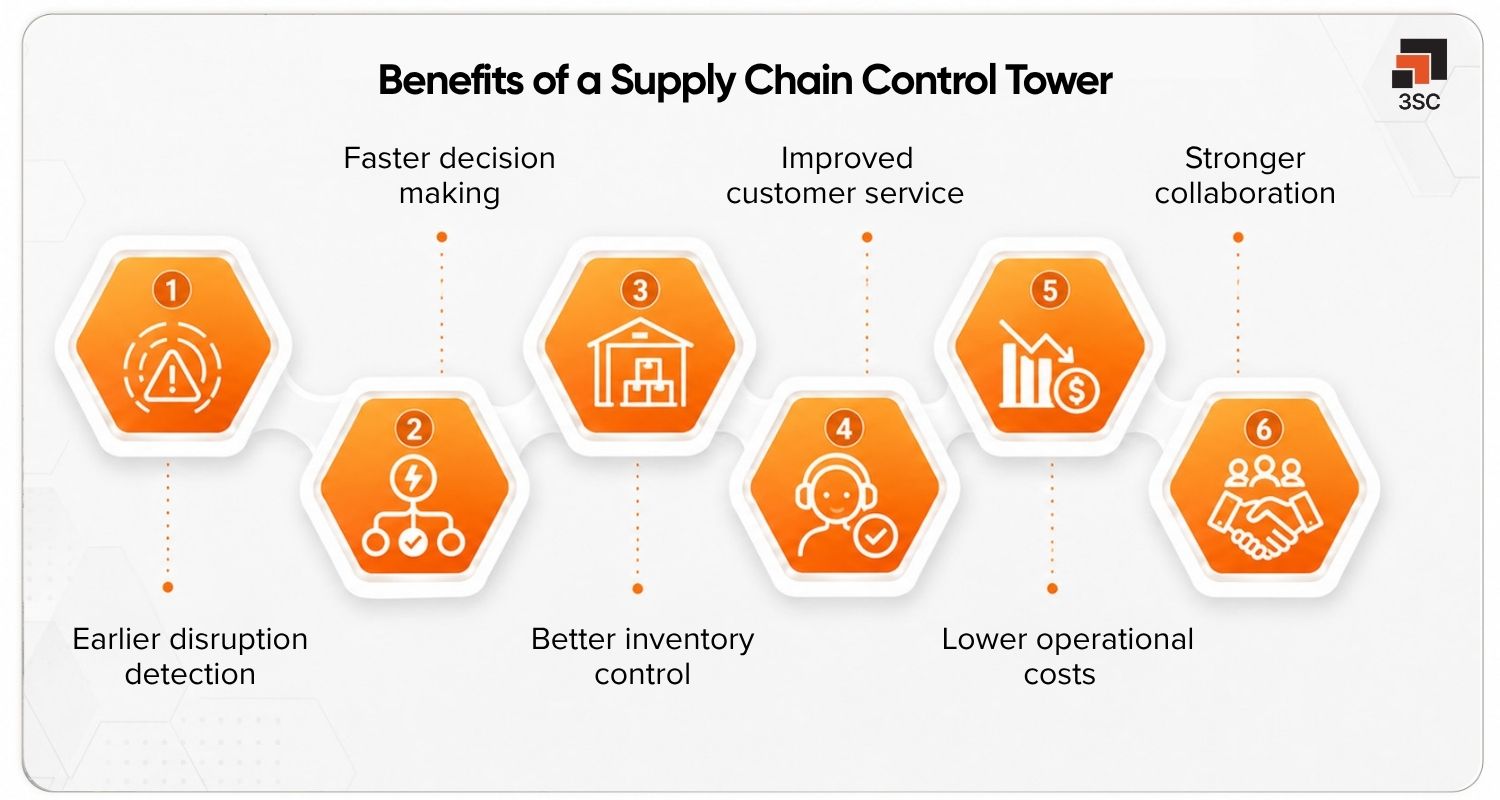
The key benefits can be seen across disruption management, inventory, cost, service, and collaboration.
1. Earlier disruption detection
A control tower continuously monitors conditions across suppliers, production, inventory, and logistics. It can identify delays, shortages, and capacity constraints before their impact reaches customers or critical operations. This early warning gives teams more time to evaluate alternatives instead of responding after the disruption has already escalated.
2. Faster decision making
Teams often lose valuable time gathering information and confirming which version is accurate. A control tower provides a shared view of the event, its cause, and its wider impact. Decision makers can therefore move more quickly from identifying the problem to selecting and executing an appropriate response.
3. Better inventory control
Visibility across locations helps teams understand where inventory is available, committed, delayed, or at risk of becoming excess. This supports better allocation and replenishment decisions across the network. Organizations can protect product availability without depending entirely on additional safety stock as a response to uncertainty.
4. Improved customer service
A control tower can identify orders at risk before a delivery commitment is missed. Customer service and operations teams gain the information needed to protect the order, select another fulfilment option, or communicate accurately with the customer. This supports more reliable service and reduces uncertainty around delivery status.
5. Lower operational costs
Early intervention can prevent expensive responses such as premium freight, emergency sourcing, avoidable storage, and repeated production changes. The control tower also helps teams compare the financial effect of different response options. Cost control therefore becomes part of the decision rather than something measured only after execution.
6. Stronger collaboration
Internal teams, suppliers, carriers, and logistics partners can work from the same operational information. Defined workflows clarify who owns the issue, which action has been approved, and what progress has been made. This reduces repeated communication, conflicting responses, and delays created by unclear accountability.
Across its control tower implementations in several industries, Deloitte reports more than $1 billion in combined client value through increased revenue, improved margins, stronger risk management, and better asset efficiency. While results vary between organizations, this shows that control towers have generated measurable business value across different companies and sectors
What Are the Main Control Tower Implementation Challenges?
These benefits do not appear automatically after a control tower is introduced. Organizations must first address several challenges that can limit its accuracy, adoption, and effectiveness.
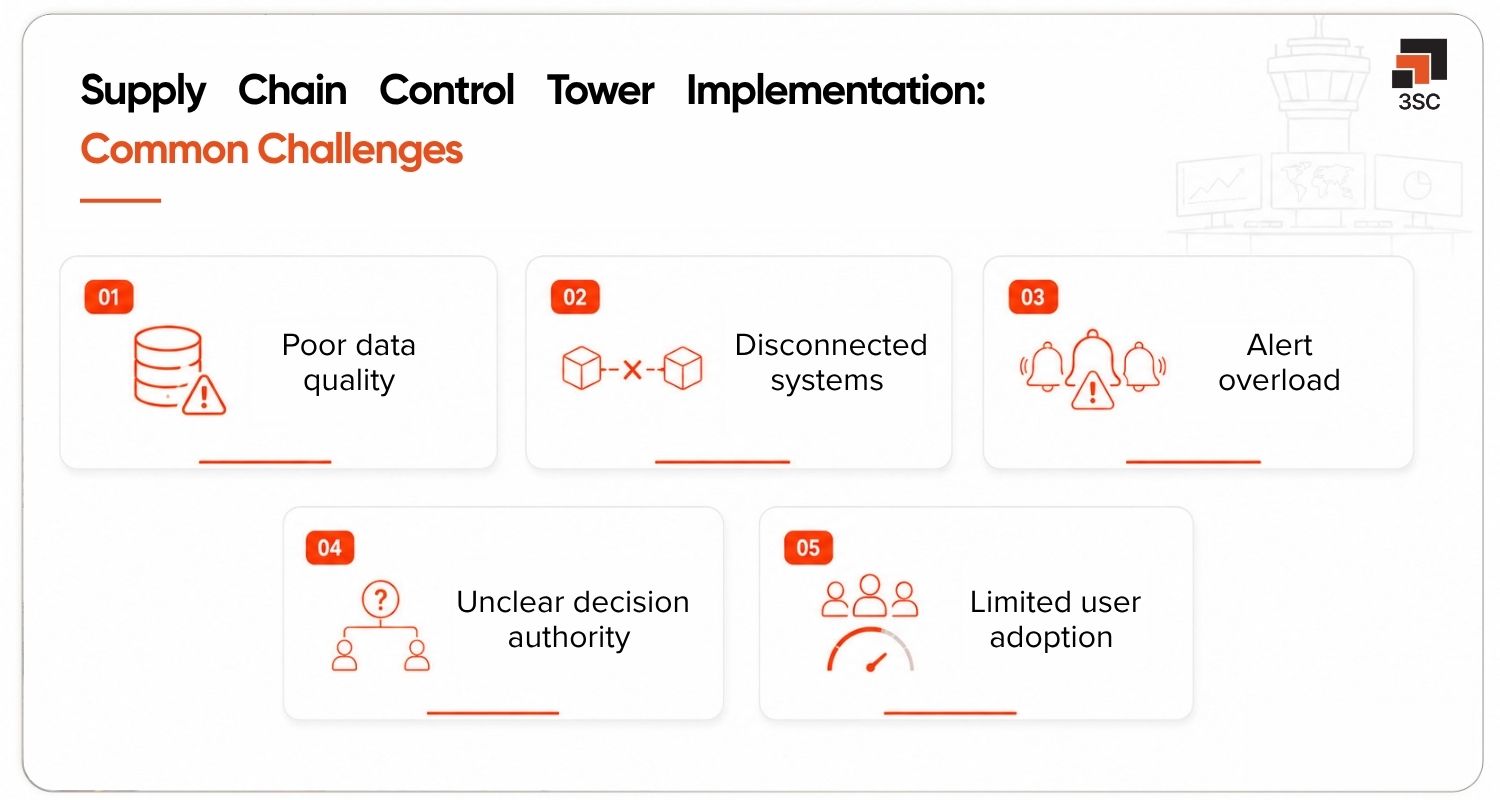
1. Poor data quality
Missing milestones, inconsistent item codes, delayed updates, and conflicting definitions reduce the reliability of control tower insights. If the underlying data is incomplete or outdated, teams may receive incorrect alerts or recommendations. Clear data ownership and governance are therefore essential from the beginning.
2. Disconnected systems
Planning, warehouse, transportation, supplier, and order systems may use different data structures and integration methods. These gaps can prevent the control tower from showing how an event moves across planning and execution. Integration should focus on the information required to support specific operational decisions.
3. Alert overload
If every deviation is treated as urgent, users may struggle to identify which issues require immediate attention. Repeated low value alerts can also reduce trust in the platform. Alerts should be prioritized according to business impact, urgency, customer commitments, and the time available to respond.
4. Unclear decision authority
A control tower may expose an issue without giving teams the authority to resolve it. When ownership, approvals, and escalation rules are unclear, the response can remain delayed despite better visibility. Decision rights should be defined as part of every control tower workflow.
5. Limited user adoption
A control tower can become another reporting layer if teams continue to depend on spreadsheets, emails, and manual coordination. Users must understand how the platform supports their daily responsibilities and improves decisions. Training, change management, and leadership participation are necessary to make the control tower part of regular operations.
Recognizing these challenges early helps organizations build the right data, process, and governance foundations. With those foundations in place, the focus can move to implementation.
How Should an Organization Implement a Supply Chain Control Tower?
With the requirements and challenges understood, the next question is where to begin. A supply chain control tower can be implemented through the following practical stages.
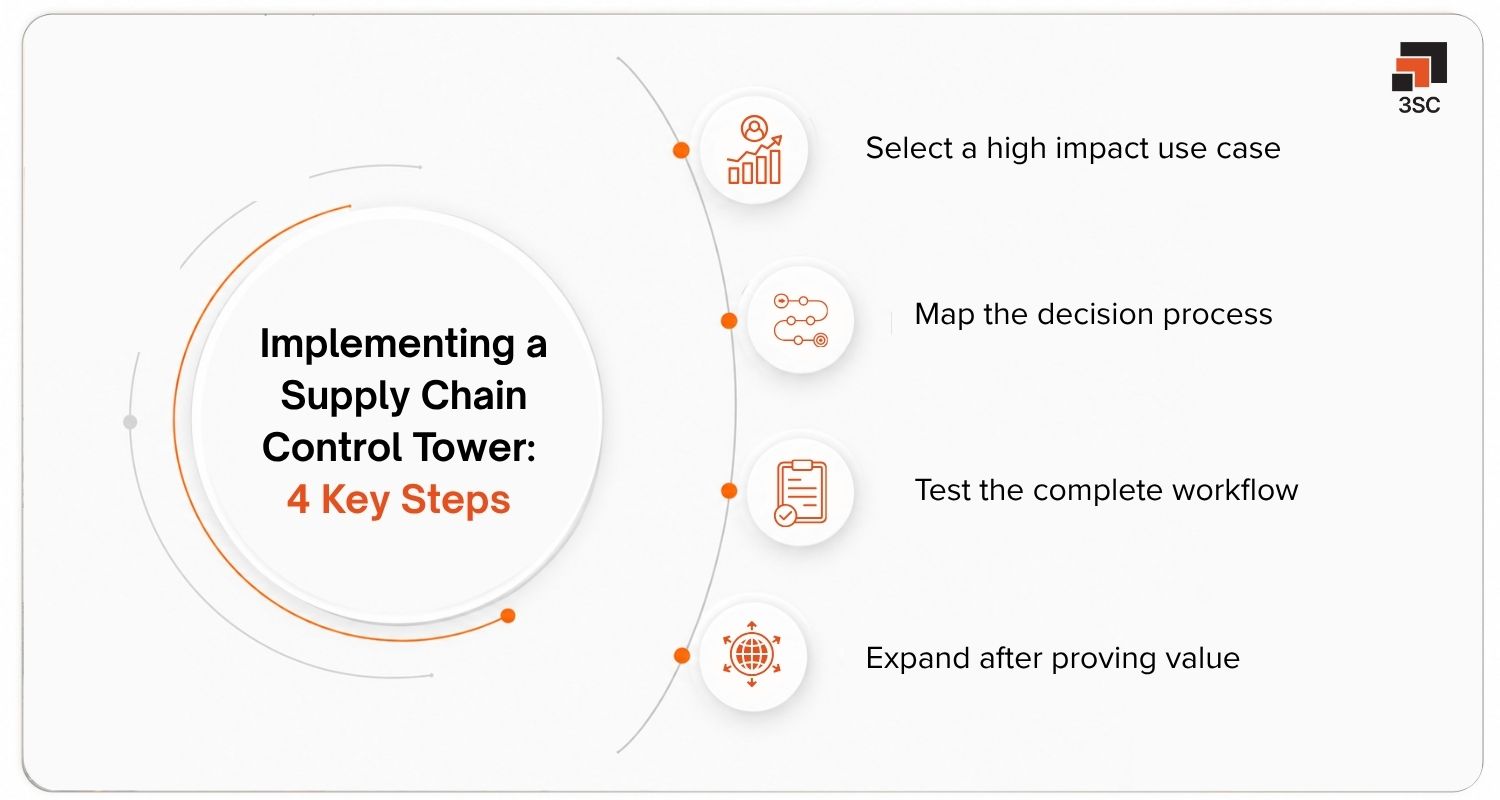
1. Select a high impact use case
Begin with a recurring problem such as transport delays, material shortages, inventory imbalances, or customer orders at risk. The use case should have a clear operational owner and a measurable business consequence. This gives the control tower an immediate purpose and creates a foundation for demonstrating value.
2. Map the decision process
Identify the signals required to detect the issue, the systems that contain the data, and the stakeholders involved in the response. Define the available actions, approval requirements, and expected outcome. This ensures that the control tower is designed around a practical decision rather than a collection of reports.
3. Test the complete workflow
A pilot should test more than whether data appears correctly on the screen. It should confirm that alerts arrive early enough, recommendations are practical, ownership is clear, and teams can execute without unnecessary handoffs. Feedback from actual users should be used to improve thresholds and workflows.
4. Expand after proving value
Once the initial process is stable, the control tower can extend across more products, regions, partners, and supply chain functions. Each expansion should build on proven data standards, workflows, and governance. This phased approach reduces implementation risk and helps the capability grow in line with operational readiness.
Following these stages allows the organization to prove value before expanding the control tower across the network. Over time, this creates the foundation for moving from supply chain visibility towards broader orchestration.
From Supply Chain Visibility to Orchestration
Supply chain control towers are moving towards deeper scenario modelling, digital twins, generative AI, and agentic workflows. These capabilities can help teams evaluate alternatives, explain risk, and automate approved responses. Greater autonomy, however, also requires stronger governance.
The purpose of a control tower remains unchanged. It should help you detect a disruption earlier, understand its wider impact, decide with confidence, and coordinate action across the supply chain.
Return to that delayed shipment. Without a control tower, it is a message waiting to be forwarded. With a mature control tower, it becomes an assessed risk, an owned decision, and a tracked response. That is the real shift from simply seeing the supply chain to orchestrating it while there is still time to make a difference.
Build a More Responsive Supply Chain with 3SC Control Tower
3SC Control Tower connects supply chain data, visibility, analytics, exception management, and execution within a unified operating view. It helps businesses monitor operations across the network, identify disruptions earlier, understand their wider impact, and coordinate faster responses.
With 3SC Control Tower, businesses can move beyond fragmented dashboards and manual coordination to improve inventory control, service performance, operational efficiency, and decision making across the supply chain.