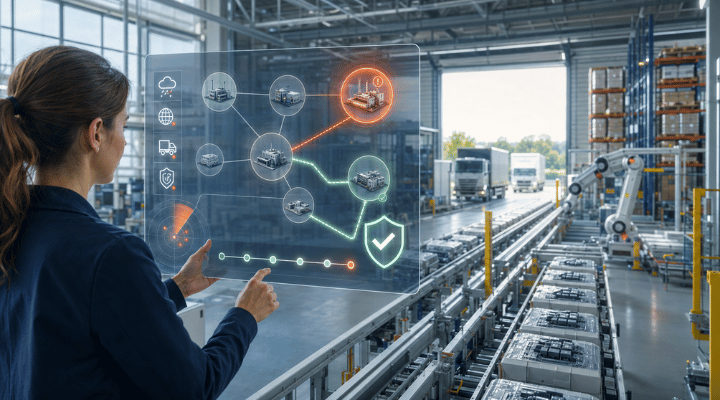
AI improves supplier risk detection by identifying early warning signals across financial health, delivery performance, lead times, logistics disruptions, geopolitical changes, and single-source dependencies. It helps businesses prioritize supplier risks, take faster mitigation actions, and move from reactive disruption management to proactive supply chain resilience.
Key Takeaways
- AI detects supplier risks before they escalate.
- It connects scattered supplier signals into one risk view.
- It helps teams prioritize the suppliers that matter most.
- It supports faster action through alternate sourcing and inventory planning.
- It turns supplier risk management from reactive to proactive.
Supplier risk does not always start with a major failure. It often begins with smaller warning signs. A shipment arrives late. A supplier asks for revised payment terms, or a quality issue appears in one plant, then another. On their own, these signals may not look urgent, but together they can point to a larger disruption taking shape.
The challenge is that supplier risk does not wait for quarterly reviews. By the time a supplier officially communicates a problem, the business may already be facing stockouts, production delays, expedited freight, missed customer commitments, or higher procurement costs.
This is where AI changes the supplier risk scenario. It helps organizations detect weak signals earlier, understand their business impact faster, and act before a supplier issue becomes an operational disruption.
In a 2026 study on AI-based supply chain disruption monitoring, researchers found that the AI system could identify disruption risks with very high accuracy and complete the full analysis in under four minutes. This shows the real value of AI in supplier risk management: not just knowing that risk exists but gaining enough time to respond.
Why Does Supplier Risk Become Visible Too Late?
Most organizations already track supplier performance in some form. They review delivery timelines, quality metrics, purchase order status, contract compliance, and supplier scorecards. Yet risk still appears late because traditional supplier monitoring is often built around past performance rather than emerging change.
The issue usually comes from three gaps:
1. Risk data is scattered across systems
Supplier information sits in ERP, procurement platforms, quality systems, emails, logistics portals, finance records, and external databases. Each team sees one part of the picture, but no one sees the full pattern.
2. Reviews happen after the signal has already developed
Monthly or quarterly supplier reviews can identify performance deterioration, but they may not detect a shift early enough. A supplier’s lead time may slowly increase for months before it becomes visible as a serious capacity issue.
3. External risks are not always mapped to internal exposure
A flood, tariff change, strike, cyberattack, or regulatory notice may be known in the market, but the business may not immediately know which suppliers, materials, plants, customers, or revenue lines are exposed.
This means supplier risk often becomes visible only when it has already entered operations.
How Does AI Detect and Mitigate Supplier Risk Before It Escalates?
AI improves supplier risk detection by looking for patterns that humans may miss when they are spread across thousands of transactions, supplier records, locations, and external updates.
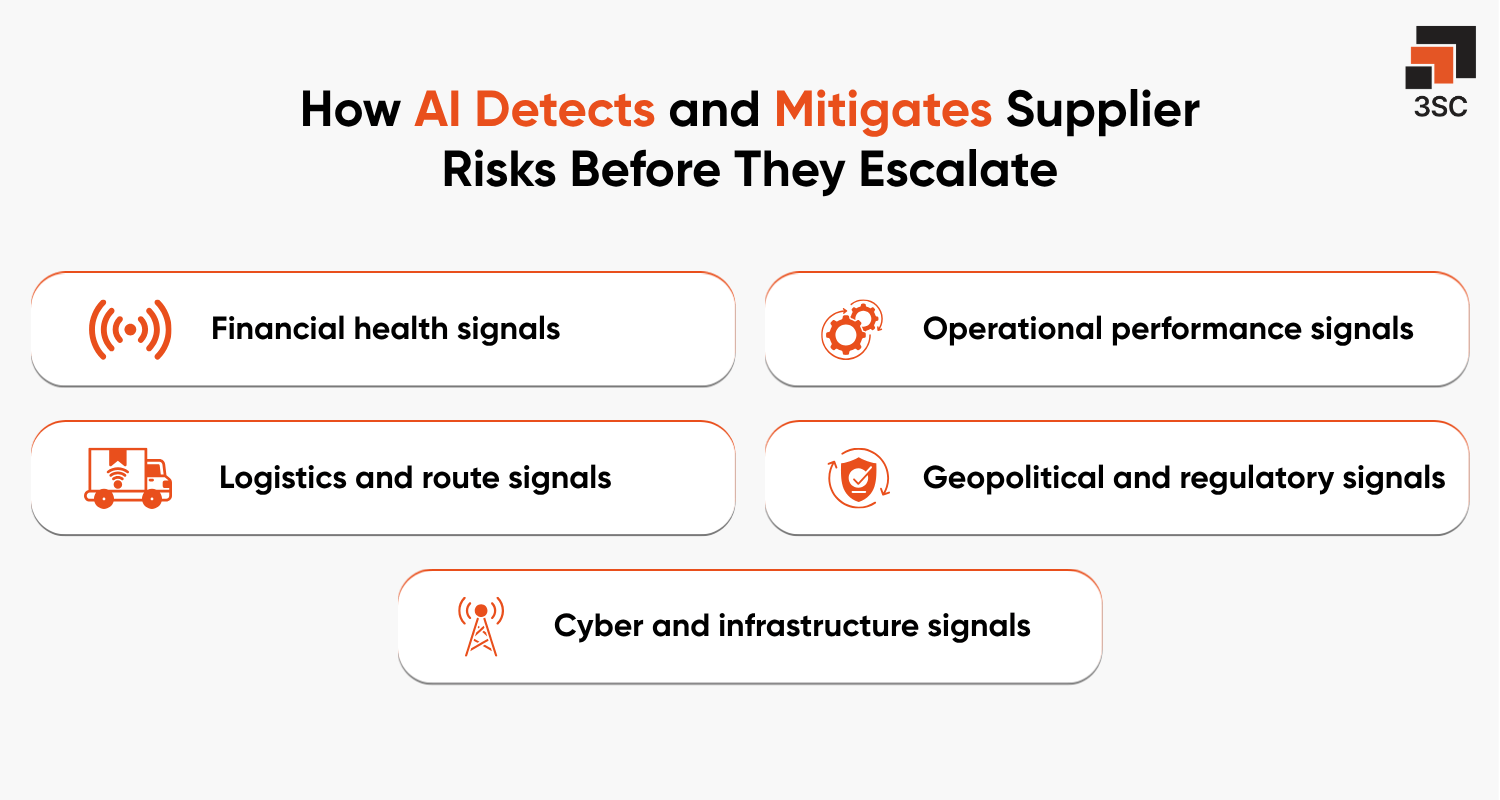
Instead of waiting for one clear red flag, AI reads multiple weak signals together, across several dimensions:
1. Financial health signals
AI can track credit rating changes, payment delays, legal filings, tax issues, bankruptcy indicators, workforce reductions, plant closures, and negative financial news. These signals help procurement teams identify suppliers that may be under cash flow or operating pressure before delivery failures begin.
2. Operational performance signals
Delivery delays, order confirmation changes, lead time drift, frequent rescheduling, partial shipments, capacity constraints, and quality deviations can all indicate supplier stress. AI can detect whether these are isolated issues or part of a worsening pattern.
3. Logistics and route signals
Port congestion, freight delays, carrier issues, weather disruptions, customs delays, and trade lane instability can affect supplier performance even when the supplier itself is stable. AI helps connect logistics disruption to the materials and orders at risk.
4. Geopolitical and regulatory signals
Tariffs, sanctions, export restrictions, political instability, local unrest, and compliance changes can reshape supplier risk quickly. McKinsey’s 2025 supply chain risk survey noted that new tariffs were affecting 30% of global supply chain activities, showing how external policy shifts can directly influence sourcing and cost decisions.
5. Cyber and infrastructure signals
Cyberattacks on logistics providers, supplier IT outages, infrastructure failures, and regional disruptions can quickly affect production continuity. AI helps teams monitor these risks beyond the four walls of the organization.
The strength of AI lies in connecting these signals. It does not only ask, “Did this supplier miss a delivery?” It asks, “What is changing around this supplier, and what could that mean for the business?”
How Should Businesses Start Using AI for Supplier Risk?
AI does not need to begin with a massive transformation program. The best starting point is often a focused risk area where the business already feels pressure.
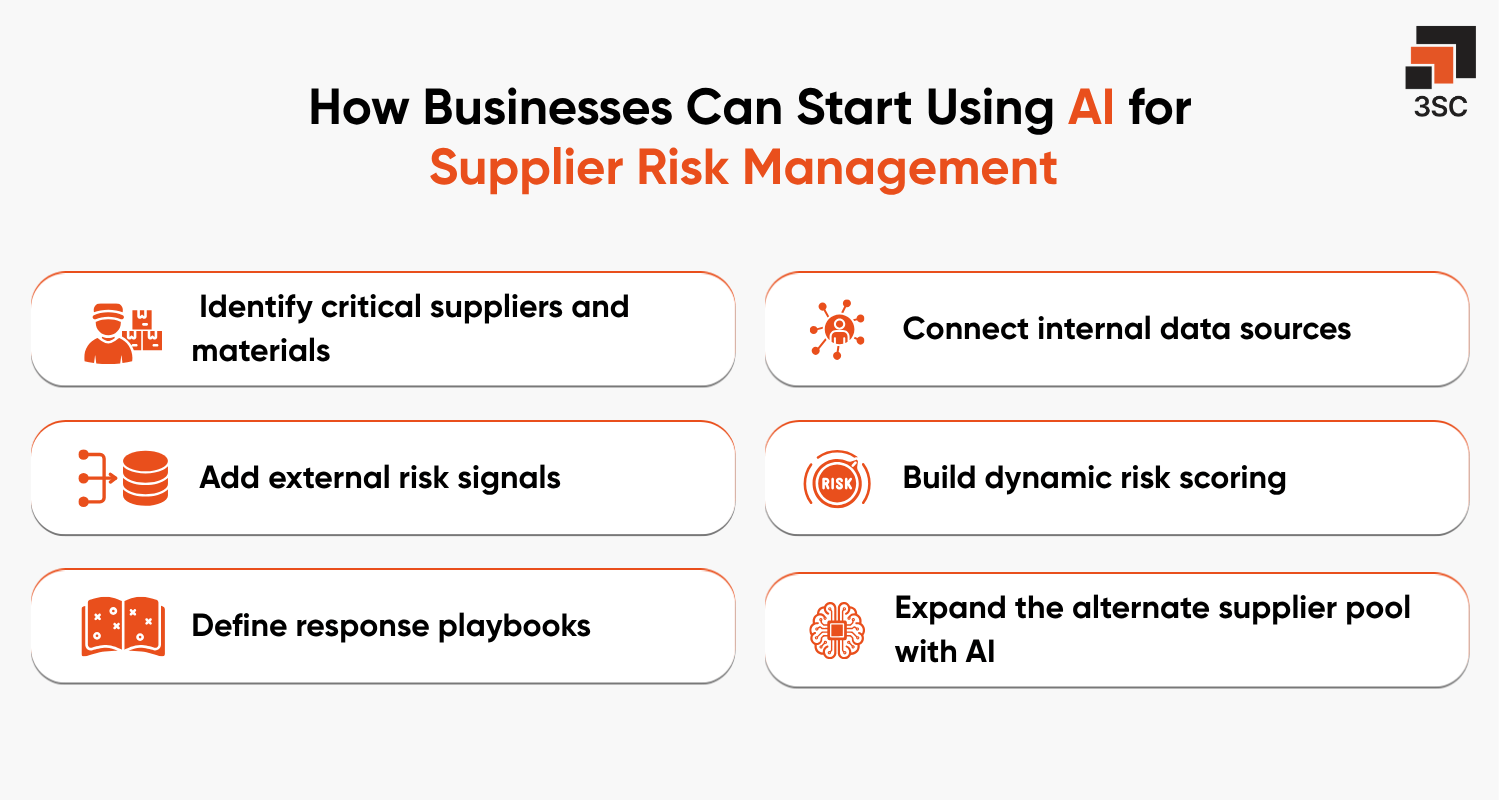
Organizations can start with five practical steps:
1. Identify critical suppliers and materials
Begin with suppliers linked to high-revenue products, long lead times, single-source materials, regulated categories, or frequent disruption.
2. Connect internal data sources
Bring together purchase orders, delivery performance, lead times, quality issues, inventory cover, supplier master data, and sourcing records.
3. Add external risk signals
Include financial, geopolitical, weather, logistics, regulatory, and news-based indicators relevant to supplier locations and trade lanes.
4. Build dynamic risk scoring
Move from static scorecards to continuously updated supplier risk profiles that reflect both performance and exposure.
5. Define response playbooks
For every major risk category, decide what action should follow. Alerts are only valuable when ownership, escalation paths, and mitigation options are clear.
6. Expand the alternate supplier pool with AI
AI can help organizations identify and evaluate potential suppliers beyond the existing supplier base, reducing dependence on a single source. It can compare suppliers across factors such as product capability, capacity, transportation cost, lead time, geographic location, trade restrictions, tariffs, regulatory requirements, and country-level risk. This allows procurement teams to build a ranked list of suitable alternatives before an existing supplier becomes unavailable.
Starting small does not mean thinking small. It means proving value through a focused use case, then expanding the model across supplier networks, categories, regions, and sub-tier dependencies.
What Does Better Supplier Risk Management Look Like With AI?
With AI, supplier risk management becomes more continuous, connected, and decision ready.
The change is visible in how teams work. Procurement no longer waits for supplier reviews to identify risk. Planning no longer discovers shortages only when material availability changes. Logistics no longer reacts only after a shipment misses its milestone. Finance no longer sees the cost impact only after emergency buying begins.
Instead, teams work from a shared risk view.
A strong AI-enabled supplier risk process helps organizations:
1. Detect early warning signals before disruption reaches production.
2. Prioritize suppliers based on business impact, not just spend.
3. Connect external events to internal material and customer exposure.
4. Reduce unnecessary alerts by focusing on actionable risk.
5. Build alternate sourcing and inventory strategies before crisis conditions.
6. Improve cross-functional decisions across procurement, planning, logistics, quality, and finance.
7. Strengthen resilience without overcorrecting through excessive buffers or costly emergency actions.
This is the difference between visibility and intelligence. Visibility shows what is happening. Intelligence helps teams understand what it means and what to do next.
Conclusion: Can AI Make Supplier Risk More Manageable?
Supplier risk will never disappear. Markets will shift, suppliers will face pressure, regulations will change, logistics networks will be disrupted, and unexpected events will continue to test supply chains.
But businesses do not have to manage these risks blindly.
AI improves supplier risk detection by reading early signals across financial health, delivery performance, lead time movement, logistics disruption, geopolitical change, quality trends, and single-source dependency. More importantly, it helps translate those signals into decisions: which supplier needs attention, which material is exposed, which plant may be affected, and which mitigation action should come first.
The real promise of AI in supplier risk management is not simply faster alerts. It is earlier clarity, better prioritization, and more confident action.
For supply chain leaders, that can be the difference between reacting to disruption after it hits and preparing for it while there is still time to protect production, cost, service, and customer trust.
Strengthen Supplier Risk Management with 3SC
Detect supplier risks earlier, understand their impact across materials, inventory, operations, and customer commitments, and prioritize the right mitigation actions. With AI-driven risk intelligence and Agentic AI, teams can identify emerging risks, evaluate response options, coordinate actions faster, and build a more proactive and resilient supplier network.