Key Takeaways
- Supply chain models define how operations are structured and executed.
- Model selection should align with product, demand, and strategy.
- The right model impacts cost, speed, and resilience.
- Factors like volatility and complexity guide model choice.
- High-performing firms use multiple models in parallel.
- Purpose-built models drive adaptability and long-term value.
What are Supply Chain Models?
Every product journey, from raw material to end customer, follows a set of decisions that shape its speed, cost, quality, and reliability. The supply chain model is the structural blueprint behind those decisions. It defines how supply chain activities are organized, coordinated, and executed across sourcing, manufacturing, logistics, inventory, and delivery. Whether designed for predictability or agility, for mass production or customization, the model determines how a business aligns its operations with demand patterns, product characteristics, and strategic goals.
Rather than relying on a one-size-fits-all approach, supply chain models are purpose-built—some prioritizing lean efficiency, others maximizing responsiveness or digital integration. The model selected not only governs day-to-day execution but also sets the foundation for resilience, scalability, and sustained performance.
Different Types of Supply Chain Models
- Continuous Flow Model
- Fast Chain Model
- Agile & Efficient Chain Model
- Custom-Configured Model
- Virtual Model
- Flexible Model
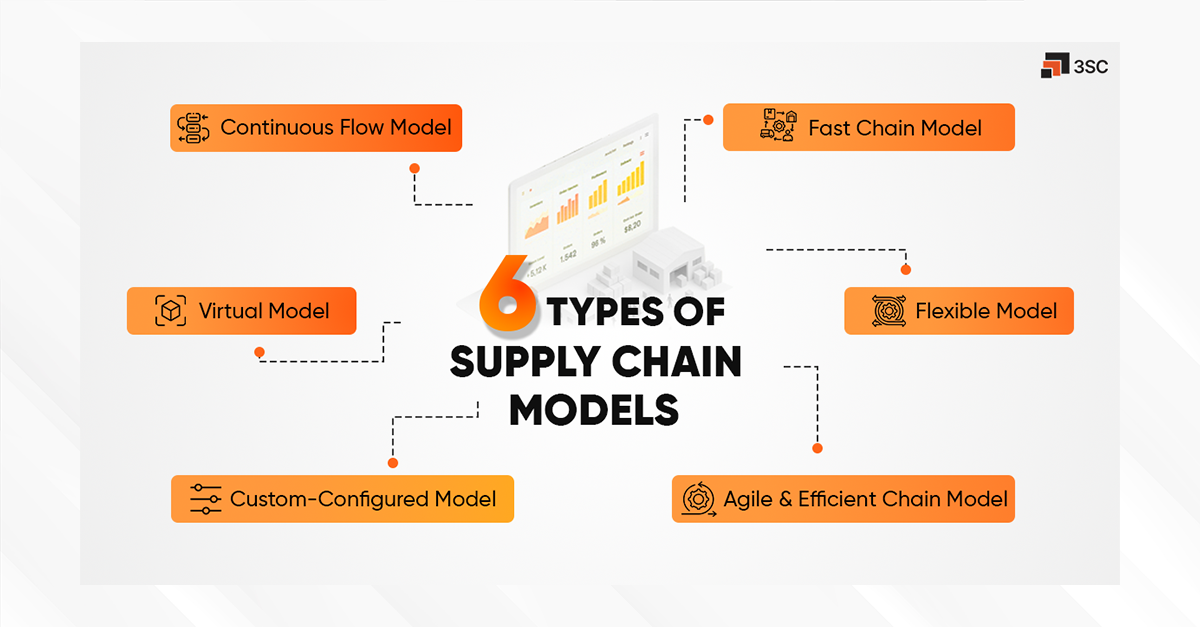
Selecting the right supply chain model is a strategic decision, one that must reflect the unique realities of the business it supports. Different models serve different operational goals: some are built for cost efficiency, others for speed, flexibility, or customization. Understanding the various types of supply chain models allows organizations to match structure with strategy, ensuring alignment across functions and resilience under pressure. From improving forecast accuracy to reducing lead times and enabling end-to-end visibility, the choice of model directly influences both performance and profitability. Below given points are some of the same:
Types, Benefits and Use Cases of Supply Chain Model
1. Continuous Flow Model
A Continuous-Flow supply chain is designed to ensure a steady, uninterrupted movement of products, especially those with predictable, high-volume demand. It relies on standardized processes, automated production, and tightly synchronized replenishment cycles to keep goods moving smoothly from production to delivery with minimal delays or inventory buildup.
Benefits
This model works best for industries like consumer-packaged goods, pharmaceuticals, chemicals, and beverages, where product demand is consistent over time. Because of its focus on efficiency and reliability, the continuous-flow model minimizes waste, reduces lead times, and keeps costs low, but it requires stable demand patterns and well-structured operations to succeed.
Use Case
PepsiCo exemplifies the Continuous-Flow supply chain model, which is designed for high-volume, stable-demand products. Operating one of the world’s largest food and beverage supply networks, PepsiCo maintains a seamless flow of goods by leveraging standardized production processes, automation, and localized manufacturing. With over 900 facilities worldwide, its operations are tightly synchronized to ensure consistent product availability, from snacks like Lay’s to beverages like Gatorade.
2. Fast Chain Model
The Fast Supply Chain model is designed for products with short life cycles, frequent design changes, or high trend sensitivity, such as fashion, consumer electronics, or seasonal items. The core objective is speed: getting products from design to shelf faster than competitors to capitalize on short-lived market demand.
Benefits
This model relies on rapid production, quick decision-making, and tight coordination across suppliers, manufacturers, and retailers. It often uses real-time sales data and agile logistics to shorten lead times and reduce the risk of markdowns or obsolescence. It thrives on responsiveness rather than cost-efficiency which is ideal for companies that win by being first to market, not necessarily the cheapest.
Use Case
Zara exemplifies the Fast Supply Chain model, built for rapid response to shifting fashion trends and short product lifecycles. The brand moves designs from concept to store in just 10–15 days by maintaining a vertically integrated supply chain and localizing much of its production in Spain and nearby countries. Stores receive new stock up to eight times a month, guided by real-time sales data and customer feedback. This agility allows Zara to stay ahead of trends, minimize markdowns, and keep inventory lean.
3. Agile & Efficient Chain Model
The Agile & Efficient supply chain model is a hybrid strategy that blends two distinct approaches:
- Agile: Designed for responsiveness and flexibility, ideal for markets with unpredictable demand, customization needs, or frequent product changes.
- Efficient: Focused on minimizing costs, maximizing asset utilization, and running lean operations. It works best for stable, high-volume products where predictability and cost control are key.
Benefits
This combined model enables companies to segment their supply chains: using an efficient model for core, predictable items, and an agile model for volatile or high-margin products. It requires data-driven planning, flexible production setups, and visibility across the supply network to switch between models as needed.
Use Case
Balancing lean operations with rapid market responsiveness, Samsung uses the Agile & Efficient supply chain model. For stable, high-volume products like semiconductors and TVs, it runs a cost-efficient, vertically integrated system. Meanwhile, in its mobile and electronics divisions, Samsung adopts Agile practices to quickly adapt to changing consumer trends. This hybrid approach enables both scale and speed within a unified supply chain.
4. Custom-Configured Model
The Custom-Configured supply chain model is designed for businesses that offer personalized or made-to-order products. It blends standardized processes in the early stages with customization in the final stages, allowing companies to deliver tailored products without sacrificing efficiency.
Benefits
This model is ideal for industries such as automotive, industrial equipment, electronics, and furniture, where customers often expect products to be configured to specific needs, think engine types, colour options, or feature add-ons. It combines elements of both the Continuous-Flow and Agile models: leveraging economies of scale in the upstream supply chain, while keeping flexibility downstream.
Success with this model relies on modular product design, flexible assembly, and tight coordination between customer demand and production planning. It allows companies to offer variety, reduce excess inventory, and improve delivery speed for customized orders, without the full cost of a one-off build.
Use Case
BMW applies the Custom-Configured supply chain model to deliver highly personalized vehicles while maintaining operational efficiency. Customers select specifications such as engine variants, paint finishes, and interior features. Standard components are produced in advance, but final assembly is initiated only after the order is placed. Through modular architecture and flexible manufacturing systems, BMW balances customization with scale, achieving efficient build-to-order production with controlled lead times.
5. Virtual Supply Chain Model
The Virtual supply chain model is built on information, connectivity, and collaboration rather than physical assets. Unlike traditional models that rely heavily on owning infrastructure, the virtual model focuses on real-time data sharing and digital coordination across a network of suppliers, manufacturers, logistics providers, and distributors.
Benefits
This model creates a “digital twin” of the supply chain, allowing companies to simulate, monitor, and optimize operations in real time. It enables end-to-end visibility, proactive risk management, and fast decision-making, without owning every link in the chain. Cloud platforms, IoT, AI, and advanced analytics are key enablers of this model.
It is especially effective for companies operating in highly dynamic, global, or outsourced environments, where agility, visibility, and integration are more valuable than asset ownership. The virtual model reduces capital investment, improves responsiveness, and enables seamless scaling, but it also demands strong data governance and digital maturity.
Use Case
Cisco uses the Virtual Supply Chain model to manage a globally outsourced network through real-time data and digital twin technology. Instead of relying on owned infrastructure, Cisco connects over 1,300 warehouses and suppliers via integrated platforms, enabling predictive planning, direct fulfilment, and agile response to disruptions.
6. Flexible Model
The Flexible supply chain model is built for adaptability in environments with variable demand, fluctuating lead times, or high product variety. It enables companies to scale production, shift suppliers, and reallocate resources quickly without disrupting operations.
Benefits
Industries like automotive aftermarket, consumer electronics, and specialty chemicals use this model to manage intermittent demand and customized orders efficiently. Key features such as multi-sourcing, buffer capacity, and decentralized warehousing help absorb disruptions and ensure service continuity. The result is greater agility, reduced lost sales, and stronger resilience in volatile or demand-sensitive markets.
Use Case
Office Depot operates a Flexible Supply Chain Model, enabling rapid adjustment to demand fluctuations and shifting customer needs in the office supplies market. The company relies on integrated software systems that unify store inventory, logistics, and delivery operations across locations. This connectivity lets Office Depot quickly scale operations up or down, reallocate inventory, and change fulfilment routes, all without overstocking or disrupting service.
Which supply chain models works best?
There is no single “best” supply chain model, it entirely depends on the nature of the business, the type of products, market dynamics, and strategic priorities. Companies must evaluate factors such as product type, demand volatility, customer expectations, cost-to-service trade-offs, and supply chain complexity when choosing a model. For instance, stable, high-volume products may benefit from a Continuous-Flow model, while highly customized or rapidly changing products are better suited to Agile, Fast, or Custom-Configured models. Businesses with globally outsourced operations often rely on Virtual or Hybrid models for greater visibility and responsiveness.
According to insights from McKinsey and Coupa, high-performing organizations don't rely on a one-size-fits-all model. Instead, they segment their supply chains, adopting different models for different product lines, markets, or risk profiles. The most effective supply chains are those designed intentionally, not inherited by default, built to balance cost, speed, resilience, and adaptability in a way that aligns with business goals.
Conclusion
Choosing the right supply chain model is a strategic decision that directly influences operational performance, customer satisfaction, and long-term competitiveness. Each model offers distinct advantages depending on the business context, whether it’s stability, speed, customization, or adaptability. By aligning supply chain design with product characteristics, demand patterns, and market dynamics, organizations can enhance resilience, optimize costs, and respond more effectively to change. A well-defined, purpose-built supply chain model is not just a framework, it’s a critical driver of sustainable value creation.
Reimagine how your supply chain thinks, adapts, and performs.
In a world of constant change, the right supply chain model isn’t just about moving goods, it’s about enabling smarter decisions, faster responses, and stronger resilience across every node. Whether you're scaling operations, managing volatility, or seeking greater visibility, 3SC helps you align the right strategy with intelligent execution.
With our AI-powered platform and deep supply chain expertise, you gain the tools to model, monitor, and optimize every link in real time, turning complexity into clarity, and disruption into opportunity.