
Summary
OTIF is a critical supply chain performance metric used to evaluate fulfilment reliability from the customer’s perspective. It brings together delivery timing and order completeness in one measure, helping businesses identify service gaps across planning, inventory, warehousing, suppliers, and transportation.
Key Takeaways
- OTIF measures whether every order reaches the customer on time and in full.
- It is stricter than OTD or Fill Rate because both timing and completeness must be met together.
- OTIF is calculated by dividing orders delivered on time and in full by total orders.
- Low OTIF usually comes from poor forecasting, stock gaps, warehouse errors, supplier delays, or transport bottlenecks.
- Companies can improve OTIF through better planning, real-time visibility, stronger supplier coordination, and faster exception management.
Every order begins as a promise.
A customer places an order expecting a specific product, in the right quantity, at the agreed time. Behind that promise is a chain of decisions involving demand planning, inventory allocation, warehouse operations, supplier coordination, transportation, and delivery scheduling.
When the order is accepted, everything may appear manageable. Inventory is available in the system, warehouse capacity looks sufficient, and a carrier has been assigned. But a forecast deviation, stock discrepancy, delayed inbound shipment, picking error, or missed transport slot can gradually place the commitment at risk.
For the customer, none of these internal complexities matter. They simply expect the business to deliver what was promised.
To understand how reliably businesses meet that commitment, let us look at the measure used to track it.
What OTIF Really Means
OTIF has two parts, and both must be achieved together.
1. On Time
An order is considered on time when it reaches the customer within the agreed delivery date or delivery window. This could mean arrival at a distribution centre, dock check in, proof of delivery, or completed receipt, depending on how the customer defines it.
2. In Full
An order is considered in full when the correct products arrive in the correct quantities, without missing items, unauthorized substitutions, or rejected goods.
The important part is that OTIF is a combined metric. A shipment that arrives on time but with missing cases is not OTIF compliant. A shipment that arrives complete but one day late is not OTIF compliant either.
This makes OTIF different from softer delivery measures. It reflects the actual customer experience.
Why OTIF Matters More Than Ever
Supply chains are under constant pressure to move faster, hold leaner inventory, and serve customers with greater accuracy. In this environment, a late or incomplete delivery is not a small operational miss. It can affect shelf availability, production schedules, customer satisfaction, and supplier relationships.
For retailers, poor OTIF can lead to empty shelves and missed sales. Research on retail out of stocks has placed average out of stock levels at around 8.3 percent in developed FMCG markets, showing how often availability gaps can still appear even in mature supply chains.
For manufacturers, poor OTIF can delay production, increase expediting costs, and force teams into last minute planning. For distributors, it can weaken service levels and make customers question reliability.
This is why OTIF is not only a logistics KPI. It is a measure of how well the entire supply chain works together.
How to Calculate OTIF
The formula is simple:
OTIF (%) = Orders Delivered On Time & In Full ÷ Total Orders × 100
Let us say a company shipped 1,000 orders in a month.
- 920 orders arrived on time.
- 950 orders were complete.
- But Only 880 orders met both conditions at the same time.
The OTIF score would be: (880 ÷ 1,000) × 100 = 88%
This example shows why OTIF often tells a more honest story than separate performance metrics. On time delivery may look strong. Fill rate may also look strong. But OTIF reveals how many customers actually received the complete order at the right time.
Before using the formula, businesses must define the rules clearly. What counts as on time? What counts as in full? Are partial shipments accepted? Are damages counted as incomplete? Which delivery timestamp will be used?
Without clear definitions, OTIF becomes a reporting argument. With clear definitions, it becomes a decision-making tool.
OTIF vs OTD vs Fill Rate
Many businesses already track delivery performance, but not every metric tells the same story.
Metrics | What It Measures |
|---|---|
On Time Delivery | Measures whether an order arrived on schedule. It does not indicate whether the order was complete. |
Fill Rate | Measures how much customer demand was fulfilled from available inventory. It helps inventory teams but does not measure delivery timing. |
OTIF | Combines both delivery timing and order completeness. It shows whether the customer received the complete order on time. |
This is why OTIF is more useful for understanding fulfilment reliability. It connects inventory, warehouse execution, transportation, and customer service into one result.
What Causes Poor OTIF Performance
OTIF failures usually do not begin on the delivery day. By the time the shipment misses the target, the issue has often been building for days or weeks.
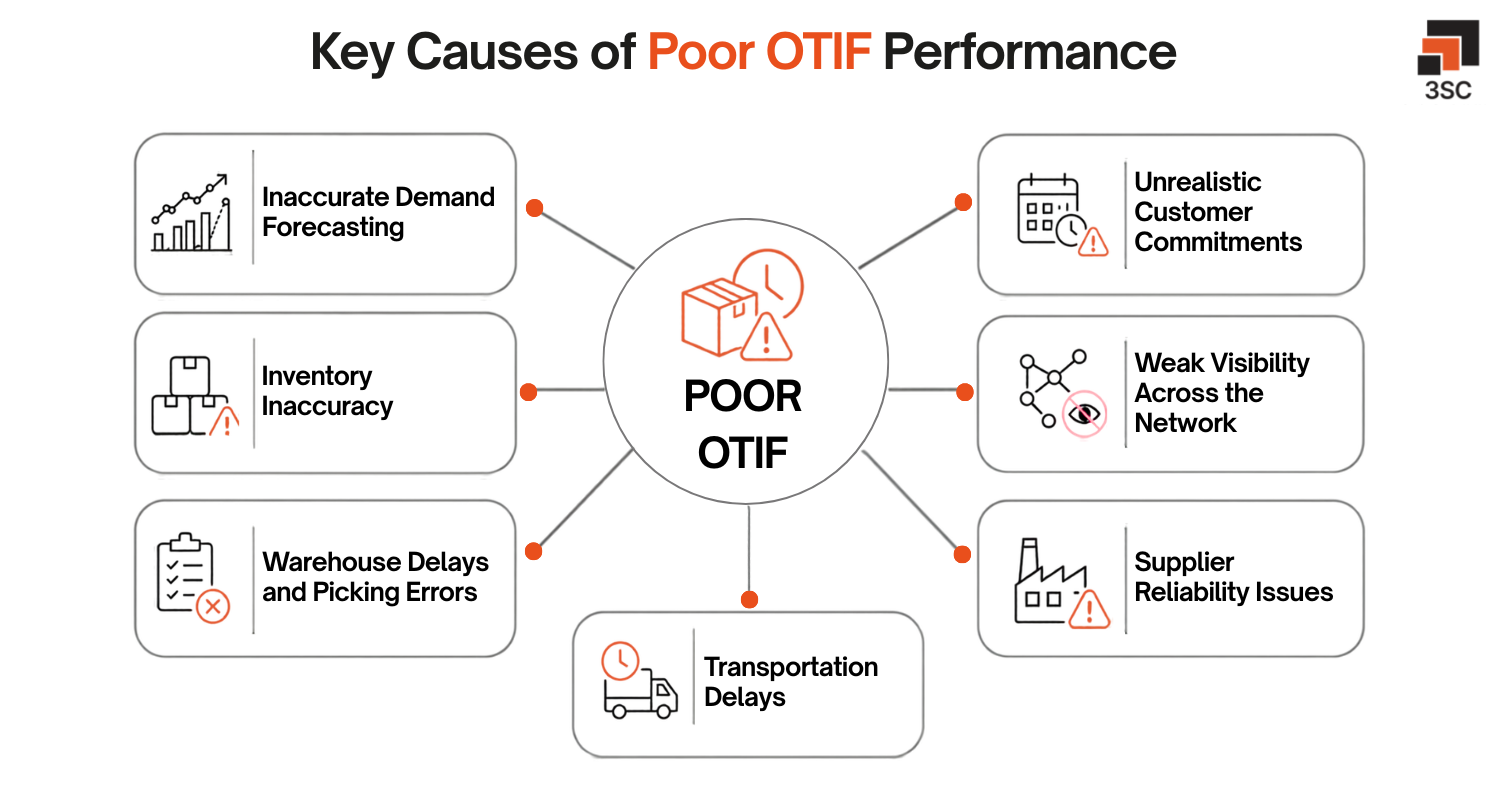
Common causes include:
1. Inaccurate Demand Forecasting
When demand is underestimated, businesses run out of stock and cannot fulfil orders in full. When demand is overestimated, inventory may sit in the wrong location while urgent orders go short elsewhere.
Poor forecasting creates pressure across the network. The warehouse rushes, planners adjust manually, and logistics teams try to recover with faster transport.
2. Inventory Inaccuracy
If system stock and physical stock do not match, teams may accept orders they cannot actually fulfil. The gap only becomes visible during picking, when it is already too late to protect the delivery promise.
3. Warehouse Delays and Picking Errors
Even when inventory is available, warehouse execution can break OTIF. Picking errors, packing delays, slow staging, poor dock scheduling, and manual checks can delay dispatch or create incomplete shipments.
4. Transportation Delays
Carrier capacity issues, route delays, missed appointments, traffic, weather, and poor lane planning can all affect the on-time component. A perfectly picked order still fails OTIF if it arrives outside the agreed window.
5. Supplier Reliability Issues
For manufacturers and distributors, inbound delays can quickly become outbound failures. If suppliers do not deliver materials or finished goods as committed, customer orders become harder to fulfil.
6. Weak Visibility Across the Network
Many OTIF failures happen because teams discover the issue too late. A delay may be known to the carrier, a shortage may be known to the warehouse, and a date change may be known to the supplier. But if this information does not flow quickly, planners continue working with outdated assumptions.
7. Unrealistic Customer Commitments
Sometimes the promise itself is the problem. If sales teams commit to timelines that operations cannot support, OTIF performance suffers before execution even begins.
The pattern is clear. Poor OTIF is rarely caused by one team alone. It is usually the result of disconnected planning, execution, and communication.
How to Improve OTIF Performance - Top Strategies
Improving OTIF does not mean adding inventory everywhere or paying for premium freight every time something goes wrong. It means building a supply chain that can make realistic promises and keep them consistently.
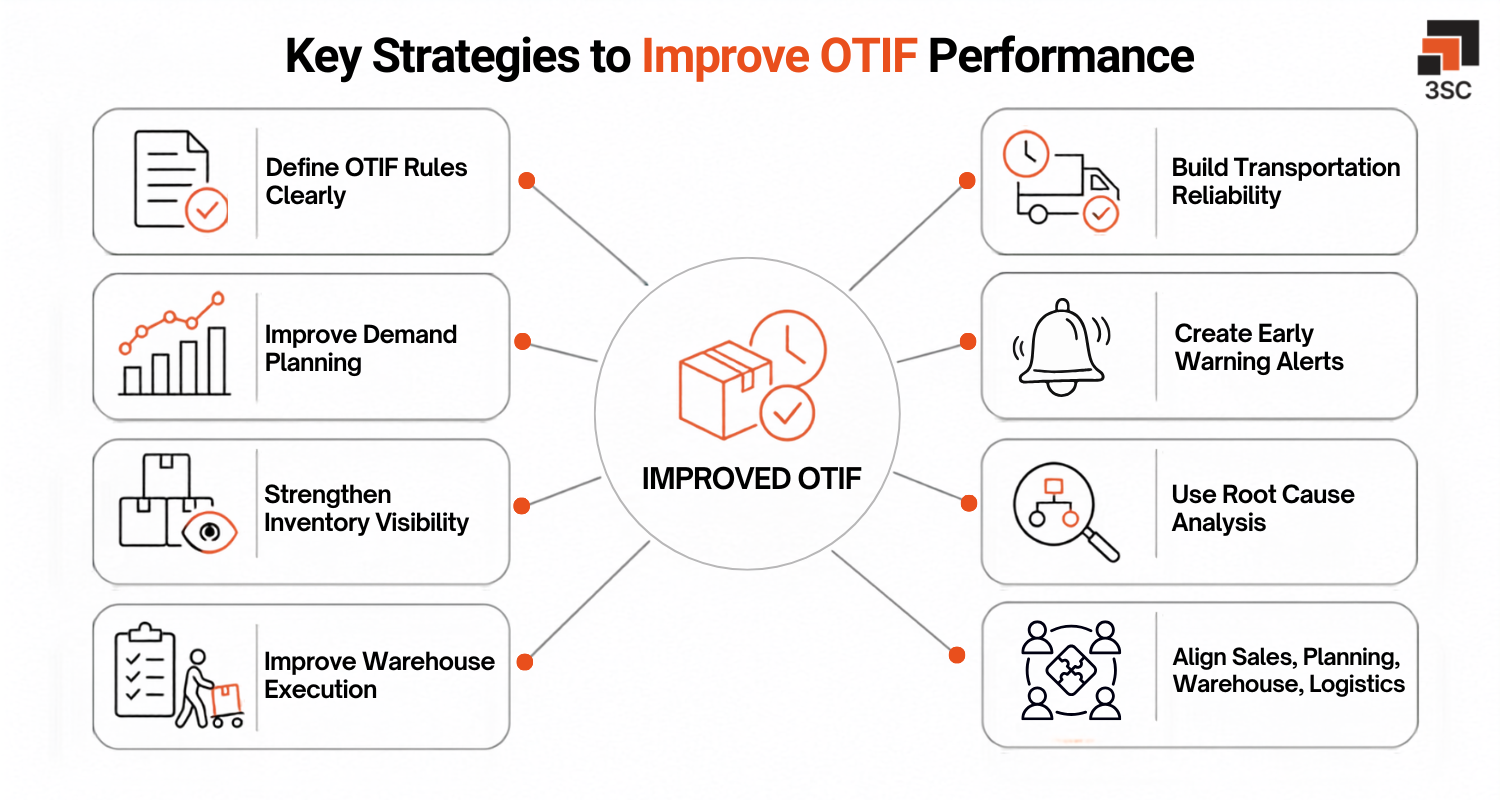
Practical strategies include:
1. Define OTIF Rules Clearly
Start by agreeing on what on time and in full mean for each customer. Define the delivery window, valid delivery timestamp, quantity rules, treatment of damages, and partial shipment policies.
This creates one version of the truth across sales, planning, warehouse, logistics, and customer service.
2. Improve Demand Planning
Better forecasts help teams prepare inventory before demand becomes urgent. Use historical sales, seasonality, promotions, customer inputs, and market signals to improve demand accuracy.
When planning is more accurate, the business can reduce stockouts, avoid last minute shortages, and improve the in full side of OTIF.
3. Strengthen Inventory Visibility
Real time inventory visibility helps teams know what is available, where it is located, and whether it can be committed. Regular cycle counts, inventory audits, and system discipline reduce the gap between recorded stock and actual stock.
This helps prevent false promises at order entry.
4. Improve Warehouse Execution
Warehouse performance has a direct impact on OTIF. A warehouse management system, barcode scanning, better slotting, order prioritization, and clear picking workflows can reduce errors and improve dispatch reliability.
Critical orders should be visible early, not discovered when the carrier is already waiting.
5. Build Transportation Reliability
Track carrier performance by lane, customer, and delivery window. Work with carriers that understand appointment-based deliveries and critical service levels.
Route planning, shipment tracking, realistic lead times, and backup carrier options help protect the on-time part of OTIF.
6. Create Early Warning Alerts
Teams should not wait for a delivery failure to find out there was a risk. Alerts for delayed supplier confirmations, inventory shortages, missed pick times, carrier delays, or appointment changes help teams act earlier.
The earlier the risk is visible, the more options the business has.
7. Use Root Cause Analysis
Do not stop at the OTIF percentage. Break failures down by reason.
Was the order late because of transportation? Was it incomplete because of inventory? Did the warehouse miss the cut off? Did the supplier delay the inbound material?
Once repeat causes are visible, improvement becomes focused.
8. Align Sales, Planning, Warehouse, and Logistics
OTIF improves when every team works from the same promise. Sales should commit based on actual available capacity. Planning should update supply risks early. Warehouses should prioritize time sensitive orders. Logistics should manage carriers against customer delivery windows.
When these teams work separately, OTIF becomes fragile. When they work together, reliability improves.
Conclusion
OTIF looks like a simple metric, but it tells a much larger story.
It shows whether the business can connect planning with execution. It shows whether inventory records can be trusted. It shows whether warehouses, suppliers, and carriers are working in sync. Most importantly, it shows whether customers are receiving what they were promised.
A strong OTIF score builds confidence across the supply chain. It improves service levels, reduces penalties, protects customer relationships, and helps teams move from reactive problem solving to controlled execution.
The best way to improve OTIF is to start with clarity. Define the metric, measure it consistently, identify where orders fail, and fix the biggest repeat causes first. Over time, OTIF becomes more than a number on a dashboard. It becomes a practical way to build a supply chain that customers can trust.
Achieve More Reliable Deliveries with 3SC
With an OTIF performance of around 98%, 3SC helps businesses improve delivery reliability by connecting planning, inventory, warehouse operations, transport management system, and real-time exception management. Gain better visibility across every order, identify risks earlier, coordinate faster across teams, and keep customer commitments on track with greater consistency.