
Key Takeaways
- Vendor Managed Inventory shifts replenishment responsibility to the supplier, using shared sales and stock data to maintain the right inventory levels.
- VMI works best when demand is predictable, products move frequently, and supplier-buyer collaboration is strong.
- The biggest benefits of VMI include fewer stockouts, lower holding costs, reduced manual procurement work, and better demand forecasting.
- Successful VMI depends on clean data, clear SLAs, secure system integration, and regular performance reviews.
- VMI is not ideal for highly unpredictable demand, custom products, unreliable suppliers, or businesses with poor inventory visibility.
Picture walking into your warehouse on a Monday morning to find two problems at once: one shelf overflowing with slow-moving stock that has been tying up capital for weeks, and another, the one your sales or production team urgently needs completely empty. Customers are waiting, procurement is chasing approvals, and your supplier is only now learning there was a demand spike.
This scenario is precisely what Vendor Managed Inventory, or VMI, is designed to prevent. Rather than reacting to shortages after the fact, VMI enables a more collaborative, data-driven replenishment model where the supplier takes responsibility for maintaining appropriate stock levels at the buyer's location. The buyer shares sales, stock, and consumption data; the supplier uses that visibility to decide when to replenish, how much to send, and how to stay within agreed thresholds, without waiting for a manual purchase order.
That said, VMI is not simply "letting the vendor send stock." It is a structured partnership built on clear rules, shared visibility, mutual accountability, and trust.
What is Vendor Managed Inventory?
In a VMI model, the vendor monitors inventory movement at the buyer's site and restocks based on agreed minimum and maximum levels. For instance, both parties might agree that a product should never fall below three days of demand and should not exceed ten days of supply. Once stock approaches the lower threshold, the supplier triggers replenishment automatically.
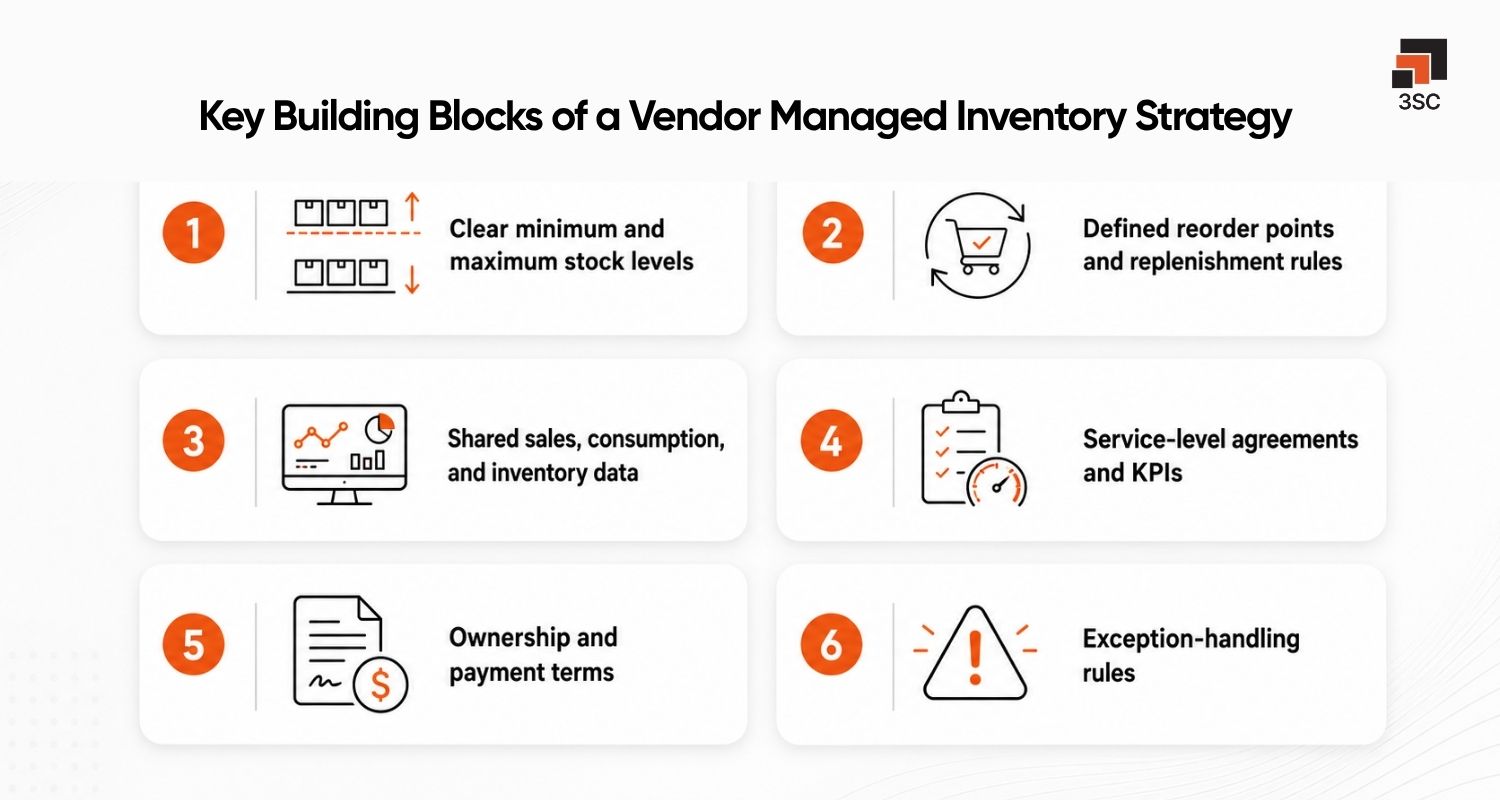
A well-designed VMI programme typically includes:
- Clear minimum and maximum stock levels - Establish defined inventory boundaries that guide supplier action and help prevent both stockouts and excess stock.
- Defined reorder points and replenishment rules - Set agreed triggers for when inventory should be replenished, reducing manual follow-ups and improving response time.
- Shared sales, consumption, and inventory data - Provide vendors with timely visibility into demand patterns and stock movement so replenishment decisions are based on actual usage.
- Service-level agreements and KPIs - Define measurable performance expectations, such as fill rates, on-time delivery, inventory turnover, and forecast accuracy, to keep both parties accountable.
- Ownership and payment terms - Clarify when inventory ownership transfers and how invoicing will be managed, ensuring financial responsibilities are understood from the start.
- Exception-handling rules - Create clear protocols for managing unusual situations, such as sudden demand spikes, supply delays, stock discrepancies, or system outages.
In this sense, VMI functions less like an inventory policy and more like a shared operating framework between buyer and supplier.
How Vendor Managed Inventory (VMI) Works: Step by Step
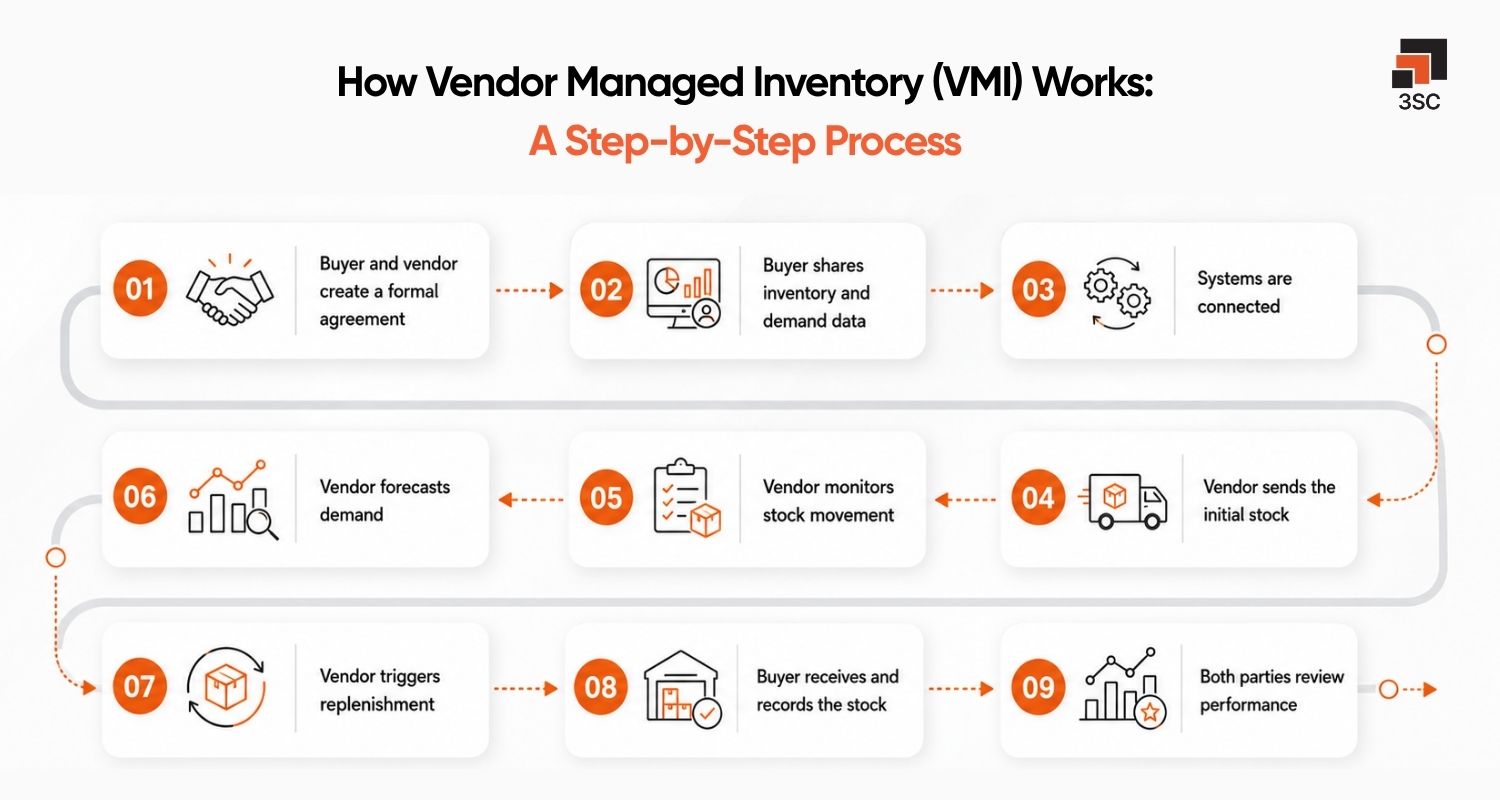
VMI operates as a continuous data and replenishment loop. Here is how it typically unfolds:
- Buyer and vendor create a formal agreement - Both sides align on roles, responsibilities, inventory ownership, payment terms, service levels, stock thresholds, and the performance metrics that will govern the relationship.
- Buyer shares inventory and demand data - The buyer provides the supplier with access to current stock levels, sales history, usage patterns, forecasts, and upcoming promotional or seasonal plans.
- Systems are connected - Data flows securely between the two parties through ERP integrations, EDI, APIs, shared dashboards, or dedicated vendor portals, ensuring the supplier always has an accurate, up-to-date picture.
- Vendor sends the initial stock - The supplier provides the opening inventory based on agreed forecasts and target stock levels, establishing the baseline from which replenishment will be managed.
- Vendor monitors stock movement - Using live data from the buyer's systems, the supplier continuously tracks consumption, sales velocity, current stock levels, and any emerging demand shifts.
- Vendor forecasts demand - Drawing on historical data, real-time sales signals, seasonality, and lead times, the vendor builds a forward-looking view of inventory requirements.
- Vendor triggers replenishment - When inventory reaches the agreed reorder point, the supplier dispatches the required stock without waiting for a manual purchase order from the buyer.
- Buyer receives and records the stock - The buyer accepts, scans, and stores the incoming inventory, updating records to keep the shared data accurate and the replenishment loop reliable.
- Both parties’ review performance - Buyer and supplier meet regularly to assess KPIs, identify gaps, and make adjustments to replenishment rules, forecasting models, or data-sharing processes.
The cycle works best when data is accurate, rules are unambiguous, and both teams are committed to continuous improvement.
Why Businesses Use Vendor Managed Inventory (VMI): Key Benefits
The appeal of VMI lies in its ability to remove the daily friction of manual inventory management. When implemented well, replenishment becomes predictable rather than reactive.
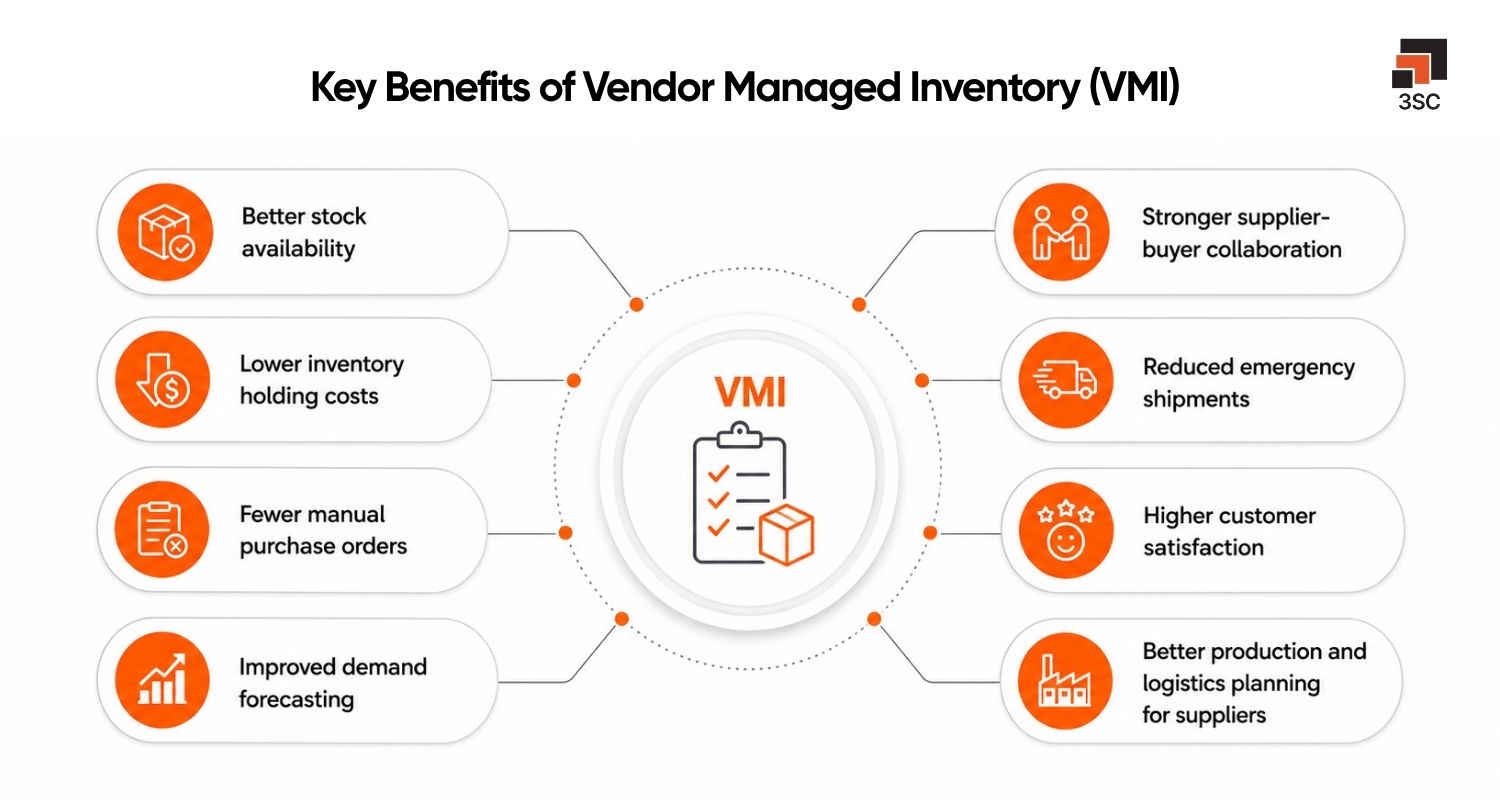
- Better stock availability - Because suppliers have direct visibility into real-time demand and consumption, they can initiate replenishment before stock reaches critical levels, significantly reducing the frequency of stockouts.
- Lower inventory holding costs - VMI eliminates the need for excessive safety stock by enabling more precise replenishment, which in turn reduces warehouse space requirements, insurance costs, and capital tied up in slow-moving inventory.
- Fewer manual purchase orders - With the supplier managing replenishment triggers, procurement teams are freed from the repetitive cycle of checking stock, raising orders, securing approvals, and following up on deliveries.
- Improved demand forecasting - Suppliers gain access to actual consumption data rather than aggregated order history, enabling more accurate production planning, better capacity utilisation, and fewer supply-side disruptions.
- Stronger supplier-buyer collaboration - The relationship evolves from transactional to strategic, with both parties working toward shared performance goals and developing a deeper understanding of each other's operational constraints.
- Reduced emergency shipments - More accurate planning and earlier replenishment signals mean fewer urgent freight requirements, last-minute orders, and the premium costs that come with expedited delivery.
- Higher customer satisfaction - When the right products are available at the right time, end customers experience fewer delays, substitutions, or service failures, strengthening the buyer's ability to meet its own commitments.
- Better production and logistics planning for suppliers - With reliable, forward-looking demand data, vendors can optimise batch sizes, transportation schedules, and production capacity rather than reacting to unpredictable order patterns.
Together, these benefits show why VMI is not just an inventory shortcut, but a smarter way to align supply, demand, and supplier collaboration for more reliable business performance.
When Should You Use Vendor Managed Inventory?
VMI works best when the product, supplier, and business environment are suited to collaborative replenishment. Consider VMI when:
- Demand is relatively stable and forecastable
- Products move frequently and replenishment is a recurring operational need
- Stock availability is directly tied to revenue, production continuity, or service quality
- You have supplier partners with the reliability, communication, and technical capability to manage replenishment effectively
- Reducing manual procurement workload is a meaningful operational goal
- Inventory data is clean, consistent, and accessible
- You operate in a sector where stockouts carry significant downstream consequences
VMI is particularly well-suited to retail, FMCG, manufacturing, healthcare, automotive, electronics, and e-commerce. A supermarket restocking high-turnover consumer goods, a manufacturing plant managing component or packaging supply, and a hospital maintaining critical medical inventory are all strong candidates for the model.
When Vendor Managed Inventory (VMI) May Not Be the Right Fit
VMI is a powerful model, but it is not universally applicable. It may not be the right choice when:
- Demand is highly volatile or difficult to forecast with any consistency
- Products are custom-made, limited edition, or subject to frequent specification changes
- Inventory volumes are low enough that the overhead of a VMI programme outweighs the benefit
- The supplier lacks the technical maturity or integration capability required for reliable data sharing
- The buyer requires granular control over every individual purchasing decision
- Inventory data is inaccurate, incomplete, or spread across disconnected systems
- Frequent changes to product design, packaging, or specifications make standardised replenishment rules impractical
In these situations, the complexity introduced by VMI may exceed the value it delivers. The best approach is to identify the specific categories where VMI can produce clear, measurable results and start there.
VMI vs. Consignment vs. Co-Managed Inventory: Key Differences
VMI is often confused with consignment and co-managed inventory. While these models may overlap in practice, they serve distinct purposes:
Inventory model | Who manages replenishment? | Who owns the inventory? | When does payment usually happen? | Best use case |
|---|---|---|---|---|
Vendor Managed Inventory (VMI) | Supplier manages replenishment based on buyer data | Buyer typically owns stock after delivery or receipt | On shipment, receipt, or agreed payment terms | High-volume products with predictable, recurring demand |
Consignment inventory | Supplier may monitor or manage stock | Supplier retains ownership until goods are sold or consumed | After sale or consumption | High-value or slow-moving goods where the buyer wants to reduce financial exposure |
Co-managed inventory | Buyer and supplier jointly manage replenishment decisions | Determined by contract terms | Based on agreed milestones or ownership triggers | Variable-demand products where the buyer wants shared planning control |
VMI is the right model when the primary objective is replenishment efficiency. Consignment suits situations where inventory ownership risk and cash flow are the main concerns. Co-managed inventory is appropriate when both parties need to remain actively involved in planning and neither wants to cede full control.
Risks and Challenges of Vendor Managed Inventory
VMI can deliver strong results, but only when the foundation is solid. Poor execution introduces risks that can undermine the model's value:
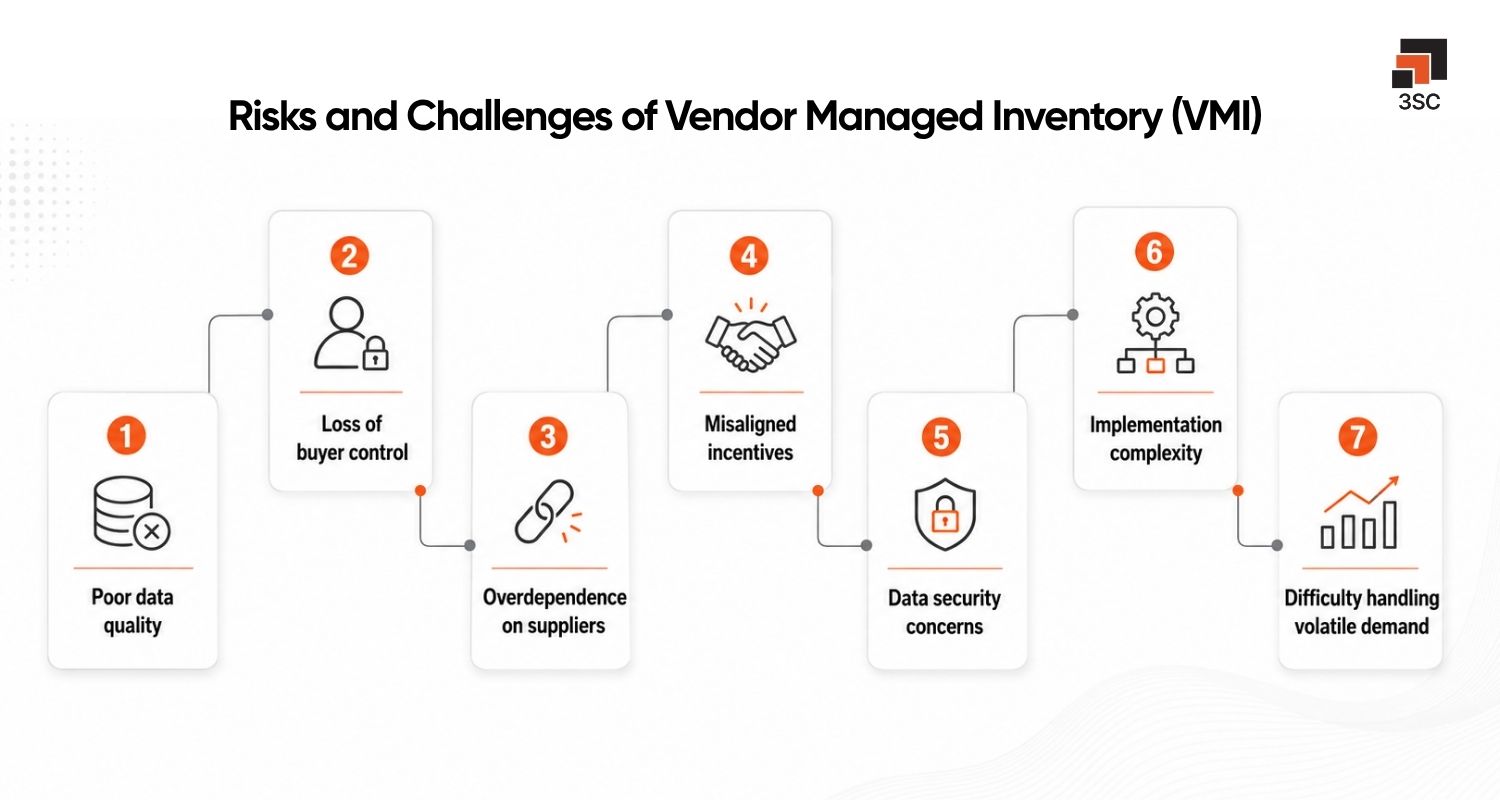
- Poor data quality - Inaccurate stock counts, delayed sales feeds, mismatched SKUs, or inconsistent units of measure can lead to flawed replenishment decisions that result in overstocking, shortages, or both.
- Loss of buyer control - Some organisations find it difficult to relinquish direct oversight of replenishment frequency and order quantities, particularly where purchasing decisions carry significant financial or compliance implications.
- Overdependence on suppliers - If the vendor encounters capacity constraints, delivery disruptions, or system failures, the buyer's operations can be directly affected with little buffer time to respond.
- Misaligned incentives - If the supplier's commercial incentives are tied to shipment volumes rather than balanced inventory performance, they may be motivated to overstock the buyer in ways that serve their own interests.
- Data security concerns - VMI requires the buyer to share sensitive sales, inventory, and demand data, which must be protected through secure integration protocols, appropriate access controls, and well-defined data governance policies.
- Implementation complexity - System integration, process redesign, staff training, and supplier onboarding all require time, investment, and careful change management, particularly in the early stages.
- Difficulty handling volatile demand - When demand shifts sharply and unpredictably, the replenishment rules underpinning VMI may require constant recalibration to remain effective.
The most effective way to manage these risks is through clearly defined SLAs, transparent performance dashboards, secure data-sharing infrastructure, and a regular joint review cadence with the supplier.
How to Implement Vendor Managed Inventory Successfully
A successful VMI programme should start with a focused pilot, prove its value, and then scale deliberately:
- Identify the right products - Begin with SKUs that have stable demand, high movement frequency, meaningful cost impact, or a strong business case for improved availability.
- Choose the right supplier - Select a partner with a track record of reliable delivery, strong communication, forecasting capability, and the technical readiness to integrate systems effectively.
- Clean your inventory data - Audit item masters, stock records, barcodes, units of measure, lead times, and location data before the programme goes live. Accurate data is the foundation everything else depends on.
- Define goals and KPIs - Establish clear targets for fill rate, stockout frequency, inventory turnover, on-time delivery, forecast accuracy, and carrying cost reduction from the outset.
- Create a clear VMI agreement - Document ownership terms, min/max levels, reorder rules, payment terms, exception-handling protocols, data access rights, and review cadence in a formal agreement signed by both parties.
- Integrate systems and data flows - Use ERP integration, EDI, APIs, or dedicated inventory management tools to establish secure, accurate, and timely data sharing between buyer and supplier.
- Run a pilot programme - Start with one supplier, one product category, or one location. Track results closely against baseline metrics for a defined period before drawing conclusions.
- Review and improve - Assess performance honestly. Address data gaps, adjust replenishment parameters, and refine communication protocols based on what the pilot reveals.
- Scale gradually - Once the pilot demonstrates consistent results, expand VMI to additional SKUs, locations, suppliers, or business units with a structured rollout plan.
The objective is not to launch VMI everywhere at once, but to build a model that works reliably and then grow it with confidence.
Conclusion: Is Vendor Managed Inventory Right for Your Business?
VMI works when inventory stops being treated as one party's problem. When buyers and suppliers share data openly, operate within clearly defined rules, and hold each other accountable for outcomes, the result is a replenishment system that keeps shelves stocked, warehouses lean, production lines running, and customers consistently well-served.
But VMI requires the right conditions to succeed. Clean data, reliable systems, well-structured contracts, secure information sharing, and genuine supplier collaboration are not optional; they are the prerequisites. Without them, VMI adds complexity rather than control.
For businesses that are ready to make that shift, VMI can transform inventory management from a constant operational challenge into a coordinated, efficient, and resilient process.
Build a Smarter Inventory Network with 3SC
VMI delivers the best outcomes when planning, visibility, execution, supplier collaboration, and exception management work together. 3SC helps businesses build that connected layer across demand planning, supply planning, inventory optimisation, control tower visibility, supplier collaboration, execution monitoring, and AI-powered decision support.
Whether you are exploring Vendor Managed Inventory or looking to reduce stockouts, excess inventory, and manual replenishment effort, 3SC can help you design a smarter, more connected supply chain operating model.