Key Takeaways
- The conflict between US-Israel against Iran quickly disrupted global energy and trade routes.
- The Strait of Hormuz became a major risk point for oil supply.
- Rising oil prices increased global transportation costs.
- Shipping reroutes and air cargo disruptions slowed logistics networks.
- Supply chains now need stronger resilience and diversification.
In late February 2026, tensions in the Middle East escalated after the United States and Israel launched coordinated military strikes against Iran. The attacks targeted several military and nuclear-related facilities, triggering retaliatory actions across the region.
While the conflict was primarily political and military, its economic effects began to appear almost immediately. This is largely because the Middle East plays a critical role in global trade and energy supply. The Persian Gulf, in particular, is one of the most important regions for global energy exports and shipping routes.
As tensions between Iran and the U.S.–Israel alliance intensified, disruptions to oil flows, maritime transport, and logistics networks began affecting global supply chains. The reason these disruptions spread so quickly lies in the region’s central role in global energy and trade routes.
Why a Regional Conflict Quickly Became a Global Supply Chain Problem?
For many people, war in the Middle East can seem distant, something discussed in diplomatic briefings or seen on news broadcasts. For global supply chains, however, the effects appear much faster. The region sits at the centre of the world’s energy flows and major maritime trade routes, meaning disruptions there can quickly spread across global markets.
Within days of the escalation, oil prices began rising, cargo flights were suspended across parts of the region, and shipping companies started rerouting vessels. What emerged was not just a regional crisis but a disruption to the infrastructure that supports global trade.
To understand why the conflict had such immediate economic consequences, it is important to look at one critical chokepoint in the global energy system — the Strait of Hormuz.
The Strait That Carries the World’s Energy
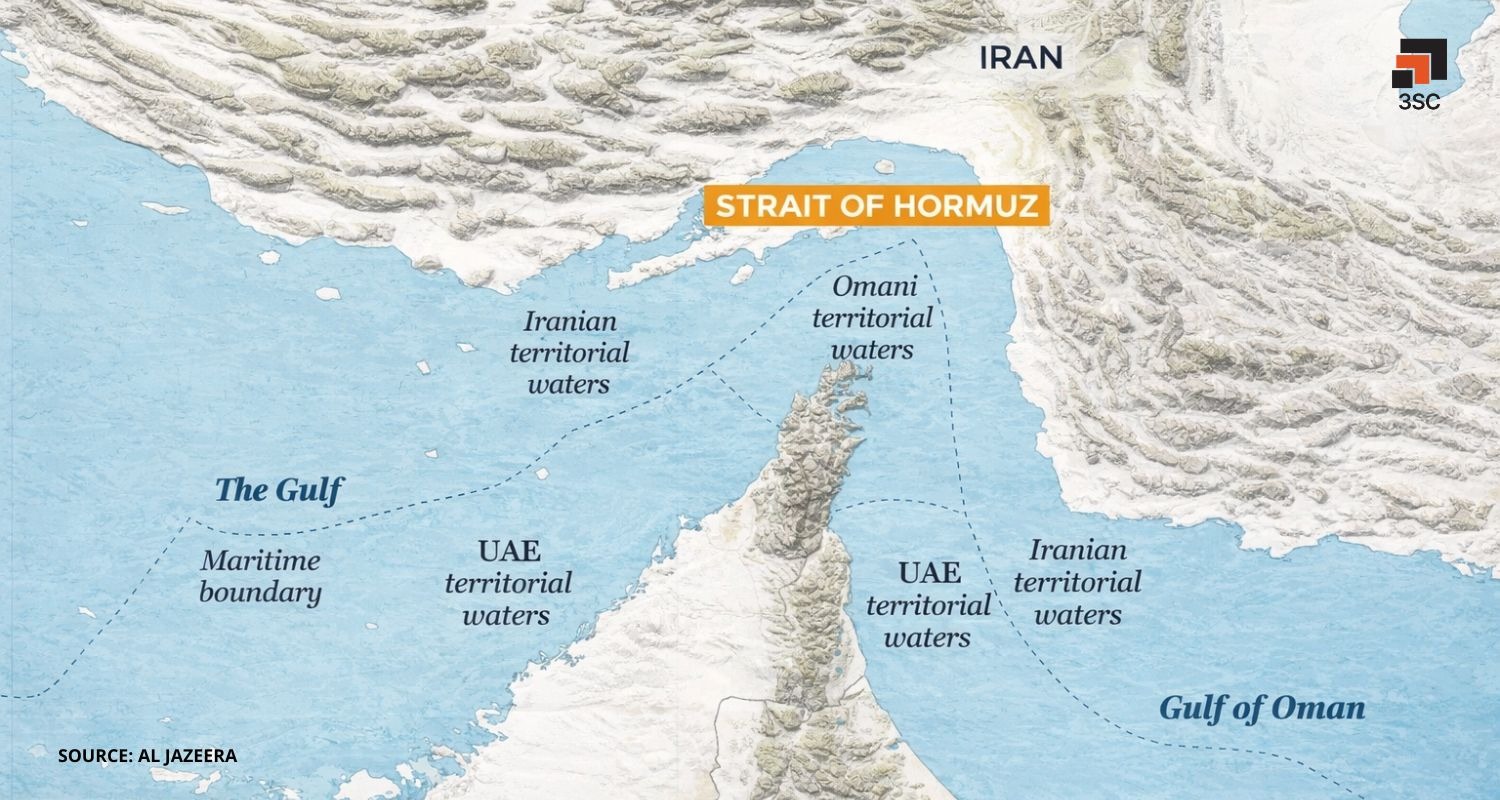
If global trade had a single pressure point, it would be the Strait of Hormuz. This narrow channel, located between Iran and the Arabian Peninsula, connects the Persian Gulf with international shipping lanes. Despite its small size, it carries an enormous share of the world’s energy supply. According to the U.S. Energy Information Administration, roughly 20% of global seaborne crude oil and petroleum liquids move through the strait every day. In addition, about 20% of global liquefied natural gas shipments and nearly one-third of global urea fertilizer trade pass through this corridor.

When tensions escalated in February, the risk of disruption to this route quickly became the biggest concern for global markets. Even before any official closure, the threat alone caused tanker traffic to collapse. Data from maritime tracking services showed that vessel movements through the strait dropped sharply, leaving over 150 ships waiting outside the corridor as security risks intensified.
For energy traders and governments, the implications were clear. The majority of oil exports from Saudi Arabia, Iraq, Kuwait, Qatar, and the United Arab Emirates rely on this passage. If shipments slowed or stopped, global fuel markets would feel the shock almost immediately. That fear quickly translated into rising oil prices.
Major Economies Most Exposed to Strait of Hormuz Energy Disruptions
According to Discovery Alert, the following economies demonstrate the highest exposure to Strait of Hormuz closure disruptions due to geographical distance and concentrated import dependencies:
Country | Hormuz Import Dependency | Alternative Sources | Strategic Reserves |
Japan | 80% of energy imports | Limited Pacific Basin supply | 150+ million barrels |
South Korea | 70% of oil supplies | Minimal alternative capacity | Regional coordination required |
India | 60% of crude imports | Domestic production insufficient | Limited strategic capacity |
China | 40% of oil requirements | Domestic/Russian alternatives | 500+ million barrels estimated |
Oil Markets React Within Hours
Energy markets typically respond quickly to geopolitical tensions, and the escalation of this conflict was no exception. Within days of the first military strikes, oil prices rose sharply as traders began pricing in the risk of disruptions to Middle Eastern energy supplies. Brent crude climbed significantly during the early stages of the conflict, reflecting concerns that instability in the Persian Gulf could interrupt shipments from some of the world’s largest oil exporters. Because so much of the world’s energy passes through this region, markets tend to react quickly to any disruption.
When Ships Take the Long Way Around the World
As security risks increased in the Persian Gulf, shipping companies faced difficult operational decisions. Although vessels could technically pass through the Strait of Hormuz, the threat of missile attacks, drones, and military activity created significant risks for crews and cargo. As a result, some shipping companies began slowing traffic through the region, while others chose to suspend certain routes entirely.
Air Cargo Networks Face Their Own Crisis
Although less than 1% of global freight moves by air, it accounts for nearly 35% of the total value of global trade because it transports high-value and time-sensitive goods such as pharmaceuticals, electronics, and medical equipment.
The Middle East also plays an important role in global air cargo networks. Airports such as Dubai and Doha function as major logistics hubs connecting trade flows between Asia, Europe, and Africa. As the conflict intensified, airspace restrictions and security concerns forced airlines to reroute flights or suspend services across parts of the region. Several cargo carriers temporarily halted operations to certain destinations as conditions remained uncertain. These disruptions affected global air freight capacity, particularly for routes that rely on Middle Eastern hubs as transit points.
What these Disruptions Mean for Businesses
While the conflict is geographically concentrated in the Middle East, the effects extend far beyond the region. Businesses across industries are already experiencing operational challenges as disruptions ripple through global logistics and energy markets.

1. Rising Raw Material and Energy Costs
One of the most immediate effects of the conflict is the increase in global energy prices. Higher oil prices raise transportation costs across shipping, aviation, and road freight networks.
Beyond fuel, energy prices also affect a wide range of industrial inputs. Petrochemical products, plastics, fertilizers, and other materials derived from oil and natural gas may become more expensive. For manufacturers and producers, these rising input costs can place significant pressure on profit margins.
2. Longer and Less Predictable Delivery Times
Shipping reroutes and airspace disruptions can extend transit times across international trade routes. When vessels travel longer distances or flights are forced to reroute, shipments take longer to reach their destinations. For businesses operating on tight production schedules, these delays can create uncertainty around delivery timelines. Supply chain planning becomes more difficult when shipping schedules become less predictable.
3. Inventory Shortages and Stockouts
Many industries operate with lean inventory models designed to minimize storage costs. However, these systems rely on steady and predictable logistics flows. When shipments are delayed, companies may face shortages of key components or raw materials. Manufacturers may be forced to slow production, while retailers and distributors could experience product stockouts. When products are unavailable for customers to buy, businesses not only risk losing immediate sales but may also face increased pressure on margins as revenue is delayed and operational costs continue to accumulate.
4. Rising Freight and Logistics Costs
Longer shipping routes and reduced transportation capacity can increase global freight rates. When vessels spend more time at sea and airlines adjust routes, the available capacity across global transport networks becomes tighter. Businesses moving goods across international supply chains may therefore face higher logistics costs, which can affect overall operational budgets.
5. Increased Supply Chain Uncertainty
Geopolitical disruptions introduce new levels of uncertainty into supply chain planning. Companies may find it harder to forecast transportation costs, delivery timelines, and supply availability. This uncertainty complicates procurement planning, inventory management, and production scheduling across many industries.
As these disruptions ripple across global trade networks, businesses must move beyond reacting to short-term shocks and begin strengthening their supply chains for a more uncertain geopolitical environment.
How Businesses Must Respond to these Supply Chain Disruptions
As geopolitical risks increasingly affect global trade corridors, businesses must adapt their supply chain strategies to operate in a more uncertain environment.

1. Diversify Supplier and Sourcing Networks
Relying heavily on suppliers in a single region increases exposure to geopolitical disruptions. Businesses must consider diversifying sourcing networks across multiple countries to reduce supply risks. This includes strategies such as nearshoring, where companies move supply chains closer to end markets, and friendshoring, where sourcing is shifted toward politically aligned or stable partner countries. Establishing relationships with alternative suppliers in different regions can help ensure continuity if one location becomes inaccessible. A geographically diversified supplier base also allows companies to shift procurement quickly when trade routes or regional stability change.
2. Build Strategic Inventory Buffers
Maintaining slightly higher inventory levels for critical materials can provide a buffer against temporary disruptions. Strategic stock reserves help businesses continue operations even when shipments are delayed. In practice, this means shifting slightly from purely just-in-time models toward limited “just-in-case” inventory for critical inputs. While excess inventory increases holding costs, carefully planned buffers for essential components can prevent costly production shutdowns. Businesses should identify which inputs are most vulnerable to disruption and prioritize safety stock for those materials.
3. Develop Alternative Logistics Routes
Businesses must work with logistics partners to identify alternative shipping routes and transportation options. Having backup logistics plans allows shipments to be redirected quickly when primary routes are disrupted. This may include identifying secondary ports, alternative transit corridors, or multimodal transport options. Planning these contingencies in advance helps businesses respond faster when geopolitical events affect key trade routes.
4. Invest in Supply Chain Visibility
Real-time tracking technologies and data-driven monitoring tools help businesses detect disruptions earlier. Improved visibility across logistics networks enables faster decision-making and response. Advanced supply chain monitoring systems can integrate shipping data, geopolitical risk indicators, and logistics analytics to identify emerging disruptions. Greater end to end supply chain visibility also improves coordination between procurement, logistics, and operations teams.
5. Strengthen Collaboration with Supply Chain Partners
Strong relationships with logistics providers, freight forwarders, and supply chain experts can help businesses navigate disruptions more effectively. Collaborative planning improves flexibility when global transport conditions change. Strategic partnerships allow companies to access market intelligence, secure transport capacity, and adjust routing strategies more quickly. Working closely with experienced logistics partners can significantly improve a company’s ability to respond to unexpected disruptions.
While these strategies can help businesses manage short-term disruptions, the broader lesson from this conflict is that geopolitical risks are becoming a permanent feature of global supply chains.
Conclusion
For businesses operating in globally connected markets, disruptions like these highlights how fragile critical trade infrastructure can be. When energy corridors, shipping lanes, or logistics hubs face instability, the effects quickly extend into procurement costs, production planning, and delivery timelines across industries.
As geopolitical risks increasingly shape the global trade environment, supply chain resilience must become a core strategic priority. Companies that diversify sourcing, strengthen logistics flexibility, and invest in greater supply chain visibility will be better positioned to maintain stability when disruptions occur. In an uncertain world, the ability to adapt quickly is becoming just as important as the ability to operate efficiently.