As manufacturing networks expand across Southeast Asia, supply chain success depends on more than adding production capacity. Organizations need connected planning, real-time operational visibility, and stronger coordination across suppliers, plants, logistics partners, warehouses, and customs processes. By integrating planning with execution and standardizing governance across the regional network, manufacturers can improve service reliability, reduce delays, optimize inventory, and respond faster to cross-border disruptions.
Key Takeaways
- Southeast Asia's manufacturing rise is no longer only sourcing; it is becoming a network-design issue for industrial supply chains.
- Vietnam, Thailand, Indonesia, Malaysia, and the Philippines each add capacity, but they also add customs, port, inland transport, and supplier-management complexity.
- For 2026, resilience will depend less on adding more suppliers and more on governing execution across countries, lanes, brokers, and inventory nodes.
- Regional control towers, customs visibility, plant logistics discipline, and 4PL orchestration can help leaders convert fragmented growth into reliable service.
- The future advantage will belong to supply chains that can balance cost control with fast exception management, compliant cross-border movement, and scenario-based planning.
For decades, manufacturers optimized supply chains by concentrating production in a few strategic locations. Today, that model is evolving. As companies diversify manufacturing to improve resilience, reduce geopolitical risk, and serve growing regional markets, Southeast Asia has emerged as one of the world's most important industrial growth corridors. According to Deloitte's Asia's Growth Story report, ASEAN continues to strengthen its position as a global manufacturing hub through expanding industrial capacity, digital supply chains, and regional investment.
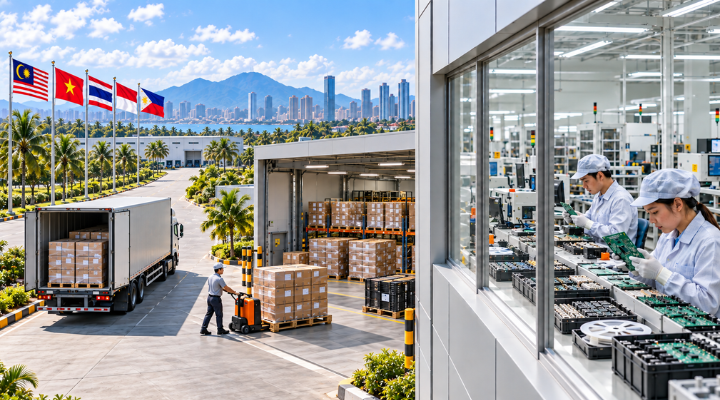
Vietnam, Thailand, Indonesia, Malaysia, and the Philippines continue to attract investment across industrial machinery, automotive, electronics, chemicals, and engineered products. While this expansion creates new opportunities for growth, it also increases the complexity of managing suppliers, factories, warehouses, transportation providers, ports, and customs authorities across multiple countries.
For industrial supply chain leaders, the challenge in 2026 is no longer deciding where to manufacture. The greater challenge is ensuring that every movement of materials, inventory, and finished goods is synchronized across an interconnected regional network. Competitive advantage is shifting from production capacity alone to the ability to execute reliably across borders.
Manufacturing Expansion Is Redefining Regional Operations
Expanding manufacturing into Southeast Asia provides greater sourcing flexibility, improved access to regional markets, and reduced dependency on a single production base. However, each additional manufacturing location introduces new operational dependencies that extend far beyond the factory floor.
Instead of managing a single-country supply chain, organizations must align suppliers, transportation networks, customs agencies, distribution centres, and logistics partners operating under different regulations, infrastructure capabilities, and service standards.
As manufacturing footprints expand, industrial leaders must now balance five things at once: supplier diversification without adding procurement complexity, regional inventory positioning against working capital, multi-modal transport across road, rail, sea, and air, country-specific compliance timelines, and steady performance across dispersed facilities.
The objective is no longer to optimize individual sites. It is to ensure that the entire regional operation performs as one unified system.
Cross-Border Execution Is Becoming a Competitive Differentiator
Production schedules depend on more than manufacturing efficiency: components, raw materials, and finished products must move predictably across borders, often through multiple logistics providers, customs checkpoints, and distribution hubs. Even minor delays in documentation, customs clearance, or transportation can affect production sequencing, inventory availability, customer deliveries, and operating costs across multiple facilities.
To maintain reliable operations, industrial organizations need greater control over cross-border execution. Key areas requiring continuous monitoring include customs documentation to prevent avoidable clearance delays, border and port movements to identify congestion before it affects production, carrier performance to improve delivery reliability across countries, inventory in transit to align material availability with production schedules, and operational exceptions so disruptions can be resolved before they escalate.
Managing these activities independently often creates fragmented decision-making. As manufacturing networks expand, organizations need a way to link operational data across procurement, logistics, manufacturing, and distribution, the visibility gap that regional control towers are built to close.
Regional Control Towers Enable Faster Operational Decisions
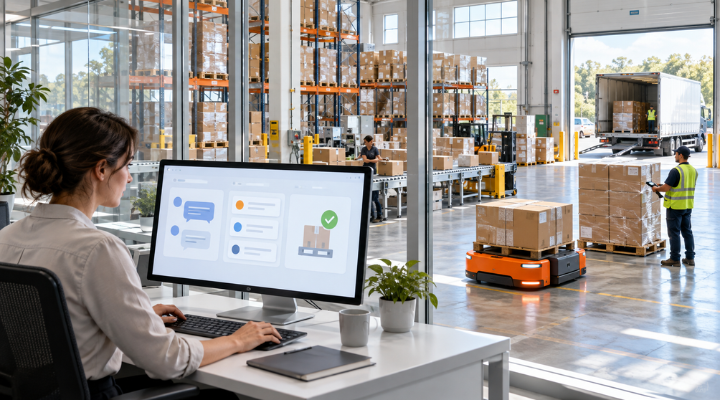
As industrial networks span multiple countries, operational visibility cannot remain limited to individual factories or transportation providers. Decision-makers need a consolidated view of how materials, inventory, production, and logistics interact across the entire region.
Rather than reacting to isolated disruptions, regional control towers enable organizations to understand how operational events affect customer commitments, production plans, and inventory availability in real time. A well-designed regional control tower helps organizations monitor end-to-end operations across suppliers, plants, warehouses, and transportation providers, detect disruptions early through automated exception monitoring, align cross-functional decisions using shared operational data, prioritize critical shipments based on production and customer requirements, and improve response times by enabling faster collaboration across teams.
This shift allows organizations to move beyond reactive issue management and toward proactive operational control. But visibility only pays off if it connects to how efficiently materials actually move into and out of manufacturing facilities.
Where Supply Chain Leaders Need Stronger Control
As supply chains become more regional and interconnected, leaders need greater visibility, coordination, and control across the functions that influence day-to-day execution.
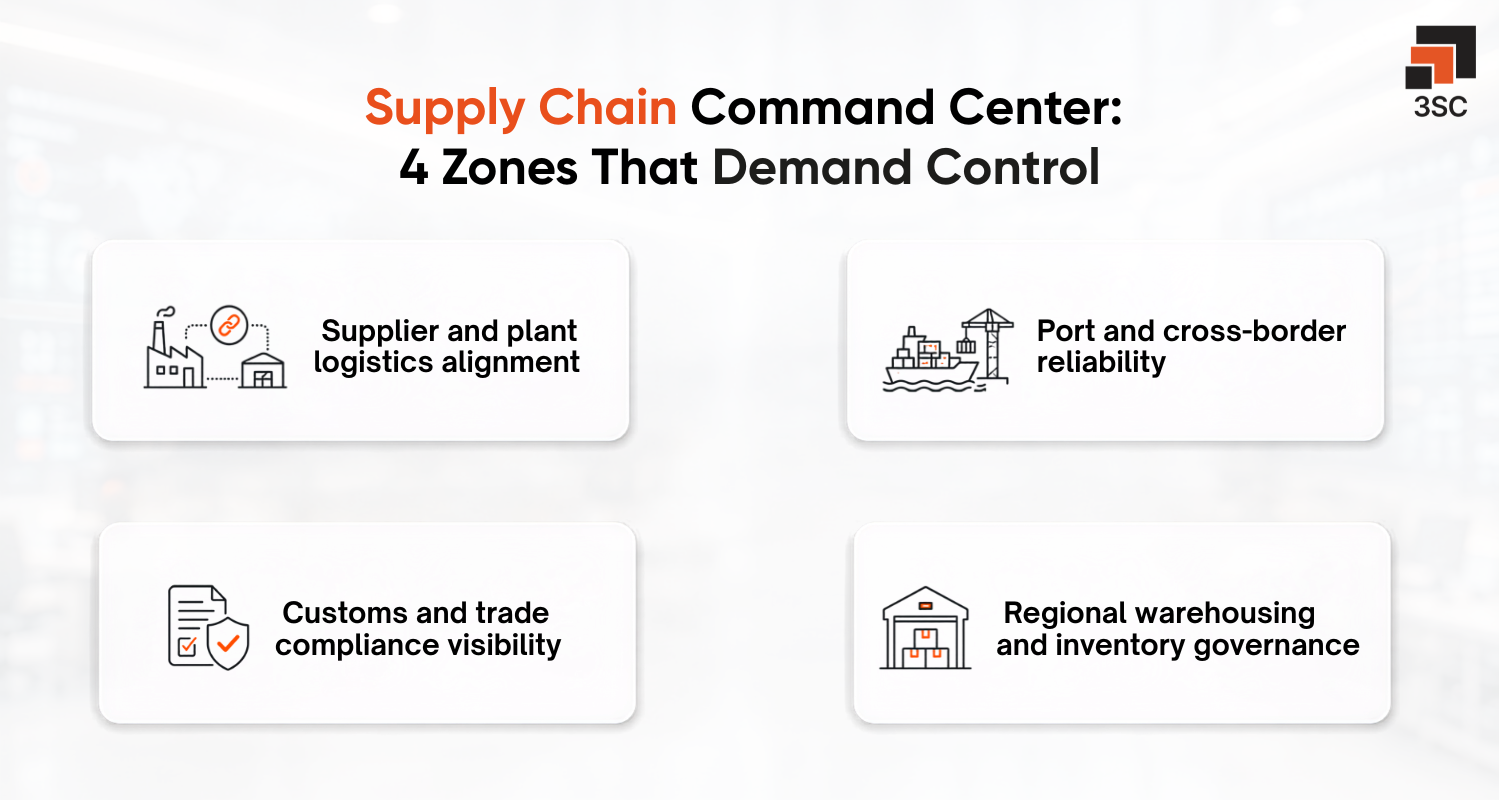
1. Supplier and plant logistics alignment
New manufacturing nodes create value only when supplier readiness, production schedules, inbound transport, and packaging flows are synchronised. Supply chain leaders need visibility into supplier capacity, cut-off times, material availability, and dock constraints. Without this alignment, the region's lower production cost can be offset by premium freight, missed production windows, and inventory buffers.
2. Port and cross-border reliability
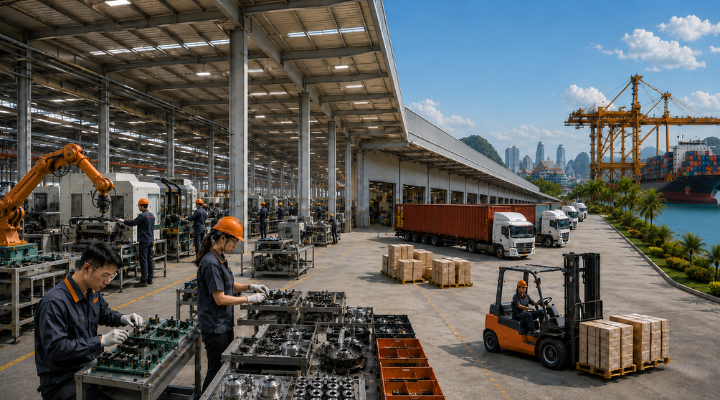
Southeast Asia's manufacturing map depends on ocean gateways, inland trucking, bonded movements, and cross-border corridors. Lead time variability often comes from handoffs rather than distance. Industrial supply chains need lane-level performance management that tracks dwell time, container availability, customs status, carrier reliability, and exception root causes.
3. Customs and trade compliance visibility
More regional movement means more classification, documentation, permit, country-of-origin, and broker-management risk. A customs delay can stop a line as quickly as a supplier failure. Centralised customs visibility helps teams identify missing documents, repeat exceptions, duty exposure, and clearance bottlenecks before they affect customer service.
4. Regional warehousing and inventory governance
Warehousing should not simply follow factory expansion. Leaders must decide where to hold raw materials, spare parts, semi-finished goods, and finished inventory based on service requirements, tax implications, customs regimes, demand volatility, and transport risk. Better inventory positioning reduces both stockouts and excess safety stock.
These four pressure points rarely fail in isolation. Fixing them one at a time treats symptoms; the more durable answer is to run plant logistics and customs as a single, connected system.
Plant Logistics and Customs Must Operate as One System
Regional manufacturing networks rely on a constant flow of materials between suppliers, warehouses, production facilities, and customers. While production efficiency often receives the most attention, day-to-day performance is equally dependent on how well logistics activities are coordinated before materials reach the factory floor.
When plant logistics and customs operate independently, even a small disruption can delay production, increase inventory costs, or affect customer commitments. Industrial leaders are therefore shifting toward integrated execution, where transportation, warehouse operations, customs processes, and production schedules are managed as part of the same operational workflow.
By treating plant logistics and customs as interconnected processes rather than separate functions, manufacturers reduce operational variability and build the foundation for more consistent execution across multiple countries.
Unified Regional Operations Create Better Business Outcomes
As manufacturing expands across Southeast Asia, the difference between high-performing and average-performing organizations is increasingly defined by how well they orchestrate operations, not simply where they manufacture.
Traditional Regional Operations | Connected Regional Operations |
|---|---|
Country-level planning | Region-wide operational planning |
Limited visibility across logistics partners | Shared operational view across suppliers, plants, warehouses, and carriers |
Reactive customs management | Proactive customs monitoring and early exception handling |
Independent plant logistics | Coordinated material movement across the regional network |
Siloed operational decisions | Cross-functional collaboration supported by real-time operational data |
The shift toward unified operations enables organizations to make faster decisions, improve service reliability, and reduce unnecessary costs without sacrificing operational flexibility.
Technology can surface the data, but execution quality ultimately comes down to how well organizations manage their logistics partners.
Stronger Partner Governance Improves Regional Execution
Industrial supply chains rarely rely on a single logistics provider. Most regional networks involve multiple transport companies, warehouse operators, customs brokers, freight forwarders, and local service partners operating across different countries.
While this ecosystem offers flexibility, it also introduces variability in service quality, communication, and operational performance. Without common governance, organizations often struggle to maintain steady execution across the region.
This does not mean replacing logistics providers, it means holding every partner to shared standards, which improves accountability and gives the network a steadier baseline of performance. The result is a supply chain better equipped to support long-term manufacturing growth while adapting to changing business conditions.
Looking Ahead: Regional Coordination Will Define Competitive Advantage
Manufacturing investment across Southeast Asia is expected to accelerate through the remainder of the decade as organizations continue to diversify production, strengthen regional supplier ecosystems, and expand access to fast-growing markets.
For industrial supply chain leaders, the opportunity extends beyond adding production capacity, it's building operating models that can orchestrate suppliers, factories, logistics partners, and distribution networks without adding complexity. Organizations that invest in unified planning and regional governance today will be better positioned to manage costs and respond to future disruptions.
The organizations that pull ahead won't be the ones with the most factories, they'll be the ones that treat execution as the core competency worth building.
3SC helps industrial manufacturers build connected, resilient regional supply chains by bringing planning and execution onto a unified platform. With capabilities including regional control towers, transportation management, warehouse and plant logistics, customs visibility, and end-to-end supply chain orchestration, 3SC enables organizations to monitor operations in real time, manage exceptions proactively, improve partner collaboration, and execute cross-border supply chains with greater control and consistency.