Route planning has evolved from simply finding the shortest path to continuously balancing cost, time, capacity, and service requirements. This blog explores the key types and benefits of route planning, the challenges of traditional approaches, and how AI, real-time data, and route optimization software are helping logistics teams improve transportation planning and execution.
Key Takeaways
- Route planning goes beyond finding the shortest route.
- Real-time optimization helps respond to changing conditions.
- Better routes can reduce costs and improve fleet utilization.
- AI is making route planning more dynamic and data driven.
- Visibility connects route planning with execution.
- Modern routing balances cost, service, capacity, and reliability.
If logistics can be reduced to one simple idea, it is moving goods from point A to point B at the right cost and within the required time. The challenge is that modern logistics rarely involves just one shipment or one fixed route.
A logistics operation may have hundreds of deliveries, multiple vehicles, different delivery windows, traffic conditions, vehicle constraints, tolls, driver availability, and last-minute changes to manage at the same time. A lane that looks efficient in the morning may no longer be the best option for a few hours later.
This is why route planning has moved beyond simply finding the shortest path. Modern logistics increasingly depends on continuously evaluating routes, resources, delivery priorities, and real-time conditions to keep execution on track.
Technology is also changing how transportation decisions are made. Machine learning, real-time tracking, and agentic AI are helping logistics teams identify issues earlier and respond faster.
In this article, we look at what route planning means, its benefits and types, the challenges of traditional approaches, and how technology is changing it in modern logistics.
What is Route Planning in Logistics?
Route planning is the process of deciding which deliveries should be made, in what sequence, by which vehicle, and along which route.
A good route plan considers more than distance. It can account for delivery time windows, vehicle capacity, traffic, road conditions, tolls, driver availability, service priorities, and depot locations.
The objective is to create a feasible route that balances cost, time, vehicle utilization, delivery commitments, and service levels.
This is also where route planning differs from route optimization. Route planning establishes the initial movement plan, while route optimization continuously looks for a better way to execute it as conditions change.
For example, if traffic builds up along a planned transit lane or a vehicle breaks down, an optimized system can evaluate the remaining deliveries and identify an alternative path or vehicle rather than relying on the original plan.
What are the Benefits of Route Planning?
Effective route planning can improve transportation performance across cost, service, resources, and execution.
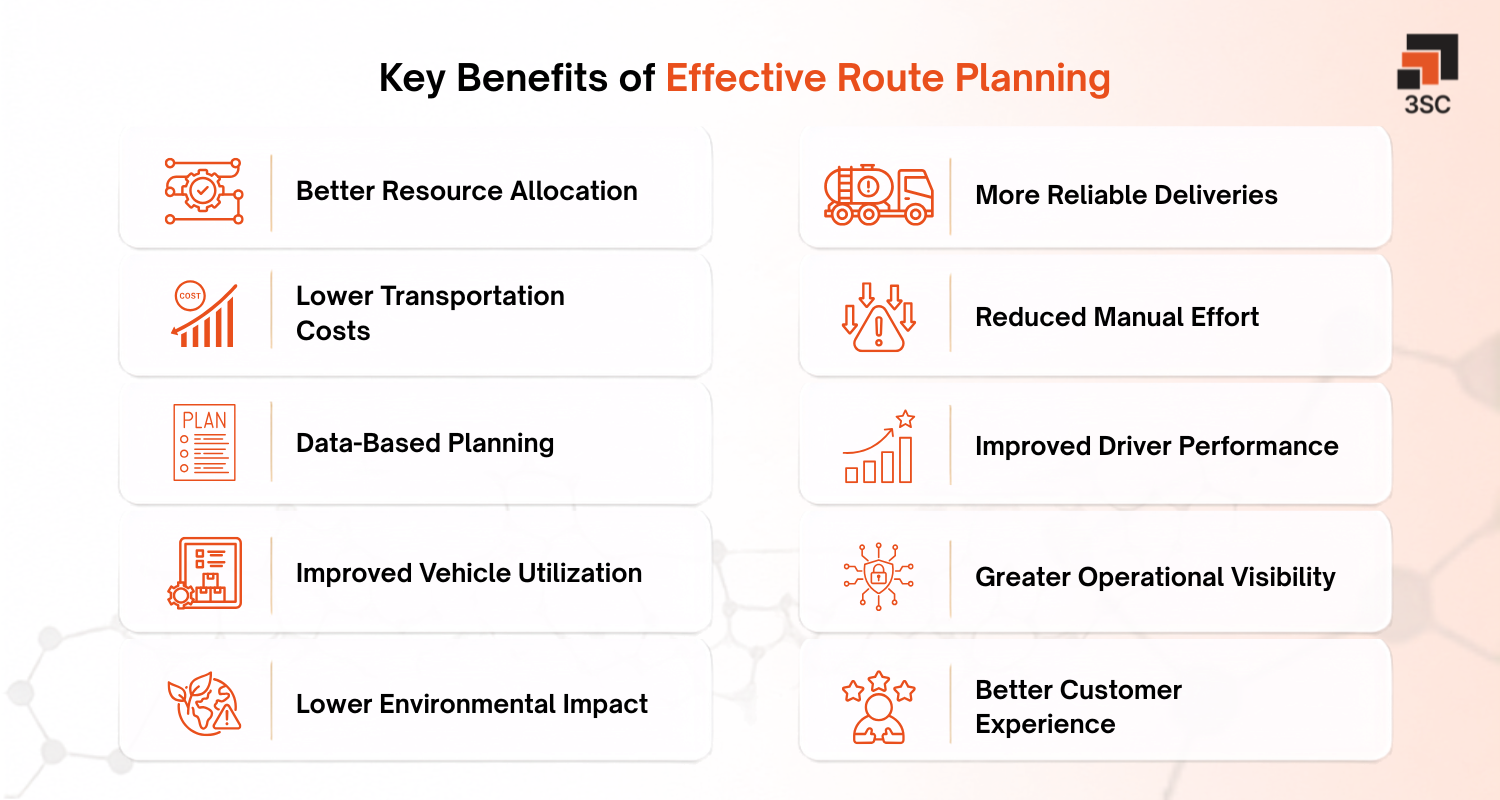
1. Better Resource Allocation
Route planning helps logistics teams assign the right vehicle and driver to the right set of deliveries based on location, vehicle capacity, availability, delivery priorities, and time windows.
This reduces unnecessary vehicle movement and helps organizations make better use of their existing fleet. When it is connected with real-time execution data, teams can also identify available vehicles nearby and respond faster when a route changes.
2. Lower Transportation Costs
Efficient route planning can reduce the number of kilometers travelled, fuel consumption, toll expenses, overtime, and unnecessary vehicle usage.
It can also improve load consolidation and vehicle utilization by grouping compatible deliveries into the same trip. Over time, these improvements across hundreds or thousands of deliveries can have a significant impact on transportation costs.
3. More Reliable Deliveries
A good route is not simply the shortest route. It also needs to account for delivery windows, traffic, loading and unloading times, vehicle restrictions, and customer priorities.
Considering these factors during planning helps logistics teams create more realistic delivery schedules and improve adherence to committed timelines.
4. Reduced Manual Effort
Planning multiple deliveries manually requires teams to compare locations, vehicle availability, capacity, delivery windows, traffic conditions, and other constraints.
As order volumes grow, this becomes increasingly time-consuming. Automated route planning can process these variables faster, generate feasible route options, and reduce repetitive planning work.
This allows logistics teams to spend more time managing exceptions and making operational decisions instead of repeatedly building routes from scratch.
5. Data-Based Planning
Modern route planning systems can use information from orders, vehicle locations, historical delivery times, traffic conditions, driver performance, and other operational data to improve planning decisions.
This helps logistics teams identify recurring delays, understand which routes perform better, and use actual operational data to improve future plans rather than relying only on assumptions or past experience.
6. Improved Vehicle Utilization
Poor planning can leave vehicles underloaded, create unnecessary trips, or result in vehicles returning empty.
Route optimization helps match shipments with available vehicle capacity and identify opportunities to consolidate deliveries. Better utilization can allow organizations to handle more deliveries without proportionately increasing fleet requirements.
7. Improved Driver Performance
Route planning can provide greater visibility into driver and transport performance, including adherence to planned routes, delivery timelines, idle time, delays, and kilometers travelled.
These insights can help identify recurring operational issues and distinguish between problems caused by route design, external conditions, or execution.
8. Greater Operational Visibility
When route planning is connected with real-time tracking, teams can compare the planned path with actual vehicle movement.
If a vehicle is delayed, deviates from its route, or is unlikely to meet a delivery window, teams can identify the issue earlier and take corrective action. This creates a stronger connection between transportation planning and execution.
9. Better Customer Experience
Accurate routes contribute to more reliable ETAs and better adherence to delivery commitments.
This is particularly important for businesses where customers expect visibility into their orders. When logistics teams can identify delays early and communicate changes, they can provide a more predictable delivery experience.
10. Lower Environmental Impact
Optimized routes can reduce unnecessary kilometers, fuel consumption, idle time, and empty vehicle movement.
For organizations working toward lower logistics emissions, route planning can therefore become part of a broader effort to improve transportation efficiency while reducing the environmental impact of delivery operations.
What are the Challenges of Traditional Route Planning?
Traditional approaches can work for relatively simple delivery networks. But as the number of orders, vehicles, constraints, and customer expectations increases, manual planning becomes harder to maintain.
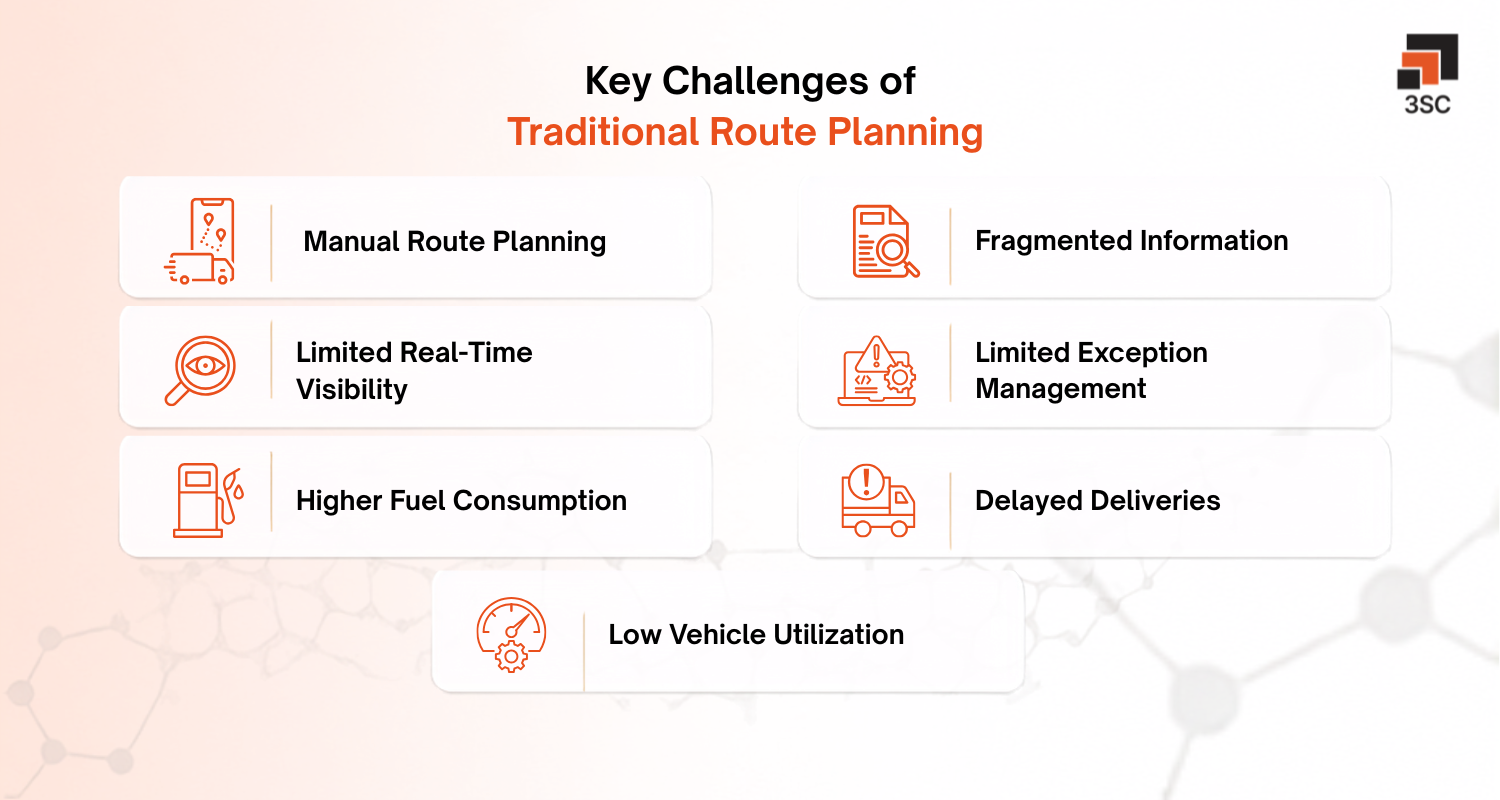
1. Manual Route Planning
As delivery volumes increase, manually creating routes becomes difficult because planners must evaluate multiple constraints at the same time.
A route that appears efficient on a map may not work in practice because of vehicle capacity, delivery windows, traffic, road restrictions, loading times, or driver availability.
2. Limited Real-Time Visibility
A route created at the beginning of the day may quickly become outdated when traffic, vehicle breakdowns, customer availability, or delivery delays change the operating conditions.
Without real-time visibility, planners may only become aware of the problem after it has already affected the next set of deliveries.
3. Higher Fuel Consumption
Poor sequencing and unnecessary kilometers can increase fuel consumption.
Repeated detours, inefficient vehicle allocation, and empty or partially loaded trips can further increase transportation costs without adding value to the delivery operation.
4. Delayed Deliveries
Static routes have limited ability to respond when conditions change.
A single delay at one stop can affect the rest of the route, creating a chain of missed delivery windows and inaccurate ETAs.
5. Low Vehicle Utilization
Without considering vehicle capacity and shipment characteristics together, companies may send multiple vehicles when deliveries could have been consolidated.
This increases fleet requirements and reduces the productivity of existing assets.
6. Fragmented Information
When order information, vehicle data, tracking information, delivery status, and transportation costs are maintained across different systems, planners have to spend additional time collecting and reconciling information before making decisions.
This can slow down response times and make it difficult to understand the complete transportation picture.
7. Limited Exception Management
Traditional planning often focuses on creating the initial route rather than managing what happens when the plan changes.
As a result, teams may spend significant time manually resolving disruptions instead of having the system identify, prioritize, and support the resolution of exceptions.
When Do You Need Route Planning Software?
The need for route planning software generally becomes clear when transportation operations become too complex to manage efficiently through spreadsheets, maps, or manual coordination.
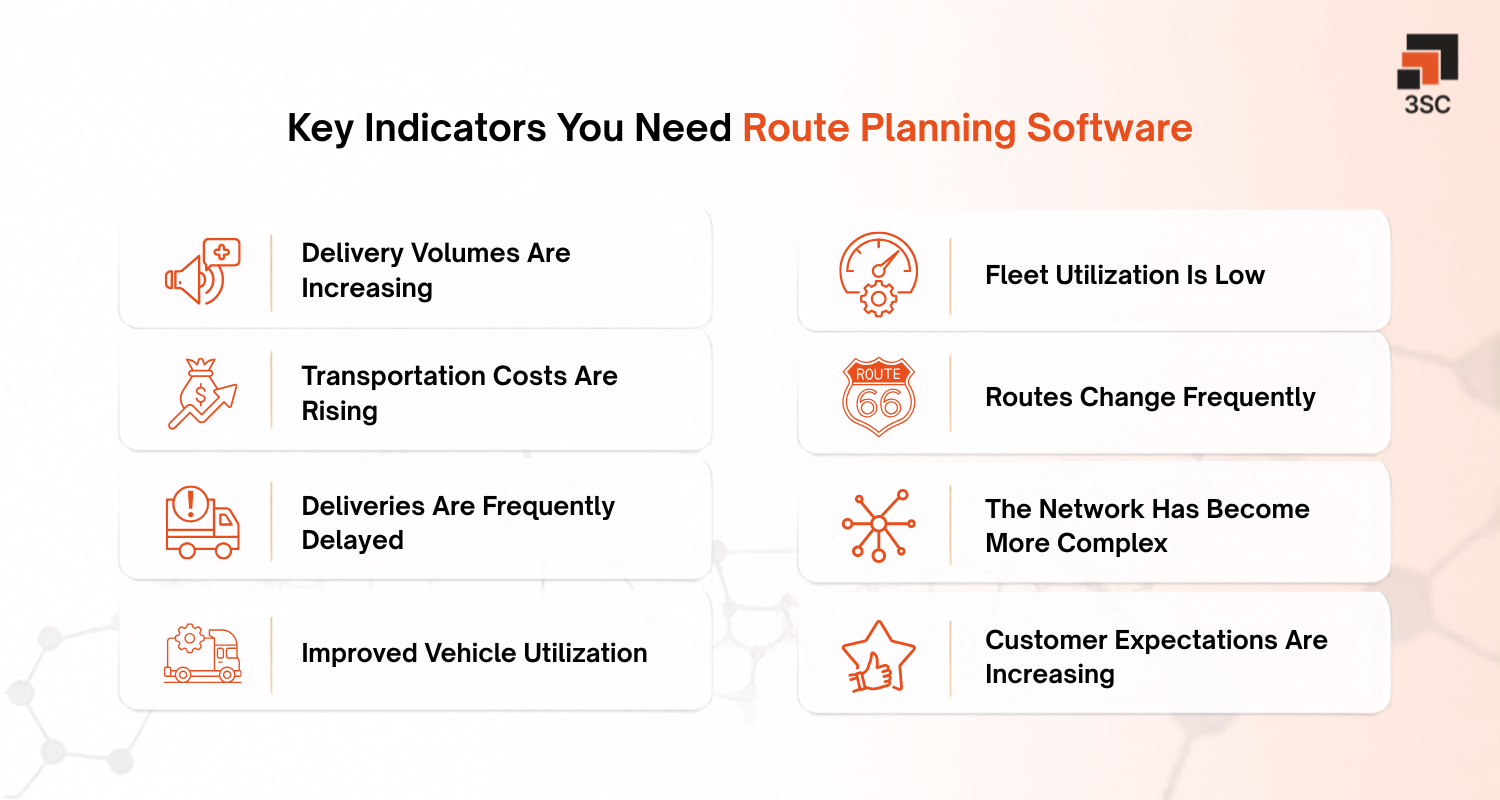
1. Delivery Volumes Are Increasing
If the number of daily deliveries has grown to a point where planners can no longer efficiently manage routes manually, route planning software can help process multiple delivery combinations and constraints at scale.
2. Transportation Costs Are Rising
Increasing fuel expenses, overtime, tolls, kilometers travelled, or fleet costs can indicate that routes and vehicle utilization need closer attention.
A route planning system can help identify where unnecessary kilometers, inefficient sequencing, or poor vehicle allocation are contributing to these costs.
3. Deliveries Are Frequently Delayed
If missed delivery windows and inaccurate ETAs are becoming common, organizations may need better route planning and real-time re-optimization rather than relying on fixed schedules.
4. Fleet Utilization Is Low
Frequent empty runs, underloaded vehicles, or unnecessary trips indicate that the organization may not be making optimal use of its available fleet.
Route planning software can help match shipments with vehicle capacity and identify opportunities for consolidation.
5. Operations Lack Real-Time Visibility
If planners cannot quickly identify where vehicles are, whether deliveries are on schedule, or which routes are facing disruption, connecting route planning with tracking and execution systems can address a major operational gap.
6. Routes Change Frequently
Businesses dealing with same-day orders, cancellations, urgent deliveries, traffic disruptions, or changing customer requirements need routing systems that can adjust plans rather than relying on static routes.
7. The Network Has Become More Complex
Multiple depots, vehicle types, delivery windows, service areas, customer priorities, and capacity constraints make manual route planning increasingly difficult.
Software becomes more valuable as the number of variables involved in each planning decision increases.
8. Customer Expectations Are Increasing
Tighter delivery windows and demand for accurate ETAs put greater pressure on logistics operations.
Route planning software can help organizations build more realistic schedules, monitor execution, and respond faster when actual conditions begin to differ from the original plan.
How is AI Changing Route Planning in 2026?
The biggest change in route planning is the move from static optimization to continuous decision-making.
Traditional systems primarily focused on finding an efficient route based on information available at the time of planning. Modern systems can increasingly combine planning data with real-time execution information to identify when a lane needs to change.
AI can support decisions such as:
- Predicting potential delays before they affect delivery commitments
- Recalculating routes based on changing traffic or delivery conditions
- Improving vehicle and capacity utilization
- Identifying recurring causes of route failure
- Prioritizing deliveries based on service requirements
- Analysing driver, vehicle, and route performance
- Evaluating multiple transportation scenarios before execution
The next development is the growing use of agentic AI, where AI systems can potentially move beyond providing recommendations and take defined actions within logistics workflows, subject to appropriate controls and human oversight.
This does not mean every routing decision should be handed over to AI. The more practical direction is human-led operations supported by systems that can continuously detect, evaluate, and respond to changing conditions.
This shift is also reflected in recent transportation research. The 2026 Transportation Pulse research found that 86% of surveyed shippers expected AI to have an impact on transportation planning and optimization over the next three to five years.
Route Planning Software for Modern Logistics
Route planning is no longer simply about drawing the most efficient path between multiple locations. It is increasingly part of a connected transportation planning and execution process.
Modern transportation management systems bring together shipment planning, route optimization, execution, tracking, and logistics analytics. This allows organizations to connect what was planned with what is actually happening and respond when the two begin to diverge.
3SC's Intelligent Transport Management System (ITMS) brings together transportation planning and optimization, execution orchestration, track and trace, contract and rate management, billing and settlement, and logistics insights and analytics.
The value of route planning therefore extends beyond finding a shorter route. It lies in helping logistics organizations make better decisions around cost, capacity, service levels, fleet utilization, and execution.
As logistics networks become more dynamic, the ability to continuously adjust the plan may become just as important as the original route itself.