There is a live experiment running in global supply chains right now, and it is brutal.
Memory chips. Dynamic RAM prices rose as much as 60% through 2025 and kept climbing into 2026; several commodities more than doubled. Lead times stretched from 8 to 10 weeks to beyond 20. Suppliers moved to allocation-only ordering. Gartner now expects the squeeze to cut global PC shipments by 10.4% and smartphones by 8.4% this year.
And here is the detail worth pausing on: no pandemic, no fire, no flood. This one is structural. AI data centres are outbidding everyone else for wafer capacity, and the major memory makers expect the imbalance to run into 2027 at least.
You cannot buffer your way out of a multi-year structural shortage. Which raises the question this piece is really about: if not buffers, then what?
The Paradox Nobody Prices
For most of my career, I believed a well-buffered supply chain was a safe one. More inventory, more suppliers, more contingency. Sleep easy. I don't believe that anymore.
The pattern I keep seeing, and the paradox in the title: the more a supply chain invests in absorbing shock, the slower it gets at responding to one. Inventory looks like safety. On the ground it behaves like sediment. I've sat with teams whose networks looked robust in the boardroom and moved painfully slowly in the field. Those two facts are not a coincidence.
The market has quietly agreed, and for three straight years now. McKinsey's risk pulse finds companies steadily shrinking their risk buffers, with cash flow pressure as a principal driver. But what genuinely worries me sits in their newest annual leader survey, published January 2026: most companies still see supplier risk only to tier one, resilience capabilities have eroded as pandemic memory faded, and digitisation budgets are being cut under cost pressure.
Read those findings together. Buffers are coming down. The capabilities meant to replace them are not going up. That is not a transition. That is exposure.
To be fair, some buffers earn their keep. Critical materials. Long-lead components. Regulated products. The US now keeps a strategic reserve of key drug ingredients, and rightly so.
My point is narrower: buffering should be a priced decision, not a reflex.
What the Memory Crunch Is Teaching, in Real Time
Watch who is winning the current shortage and the lesson writes itself:
- Front-loading worked, briefly. Retailers who pulled inventory forward in early 2026 bought themselves a quarter, not a strategy
- Allocation changed the game. With suppliers restricting buyers to contracted volumes, relationships and credible demand signals now matter more than purchase orders
- The impact is asymmetric. IDC expects larger vendors with visibility and supplier leverage to take share from smaller ones. Same shortage, different outcomes
That last point is the whole thesis in one line. The disruption is shared. The outcome is not. And the dividing line is not stock. It is sensing, credibility with suppliers, and speed of decision.
The economics push the same way. Holding inventory costs 20 to 30 percent of its value, every year. On a billion dollars of excess stock, that's roughly 250 million a year, burning quietly. When I put it that way to finance leaders, the room goes quiet.
Walmart, Twice
My favourite proof that this is learnable comes from one company, measured four years apart.
In 2022, Walmart was the cautionary tale: excess inventory cut operating income by $1.6 billion and forced billions of dollars in cancelled orders. Nike and Target wrote the same story that year. Gluts, markdowns, wrecked margins.
In June 2026, Gartner ranked Walmart third in the world in its Supply Chain Top 25, a ten-position jump, crediting real-time sales data shared directly with suppliers and a reported 15% improvement in inventory turnover.
Same company. Four years. The difference was not deeper buffers. It was turning disruption into a curriculum: sense demand at the shelf, share it upstream, decide faster than the planning cycle. That, in a word, is anti-fragility.
Resilient vs Anti-Fragile
The word belongs to Nassim Taleb: anti-fragile. Fragile breaks under stress. Robust survives it unchanged. Anti-fragile gets stronger because of it, the way muscle does.
Gartner found only 9% of supply chains expect to gain value from uncertainty. That's the gap.
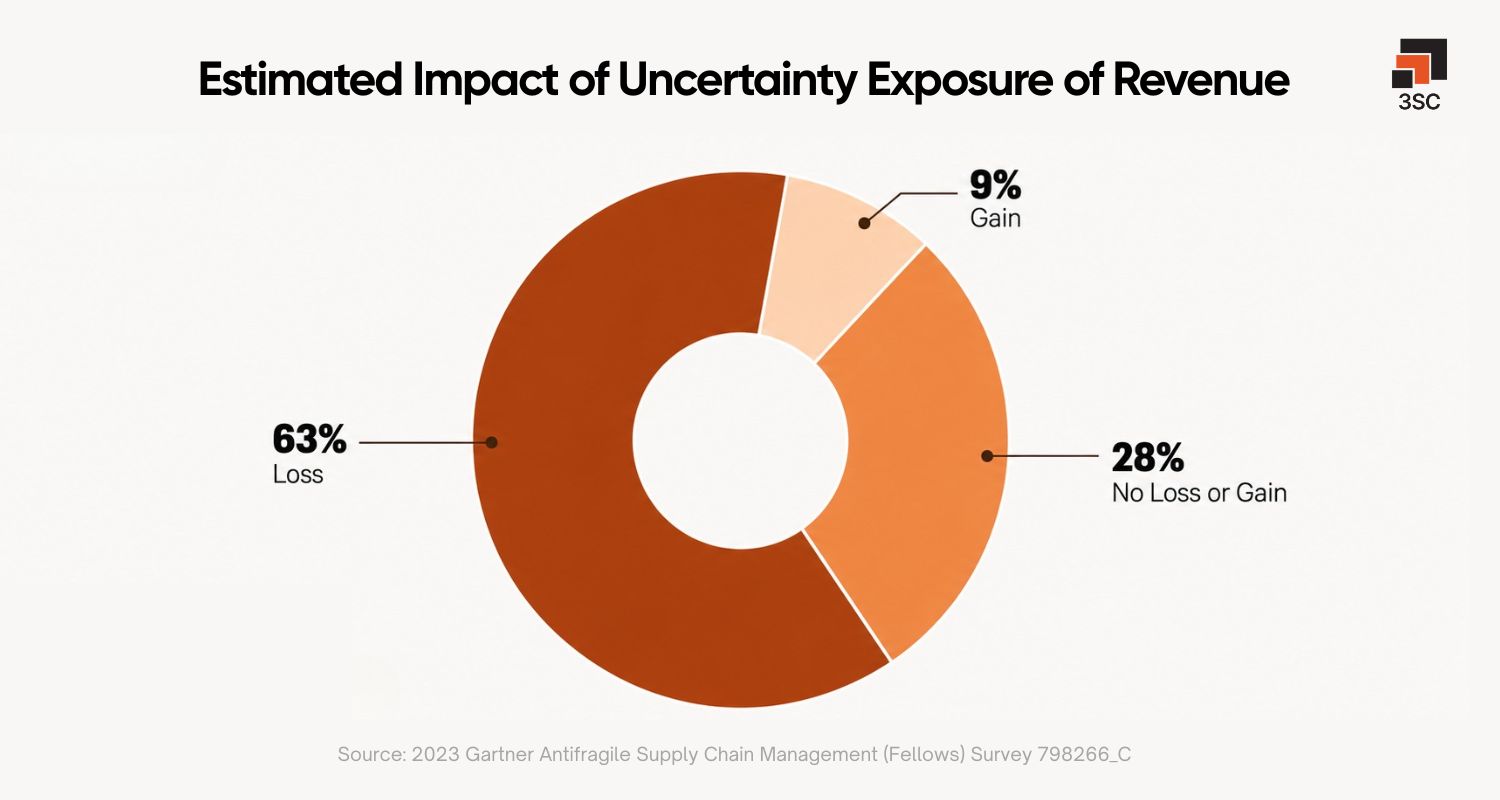
A resilient supply chain recovers to where it was. An anti-fragile one comes out better: sharper risk priorities, faster decisions, a team that responds better the next time volatility shows up.
Two Ways to Meet the Same Disruption
Framework Dimension | Resilient – Absorbs the Shock | Anti-Fragile – Gains from the Shock |
|---|---|---|
Primary Lever | Inventory and capacity buffers | Sensing plus decision speed |
Response to a Signal | Periodic re-planning cycles | Continuous sense-and-act, with pre-agreed thresholds |
Capital Posture | 20–30% carrying cost on standing buffers | Capital freed for execution capability |
After a Disruption | Recovers to the previous state | Learns, rewires, and becomes measurably better |
Operating Design | Alert system with manual alignment | Response system with decision rights in place |
This is a leadership choice before it's a technology one. Which supply chain are you building: one that absorbs disruption, or one that learns from it?
Decision Readiness Beats Scenario Planning
Most leaders I meet have invested seriously in scenario planning. Good. But real disruptions never follow the planned version.
What actually matters when the plan breaks:
- Thresholds: what level of deviation triggers action
- Escalation paths: who gets pulled in, and when
- Trade-offs: service vs cost vs cash, visible upfront
- Decision rights: who has the authority to act, agreed in peacetime
I've seen the first hours of enough disruptions to know the difference between a team that opens a blank spreadsheet and a team that opens a playbook.
The numbers back it up. Over half of manufacturers take a week or more just to decide on corrective action. And McKinsey's long-running analysis pegs the cost of disruption at 45% of a year's profit, every decade.
Statistic | Description | Source |
|---|---|---|
45% | One year's profit lost to disruptions per decade. | McKinsey |
3.7 Years | Average gap between disruptions lasting one month or longer. | McKinsey |
20–30% | Annual carrying cost of holding inventory. | NetSuite / ISM |
7% | Supply chains that can execute decisions in real time. | Gartner |
From Visibility to Execution Intelligence
Visibility is mostly solved. Dashboards flag exceptions. Control towers light up.
Then come the meetings. The manual checks. The follow-ups. Visibility without execution just makes the delay easier to watch.
The numbers have not moved enough. 95% of supply chains must react quickly to change, yet only 7% can execute decisions in real time. In a February 2026 survey of US supply chain leaders, just 6% use AI for automated, prescriptive responses when a major disruption actually lands, and 58% still name manual workflows as their biggest inefficiency.
But the direction of travel is unmistakable. In Gartner's October 2025 survey of 509 supply chain leaders, AI-driven changes to ways of working ranked as the single most influential driver of performance over the next two years, and Gartner now predicts that by 2031, 60% of disruptions will be resolved without human intervention. Agentic AI and decision governance headline its 2026 technology trends. The execution layer is being built, right now.
The next stage of maturity, and the one I care most about, is what I call execution intelligence: connecting signals to consequences, and consequences to action. Knowing what happened, what it means for service, cost and customers, and what to do next, with the authority to do it.
That's why transformation programmes stall. Not missing data. The distance between knowing and doing.
The Leadership Shift
The winning supply chains of the next decade won't have the deepest buffers. They'll sense earlier, align faster, and act before a disruption becomes a crisis.
Adaptability isn't a complement to protection anymore. It is the strategy.
One note of caution, because I've watched enough technology cycles to have earned it: autonomous execution without decision governance is just faster chaos. The leaders getting this right are building guardrails and decision rights alongside the algorithms, not after them.
Every supply chain gets tested eventually. This year it's memory. Next year it will be something none of us modelled. What separates organizations in that moment isn't what they stockpiled. It's how fast they could think, decide and act, and whether they came out better than they went in.