Highlights
- As QSRs grow, decision speed struggles to keep up with complexity.
- Data and forecasts create clarity, but they don’t create outcomes.
- Value leaks when key decisions are delayed, even with clear signals.
- Better plans matter but faster, explicit decisions matter more.
- Decision-centric planning turns clarity into results.
Over the last decade, the operating environment for QSR chains has transformed dramatically. Expansion into new geographies, faster product innovation cycles, and the rapid rise of digital ordering, delivery platforms, and drive-thru formats have all become essential levers for staying competitive in an increasingly crowded market.
The global QSR market is projected to expand from USD 1,055.48 billion in 2025 to USD 2,311.54 billion by 2034 (9.14% CAGR), this rapid expansion is accompanied by a significant rise in operational complexity. What was once a relatively straightforward store network with limited menu variation has evolved into a multi-format, multi-channel ecosystem spanning hundreds of locations. Today’s QSR landscape must contend with volatile input costs, fragmented demand signals, omnichannel customer journeys, and constantly shifting consumption patterns.
To keep pace, growing QSRs have invested heavily in strengthening their planning capabilities. Over time, these investments delivered tangible benefits like improved data visibility, more accurate forecasts, and tighter cross-functional alignment.
Yet, despite these advancements, many chains continue to face performance volatility, margin pressure, and missed growth opportunities.
The Hidden Cost of Scale
At a smaller scale, QSR operations run on proximity and speed. Teams are close to the stores and close to the customer, so adjustments happen quickly. Staffing shifts, inventory corrections, and promotional changes can be made without heavy coordination.
As scale increases, that responsiveness becomes harder to maintain. A growing footprint introduces more operational variables such as menus, multiple customer channels, local demand differences, and greater cost volatility. The number of decisions required to keep the system running expands rapidly.
Planning systems bring structure to this environment. Data is standardized. Forecasts improve. Trade-offs can be evaluated more systematically. But better structure does not automatically translate into faster execution.
As organizations grow, decision volume rises faster than decision velocity. What were once straightforward operational calls now require cross-functional alignment and additional validation. Over time, decision cycles lengthen.
The tension is simple: scale increases the number and complexity of decisions, but it does not inherently increase the speed at which they are made.
In a QSR environment where both demand and input costs shift frequently, slower decision-making quietly erodes performance through missed timing, reduced agility, and incremental margin pressure.
Where Value Leaks
Decision lag rarely shows up as a single, visible failure. Instead, it accumulates quietly across everyday operational choices, where timing matters as much as accuracy. Over time, these small delays compound into meaningful value loss.
Menu
Menu decisions are often among the most visible and time-sensitive choices QSR teams make. Limited-Time Offers (LTOs) are designed to create urgency and excitement, both for customers and for the business. Their success depends on precise timing when to launch, where to expand, and when to exit.
Even when demand signals are visible and forecasts are reliable, delayed decisions around LTO rollouts can result in missed demand peaks. By the time a decision is finalized and communicated, customer interest may already be shifting. Stores execute exactly as planned, but the plan arrives too late to capture the full upside the forecast initially indicated.
Inventory
Inventory planning improves significantly with better data and forecasting. Volume projections are clearer, variability is better understood, and supply constraints are more visible.
However, when decisions around volume adjustments, sourcing changes, or buffer levels are slow to materialize, supply chain teams are forced into defensive positions. To manage uncertainty, they hedge overcommitting in some regions while holding back in others. The result is excess inventory in certain locations and stockouts in others. The forecasts were directionally right, but the timing of inventory commitments didn’t align with how demand actually unfolded.
Channels
Modern QSRs operate across multiple channels dine-in, drive-thru, and various delivery platforms; each with different margin profiles, service expectations, and capacity requirements. Data and forecasts often clearly show where demand is shifting, and which channels are under the most pressure.
Yet when prioritization decisions lag, teams try to support all channels equally. Capacity, labour, and attention are spread thin, even when the data suggests a sharper focus is needed. This leads to diluted service levels, longer wait times, and missed margin opportunities, despite having clear visibility into where performance could be optimized.
Labor
Labor plans are typically built on sound assumptions, informed by historical patterns and forward-looking forecasts. The challenge arises when demand shifts faster than staffing decisions can adapt.
Without timely decisions on when and how to flex labour up or down, stores experience rapid mismatches between staffing levels and actual demand. Some locations face margin drag from overstaffing, while others struggle with service degradation due to understaffing, sometimes within the same week. These issues persist not because the data is wrong, but because the decision to act on it comes too late.
In each of these cases, what’s missing is a timely decision that translates insight into action.
Why Clarity Alone Isn’t Enough
This is not just a data or forecasting problem.
High-growth QSRs have made meaningful progress on all fronts. Data quality has improved. Forecast accuracy has increased. Cross-functional alignment is stronger than ever.
Yet outcomes still vary.
The root cause is that outcomes depend on decisions and the most consequential ones are often delayed or left unspoken.
Planning answers what might happen.
Decisions determine what will be done about it.
In the absence of clear guidance on whether margin or volume should be prioritized, teams default to caution, even when the underlying data and forecasts are clear. When trade-offs are not explicitly resolved, action slows. Over time, organizations become very good at building plans, but less effective at converting those plans into results.
How QSRs Need to Adapt as They Scale
To move from clarity to outcomes, growing QSRs need to evolve from purely plan-centric approaches to decision-centric planning.
Decision-centric planning does not replace data, forecasting, or integrated business planning. It relies on them. High-quality data enables credible forecasts. Credible forecasts enable meaningful decisions.
The shift is in focus. Instead of stopping at “Is the plan accurate?”, decision-centric planning pushes further to ask: “Given what we know, what should we prioritize now?”
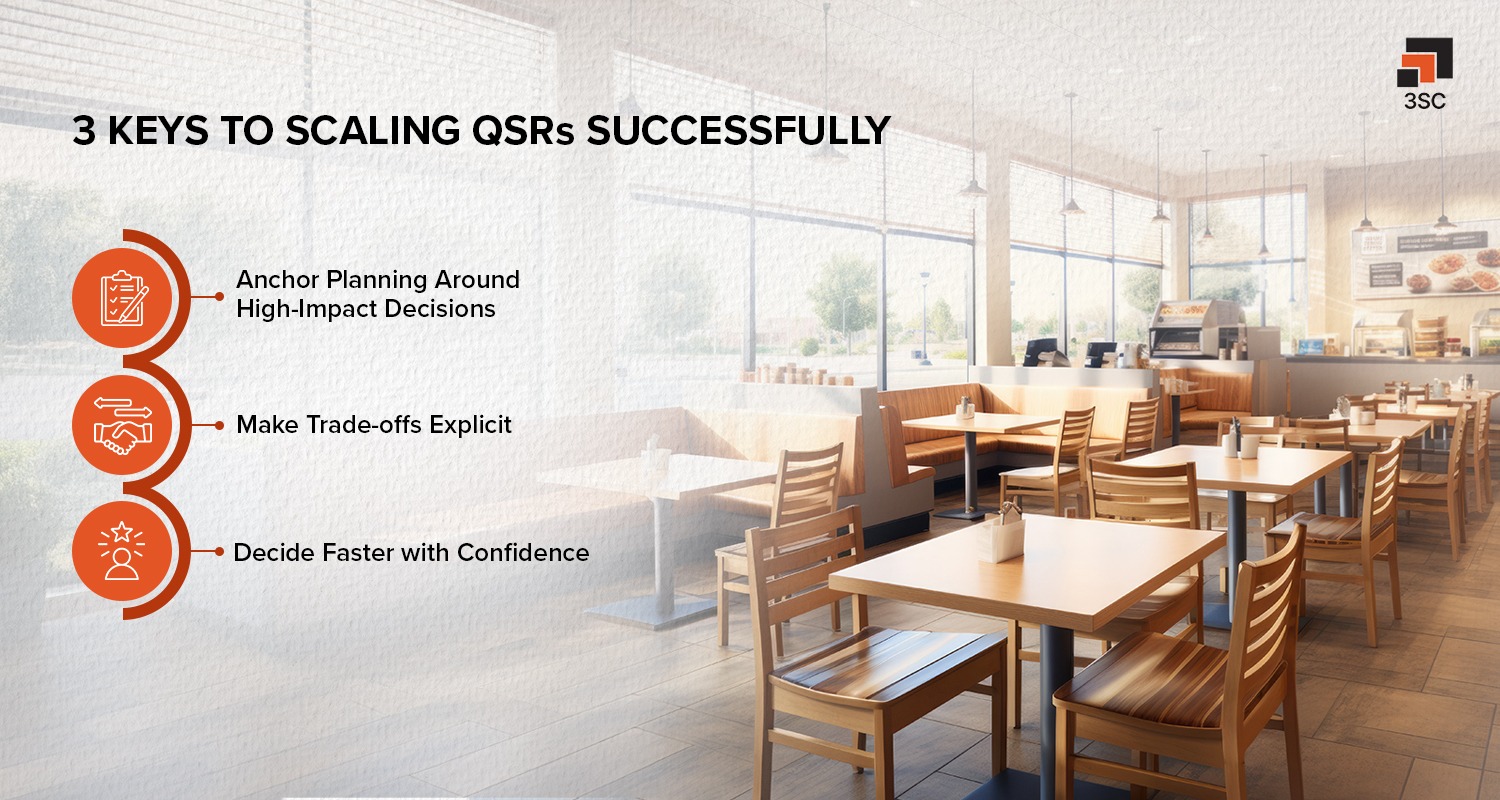
This involves three key changes:
1. Anchor Planning Around High-Impact Decisions
Not all decisions carry equal weight. Decision-centric organizations identify a small number of recurring decisions that drive disproportionate value such as LTO timing, labour flexibility thresholds, inventory commitment levels, or channel prioritization during demand swings.
Plans are built explicitly to inform these decisions, not as an end in themselves.
2. Make Trade-offs Explicit
Every decision involves trade-offs, whether acknowledged or not. Decision-centric planning brings these trade-offs into the open.
For example, prioritizing service levels may reduce short-term margin. Protecting margin may require selective channel throttling. Making these choices explicit accelerates alignment and reduces hesitation.
3. Decide Faster with Confidence
Decision-centric planning enables speed, not by eliminating uncertainty, but by defining how to act despite it.
Clear decision thresholds, predefined scenarios, and aligned assumptions allow teams to move quickly when conditions change, using forecasts as guidance rather than waiting for perfect certainty.
Turning Clarity into Results
As QSR chains scale, value isn’t lost because teams lack data, forecasts, or execution capability. It’s lost when decisions arrive too late to shape outcomes.
Reliable data is essential.
Accurate forecasts are essential.
Aligned planning is essential.
But they are enablers, not outcomes.
Outcomes are created when insights are translated into timely, explicit decisions. At scale, even small delays compound, turning hesitation into missed revenue, higher costs, and eroded margins.
The next advantage for growing QSRs isn’t abandoning planning; it’s extending it.
By layering decision-centric planning on top of strong data and forecasting foundations, QSRs can move faster, prioritize better, and convert clarity into measurable results.
In this increasingly complex environment, the winners won’t just be the best planners.
They’ll be the organizations that decide early, clearly, and let decisions drive outcomes.
Turn Forecasts into Faster Decisions with 3SC
As QSR supply chains scale, delays between insight and action lead to lost sales, excess waste, and service risk. See how decision-centric planning helps organizations reduce decision latency and stay ahead of volatility. Connect with us to know more - 3SC | Leading AI-Driven Supply Chain Solutions & Analytics Provider